Why Is My Check Engine Light Flashing?
A flashing check engine light usually means the engine is misfiring right now. Back off the throttle, avoid hard acceleration, and stop driving if the engine shakes, loses power, or smells like raw fuel, because the catalytic converter may overheat quickly. If you keep driving, a basic ignition or fuel fault can turn into catalyst damage and a much larger repair bill. This guide explains what the ECU is seeing, how to judge driveability, and how to narrow the cause before replacing parts. (Wikihow)
This guide is part of our Check engine light: meaning, causes, and what to do series.
Misfires, ECU reaction, and why a flash is an urgent warning
The ECU flashes the light when it sees a fault severe enough to threaten the engine or exhaust system right now. A steady light usually points to a fault that is serious but less urgent; a flash means the problem can damage the catalytic converter quickly if combustion is not under control.
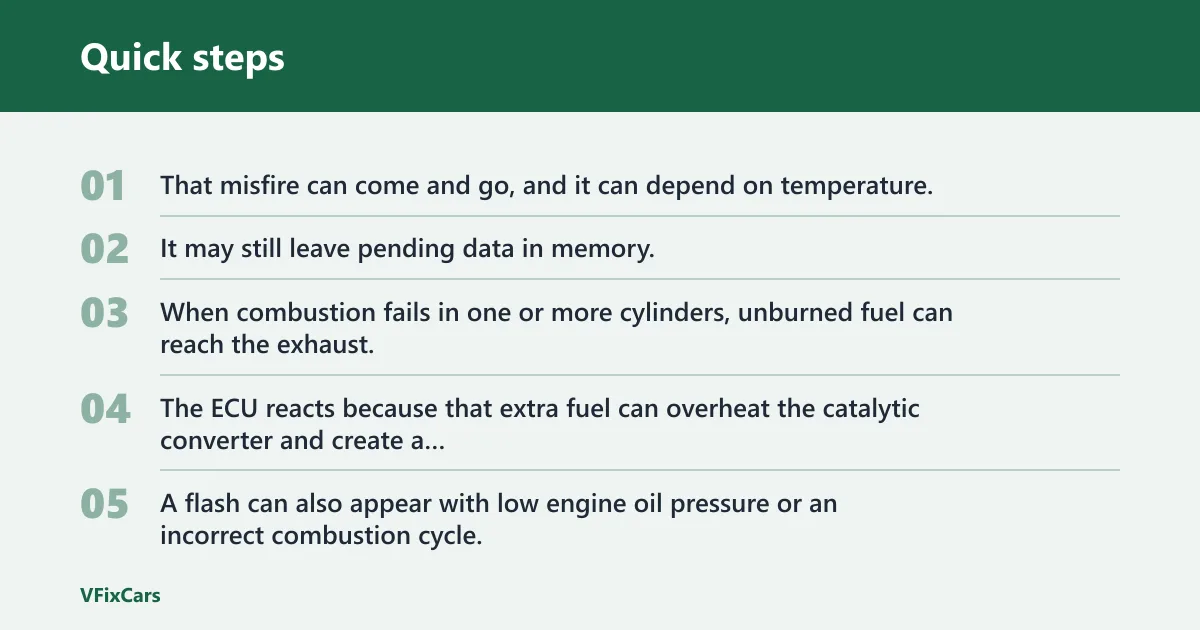
The most common cause is a misfiring engine. That misfire can come and go, and it can depend on temperature, so the light may flash for a few seconds, then stop once conditions change. It may still leave pending data in memory, which is why a scan can still matter even after the dash light goes quiet.
Why the ECU flashes the light
When combustion fails in one or more cylinders, unburned fuel can reach the exhaust. The ECU reacts because that extra fuel can overheat the catalytic converter and create a much larger repair. A flash can also appear with low engine oil pressure or an incorrect combustion cycle, but misfire sits at the top of the list.
Why a flash is more serious than a steady light
A steady light usually means you can plan a diagnosis. A flashing light means you should treat the vehicle as being in active protection mode. If the engine shakes, stumbles, or loses power, the safest move is to stop and have it towed rather than keep driving through the fault.
Can you keep driving?

If the light is flashing and the engine is shaking, do not continue driving. If it flashes briefly but the engine runs smoothly afterward, short and gentle movement to a safe place may be the least bad option, but avoid load, speed, and hard throttle until you read codes and inspect the basics.
When to pull over right away
Pull over if the flash is constant, the engine is shaking badly, the car struggles to accelerate, or you smell raw fuel. These are signs the misfire is active enough to keep heating the catalyst. CarVertical advises pulling over and towing the vehicle to a repair shop in that situation.
What not to do while the light is flashing
Do not floor the throttle to “clear it out.” Do not keep cruising at highway speed if the engine is missing, bucking, or stumbling. Do not swap coils, plugs, or sensors at random before checking the code pattern, because you can replace the wrong part while the real fault stays put.
Flash pattern triage table
| Flash pattern | Likely system | Immediate risk level | First check | What not to do next |
|---|---|---|---|---|
| Flashing at idle | Misfire, vacuum leak, weak ignition | High if shaking is present | Listen for rough idle, scan for misfire codes, inspect plugs and coils | Do not ignore it because the car is stationary |
| Flashing on acceleration | Load-related misfire or fuel delivery fault | High | Check fuel pressure, coil output, plug condition, pending DTCs | Do not keep accelerating hard to see if it clears |
| Flashing then stops | Intermittent or temperature-dependent misfire | Moderate to high | Read stored and pending codes before they disappear | Do not assume the fault is gone just because the light stopped |
| Flashing then steady | Active misfire plus a stored emissions fault | High | Scan all codes and check freeze-frame data if available | Do not clear codes before writing them down |
| Flashing with shaking | Engine misfire | Very high | Stop driving, check codes, inspect ignition and fuel basics | Do not keep driving; this combination points toward misfire |
| Flashing with no codes | Pending or intermittent fault, code history cleared, scan tool limitation | Moderate to high | Recheck after a drive cycle with an OBD-II scanner | Do not assume no code means no problem |
What usually causes the flash
The list is shorter than many drivers expect. Mechanic Base lists four possible causes to consider, and the common thread is that the engine is not burning the air-fuel mix the way it should. That puts misfire, spark, fuel delivery, and related sensor faults ahead of everything else.
Engine misfire
An engine misfire is the most common cause of a flashing check engine light. It can come and go, and it can show up only when the engine is cold, hot, idling, or under load. Common symptoms include shaking, rough idle, power loss, and poor acceleration.
A flashing check engine light and shaking both point toward an engine misfire. If the engine is stumbling at the same time, treat it as a driveability fault, not a harmless dashboard alert.
Spark plugs and ignition coils
Bad spark plugs are described as the #1 culprit of these symptoms. Each cylinder has one spark plug, and plugs may need replacement at about 100,000 miles or so, depending on the engine and plug type. Worn plugs can misfire under load before they misfire at idle.
Ignition coils can create symptoms similar to bad spark plugs because they are part of the system that delivers spark. A failing coil can break down when hot or when cylinder pressure rises, so the engine may seem fine until you merge, climb a hill, or accelerate hard.
Fuel pressure problems
Low fuel pressure can cause trouble accelerating, misfire, or stalling. The cause may be a bad injector, a failing regulator, a broken pump, a clogged fuel filter, or a defective sensor. If the engine leans out under load, the flash often appears at the exact moment you ask for more power.
Oxygen sensor and catalytic converter faults
A faulty oxygen sensor can trigger a check engine light because it affects the air-fuel ratio the ECU uses for control. A catalytic converter problem can also appear in flash-related diagnosis; failure or clogging may trigger P0420. These faults matter, but they usually move down the list if the engine is clearly misfiring first.
Other common sensor failures include the oxygen sensor and mass airflow sensor. A misfiring engine can also be caused by fouled-out spark plugs or a vacuum leak, so do not lock onto a sensor code before checking whether the engine is actually skipping combustion.
How to read the codes
Use an OBD-II scanner to read diagnostic trouble codes, or have the codes scanned at some auto parts stores that offer free scanning. The scan result is only the start of diagnosis. After a flash, you want stored codes, pending codes, and any freeze-frame data that shows what the engine was doing when the fault set.
Pending, intermittent, and stored DTCs
Pending codes matter because a flashing light may stop before the code becomes stored. If the scanner shows nothing, recheck after another drive cycle, especially if the problem only happens under load or when cold. An intermittent misfire can leave clues even when the dash light is off.
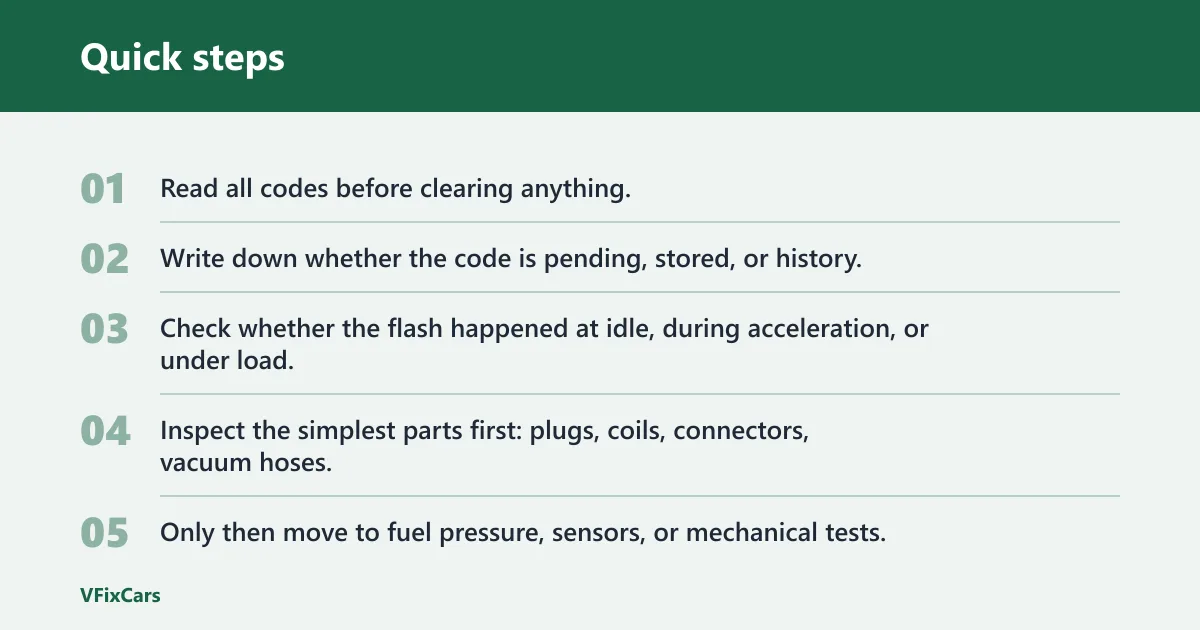
- Read all codes before clearing anything.
- Write down whether the code is pending, stored, or history.
- Check whether the flash happened at idle, during acceleration, or under load.
- Inspect the simplest parts first: plugs, coils, connectors, vacuum hoses.
- Only then move to fuel pressure, sensors, or mechanical tests.
What common codes usually suggest
| Code | High-level meaning | What it usually points toward first |
|---|---|---|
| P0300 | Random or multiple-cylinder misfire | Ignition, fuel delivery, vacuum leak, or more than one weak cylinder |
| P0420 | Catalyst efficiency below threshold | Catalytic converter concern, often after misfire or exhaust contamination |
| P0171 | System too lean | Vacuum leak, low fuel pressure, unmetered air, or sensor input issue |
| P0455 | Large evaporative leak | Loose gas cap or EVAP leak, usually not the first answer for a hard misfire |
Say your truck flashes only when climbing a long hill at 2,000 to 3,000 rpm, then runs smooth again on level ground. That pattern points more toward load-related ignition or fuel delivery weakness than a constant idle problem, so the next step is code reading, then coil and fuel-pressure checks.
A common first-timer mistake is to clear the codes and drive until the light disappears, then assume the fault is fixed. That erases some of the best clues, especially if the issue is intermittent or happens only under heat and load.
Why the light flashes under load
When the light flashes mainly during acceleration, the engine is asking for more spark and more fuel at the same time. That is where weak coils, worn plugs, and low fuel pressure often show up first. Ford F-150 owners often search for this pattern because load-related misfire can be easy to miss at idle.
Acceleration-only flash patterns usually point to a cylinder that cannot keep up under pressure. If the truck or car feels fine at cruise but stumbles when merging, climb testing, or towing, focus on ignition breakdown and fuel supply before sensor replacement.
Acceleration-only misfire clues
Look for a flash that appears the moment the throttle opens, then eases when you back off. That often means the system is failing under load, not at idle. A weak spark plug, a coil that breaks down, or low fuel pressure can all create that pattern.
Fuel delivery checks
Check fuel pressure before buying parts if the vehicle struggles to accelerate. A clogged filter, weak pump, or bad regulator can reduce delivery enough to cause a lean misfire and a flashing light. If the fuel trims are skewed lean, P0171 may appear alongside the flash.
Ignition breakdown under load
Coils can pass a light-load test and still fail when cylinder pressure rises. That is why a car can idle acceptably, then flash on the road. If the misfire is isolated to one cylinder, swap testing should be guided by the code, not by guesswork.
Why the light flashes after spark plug replacement
If the flash starts after plug work, do not assume the new plugs caused a separate mystery. The usual issues are plug gap, plug type, coil boot damage, connector damage, crossed wires on engines that use plug wires, or an installation mistake. That post-repair pattern deserves a close visual check first.
Plug gap and plug type
A plug that is not gapped correctly can misfire right away or only under load. The wrong heat range or the wrong plug design can also create a driveability problem that looks like a failed coil. Compare the installed part number and gap to the engine’s required spec.
Coil boot or connector damage
When a coil is removed, the boot can tear or a spring contact can stay behind on the plug. A loose electrical connector can create an intermittent flash that comes and goes with vibration. Inspect each coil, boot, and connector before replacing more parts.
Installation mistakes to check first
Confirm that each plug is seated properly and torqued correctly. Cross-threading, a cracked insulator, or a connector that was not fully latched can trigger a misfire immediately after service. If the engine now flashes on the same cylinder that was just touched, that cylinder is the first place to inspect.
Frequently asked questions
Why is my check engine light flashing and car shaking?
That combination usually means an active engine misfire. A flashing check engine light and shaking both point toward an engine misfire, and the risk is high enough that you should stop driving if the shaking is severe. Read the codes, then inspect spark plugs, coils, and fuel delivery.
Why is my check engine light flashing then stops?
A flash that stops can still matter because the fault may be intermittent, temperature-dependent, or load-dependent. The ECU may also store only a pending code at first. Scan the vehicle soon after the event, before the fault disappears from memory or becomes harder to duplicate.
Why is my check engine light flashing while driving?
While driving, a flash usually means the ECU is seeing a misfire severe enough to threaten the catalyst. Ease off the throttle, avoid passing or hill climbs, and pull over if the engine shakes or loses power. Then read codes and check whether the problem happens under load.
Why is my check engine light flashing then stays on?
A flash that turns steady often means the ECU first saw an active misfire, then logged a related fault after the condition persisted or changed. That can leave you with both a driveability issue and a stored emissions code. Scan for misfire and catalyst-related DTCs together.
Why is my check engine light flashing but no codes?
No codes does not mean no problem. The fault may be pending, intermittent, or cleared before the scan. Recheck with an OBD-II scanner after another drive cycle, and look for pending data, misfire counters, or history codes if your scanner supports them.
Can I drive with a flashing check engine light?
Only for the shortest, gentlest move needed to reach a safe spot, and only if the engine is not shaking badly or losing power. If the flash is constant, or the car shakes, do not continue driving. That pattern points toward a severe misfire that can damage the catalyst fast.