Dead Battery vs Bad Starter: How to Tell the Difference
A no-start with dim lights, rapid clicking, or a dash that wakes up usually points to a weak battery or bad connections; one loud click or no-crank with full lights points more toward the starter. Misreading it can waste time, drain a good battery, or replace the wrong part. This guide gives a symptom-by-symptom decision tree, simple home tests, and clues for cables, grounds, and alternator faults.
This guide is part of our Dead battery: symptoms, fixes, and next steps series.
| Decision factor | Dead battery | bad starter | Winner |
|---|---|---|---|
| Typical light pattern | Dim headlights and weak dash lights are common, especially during crank. | Lights often stay bright because the starter is the part failing to turn. | bad starter |
| Sound at key turn | Rapid clicking or repeated relay chatter is common when voltage is low. | One solid click or silence is a strong starter clue. | bad starter |
| Best first test | Check battery voltage with a multimeter and inspect terminals. | Try a jump-start and listen for change in crank behavior. | tie |
| Heat and weather pattern | Cold weather weakens a marginal battery more often. | Hot-start failure points more toward starter heat soak. | tie |
| Likely follow-up system | Battery, terminals, cable, ground, or alternator if it keeps returning. | Starter, solenoid, or starter wiring. | tie |
Understanding core symptoms and component roles
The core trade-off is simple: a dead battery lacks stored power, while a bad starter cannot turn that power into engine cranking. The symptom pattern matters more than the single sound you hear. Dim lights, weak dash power, and rapid clicking usually point toward battery or connection trouble; bright lights with no crank point toward starter, wiring, or ground faults.
Battery: what it does
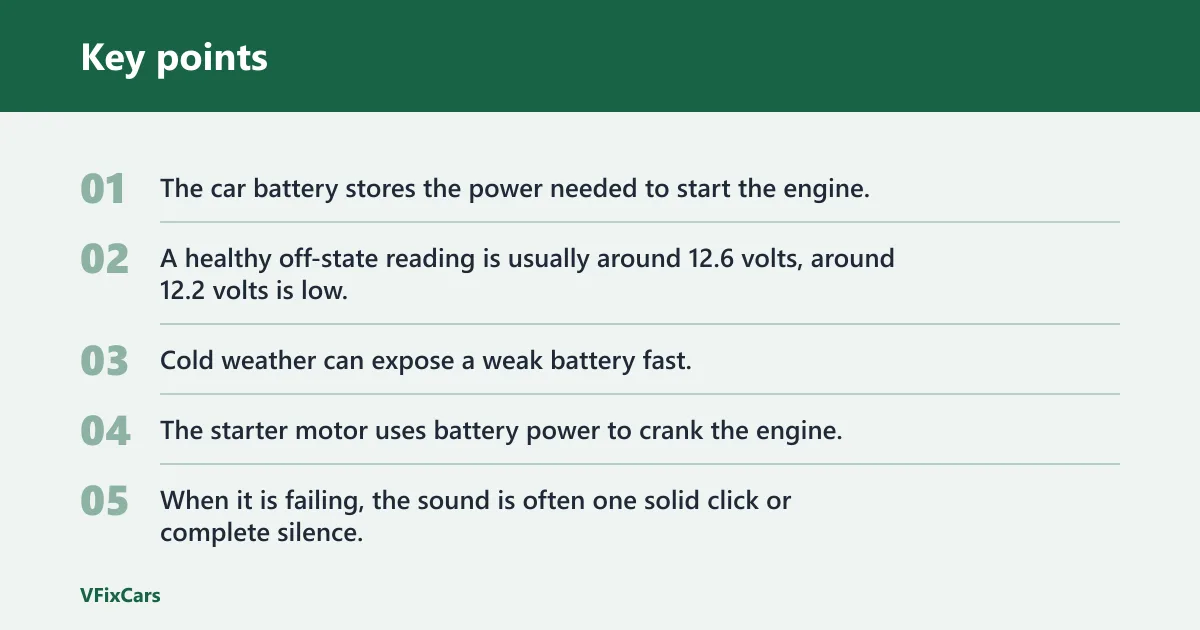
The car battery stores the power needed to start the engine. A healthy off-state reading is usually around 12.6 volts, around 12.2 volts is low, and near 12.0 volts or below often means the battery is heavily drained. Cold weather can expose a weak battery fast, and corrosion can block the power it still has.
Starter: what it does
The starter motor uses battery power to crank the engine. When it is failing, the sound is often one solid click or complete silence, even though the battery may still have enough charge to keep the lights bright. Starter problems can show up more when the engine is hot.
Why the same no-start can mean different faults
Battery, starter, cables, grounds, and alternator issues can produce similar symptoms. That is why the next test should follow the pattern: voltage first, then terminals, then a jump-start, then the crank behavior itself. The wrong guess often leads to replacing parts that were not the real problem.
Battery starter diagnosis table
Use this table as a symptom-combination decision tree. Match what the car does, then move to the next test and avoid replacing the first part that comes to mind.
| Scenario | Likely cause | Next test | What not to replace first |
|---|---|---|---|
| Dim lights + rapid clicking | Dead battery, corroded terminals, or loose battery clamp | Measure off-state voltage and inspect terminal corrosion | Starter motor |
| Bright lights + one click | Starter motor, starter relay, or starter circuit fault | Try a jump-start and listen for change in crank behavior | Battery |
| Lights normal + complete silence | Starter circuit, starter motor, park/neutral switch, or bad ground | Check battery voltage, then confirm terminal and ground connection tightness | Battery, unless voltage is low |
| Jump-start works then dies | Dead battery or alternator problem | Measure charging voltage after start and retest battery later | Starter motor |
| Jump-start does nothing | Starter, cable, ground, or ignition circuit fault | Watch whether lights dim during crank request and check for terminal corrosion | Battery alone |
| Hot-start failure | Starter heat soak, weak starter, or high-resistance cable/ground | Let the car cool, then retry and compare the result | Battery, unless voltage is low |
What do the lights and sounds mean?
Light behavior and sound together tell you which system is under stress. Dim headlights and weak dash lights usually point to battery trouble or a poor connection. Bright lights with no crank point more toward the starter, starter circuit, or ground path.
Dim headlights and weak dash lights
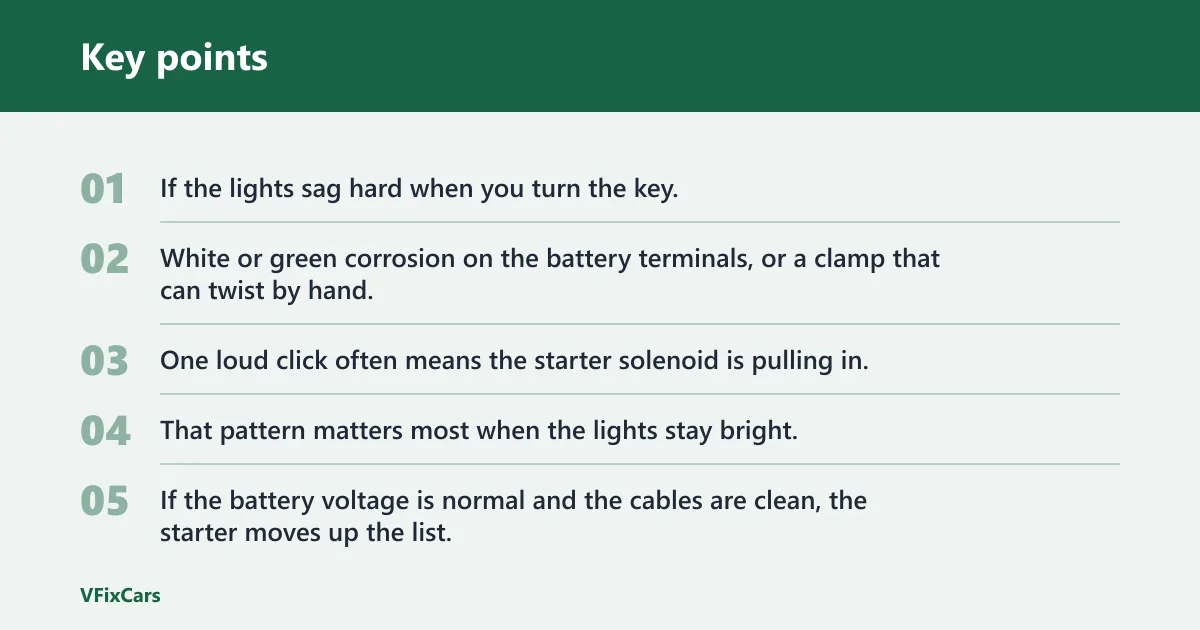
If the lights sag hard when you turn the key, the battery may be low or the current may be blocked at the terminals or ground. White or green corrosion on the battery terminals, or a clamp that can twist by hand, can mimic a dead battery. Check those before replacing anything.
One loud click
One loud click often means the starter solenoid is pulling in, but the starter motor is not spinning the engine. That pattern matters most when the lights stay bright. If the battery voltage is normal and the cables are clean, the starter moves up the list.
Rapid clicking
Rapid clicking usually means voltage is collapsing under load. That is common with a dead battery, but it can also happen with a bad battery terminal or poor ground connection. The click pattern matters less than the light drop and the battery reading.
Silence with normal lights
Silence with full lights often shifts attention away from the battery and toward the starter circuit, neutral safety switch, relay, or ground. If the battery reads around 12.6 volts off and the terminals are clean, do not assume the battery is bad just because the engine will not crank.
How do you test the battery first?
Start with the battery because it is the easiest part to rule out. A multimeter tells you the off-state voltage, while the terminals tell you whether the power can actually move into the car. If the battery reading is normal but the engine still will not crank, the test has not ended; it has shifted to cables, ground, or starter.
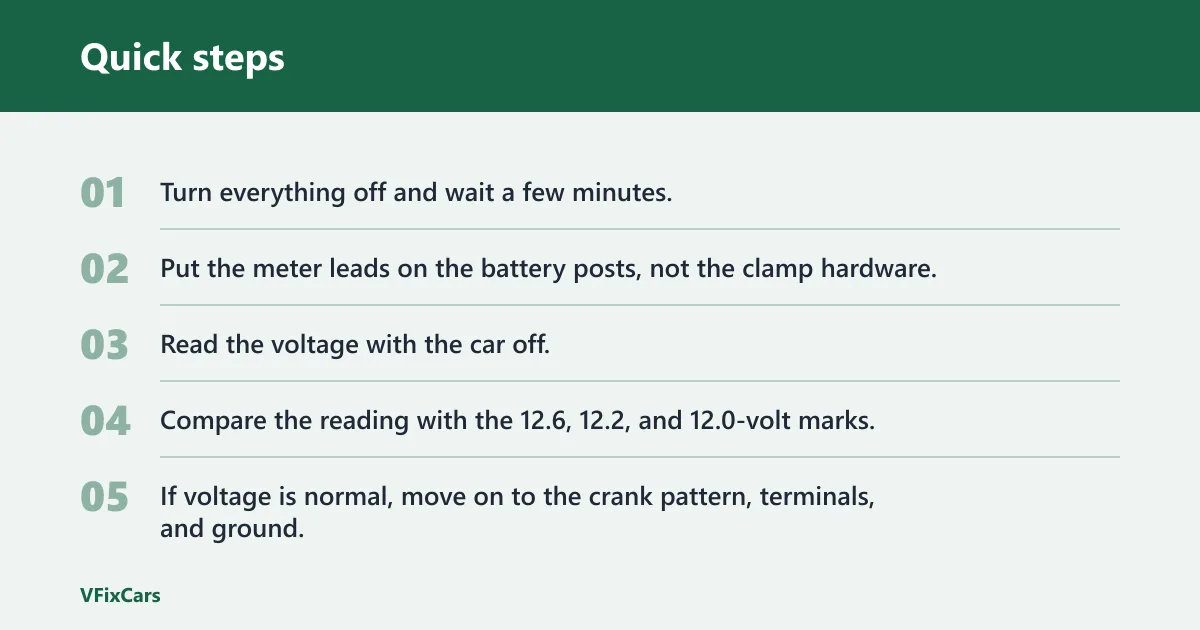
Check battery voltage with a multimeter
Measure the battery with the car off. Around 12.6 volts is a healthy resting reading, around 12.2 volts is low, and near 12.0 volts or below means the battery is heavily drained. If the reading is low, charge or jump the battery before condemning the starter.
- Turn everything off and wait a few minutes.
- Put the meter leads on the battery posts, not the clamp hardware.
- Read the voltage with the car off.
- Compare the reading with the 12.6, 12.2, and 12.0-volt marks.
- If voltage is normal, move on to the crank pattern, terminals, and ground.
Read the terminals and clamps
Look for white or green corrosion, loose clamps, or cables that feel soft at the ends. Corrosion and looseness can block the current path enough to mimic a dead battery or a failed starter. Clean, tight terminals matter before any part replacement.
Look for cold-weather weakness
Cold weather can expose a battery that is already marginal. A car that cranks slowly on a cold morning but improves after charging often has a weak battery or a high-resistance connection. That same pattern is less typical of a starter-only fault.
Will a jump-start work?
A jump-start is one of the best separation tests because it helps divide battery and connection problems from starter problems. If the car starts and keeps running, the battery or charging system may be suspect. If nothing changes, the starter, cable, ground, or control circuit moves up the list of likely causes.
If the engine starts and keeps running
That result points away from a pure starter failure. The battery may be weak, or the alternator may not be recharging it properly. If the car dies again after the jump pack is removed or after a short drive, test the alternator and battery before buying a starter.
If nothing changes
If the jump cables are connected correctly and the symptom does not change, the starter circuit or wiring becomes more likely. Bright lights with no crank, or one click with no crank, are stronger starter clues than a flat battery clue in this case. Recheck terminals and grounds before replacing the starter.
If it starts once and then dies
That pattern often means the battery was too weak to start the car on its own, or the alternator is not keeping it charged. A jump-start alone does not prove the battery is bad. It can also point to a charging fault or a poor connection that came back under load.
Battery cable and ground problems
Cables and grounds are common mimics. They sit between the battery and the starter, so a fault there can look exactly like a dead battery or a bad starter. If you skip them, you can misdiagnose the entire system.
Corroded battery terminals
White or green corrosion on the battery terminals can create enough resistance to prevent cranking. Clean the terminals and clamp surfaces before replacing the battery or starter. A shiny post with a loose clamp is still a bad connection.
Loose clamps and bad connections
A loose clamp can let lights come on normally while the starter gets almost nothing under load. That is why the light test alone is not enough. Wiggle-check the clamps by hand, then confirm the bolts hold the cables tightly.
Ground faults that mimic a dead battery
A bad ground connection can stop the starter from completing the circuit even when the battery is strong. This can produce silence, a click, or weak cranking. If the battery voltage is good and the terminals are clean, the ground cable and its mounting point deserve a close look.
Starter failure clues
Starter failure becomes more likely when the battery is strong, the lights stay bright, and the engine still will not crank. Heat-related failure is a key clue. A starter that fails after a hot soak and then works again after cooling is a classic pattern.
Bright lights but no crank
If the headlights and dash lights stay bright while the engine does nothing, the starter motor or its control circuit is a stronger suspect than the battery. That is especially true if the battery tests near 12.6 volts off and the terminals are clean. Do not swap batteries first just because the engine stays quiet.
Hot-start failure and heat soak
Hot-start failure means the car may start cold, then refuse to crank after a short stop. Heat can raise resistance inside an aging starter or starter circuit. If the car restarts after cooling, the starter moves higher on the list than the battery.
One solid click or no response
A single click with strong lights can mean the solenoid is trying but the starter motor is not turning. Complete silence can still point to a starter circuit problem, relay issue, or ground fault. The click pattern matters most when the battery reading is normal.
Choose Dead battery if… / Choose bad starter if…
Choose Dead battery if the battery reads around 12.2 volts or lower, the headlights dim hard during crank, the terminals show corrosion or looseness, or a jump-start makes the car start and keep running. Choose bad starter if the lights stay bright, you hear one solid click or silence, the problem gets worse when hot, or a jump-start changes nothing.
Choose Dead battery if…
- The off-state voltage is near 12.0 volts or below.
- Rapid clicking comes with dim headlights or weak dash lights.
- The battery terminals have white or green corrosion, or the clamps are loose.
- A jump-start gets the engine running and it keeps running afterward.
Choose bad starter if…
- The lights stay bright, but the engine will not crank.
- You hear one loud click or complete silence.
- The failure shows up after the engine is hot, then improves after cooling.
- A jump-start does nothing, and the battery voltage is already normal.
When the alternator or wiring is more likely
If the car starts after a jump but dies soon after, the alternator becomes more likely. If the battery keeps going dead again and again, charging or wiring problems may be draining it. If voltage is normal but the engine still will not crank, move past the battery and inspect the starter circuit, ground, and cable connections.
When should you stop trying to start the car and call for help?
Stop after a few careful attempts if the same symptom repeats, the starter only clicks, or repeated key turns start to drain the battery further. More cranking can turn a borderline diagnosis into a flat battery and make testing harder. Call for help sooner if the car is in traffic, on a slope, or you smell burning.
Say your sedan shows bright dash lights, one loud click, and no crank in a parking lot after a 20-minute stop. That pattern fits starter or ground trouble more than a dead battery, and repeated key turns will not fix it. A better next step is a voltage check and a jump-start test, not endless retries.
Suppose your compact car wakes up with dim headlights on a cold morning and rapid clicking at the dash. That points first to battery charge, corrosion, or a loose clamp. Clean the terminals, check off-state voltage, and then decide whether the battery still holds enough power to justify a charge or replacement.
Frequently asked questions
How can I tell if my car needs a battery or starter?
Use the symptom combination, not one clue. Dim lights, rapid clicking, and low voltage point toward the battery or connections. Bright lights with one click or silence point more toward the starter, starter circuit, or ground. A jump-start and a multimeter reading help separate those paths quickly.
What does a bad starter sound like compared with a dead battery?
A bad starter often gives one solid click or no sound at all while the lights stay bright. A dead battery more often causes slow cranking, rapid clicking, and dimming lights. If the battery voltage is normal but the engine still will not crank, the starter climbs the list.
Will a jump start work if the starter is bad?
Usually no. A jump-start can help a weak battery, a bad connection, or a charging issue, but it cannot repair a failed starter motor. If the jump makes no difference and the lights stay bright, the starter, wiring, or ground connection becomes more likely.
Why do my lights come on but the car won’t crank?
Lights need far less current than the starter, so the battery can seem fine while the crank circuit fails. That pattern can point to the starter, a bad ground, corroded terminals, or wiring resistance. If the lights stay bright during the key turn, do not stop at the battery.
What does one loud click mean when I turn the key?
One loud click often means the starter solenoid is pulling in but the motor is not turning the engine. That is a strong starter clue, especially if the battery voltage is near 12.6 volts and the terminals are clean. It can also happen with a weak ground or cable issue.
How do I test battery voltage before replacing parts?
Set a multimeter to DC volts and read the battery with the car off. Around 12.6 volts is healthy, around 12.2 volts is low, and near 12.0 volts or below is heavily drained. If the reading is normal, check terminals, clamps, and ground before blaming the starter.
Can corroded battery terminals mimic a bad starter?
Yes. White or green corrosion can block current enough to cause silence, clicking, or weak cranking even when the battery itself is not the main fault. Loose clamps can do the same thing. Clean and tighten the terminals before you buy a battery or starter.