Bad Mass Airflow Sensor Symptoms: How Does a Car Act?
A bad mass airflow sensor is commonly reported to cause rough idle, hesitation, stalling, hard starting, and poor fuel economy. If unplugging it makes the engine run better, the sensor or its wiring is suspect. Ignore it, and you can spend money on the wrong parts while the drivability problem stays. This guide shows how MAF faults change behavior at idle, under acceleration, at cruise, and during starting, and how to separate them from lookalike problems.
What a mass airflow sensor does
The mass airflow sensor measures the air entering the engine and sends that airflow data to the engine control unit. The ECU uses that signal to decide injector pulse width and help keep the air-fuel ratio on target for combustion. If the reading is off, the mixture goes rich or lean and drivability problems begin.
That wrong signal can come from a sensor that reads low, reads high, or drops out intermittently. Any of those can make the ECU add too much fuel or not enough fuel. Either way, the engine may act unstable, sluggish, or hard to start.
How the signal affects driveability
At idle, the engine depends on exact airflow data because very little air moves through the intake. At light cruise, the ECU expects steady readings. During acceleration, it needs fast, accurate airflow changes so fuel delivery matches throttle opening.
When the MAF signal is wrong, the engine gets the wrong air-fuel ratio for the load it sees. That can trigger jerking, hesitation, stalling, and weak performance. Fuel economy often drops too, because the ECU may richen the mixture or chase a bad reading.
How does a car act with a bad mass airflow sensor?
A car with a bad MAF often feels uneven at idle, lazy on takeoff, and inconsistent at highway speed. The symptom can change with engine load, temperature, and whether the fault is steady or intermittent. A bad sensor can also make starting difficult after a short stop or hot soak.
What changes at idle
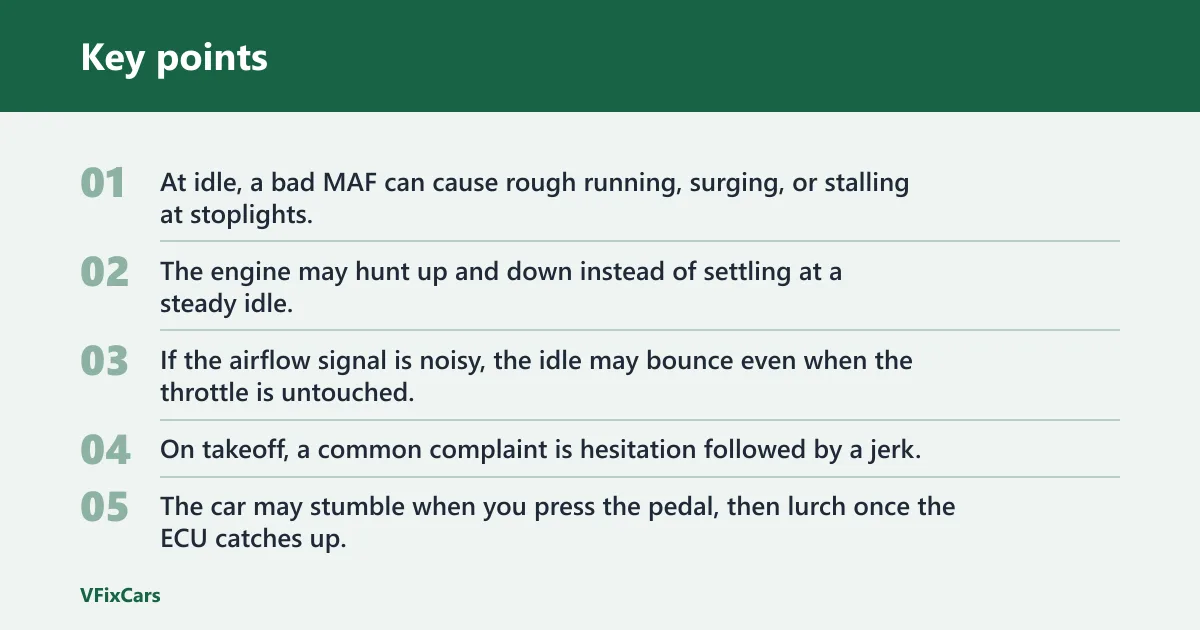
At idle, a bad MAF can cause rough running, surging, or stalling at stoplights. The engine may hunt up and down instead of settling at a steady idle. If the airflow signal is noisy, the idle may bounce even when the throttle is untouched.
What changes on acceleration
On takeoff, a common complaint is hesitation followed by a jerk. The car may stumble when you press the pedal, then lurch once the ECU catches up. If the signal is badly off, acceleration can feel flat even though the engine revs.
What changes at steady cruise
At steady speed, a failing MAF may cause light bucking, small surges, or poor throttle response. The problem can feel more obvious at a constant road speed than during hard acceleration. A bad reading can also make the transmission shift feel odd because engine load is not being reported correctly.
What changes during starting and restart
During starting, a faulty MAF can cause long cranking, hard starting, or a start-and-die condition. After a short stop, the engine may restart poorly because the ECU is using a bad airflow value while it is trying to stabilize the mixture. Hot restarts can be especially revealing.
Say your sedan idles smoothly in park, but it bucks as soon as you pull away from a stop sign. That pattern points more toward airflow or mixture control than a random dead cylinder, especially if the symptom fades once road speed rises.
Suppose your compact SUV starts fine cold, then cranks longer after a 10-minute fuel stop and settles into a rough idle. If the intake ducting is tight and the air filter is clean, a bad MAF signal or wiring fault moves higher on the list.
MAF symptom matrix
This table ties common complaints to the situation, the feel, the most likely lookalikes, and the first check. Use it to sort out whether the MAF is the leading suspect or only one possibility.
| Complaint | When it happens | What it feels like | Common non-MAF causes | Next diagnostic step |
|---|---|---|---|---|
| Rough idle | Stopped, in gear, or at a light | Shaky idle, surging, near-stall behavior | Vacuum leak, throttle body carbon, intake leak | Inspect the intake duct, clamps, and vacuum hoses for leaks |
| Hesitation on takeoff | First pedal input from a stop | Delay, stumble, then sudden jerk | Dirty throttle body, misfire, fuel pressure problem | Check the sensor connector and scan for airflow-related codes |
| Stalling at stops | Idle after deceleration or warm restart | Engine dies or nearly dies | Vacuum leak, dirty throttle body, EGR issue | Inspect for unmetered air before replacing the sensor |
| Poor fuel economy | Over multiple drives | More fuel used for the same route | Dragging brakes, tire pressure, leaking injector | Look for MAF contamination and check live airflow data if available |
| Hard starting | Cold start or hot restart | Long crank, starts then stalls | Battery issue, fuel pressure loss, intake leak | Unplug and recheck the connector, then inspect the duct and filter housing |
Which symptoms point to the MAF first?
Rough idle, hesitation on takeoff, stalling at stops, and poor fuel economy are the strongest MAF clues when they travel together. The sensor is more suspect when the symptom changes with throttle movement and engine load, not just with engine speed alone. A code for airflow data makes the case stronger.
Rough idle and surging
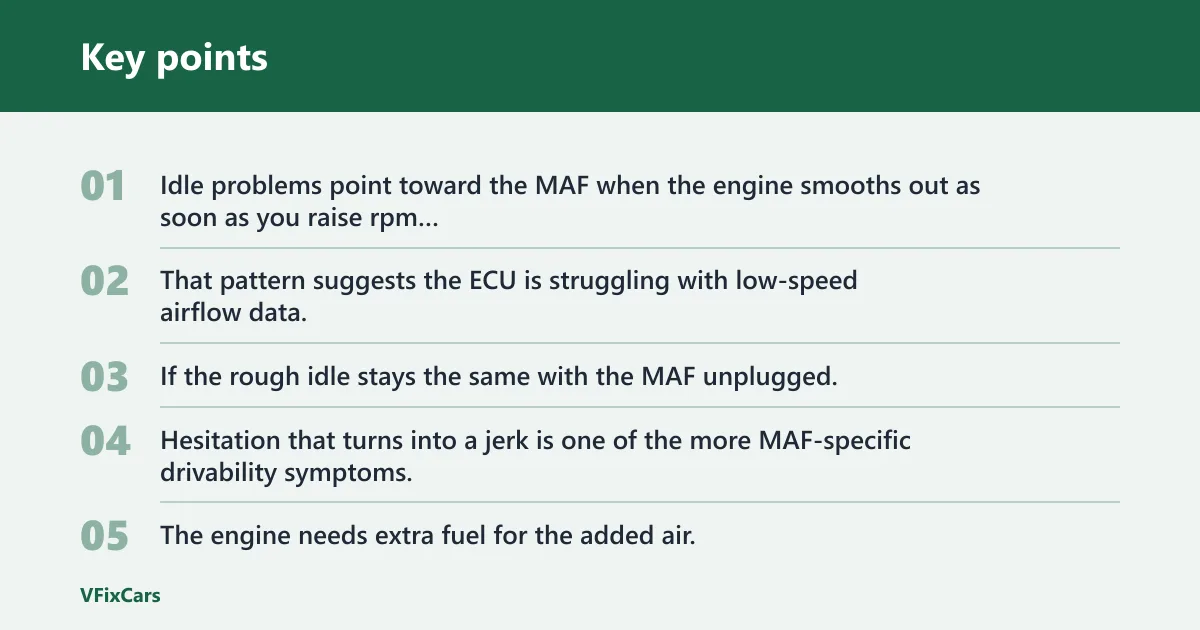
Idle problems point toward the MAF when the engine smooths out as soon as you raise rpm slightly. That pattern suggests the ECU is struggling with low-speed airflow data. If the rough idle stays the same with the MAF unplugged, a vacuum leak or throttle body issue may be more likely.
Hesitation and jerking on takeoff
Hesitation that turns into a jerk is one of the more MAF-specific drivability symptoms. The engine needs extra fuel for the added air, but the ECU receives a delayed or wrong signal. A fuel pump issue usually feels different because the problem tends to worsen under sustained load, not just tip-in.
Stalling at stops or after startup
Stalling can come from many faults, but a bad MAF rises on the list when the engine dies right as it settles into idle or right after a restart. That points to unstable airflow data at low rpm. If the stall happens only on cold starts, intake leaks and idle-control faults also deserve attention.
Poor fuel economy and weak power
Fuel economy often drops when the MAF misreads incoming air. The ECU may add too much fuel to protect the engine from a lean condition, or it may chase unstable readings and keep the mixture out of range. Weak power can follow because the mixture is no longer correct for combustion.
What can look like a bad MAF?
Several faults create the same complaints. Vacuum leaks and intake leaks let air in after the MAF, so the ECU never sees it. Dirty throttle bodies, clogged air filters, and wiring faults can also create rough idle, hesitation, or stalling without the sensor itself being dead.
Vacuum leaks and intake leaks
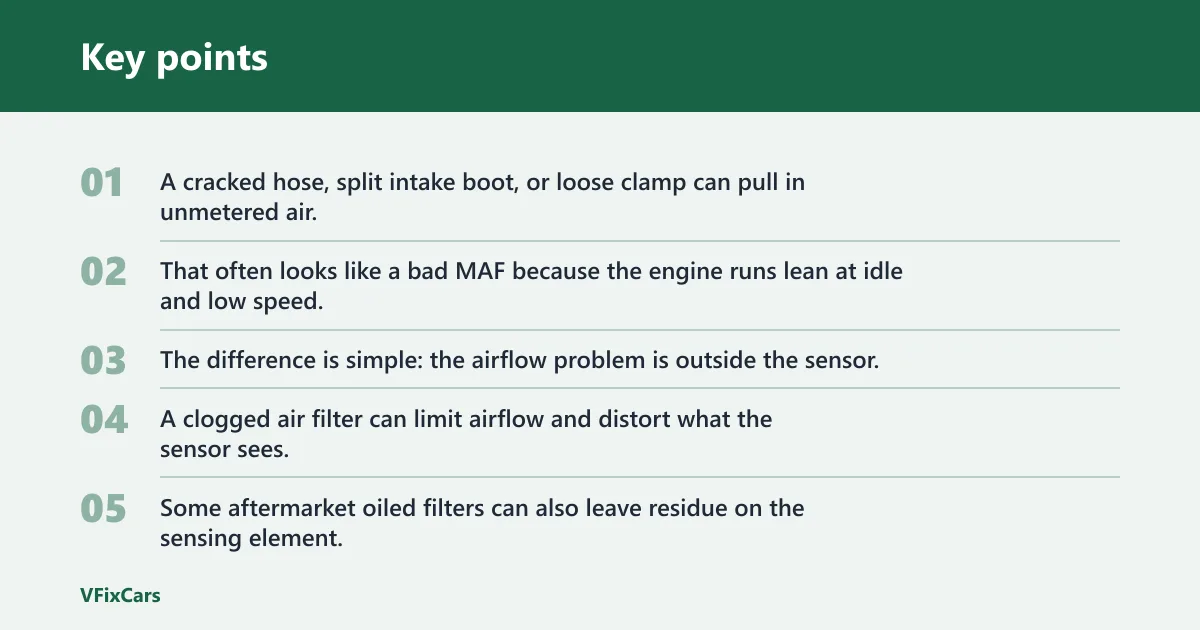
A cracked hose, split intake boot, or loose clamp can pull in unmetered air. That often looks like a bad MAF because the engine runs lean at idle and low speed. The difference is simple: the airflow problem is outside the sensor, so fixing the leak matters more than replacing the MAF.
Dirty or restricted air filter issues
A clogged air filter can limit airflow and distort what the sensor sees. Some aftermarket oiled filters can also leave residue on the sensing element. If the filter is packed with dirt, cleaning the MAF alone will not solve the restriction.
Throttle body faults
A dirty or sticking throttle body can make the engine idle badly and stumble on tip-in. That symptom set overlaps with MAF trouble, but the throttle plate may be the real issue. If the sensor readings look plausible and the throttle body is coated with carbon, clean that system first.
Connector and wiring problems
Loose terminals, corrosion, broken wires, and heat-damaged insulation can make the MAF signal unstable. This is common when the symptom changes with bumps, vibration, or engine movement. A sensor that improves when the connector is wiggled points to wiring, not airflow measurement, as the main fault.
Misfire and fuel delivery problems
Ignition misfires and fuel pressure problems can mimic MAF failure because they also cause hesitation and rough running. The key difference is that those faults usually do not track cleanly with airflow changes. If the problem shows up under load regardless of MAF cleaning or connector checks, do not rule out ignition or fuel delivery.
Should you clean or replace it?
Cleaning is worth trying only when dirt, dust, or light contamination is the likely problem. A spray cleaner made for mass airflow sensors can remove buildup from the sensing element. Do not use carb cleaner, brake cleaner, or shop air on the hot wire element, and do not touch the wire.
When cleaning makes sense
Start with cleaning if the sensor is dirty, the air filter is questionable, or the intake tract has dust residue. This is most useful when the engine otherwise runs normally except for a mild idle or hesitation issue. If the fault is caused by contamination, the signal may recover after cleaning.
When cleaning will not help
Cleaning will not fix a damaged hot wire, a cracked sensor body, oil-soaked contamination from an aftermarket filter, or a wiring fault. It also will not repair an ECU problem or a vacuum leak. If the signal drops out intermittently because of heat or vibration, replacement or wiring repair is more likely.
First checks before replacement
- Inspect the intake duct from the air filter housing to the throttle body for splits, loose clamps, or disconnected hoses.
- Check the air filter for dirt, collapse, or oil residue.
- Unplug and inspect the MAF connector for corrosion, bent pins, or broken locks.
- Trace the harness for rubbing, melted spots, or a loose ground.
- Clean the sensor with the correct spray if contamination is visible and the element is intact.
- Replace the sensor if the fault returns after these checks or if the element is damaged.
Where is the mass airflow sensor located?
Most vehicles place the MAF near the throttle body and air filter housing. It is usually mounted in the intake tube between the air box and the engine, where it can measure all incoming air before that air reaches the throttle. That location makes intake leaks and loose clamps especially important to inspect.
What to inspect around the sensor first
Check the air filter housing, the rubber intake tube, and the clamps on both sides of the sensor. Look for cracks, oil film, disconnected vacuum lines, and damaged wiring. If the ducting is split, the sensor may be reading correctly while unmetered air still enters the engine.
Replacement cost and labor
Replacement usually takes about half an hour to an hour. With mechanic labor rates around $110 to $175 per hour, the total replacement cost is typically between $240 and $684, including parts and labor. The exact price depends on the vehicle and the sensor design.
A common first-timer mistake is replacing the sensor before checking the intake boot. A crack after the MAF can create the same stumble and lean idle, and a new sensor will not fix that air leak.
Frequently asked questions
What are the most common bad mass airflow sensor symptoms?
The most common symptoms are rough idle, hesitation, jerking, stalling, hard starting, and weak acceleration. These problems often show up together. If the engine runs better with the MAF unplugged, the sensor or its wiring moves near the top of the suspect list.
Can a bad MAF sensor cause rough idle, stalling, or hesitation?
Yes. Those are among the most common drivability symptoms tied to a malfunctioning MAF. A bad signal can throw off the air-fuel ratio, especially at idle and during tip-in. Vacuum leaks and throttle body problems can look similar, so inspect those too.
Does a bad mass airflow sensor reduce fuel economy?
Yes. When the MAF reads incorrectly, the ECU may add too much fuel or fail to trim the mixture correctly. That raises fuel use over time. A drop in fuel economy is less specific than a stall or hesitation, but it fits MAF trouble well.
Can you drive with a malfunctioning mass airflow sensor?
You may be able to drive short distances, but it is not a good idea to keep using the car for long. The engine can become unreliable, stall in traffic, or run poorly enough to damage other parts over time. Treat it as a repair that should not wait.
Is it safe to clean a mass airflow sensor instead of replacing it?
Yes, if the problem is dirt or light contamination and the sensing element is intact. Use only MAF-safe spray cleaner and avoid touching the hot wire or flooding it with fluid. If the sensor has wiring damage, oil contamination, or a failed element, cleaning will not fix it.
What should you check before replacing the mass airflow sensor?
Check the intake ducting, air filter, connector, and wiring first. Then inspect for vacuum leaks and throttle body deposits. If those parts are sound, clean the sensor if contamination is visible. Replace the MAF only after the simpler air and electrical checks do not explain the symptom.