What Does a Dead Car Battery Sound Like When You Turn the Key?
A dead car battery often makes a single click, rapid clicking, or no crank at all. If the dash lights go dim or die as you turn the key, check the battery and terminals first. Ignoring that clue can leave you replacing the wrong part and still stranded. This guide maps each sound to the most likely fault and the next safe check.
This guide is part of our Dead battery: symptoms, fixes, and next steps series.
What you’ll need
- Jumper cables with intact clamps
- A battery charger for a flat but recoverable battery
- Gloves and a flashlight
- A rag or brush for light corrosion on the terminals
- A way to inspect the battery, including the trunk if the battery is not under the hood
Sound diagnosis table
| Exact sound | Most likely cause | What it usually means electrically | Next safe check |
|---|---|---|---|
| Single click | Weak battery, poor terminal connection, or starter fault | The starter relay or solenoid may have enough signal to click, but the starter motor is not getting enough current to turn | Check the battery terminals first, then try a jump-start |
| Rapid clicking | Low battery voltage | Voltage collapses when the starter is asked to draw current, so the relay opens and closes fast | Try a jump-start or charger before assuming the starter is bad |
| Slow crank | Weak battery, cold weather, or high resistance in cables | The starter turns, but not fast enough for a clean start | Inspect terminals and cable clamps, then test with a jump or charger |
| No sound | Dead battery, open connection, bad relay, or starter fault | No current is reaching the starter circuit, or the circuit is not being commanded | Check dash lights, battery terminals, and battery placement before deeper testing |
| Grinding | Starter gear or flywheel issue | The starter drive is not meshing with the engine properly; this is not a normal battery symptom | Stop cranking and inspect the starter system |
| Likely battery vs likely starter | Battery if you hear clicks, dim lights, or a weak crank; starter if battery and terminals check out but the same symptom repeats | Battery faults usually starve the starter of current; starter faults fail after power reaches the motor | Test with a jump or charger first, then move to starter diagnosis if the symptom does not change |
What does each sound usually mean?
A single click often means the starter solenoid is trying to engage, but the starter motor is not turning the engine. Rapid clicking often points to low battery voltage, while grinding can point away from the battery and toward the starter drive or flywheel. Silence can still be electrical trouble.
How to read one click
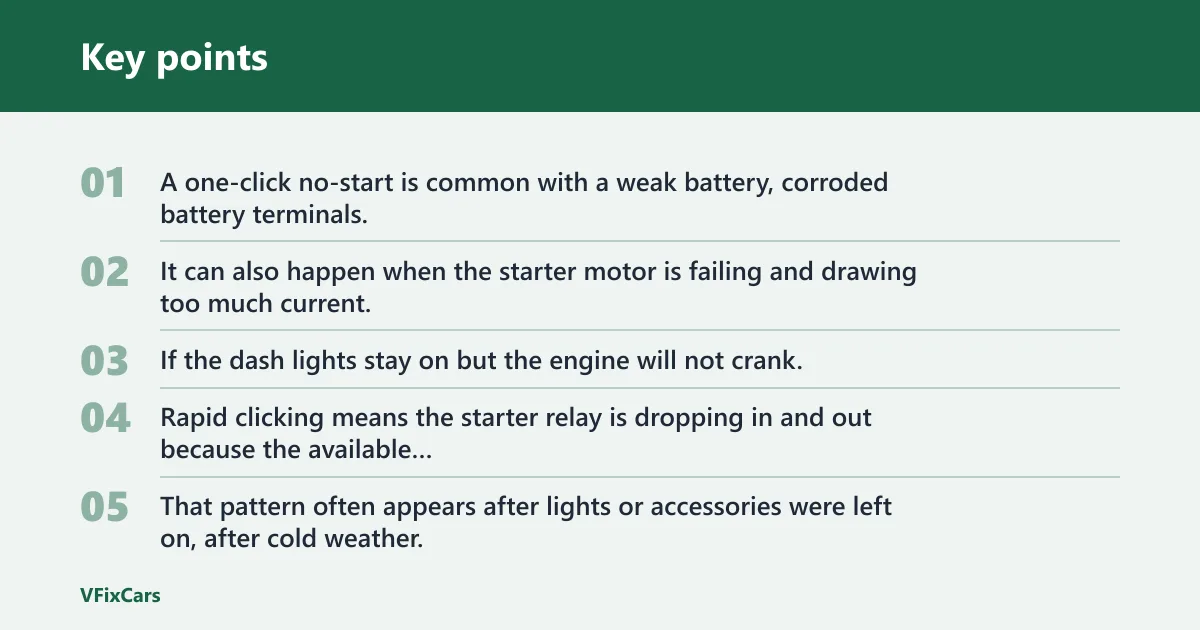
A one-click no-start is common with a weak battery, corroded battery terminals, or loose cable clamps. It can also happen when the starter motor is failing and drawing too much current. If the dash lights stay on but the engine will not crank, do not assume the battery is the only problem.
Why rapid clicking points to low voltage
Rapid clicking means the starter relay is dropping in and out because the available power falls as soon as the starter loads the circuit. That pattern often appears after lights or accessories were left on, after cold weather, or after a battery has aged out. A charger or jump-start is the fastest first test.
Why grinding is different
Grinding is a mechanical warning. It can mean the starter gear is not engaging cleanly, or the flywheel teeth may be damaged. Keep turning the key only long enough to confirm the noise, then stop. A jump-start will not fix a grind caused by worn starter parts.
How can you tell battery from starter?
Start with what the cabin power does. Dim dash lights, a weak horn, or a radio that fades when you turn the key usually point to battery or cable trouble. If the lights stay bright and the symptom does not change with a jump, the starter motor or its control circuit moves higher on the list.
Watch the lights, not just the sound
Dashboard lights or a working radio do not prove the battery can crank the engine. Those loads need far less current than the starter motor. A battery can light the cabin and still be too weak to turn the engine over.
Why the starter can mimic a dead battery
The starter motor is the part that cranks the engine. When it fails, the symptom can look like a flat battery because the engine still does not turn. A starter fault may produce a single click, a heavy thunk, or nothing at all if the motor or solenoid is worn.
Why terminals can copy both faults
Corroded or loose battery cables can cause a no-start condition even when the battery itself is charged. If current cannot pass through the clamps, the starter will act underfed. Clean, tight terminals are often one of the first things to inspect because they can imitate both battery and starter problems.
What should you check first?
Inspect the battery terminals first, then try a jump-start, then use a charger if the battery may still recover. If the battery is cold, old, or has been drained by lights or another accessory left on, it may still be worth saving. Repeat no-starts after a full charge point toward charging or battery replacement issues.
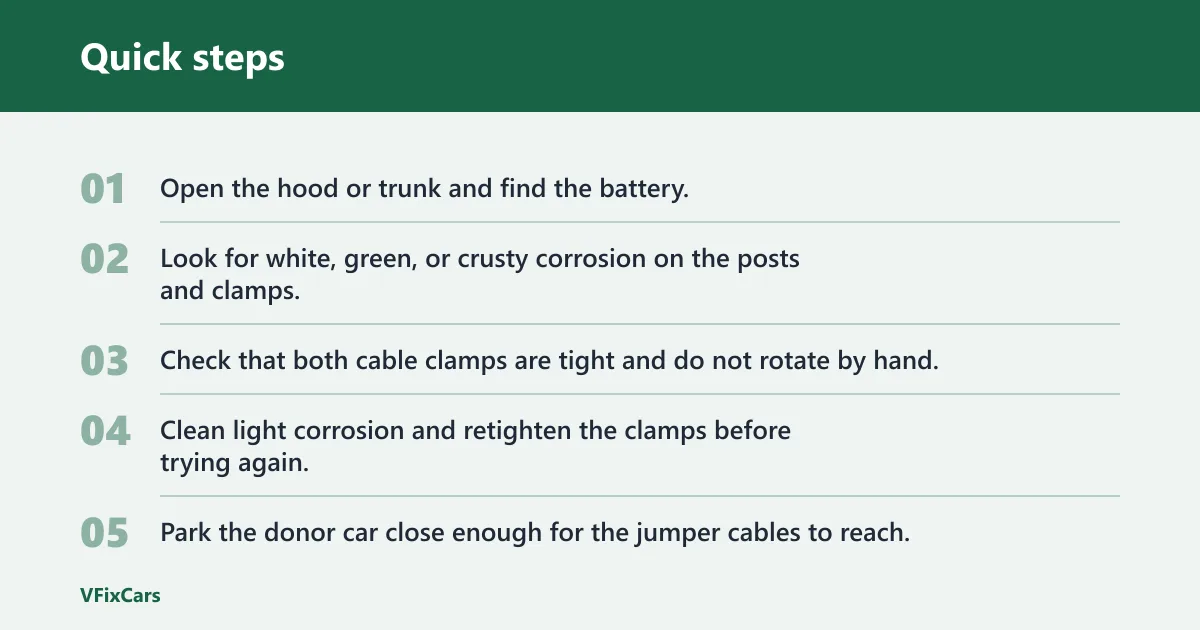
1. Inspect the battery terminals
- Open the hood or trunk and find the battery.
- Look for white, green, or crusty corrosion on the posts and clamps.
- Check that both cable clamps are tight and do not rotate by hand.
- Clean light corrosion and retighten the clamps before trying again.
2. Try a jump-start the right way
- Park the donor car close enough for the jumper cables to reach.
- Connect the red jumper cable to the positive terminals first.
- Connect the black cable to a metal-clean surface or engine ground, not the battery negative terminal.
- Start the donor car, then try the disabled car.
Jump-starting requires another car with a working battery and jumper cables. If the engine starts and then dies again soon after, the battery may be weak, the alternator may not be charging, or both may need attention.
3. Use a charger if the battery may recover
A dead battery can be recharged with a car battery charger. That is often the better choice if the battery was drained by a light, a dome lamp, or a parked accessory and the car does not need to move immediately. Charge it fully, then recheck starting behavior.
4. Check cold weather and battery age
Cold weather is a common cause of battery drain, and very cold conditions can freeze a battery if it is already low charged or empty. Battery age matters too. Car batteries have an average lifetime of around 5 years, so an older battery is more likely to fail on a cold morning.
Do you need a jump start or a new battery?
Try a jump start first if the battery may be recoverable and the car has only recently failed to start. Replace the battery sooner if it is old, keeps dying, or will not hold a charge after a full recharge. If the car starts but dies again later, check the alternator next.
When a jump-start is the right first move
- Use a jump if the lights are dim, the starter clicks, or the car has been sitting in cold weather.
- After it starts, let it run and watch for a repeat no-start later the same day.
- If the symptom returns, the battery may be weak or the alternator may be failing.
When repeat no-starts point to the alternator
A bad alternator may fail to charge the battery while driving. A healthy alternator should show over 14 volts at idle. If the car keeps going flat after a drive, or starts only after charging but dies again later, the charging system needs testing.
When battery age makes replacement more likely
An older battery can lose reserve capacity even if it still lights the dash. If the battery is about 5 years old and the car now needs frequent jumps, replacement is often the practical fix. That is especially true after a cold snap or a drain event.
Common mistakes
- Assuming any click means a dead battery. A starter or cable fault can click too.
- Skipping the terminals. Corrosion and looseness can stop current flow.
- Using resting voltage alone to decide the battery is bad. Recent driving, cold weather, and surface charge can skew the reading.
- Ignoring the charging system after the car starts. A weak alternator can drain a good battery again.
- Forgetting that some batteries sit in the trunk, not under the hood.
Say your car clicks once on a freezing morning, the dome light looks weak, and the engine never turns over. That pattern points first to battery output or terminal resistance, not an immediate starter replacement. Try a jump, then test whether the symptom changes.
If the car starts after charging overnight but is dead again the next afternoon after about a 20-minute drive, that may point to alternator problems. That repeated failure is a strong clue that the alternator is not keeping up, especially if the battery is older than 5 years.
Frequently asked questions
What does a dead car battery sound like when you turn the key?
Most often it sounds like a single click, rapid clicking, a slow crank, or complete silence. The sound matters because it helps separate battery drain from starter or cable trouble. If the dash lights dim hard at the same time, start with the battery and terminals.
Does a dead battery make a clicking noise?
Yes. Clicking is one of the most common no-start clues tied to low battery power. Single clicking often means the solenoid moved but the starter motor did not, while rapid clicking usually means voltage collapsed under load. Both call for a jump or a charger first.
Why does my car just click when I try to start it?
A click with no crank usually means the starter circuit is trying to work but does not have enough current, or the starter itself is failing. Check the battery terminals first, then try a jump-start. If the sound does not change, the starter motor moves higher on the list.
Can a dead car battery make no sound at all?
Yes. A completely flat battery, a loose cable, or a bad connection can leave you with silence. No sound does not rule out battery trouble. Check whether the interior lights, radio, or dash lights behave normally before moving to the cables and the jump-start test.
What should I check first if the car won’t start?
Check the battery terminals for corrosion or looseness, then try a jump-start with the red cable on positive terminals first and the black cable on a clean engine ground. If the car still will not crank, use a charger next or test the starter circuit and alternator.
Can cold weather make a battery sound dead?
Yes. Cold weather is a common cause of battery drain, and a weak battery can fail fast in low temperatures. If the battery was already low, the cold can push it below starting strength. A charger or jump-start may work temporarily, but the battery may still need replacement.
Can loose battery cables sound like a dead battery?
Yes. Loose or corroded battery cables can cause a no-start condition that sounds just like a dead battery. You may hear a click, see dim lights, or get total silence. Tight, clean terminals are one of the fastest checks and can solve the problem without parts replacement.