Car Overheating but Coolant Is Full: What Causes It?
If your car overheats while the coolant reservoir is full, the usual causes are trapped air, a thermostat stuck closed, a weak water pump, a clogged radiator, a bad fan, or a pressure-cap problem. The symptom pattern tells you which one to check first. Ignoring it can warp the head, blow a gasket, or leave you stranded. This guide shows how to match idle, highway, and post-service overheating to the right fault.
Why it is overheating if coolant looks full
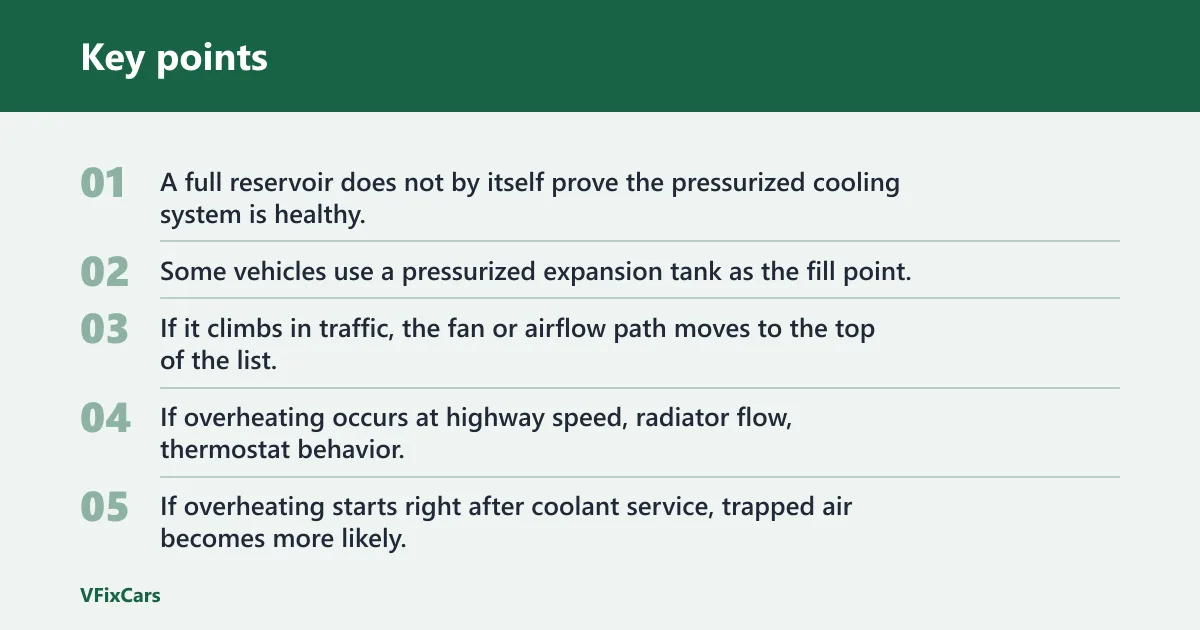
A full reservoir does not by itself prove the pressurized cooling system is healthy. Some vehicles use a pressurized expansion tank as the fill point, while others use a separate reservoir that does not tell you whether coolant is moving through the engine, radiator, heater core, and pump correctly. The problem is circulation, not just volume.
The temperature gauge is your first clue. If it climbs in traffic, the fan or airflow path moves to the top of the list. If overheating occurs at highway speed, radiator flow, thermostat behavior, or water-pump output should be investigated. If overheating starts right after coolant service, trapped air becomes more likely.
Car overheating but coolant table
| Overheating situation | Likely cause | Fastest check | Urgency |
|---|---|---|---|
| Overheats in traffic | Radiator fan not running, weak relay, blown fuse, wiring fault, or blocked airflow | With the engine cool enough to inspect safely, confirm whether the fan comes on when the temperature rises or when A/C is switched on, if the vehicle uses that command | High |
| Overheats at highway speed | Restricted radiator flow, stuck thermostat, or weak water pump | Check for uneven hose temperatures, poor heat transfer across the radiator, and a lower hose that stays cooler than expected after warm-up | High |
| Overheats right after coolant service | Air pocket from poor bleeding or wrong fill method | Look for gurgling, fluctuating temperature, and weak heater output after the repair | Medium to high |
| Heater blows cold | Trapped air or circulation loss through the heater core | Compare cabin heat at idle and at a steady cruise; cold or inconsistent heat points to flow trouble | High |
| Temp spikes after warm-up | Thermostat stuck closed or only partly opening | Watch whether the upper radiator hose stays cool longer than expected, then suddenly heats when the thermostat opens | High |
| Bubbling reservoir | Head gasket leak, trapped gas, or pressure loss | Check for repeated pressurization, hard hoses, and white exhaust smoke | Very high |
| Fan never comes on | Fan motor, fuse, relay, module, or wiring fault | Inspect the fan circuit, then verify command and power at the connector | High |
| Repeated overheating after bleeding | Persistent air pocket, hidden leak, weak radiator cap, or head gasket | Recheck fill level cold, then use a pressure test if the level stays normal but the problem returns | High |
Say your sedan overheats only after sitting in a drive-thru line, but the temperature settles once you are moving. That pattern points first to fan operation and airflow through the radiator, not to a low-coolant problem.
Suppose the gauge climbs ten minutes after a coolant flush, and the cabin heat turns cold at the same time. That combination fits trapped air better than a failed water pump, because the heater core is usually one of the first places air shows up.
What should you check first?
Start with safety, then confirm the right fill point, visible leaks, fan operation, heater output, and engine oil level. If the gauge is in the red, pull over and shut the engine off. Do not keep driving an overheating car, and do not open the radiator cap while hot.
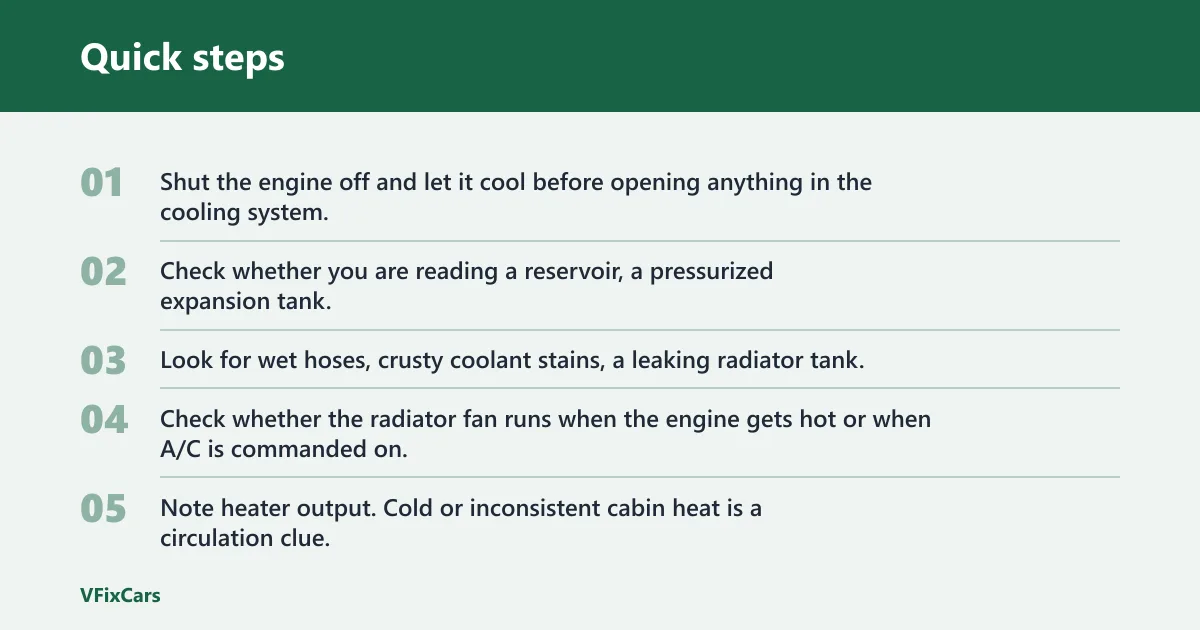
- Shut the engine off and let it cool before opening anything in the cooling system.
- Check whether you are reading a reservoir, a pressurized expansion tank, or the actual fill point for your vehicle.
- Look for wet hoses, crusty coolant stains, a leaking radiator tank, or seepage around the water pump.
- Check whether the radiator fan runs when the engine gets hot or when A/C is commanded on, if that applies.
- Note heater output. Cold or inconsistent cabin heat is a circulation clue.
- Check engine oil level and condition. Low or degraded oil can add heat and make an overheating problem worse.
Why reservoir level alone can mislead you
Some cars hide the problem because the reservoir looks normal while coolant movement is poor. A full coolant level does not guarantee proper circulation, and a full-looking tank can still coexist with a stuck thermostat, trapped air, a bad cap, or a pump that is not moving enough coolant.
If the level is low only in the pressurized side, the overflow bottle may not tell the whole story. That is why the fill point matters. A pressurized expansion tank can be part of the system itself, while a separate reservoir may only reflect overflow. Read the cap and service layout, not just the plastic bottle.
Can a bad thermostat cause overheating with full coolant?
A thermostat can stick closed or open only partway and still leave the coolant reservoir looking normal. Fast overheating soon after startup often points that way, especially if the upper radiator hose stays cool longer than expected and then heats abruptly when flow finally starts.
What the thermostat clue looks like
The thermostat controls coolant flow to the radiator. When it sticks closed, hot coolant stays trapped in the engine. When it opens only partway, the engine may warm up too fast, then run hot again under load because flow is limited. That can happen without any visible coolant loss.
A quick check starts from cold. Watch the warm-up pattern, then feel the upper hose only with a burn-safe approach and only after the engine is cool enough to touch safely. If the gauge rises while the radiator stays cool too long, the thermostat moves up the list.
Why does my car overheat at idle but not while driving?
Traffic or idle overheating often points to a cooling fan problem. At speed, road airflow helps the radiator, so a weak fan may not show up. If the car runs hot in a parking lot but cools down on the highway, check the fan, its fuse, relay, motor, module, wiring, and whether the A/C command wakes it up where applicable.
Fan and airflow checks that matter
The radiator fan should run when engine temperature rises, and on some vehicles it also runs when the A/C is on. If it never comes on, start with the simplest electrical checks first. A blown fuse or bad relay is cheaper to find than a fan module or motor failure.
- Check the fan fuse first.
- Check the relay next.
- Inspect the motor connector for heat damage or corrosion.
- Check the module and wiring if the fuse and relay are good.
- Confirm the fan blade is not jammed by debris or broken shrouding.
External blockage matters too. Packed leaves, plastic bags, bent fins, or road debris can reduce airflow through the radiator enough to overheat the engine in traffic even when the coolant level is normal.
Why does it overheat at highway speed?
Highway-speed overheating often suggests a restricted radiator or stuck thermostat, and it can also point to a weak water pump. At speed, airflow is usually available, so a problem that survives road speed is often about circulation through the engine or radiator rather than fan output.
Water pump, radiator, and cap clues
The water pump moves coolant through the engine and radiator. It can fail from a weak impeller, belt-drive trouble, or leakage. If the impeller cannot push enough coolant, overheating may show up under load or at highway speed even though the reservoir still looks full.
The radiator can also be the restriction. Internal clogging limits flow, while blocked fins limit heat rejection. A useful clue is hose temperature pattern: one hose may be hot while the other stays much cooler than expected, which suggests poor transfer across the radiator.
A faulty radiator cap is another common cause. The cap maintains cooling-system pressure, and a weak cap lowers the boiling point of the coolant. That can create overheating even when the level looks normal. If the cap is worn, test it or replace it rather than guessing.
Could trapped air or a head gasket be the cause?
Yes. Trapped air after service can block circulation, and a head gasket leak can push combustion gases into the cooling system. The symptom mix matters. Cold heater output, gurgling, and fluctuating temperature point toward trapped air. Bubbling reservoir, hard hoses, and repeated pressurization point more toward a head gasket issue.
After service: air pockets and bleeding mistakes
Overheating right after a coolant flush, thermostat replacement, radiator swap, or hose repair often comes from poor bleeding or the wrong fill method. Air pockets can sit in the heater core, thermostat housing, or upper passages and stop coolant from circulating properly.
Bleeding may require a bleed screw, a fill procedure that keeps the system level, or a vacuum fill tool on vehicles that need it. If the car repeatedly overheats after a refill and the heater stays weak, do not assume the new part is bad before you rule out trapped air.
Head-gasket signs that are more specific
Common warning signs include bubbling in the reservoir, hard hoses soon after startup, white exhaust smoke, and repeated pressurization even after the engine has cooled. Those clues matter more than a vague overheating complaint. A block test fluid kit or combustion-gas test helps confirm the diagnosis.
That confirmation step matters because head-gasket repair is far more expensive than a fan relay or thermostat. A pressure test can also help when the diagnosis is unclear. It is most useful with the engine cool and the system at the proper fill level, because hidden leaks and pressure loss are easier to spot without heat and steam masking them.
One more adjacent check belongs in the flow. Low engine oil or oil that is badly degraded can contribute to overheating. It is not the most common root cause, but it should not be ignored while you are tracing the cooling problem.
Frequently asked questions
Why is my car overheating if the coolant is full?
A full reservoir does not guarantee proper circulation. The most common reasons are trapped air, a thermostat stuck closed, a weak water pump, a clogged radiator, a bad fan, or a weak radiator cap. The pattern matters most: traffic, highway, or right after service.
Can trapped air make a car overheat even when coolant level is full?
Yes. Air pockets can block circulation after coolant service and create gurgling, fluctuating temperature, and poor heater output. A full reservoir can hide the problem if the air is sitting in the engine or heater core. Correct bleeding or vacuum filling is often the fix.
Could a bad water pump overheat the engine without losing coolant?
Yes. A water pump can lose pumping ability because of a weak impeller, belt-drive issues, or internal damage without an obvious leak. That may show up as overheating at highway speed or under load, where circulation demand is higher. The coolant level may still look normal.
Should I keep driving if my temperature gauge is in the red but coolant is full?
No. Pull over and shut the engine off. Do not keep driving an overheating car, and do not open the radiator cap while hot. A full reservoir does not prove the system is safe, and continued driving can cause severe engine damage in minutes.