
Full synthetic vs synthetic blend vs conventional oil
Full synthetic is the safest default for turbo engines, towing, hot or cold climates, and severe service; synthetic blend fits many older daily drivers on a midrange budget; conventional oil is acceptable only if your owner’s manual allows it and your driving is mild. Pick the wrong type and the oil can break down sooner, leave more deposits, make cold starts harder, and waste maintenance money. This guide compares full synthetic vs synthetic blend vs conventional oil by engine condition, climate, driving pattern, and budget.
synthetic vs synthetic blend vs conventional oil
All three oils lubricate, cool, clean, and protect, but they do not start from the same base stocks. Conventional oil is mineral-based and comes from crude oil, usually as Group I or Group II oil. Full synthetic uses highly refined base stocks, which can help it keep viscosity steadier as temperatures change.
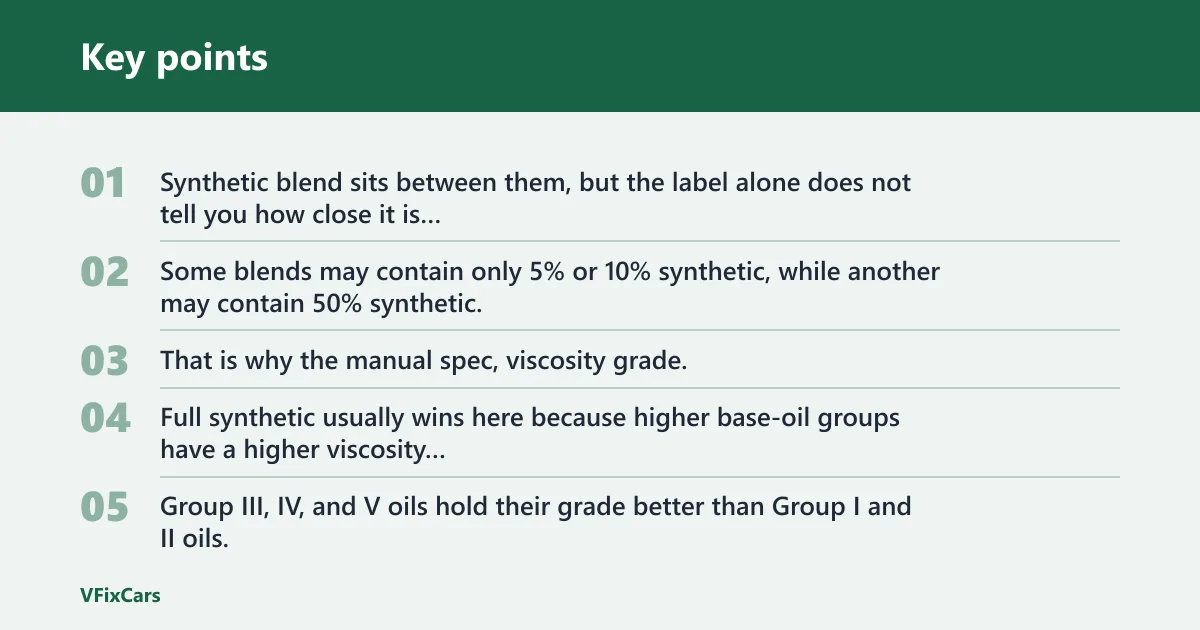
Synthetic blend sits between them, but the label alone does not tell you how close it is to either end. Some blends may contain only 5% or 10% synthetic, while another may contain 50% synthetic. That is why the manual spec, viscosity grade, and approvals matter more than the marketing name on the bottle.
| Decision factor | Full synthetic | Synthetic blend vs conventional oil | Winner |
|---|---|---|---|
| Cold-start and temperature control | Usually best low-temperature flow and stable viscosity | Blend improves over straight conventional, but varies by brand | Full synthetic |
| Heat, oxidation, and sludge resistance | Strong resistance to oxidation, thermal breakdown, and sludge | Better than conventional, weaker and less consistent than full synthetic | Full synthetic |
| Upfront cost | Highest | Lower than full synthetic, higher than conventional | Synthetic blend vs conventional oil |
| Best fit for older, mild-use engines | Often more than needed if intervals are short and conditions are mild | Often a practical middle ground if the manual allows it | Synthetic blend vs conventional oil |
| Drain-interval value | Best when long drains are allowed by the manual | Can be a good value if priced well and used within normal intervals | Depends on interval |
Cold-start and temperature control
Full synthetic usually wins here because higher base-oil groups have a higher viscosity index, which means viscosity changes less during startup and normal operation as temperatures change. Group III, IV, and V oils hold their grade better than Group I and II oils, so they are easier to justify in cold weather, short trips, and repeated start-stop use.
Suppose a 2.0-liter turbo sedan sits outside overnight in freezing weather and then gets driven five miles to work. A full synthetic that meets the manual spec is the safer default, because the engine sees its hardest wear during startup and warmup.
Heat, oxidation, and sludge resistance
Full synthetic also has the edge when heat is the problem. Synthetic oils may resist oxidation, thermal breakdown, and sludge, which matters during towing, mountain driving, turbo heat, and long highway runs in hot weather.
Conventional oil can still protect an engine that is built for it, but higher heat shortens the comfort margin. That is where the base-oil group difference matters more than the label on the front of the jug.
Cost and value
Synthetic blend is cheaper than full synthetic, so it can make sense if you want some cold-flow and deposit-control benefit without paying for the highest tier. The value case weakens fast if the blend is only slightly cheaper and the oil must still be changed on a short interval.
Conventional oil stays the lowest-cost option upfront. It becomes the least attractive choice when the vehicle sees frequent cold starts, heat, or long service intervals, because the cheaper fill can turn into more frequent maintenance.
📊 Another synthetic blend may contain 50% synthetic. Source: Synthetic Oil vs. Conventional Oil vs. Synthetic Blend in 2025.
What do conventional, synthetic blend, and full synthetic oil actually mean?
Conventional oil is mineral-based and comes from crude oil, usually as Group I or Group II base oil. Synthetic blend is a mix of mineral and synthetic base oils, and full synthetic uses highly refined base stocks such as Group III, Group IV, or Group V. Those base oils shape viscosity index, oxidation resistance, and high-temperature stability more than the marketing label does.
Conventional oil: mineral-based and usually Group I or II
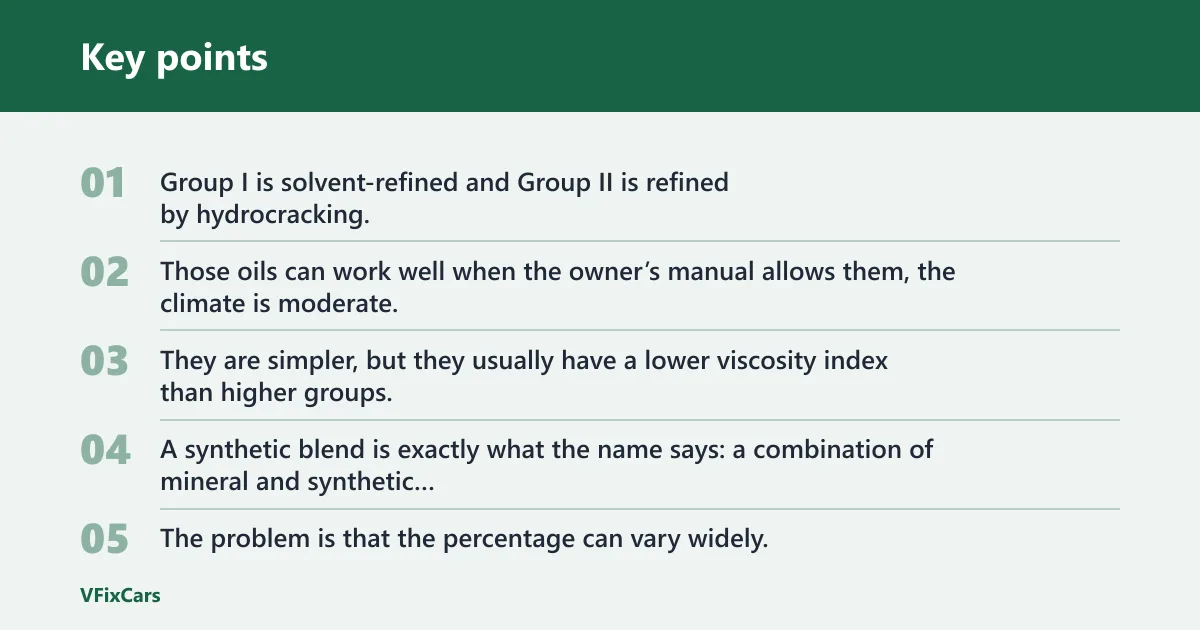
Group I is solvent-refined and Group II is refined by hydrocracking. Those oils can work well when the owner’s manual allows them, the climate is moderate, and the service interval is conservative. They are simpler, but they usually have a lower viscosity index than higher groups, so their behavior changes more with temperature.
Synthetic blend oil: mixed base stocks with wide formulation spread
A synthetic blend is exactly what the name says: a combination of mineral and synthetic base oils. The problem is that the percentage can vary widely, so two bottles called “synthetic blend” may not be close in actual base-stock content. Some may contain only 5% or 10% synthetic, while another may contain 50% synthetic.
Full synthetic oil: Group III, IV, or V base stocks and tighter temperature control
Full synthetic usually means more refined base stocks and better control over viscosity, oxidation, and heat. Group IV is a polyalphaolephin, or PAO, and Group V includes polyalkylene glycols and esters. Group III, IV, and V base oils have a higher viscosity index than Groups I and II, so they usually hold their grade better across a wider temperature range.
How do the oils compare on temperature, wear, and drain interval?
The clearest gap is temperature stability. Full synthetic generally handles both startup and operating heat better, while synthetic blend sits in the middle and conventional oil sits at the lower end of that scale. Additive packages also matter, because cleaning, wear protection, and deposit control vary by brand even within the same category.

Cold-start flow and low-temperature pumping
Faster flow at startup matters because most wear happens before full oil circulation is established. Full synthetic usually offers the strongest low-temperature behavior, synthetic blend can improve on conventional oil, and conventional oil is the least forgiving in deep cold.
High-heat resistance and thermal breakdown
Heat exposure is where full synthetic usually separates itself. Towing, turbochargers, and long summer runs can push oil toward thermal breakdown, and a better base stock gives the formulation more room to survive that stress. A synthetic blend may still be fine for moderate service, but its margin depends on the exact formulation.
Oxidation resistance and sludge control
Oxidation is the slow chemical aging process that thickens oil and contributes to sludge. Full synthetic has the best odds here, especially for long drains or engines that run hot. Conventional oil can handle normal use, but it needs more conservative change timing to stay out of trouble.
How longer drain intervals change the value equation
Longer intervals can make full synthetic worth the extra money because the oil’s stability becomes part of the savings. If the vehicle manual allows a longer interval and the driving pattern is severe, the upfront gap is easier to justify.
Short intervals change the math. If you are changing oil frequently no matter what, a midpriced synthetic blend can be the better value than paying for full synthetic capability you never use.
Is full synthetic better than synthetic blend?
Full synthetic is better when the engine sees hard cold starts, high heat, turbocharger load, towing, or longer drain intervals. It usually gives you more stable viscosity, stronger oxidation resistance, and better thermal breakdown resistance. Synthetic blend can still be the smarter purchase when those stresses are mild and the manual does not require a full synthetic.
When full synthetic is the better choice
It is often a good choice for turbo engines and for driving in hotter or colder conditions, frequent short trips, towing, or other severe service. These are the conditions that punish oil most quickly, and they reward the stronger base stock and additive reserve of a true full synthetic.
When synthetic blend is good enough
Choose it when the vehicle is older, the driving pattern is ordinary, and the service interval is modest. A blend is often the right middle ground for a commuter that sees mixed city and highway use without sustained heat or long idle time.
When the price gap is worth paying
Paying more makes sense when the oil change is expensive to do, when the manual allows longer intervals, or when the engine is costly to repair. It is also justified if the car spends most of its life in severe service, where oxidation and thermal stress matter more than the sticker price on the jug.
Is synthetic blend better than conventional oil?
Yes, in most cases synthetic blend is an upgrade over conventional oil because it performs better than straight conventional oil and can provide better low-temperature properties. That said, it is not automatically the right answer for every engine, because blend quality varies so much by brand and formulation. Manual approval still comes first.
When blend is a real upgrade
A blend is a sensible step up when you want better cold-flow behavior, more heat tolerance, and somewhat better deposit control without moving all the way to full synthetic. It is especially useful for drivers who keep to normal intervals but want more cushion than conventional oil offers.
When conventional oil still makes sense
Conventional oil still fits engines and manuals designed for it, especially in mild climates and simple driving patterns. If the engine is older, the intervals are short, and the oil spec does not call for synthetic, conventional oil can be a reasonable choice rather than a compromise.
Why blend quality varies so much by brand
“Synthetic blend” is a category, not a fixed recipe. One blend may lean heavily on synthetic base stocks, while another may be mostly conventional oil with a small synthetic portion. That is why two products in the same category can behave differently in cold starts, hot operation, and oil life.
Which oil is better full synthetic or synthetic blend?
Full synthetic may be a better fit when you want more performance margin, longer service life, or more consistent behavior in heat or cold. Synthetic blend is better when you want a lower price and your use case is moderate enough that full synthetic would be more capability than you need. The better choice is the one that fits the manual and your driving pattern.
Choose full synthetic if your car sees cold starts, long drains, turbo heat, or severe service
- Check the owner’s manual for viscosity grade and required approvals first.
- Use full synthetic if the engine regularly sees short trips, towing, stop-and-go traffic, or extreme temperatures.
- Favor it when oxidation resistance and thermal stability matter more than upfront cost.
Choose synthetic blend if you want a middle-ground option for moderate service and moderate cost
- Confirm that the blend meets the exact manual spec.
- Use it for mixed commuting, normal highway use, and older engines that do not need the highest oil performance tier.
- Pick it when the price gap to full synthetic is large enough to matter at every oil change.
Choose conventional oil if the manual allows it and the engine, climate, and interval are simple
- Verify that conventional oil is permitted by the manufacturer’s spec.
- Keep the interval conservative, especially if the engine runs hot or sees short trips.
- Use it mainly for mild-duty engines where lower upfront cost is the main goal.
Full synthetic oil vs blend vs conventional oil
Full synthetic is the strongest choice for temperature stability, oxidation resistance, and severe-service margin. Synthetic blend is the middle option and can be a smart value if the formulation is decent and the driving load is moderate. Conventional oil remains acceptable only where the manual allows it and the operating conditions stay simple.
Daily commuting and normal highway use
For ordinary use, synthetic blend is often the value sweet spot, especially if the vehicle is older and the manual does not require a stronger oil. Full synthetic is still a fine default, but its extra margin may not pay back unless the car sees long intervals, frequent cold starts, or harsh weather.
Short trips, cold starts, and stop-and-go traffic
Full synthetic is the stronger choice because it reaches protective flow sooner and holds viscosity better across temperature swings. Short trips are hard on oil because the engine spends more time cold, and that makes oxidation and contamination more relevant.
Towing, turbo engines, hot climates, and severe service
Full synthetic wins this category clearly. Turbo heat and towing raise oil temperature and stress, while hot climates and stop-and-go traffic push oxidation harder; the stronger base stocks and additive packages give synthetic oil more room to handle that load.
Older engines, higher oil consumption, and budget-focused maintenance
Conventional oil can still be fine if the manual allows it and the engine is simple, but many older daily drivers do better with a synthetic blend. A blend can offer better low-temperature properties and better overall stability without forcing the full synthetic price point.
synthetic blend vs full synthetic vs conventional oil
The practical ranking is not the same for every driver. Full synthetic ranks first for protection and temperature control, synthetic blend ranks first for middle-ground value, and conventional oil ranks first only for lowest upfront cost. The right answer depends on engine condition, climate, drain interval, and whether the manual allows the choice.
Picture a 2011 compact car used for a 3-mile school run in winter, then parked outside overnight. Full synthetic is the safer pick because repeated cold starts punish oil, and the engine may never fully warm up. In contrast, a 2008 sedan that sees 40-minute highway drives in a mild climate may be perfectly well served by a good blend if the manual allows it.
Choose full synthetic if… / Choose synthetic blend if… / Choose conventional oil if…
Choose full synthetic if your engine sees cold starts, turbo heat, towing, long intervals, or severe service, and the manual approves it. Choose synthetic blend if you want a practical middle ground for mixed driving and you care about value more than maximum margin. Choose conventional oil only if the manual allows it and the service pattern is mild.
Choose full synthetic if…
- Your car has a turbocharger or sees towing.
- You live in a hot or cold climate with frequent temperature swings.
- You want the strongest oxidation resistance and thermal breakdown margin.
- The manufacturer allows long drains or specifically calls for synthetic.
Choose synthetic blend if…
- You drive mostly ordinary city and highway miles.
- You want better protection than conventional oil without paying full synthetic pricing.
- Your engine is older but still healthy, and the manual allows a blend.
- Your service interval is normal, not extended.
Choose conventional oil if…
- The owner’s manual permits mineral-based oil.
- Your climate is mild and the engine sees simple, low-stress use.
- You keep intervals short and do not need extended heat resistance.
- Lowest upfront cost matters more than extra performance margin.
Frequently asked questions
what is synthetic blend vs full synthetic
Synthetic blend is a mix of mineral and synthetic base oils, while full synthetic uses highly refined base stocks and is usually built around Group III, IV, or V oils. The blend category can vary a lot by brand, so two bottles with the same label may not behave the same way in cold starts or high heat.
is full synthetic oil better than synthetic blend
Yes, if your priority is durability under heat, cold-start protection, and resistance to oxidation and sludge. It is not automatically the better purchase for every driver, though, because a synthetic blend can be enough for normal service and may cost less. The manual spec still decides the floor.
is synthetic blend oil better than conventional oil
Usually yes, because a blend performs better than straight conventional oil and can provide better low-temperature properties. The gain is not identical across brands, however, because some blends contain only a small amount of synthetic base oil while others contain much more. Check the exact specification, not just the label.
what’s better full synthetic or synthetic blend
Full synthetic is better for hard use, long drains, and harsh temperatures. Synthetic blend is better when you want a lower-cost step up from conventional oil and the car’s use is moderate. The correct answer depends on how hot, cold, or demanding the engine’s life is.
conventional vs synthetic blend vs full synthetic
Conventional oil is the simplest and cheapest upfront, synthetic blend is the middle option, and full synthetic has the strongest stability and heat resistance. The owner’s manual, viscosity grade, and approval standard matter more than the category name. If those match, then driving severity and budget decide the rest.