
What Is the Difference Between Synthetic and Conventional Oil?
Synthetic oil uses more highly processed or chemically built base stocks, so it usually handles heat, oxidation, and viscosity loss better than conventional oil. Conventional oil is refined from crude and usually costs less, so the right pick depends on your engine’s spec and driving conditions. Using the wrong oil or stretching intervals can increase wear, sludge, and cold-start friction. This guide separates base oil, refining method, and real engine behavior so you can choose correctly before an oil change.
This guide is part of our Synthetic vs conventional oil: which should you use series.
Synthetic vs conventional oil: the core trade-off
The main difference is not price alone. Synthetic oil uses higher-grade base stocks with tightly controlled chemistry, so it usually moves faster in cold starts, holds up better in heat, and resists oxidation longer than conventional oil. Conventional oil can still lubricate well when the manufacturer allows it.
What the bottle label does not tell you
Two oils can meet the same viscosity grade and still behave differently under stress. Base-oil quality can affect impurity levels, chemical stability, oxidation resistance, and how well the additive package can perform. That is why two 5W-30 oils can behave very differently in winter starts or long highway service.
Motor oil comparison table
| Row | Conventional | Synthetic blend | Full synthetic | What this means for your car |
|---|---|---|---|---|
| Base oil | Less-refined base oils; also called mineral oil | Mix of conventional and synthetic base oils | Higher-quality base oils with tightly controlled molecular qualities | Cleaner base stock usually means better stability and less thinning or thickening under stress. |
| Refining method | Refined from crude oil with less chemical development | Partly refined, partly chemically developed | Chemically developed from petrochemicals through complex processes | More controlled chemistry usually gives more consistent performance from bottle to bottle. |
| Cold-start behavior | Flows adequately, but less quickly in low temperatures | Better than conventional, but below full synthetic | Flows quickly even at low temperatures | Better cold flow can reduce startup friction and help oil reach parts faster on winter mornings. |
| Heat and sludge resistance | Breaks down faster under heat and oxidation; can form sludge over time | Better than conventional, but can break down faster than full synthetic | Better resistance to heat, oxidation, wear, sludge, and deposit buildup | Higher resistance matters more in turbo heat, towing, hauling, stop-and-go heat, and longer drain intervals. |
What is conventional oil?
Conventional oil is mineral oil made from less-refined base oils. It can provide adequate lubrication in engines that allow it, but it is less chemically stable, oxidizes and acidifies more easily, and can break down faster under heat than synthetic oil.
Where conventional oil still makes sense
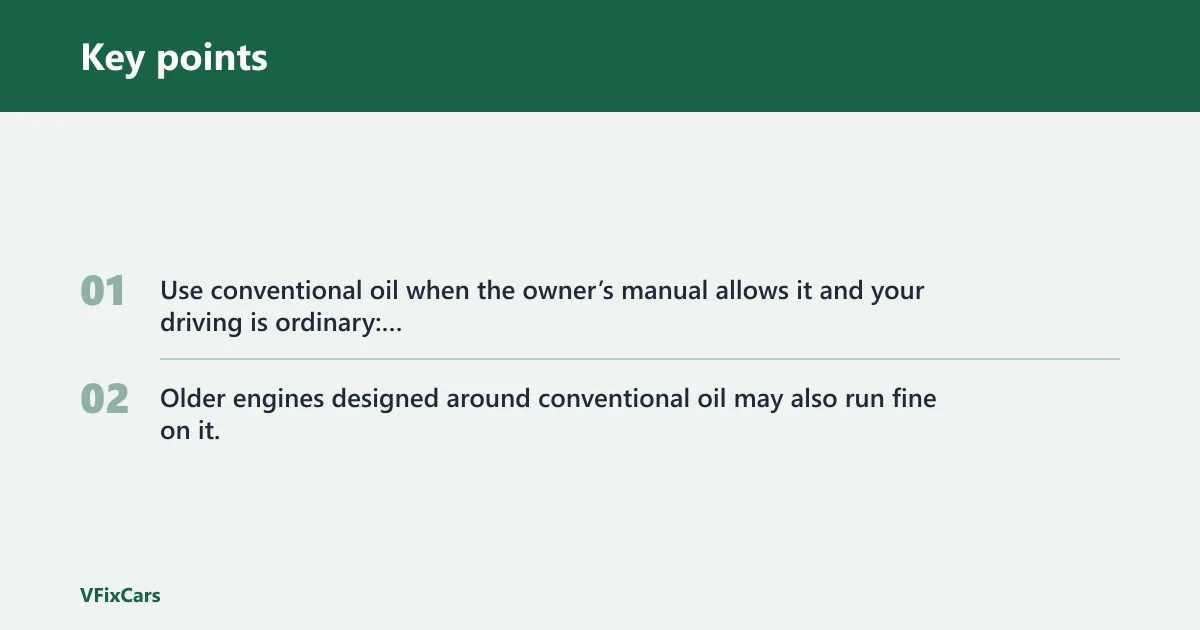
Use conventional oil when the owner’s manual allows it and your driving is ordinary: steady commutes, mild temperatures, and no sustained towing or heavy heat load. Older engines designed around conventional oil may also run fine on it, especially when oil-change intervals stay conservative.
What makes synthetic oil different?
Synthetic oil is chemically developed from petrochemicals through complex processes. It uses higher-grade base oils with engineered molecular qualities, so the final oil can move better in the cold, resist oxidation longer, and protect better at high temperatures than conventional oil.
Why molecular consistency matters in use
More uniform base oil helps the additive system work more predictably. That matters during a cold start, when oil must move quickly, and during long heat exposure, when viscosity loss and oxidation can chip away at protection. Full synthetic oils take that one step further with a tailored additive system.
Base oil quality and additive packages
Base oil quality and additives do different jobs. The base oil affects impurity level, chemical stability, and oxidation resistance. The additive package handles detergents, dispersants, anti-wear agents, and other functions that help the finished oil stay clean and protective.
Why additives do not erase a weak base oil
A strong additive package helps, but it cannot fully rescue a less-stable base oil. If the oil starts with lower chemical stability, heat and oxidation can still break it down faster. Full synthetic oils usually pair better base stocks with a tailored additive system, which is why they sit at the top of the comparison.
Cold starts, heat, and sludge

Synthetic oil can help most where engine stress is highest. It moves quickly at low temperatures, which helps in cold starts. It also resists high-temperature breakdown better, including the heat around turbochargers. Over time, it can help fight sludge and deposit buildup, which supports cleaner internals and better long-term efficiency.
Cold starts in plain language
On a cold morning, thick oil takes longer to reach tight engine parts. That brief delay increases startup friction. Synthetic oil’s better low-temperature flow reduces that delay, especially in colder climates or in vehicles that sit overnight before driving.
High heat, towing, and turbo exposure
Heat is where oil quality becomes obvious. Turbochargers, towing, hauling, and long climbs push oil temperatures up and increase oxidation stress. Full synthetic oils generally handle that better than conventional oils and better than synthetic blend oils, which can break down faster than full synthetic.
Sludge and deposit control
Sludge forms when oil oxidizes, thickens, and leaves residue behind. Synthetic oils can help fight sludge and deposit buildup, which matters for valve train cleanliness, ring control, and long-term durability. Conventional oil can still work, but it is more likely to form sludge over time if intervals run long or heat loads stay high.
Say your car sits outside in winter and the morning temperature drops below freezing. A full synthetic oil in the correct grade should reach moving parts faster than a conventional oil of the same grade, which can help reduce startup friction on short trips.
Suppose a midsize SUV tows a small trailer through hilly summer traffic. The engine oil sees more heat, more oxidation stress, and longer high-load operation. In that case, full synthetic usually makes more sense than conventional oil, especially if the owner’s manual allows the upgrade.
Choose conventional oil if… / Choose full synthetic oil if…
Choose conventional oil if your owner’s manual allows it, your driving is mild, your engine is older and has always used mineral oil, or your budget calls for the lowest acceptable option. Choose full synthetic if you want stronger heat resistance, better cold-start flow, cleaner internals, or a longer drain interval that your vehicle and driving pattern actually support.
Where synthetic blend fits
Synthetic blend oil sits between conventional and full synthetic. It gives you some benefits of synthetic base oil without moving all the way to the top tier. It is useful when you want more protection than conventional oil but do not need the highest level of full synthetic protection.
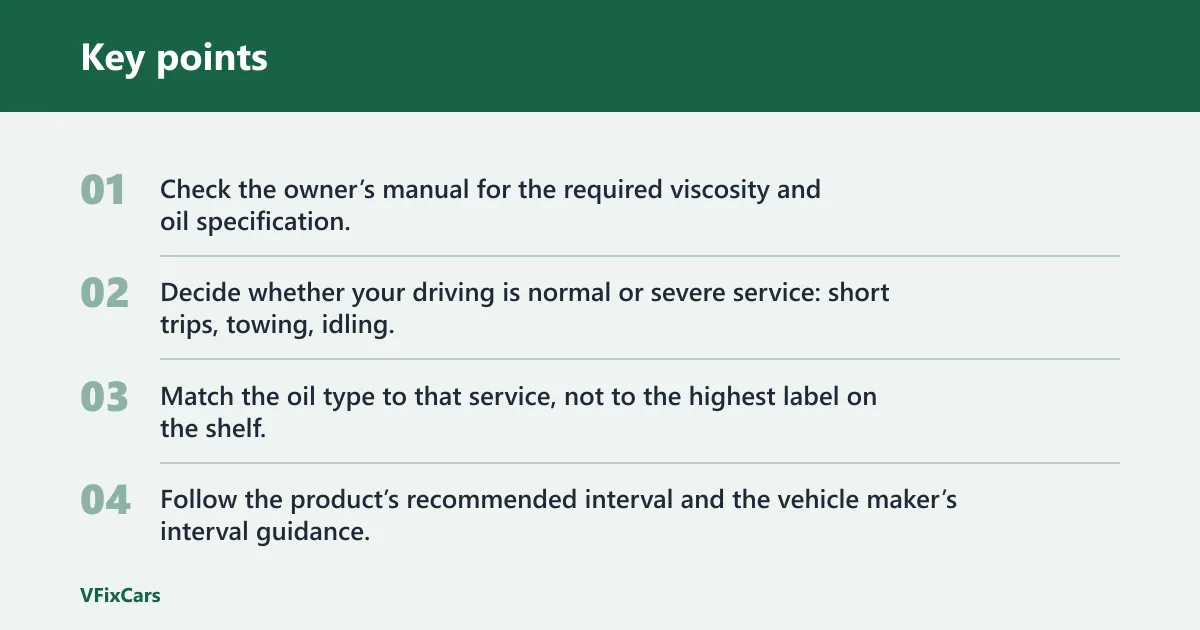
- Check the owner’s manual for the required viscosity and oil specification.
- Decide whether your driving is normal or severe service: short trips, towing, idling, heat, or cold starts.
- Match the oil type to that service, not to the highest label on the shelf.
- Follow the product’s recommended interval and the vehicle maker’s interval guidance, whichever is more restrictive.
Older engines and high-mileage cars
Older engines and high-mileage cars do not automatically need synthetic oil, but they may benefit from it if they see heat, sludge risk, or winter starts. If the vehicle has always run conventional oil and the manufacturer approves it, a careful switch is usually about service needs, not hype. Watch for leaks that were already there.
Severe-service driving
Severe service commonly includes repeated short trips, stop-and-go traffic, towing, hauling, extended idling, and high heat. Those conditions put more stress on oxidation resistance and oil film strength. Synthetic oil is usually the safer choice there, but you still need to follow the correct change interval for the exact product and vehicle.
Frequently asked questions
What is the difference between synthetic and regular oil?
Synthetic oil starts with chemically developed, higher-quality base oils, while regular oil usually means conventional mineral oil made from less-refined base stocks. Synthetic generally resists heat and oxidation better, moves more quickly in the cold, and supports cleaner engine operation when the vehicle is used in tougher conditions.
What is the difference between full synthetic and conventional oil?
Full synthetic sits at the top of this comparison. It uses a tailored additive system and higher-quality base oils, so it usually offers better wear protection, better cold flow, and better resistance to heat and sludge than conventional oil. Conventional oil can still be adequate where the manufacturer allows it.
What is the difference between synthetic blend and conventional oil?
Synthetic blend oil mixes conventional and synthetic base oils, so it usually performs better than conventional oil in cold starts and heat resistance, but not as well as full synthetic. It is a middle-ground option for drivers who want more protection without moving to the highest tier.
Does synthetic oil last longer than conventional oil?
Synthetic oil can support longer drain intervals because it resists heat, oxidation, and breakdown better than conventional oil. That does not make the interval automatic. The vehicle maker’s schedule, the oil product’s recommendation, and your driving pattern still decide how long the oil should stay in service.
What is the difference between synthetic and conventional oil change?
The oil-change job is usually the same, but the service interval and protection margin are different. Synthetic oil often lets you follow a longer interval if the vehicle and product allow it, while conventional oil usually needs more conservative timing in heat, sludge-prone driving, or repeated short-trip use.
What is the difference between full synthetic and conventional oil change?
A full synthetic oil change may support a longer interval and better protection between changes, but only if the oil, engine, and driving conditions allow it. Conventional oil changes are often scheduled more often because the oil breaks down faster under heat and oxidation and is less resistant to sludge buildup.