Why Change Oil by Time and Not Just Mileage for Most Drivers
Change oil by time when mileage is low: if you drive mostly short trips, sit parked for long periods, or make few annual miles, follow the time limit in your owner’s manual, which is often around 6 to 12 months, even if you have not hit the mileage interval. Waiting too long can leave acid, water, and sludge in the engine. This guide shows how time and mileage interact and gives a simple rule for your driving pattern.
This guide is part of our Oil change: when, why, and how to do it right series.
Why oil changes use time and mileage
Oil changes are set around both miles and months because oil wears out in two ways. It gets contaminated as the engine runs, and it also ages while the car sits. The standard wording is “miles or months, whichever comes first,” so the earlier trigger wins.
What “whichever comes first” means
That phrase means exactly what it says. If a car is due at 5,000 miles or 6 months, service is due at the first limit reached, even if the other number still looks low. Many service stickers use the same rule, and some shops print a reminder such as 3,000 miles or 3 months.
Why both triggers matter
Mileage tracks use. Time tracks aging. More miles usually mean more contaminants in the oil, while more months mean more oxidation and weaker additives. Ignore one side, and you miss part of the service interval.
Why does oil age even when the car is parked?
Oil ages while a car sits because oxygen exposure and heat slowly change its chemistry. Additives also break down over time, so oil that still looks clean can lose part of its protective ability. Parked does not mean fresh forever.
Oxidation from oxygen exposure and heat
Oxidation is a chemical reaction between oil and oxygen. Heat speeds it up. As oxidation increases, oil can thicken, lose stability, and protect less well under load. That is why a low-mileage car can still be due by date.
Additive breakdown over time
Oil additives carry away contaminants such as unburned fuel, soot, and metal bits. They also help control wear and deposits. Over time, those additives are used up or weakened, so the oil’s job gets harder even if the odometer moves slowly.
Why stored cars still need calendar checks
A car that sits for months still has air inside the crankcase. Moisture can collect too. A vehicle with only 2,000 miles in six months may still be due for an oil change if the manual’s time limit has passed.
Suppose a weekend coupe racks up only 1,500 miles in a year. If the manual calls for 6 months or 5,000 miles, the car still needs service at 6 months. Waiting for mileage alone leaves the oil aging past its intended window.
Which driving habits age oil fastest?
Short trips, stop-and-go traffic, idling, and low-speed driving are harder on oil than steady highway use. Highway cruising is easier because the engine reaches and holds operating temperature, which helps the oil do its job and burn off moisture.
Short trips and moisture buildup
Short trips are a common problem because the engine may not get hot enough to evaporate water. Condensation can add moisture to engine oil and raise corrosion risk. That moisture can also help sludge form when the oil stays in service too long.
Stop-and-go traffic, idling, and low-speed use
Traffic and idling still rack up engine hours while cooling and flow conditions change often. Oil sees more heat cycles and more contamination. Manufacturers still separate normal and severe service because the same mileage can be much harder on oil in dense traffic than on open roads.
Why highway driving is usually easier on oil
Steady highway cruising keeps the engine hot and stable. That helps moisture leave the oil and reduces the harsh start-stop load. It does not erase the mileage interval, but it often means the calendar limit matters less than it does for short-trip use.
How do you read your owner’s manual interval?
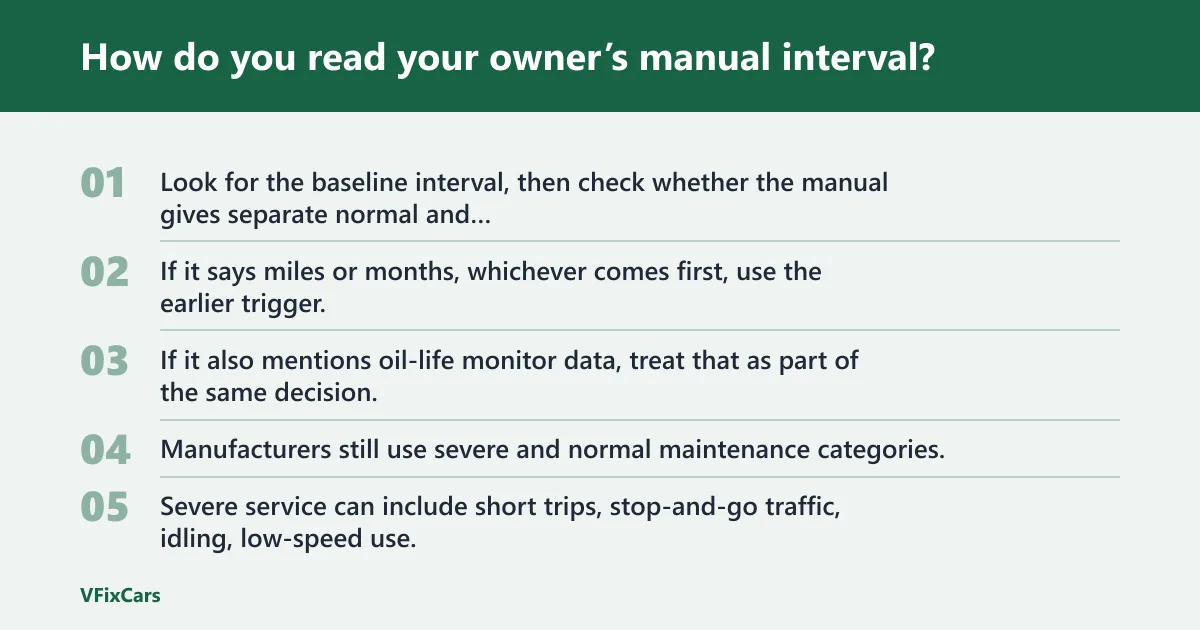
Start with the owner’s manual. Look for the baseline interval, then check whether the manual gives separate normal and severe service schedules. If it says miles or months, whichever comes first, use the earlier trigger. If it also mentions oil-life monitor data, treat that as part of the same decision.
Normal versus severe service schedules
Manufacturers still use severe and normal maintenance categories. Severe service can include short trips, stop-and-go traffic, idling, low-speed use, towing, dusty roads, and frequent cold starts. If a car fits that pattern, the severe schedule may be the better guide.
How to compare miles, months, and oil-life monitor data
Use all three in order. First, read the manual. Second, note the mileage limit and the month limit. Third, check the oil-life monitor if the vehicle has one. If the monitor, mileage, or calendar says service is due, do not wait for the other two to catch up.
How shop stickers and reminder labels fit in
A windshield sticker or dash reminder is a service cue, not a replacement for the manual. Some stickers say 3,000 miles or 3 months, which is a shop-issued reminder, not a universal rule. If the sticker and the manual differ, the manual wins.
Use this driver-pattern decision table
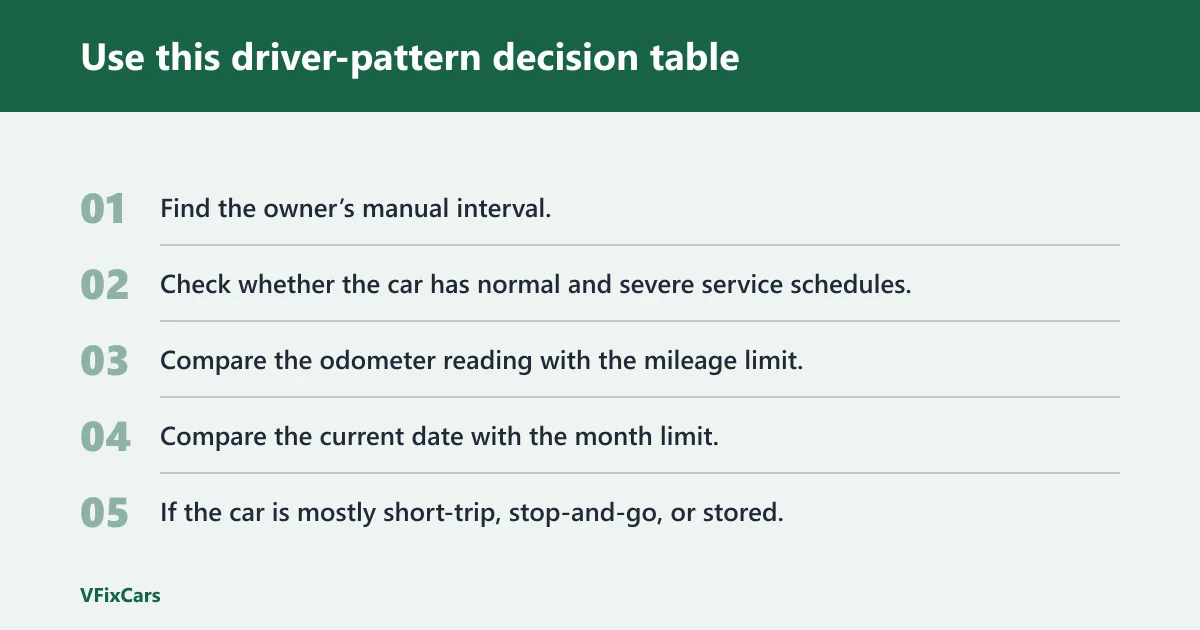
This table gives a fast way to choose the better trigger first. It does not replace the manual. It helps you decide whether the calendar or the odometer should be checked first for your driving pattern.
| Driving pattern | Better trigger to follow first | Why | What to watch |
|---|---|---|---|
| Weekend car | Time | Low mileage can still leave oil aging, oxidizing, and absorbing moisture while parked. | Calendar date, storage time, and any shop reminder label |
| Short-trip commuter | Time | Frequent cold starts and short drives may prevent full warm-up and water evaporation. | Months since last service, severe-service schedule, and oil condition notes |
| Mostly-highway commuter | Mileage, then time | Highway cruising is easier on oil, so the mileage limit often arrives before the date limit. | Odometer, manual interval, and oil-life monitor if equipped |
| Stored or rarely driven vehicle | Time | Oil still ages in storage, and a low-mileage car may still need service on schedule. | Months in storage, battery maintenance, and calendar due date |
- Find the owner’s manual interval.
- Check whether the car has normal and severe service schedules.
- Compare the odometer reading with the mileage limit.
- Compare the current date with the month limit.
- If the car is mostly short-trip, stop-and-go, or stored, use the earlier calendar trigger first.
- If the car is mostly highway, mileage may arrive first, but the calendar still matters.
What happens if you ignore the calendar interval?
Ignoring the calendar can let moisture, oxidation, and contaminant buildup stay in the engine too long. That raises the chance of sludge, corrosion, and wear. Low-mileage cars are not immune, because time alone can age the oil past its useful range.
Sludge formation and corrosion
Sludge is thick, dirty residue formed by aged oil and moisture. It is more likely with short trips because water may stay in the oil longer. Sludge can restrict flow and hurt engine parts that depend on clean oil circulation.
A failure-case example for low-mileage cars
Picture a stored sedan that gets driven only to the grocery store twice a month. The odometer barely moves, but the oil may stay in service for well over a year. By the time the car is driven harder, the oil may already be loaded with moisture and aged additives, which raises the risk of deposits and wear.
Does synthetic oil change the answer?
Synthetic oil can last longer than conventional oil, but it does not cancel the time rule. Modern synthetics may last 5,000 to 10,000 miles depending on the car and driving conditions. The manual still sets the real limit, and severe service can shorten it.
Typical longer intervals and their limits
Synthetic oil is often built to handle heat and breakdown better than older oil types. That can support longer intervals, but the claim only means something when it matches the vehicle and use pattern. A long-mileage rating does not override months of storage or short-trip use.
When mileage should not overrule time
If the car is under-mileage but over-time, do not wait for the odometer. A calendar-overdue oil change can be the right call even with modern synthetic oil, especially on a weekend car, a short-trip commuter, or a stored vehicle.
Calendar-vs-mileage checklist
Use this checklist before the next service. It keeps the decision simple and makes the manual easier to apply in real driving conditions.
When to follow the date first
- You drive mostly short trips.
- You sit in stop-and-go traffic often.
- The car idles a lot or sees low-speed use.
- The vehicle is stored for long periods.
- The manual lists a month limit that comes before the mileage limit.
When to follow miles first
- You drive mostly highway miles.
- The engine reaches operating temperature on most trips.
- The odometer hits the manual’s mileage limit before the calendar limit.
- The oil-life monitor drops to the service point before the date limit.
What to record before the next service
- Date of the last oil change
- Odometer reading at service
- Manual interval in miles and months
- Whether the car fits normal or severe service
- Any dash reminder or sticker interval
Frequently asked questions
oil change time vs mileage
Time and mileage work together because oil ages in two ways. Mileage tracks contamination from engine use, while time tracks oxidation, moisture exposure, and additive breakdown. The safer rule is to follow the owner’s manual and use the earlier trigger, not mileage alone.
oil change time vs mileage chart
A useful chart puts your driving pattern on one side and the better trigger on the other. Weekend and stored cars usually point to time first. Mostly-highway driving often points to mileage first. Short-trip commuting usually pushes you back to the calendar limit sooner.
oil change frequency mileage vs time
Oil change frequency depends on both the number of miles and the number of months since the last service. Many manuals use “miles or months, whichever comes first.” That means a car can be due on time even with low miles, especially under severe service conditions.
should you get oil change before mileage
Yes, if the calendar limit comes first. That is common for low-mileage drivers, weekend cars, and vehicles that spend long periods parked. If the manual says 6 months or 5,000 miles, and 6 months arrive first, the oil change is due before the mileage limit.
does an oil change help gas mileage
Fresh oil can help an engine run as intended, but oil change timing should not be treated as a fuel-economy fix. The main reason to service oil on time is engine protection, not a promised mileage gain. Follow the manual interval for wear control and cleanliness.
change oil based on mileage or time
Use both, then follow the earlier one. That is the cleanest rule for most drivers and matches the standard “miles or months, whichever comes first” wording. If your driving is severe, short-trip, or low-mileage, time often matters first.
time or mileage more important oil change
Neither one always wins. For highway commuters, mileage may be the first trigger. For low-mileage, short-trip, or stored vehicles, time is often more important because oil can age, collect moisture, and lose additive strength while the car sits.