Synthetic vs Conventional Oil Change Interval: How Long?
The safest oil-change interval is the first limit you hit: the owner’s manual, the oil life monitor, the severe-service schedule, the oil’s mileage range, or the time cap. Many cars on synthetic oil can run 7,500 to 10,000 miles, while conventional oil usually falls in the 3,000 to 5,000 mile range. Go past those limits and you increase wear, sludge formation, and repair bills. This guide helps you pick the right interval for your vehicle, your driving pattern, and your oil type.
| Factor | Synthetic | conventional oil change interval | Winner |
|---|---|---|---|
| Typical mileage ceiling | Often supports 7,500 to 10,000 miles or more. | Typically supports 3,000-5,000 miles. | Synthetic |
| Heat and cold performance | Better thermal stability and improved flow during cold starts. | Breaks down faster under heat and is less suited to extreme cold starts. | Synthetic |
| Severe driving fit | Often recommended for stop-and-go traffic, big-city commutes, towing, and other severe use. | Can work in lighter-duty use, but severe duty usually shortens the interval. | Synthetic |
| Low-mileage time limit | Still needs a time cap; many vehicles should change oil at least once per year. | Still needs a time cap; oil ages with moisture and time even if miles stay low. | Tie |
| Cost | Usually higher upfront. | Usually lower upfront. | conventional oil change interval |
| Best use case | Newer engines, severe service, long highway runs, and vehicles that specify synthetic or OLMS-based service. | Older, low-stress engines that see modest duty and shorter intervals. | Depends on use |
How long can you go between oil changes?
Start with the shortest limit in the chain: owner’s manual, oil life monitor if equipped, severe-service schedule if your driving fits it, oil-type mileage ceiling, or time limit. That order is safer than one broad number, because the engine, the trips, and the climate set the real ceiling.
Why miles and months both matter
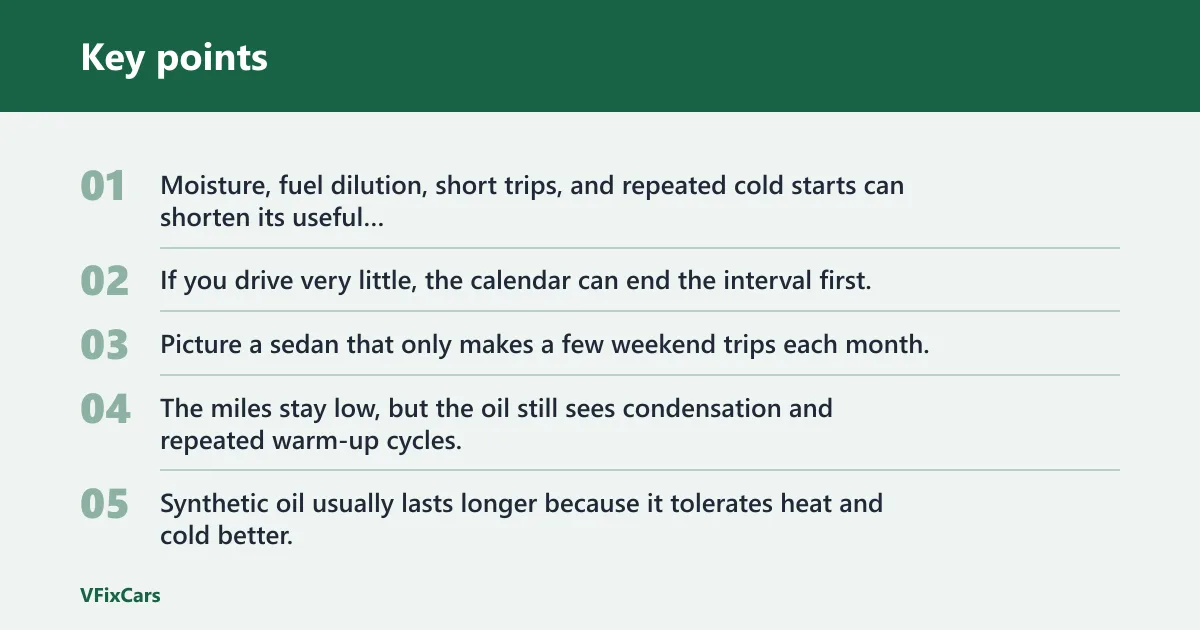
Oil ages by more than mileage. Moisture, fuel dilution, short trips, and repeated cold starts can shorten its useful life even when the odometer barely moves, which is why 12 months is a common maximum regardless of mileage. If you drive very little, the calendar can end the interval first.
Picture a sedan that only makes a few weekend trips each month. The miles stay low, but the oil still sees condensation and repeated warm-up cycles, so a mileage target alone can miss the real limit.
Where synthetic and conventional diverge
Synthetic oil usually lasts longer because it tolerates heat and cold better. Conventional oil usually needs more frequent changes, especially in stop-and-go traffic, towing, or winter cold starts. Even then, the manual still sets the ceiling if it is lower than the oil label suggests.
Owner’s manual first
The owner’s manual is the main source for oil-change timing and viscosity grade. It usually lists both normal and severe service schedules, and it tells you which viscosity the engine needs, such as 5W-30. That spec matters no matter which oil type you buy.
Find the normal service schedule
Normal service is the baseline for steady highway use, longer trips, and moderate temperatures. If the manual gives one interval for normal driving and another for severe service, use the one that matches how you actually drive the vehicle, not the easier number.
Find the severe service schedule
Severe service is not a marketing label. It usually means stop-and-go traffic, short trips, extreme temperatures, towing, or heavy loads. Those conditions shorten oil life, so the severe schedule is the safer one when your routine fits it.
Check the required viscosity grade
The viscosity grade is the part on the bottle that looks like 5W-30 or 0W-20. Oil type and viscosity are separate choices. You still need the right grade even if you choose full synthetic, and the manual beats a guess based on brand or price.
Oil interval decision table
The table below turns common driving patterns into a ceiling rule. Use the first limit that appears: mileage, time, or the oil life monitor. When the manual and the oil label disagree, the manual wins.
| Driving scenario | Follow first | Synthetic | conventional oil change interval |
|---|---|---|---|
| Normal highway use | Mileage, then time | 7,500 to 10,000 miles or the manual’s limit, with 12 months as the time cap | 3,000 to 5,000 miles or the manual’s limit, with 12 months as the time cap |
| City commuting | Severe-service mileage, then time | Use the severe-service schedule; often shorter than highway use | Use the severe-service schedule; usually shorter still |
| Short-trip winter use | Time or severe-service mileage, whichever comes first | Shorten the interval because cold starts and moisture load the oil | Shorten the interval even more because conventional oil is less tolerant of this pattern |
| Towing and heavy loads | Severe-service mileage, then time | Follow the manual’s severe schedule; synthetic is often a better fit | Follow the manual’s severe schedule; interval usually shrinks |
| Turbocharged driving | Manual limit, then time | Follow the manufacturer’s spec; many turbo engines call for synthetic and tight service control | Usually not the safer choice unless the manual allows it and the use is light |
| Older high-mileage engines | Manual limit, then time | Use if the engine calls for it or benefits from better leak control; do not extend the interval just because it is synthetic | Can be fine for gentle use if the engine spec allows it and leaks or burn-off are minor |
| Low-mileage seasonal cars | Time first | Change at least once per year unless the manual says sooner | Change at least once per year unless the manual says sooner |
| Oil-life-monitor-equipped vehicles | OLMS first, then time | Follow the monitor if the engine and manual allow it | Follow the monitor only if the manual allows that oil type for the engine |
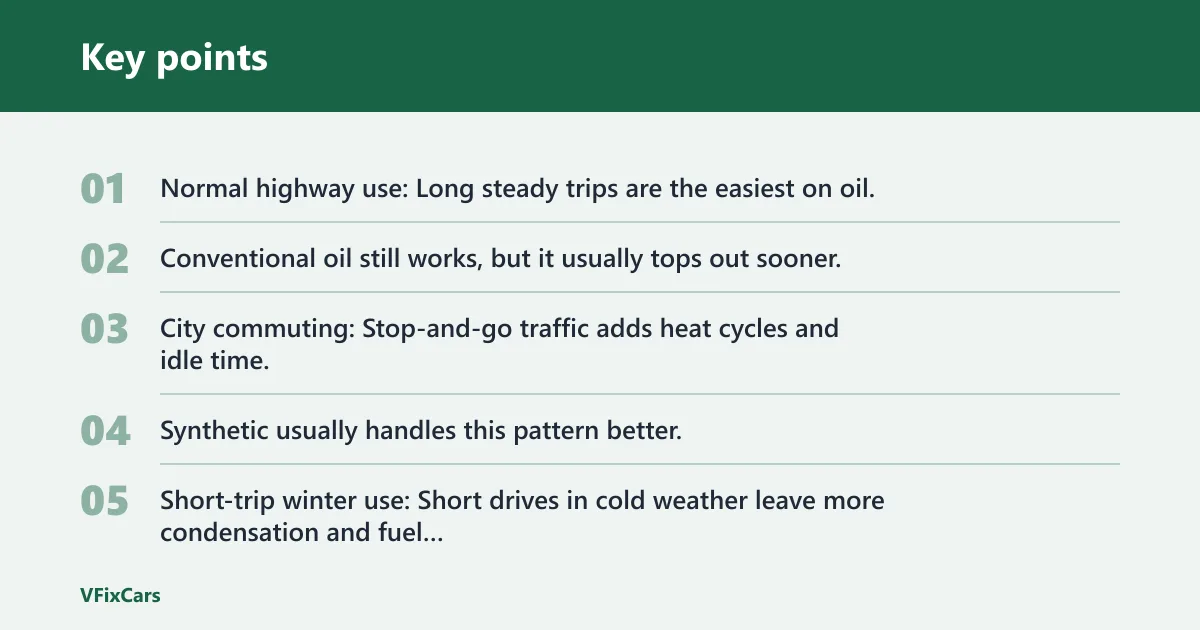
Normal highway use: Long steady trips are the easiest on oil, so synthetic most often reaches the longer end of its range here. Conventional oil still works, but it usually tops out sooner. The manual is still the ceiling.
City commuting: Stop-and-go traffic adds heat cycles and idle time, so severe-service guidance matters more than a generic mileage number. Synthetic usually handles this pattern better, while conventional oil often needs a shorter ceiling.
Short-trip winter use: Short drives in cold weather leave more condensation and fuel dilution in the oil. Time matters as much as miles, and the safe interval often drops below the normal-service number for both oil types.
Towing and heavy loads: Pulling weight raises oil temperature and stress. Virginia Tire & Auto lists towing and big-city commutes among severe-driving examples, so the severe schedule should set the interval, not the highway number.
Turbocharged driving: Turbo engines can put more thermal stress on oil, especially after hard acceleration or hot shutdowns. If the manual requires synthetic, that requirement is fixed, and the service interval still follows the manual or OLMS first.
Older high-mileage engines: High-mileage oil is made for vehicles with more than 75,000 miles and is aimed at burn-off and leaks. It can fit an older engine, but it does not automatically buy a longer oil-change interval.
Low-mileage seasonal cars: This is the clearest case for a time limit. A car that sits most of the year can still need service once per year because oil ages while parked, especially if moisture builds up from short warm-up cycles.
Oil-life-monitor-equipped vehicles: Many newer vehicles use an oil life monitoring system, and the monitor estimates remaining life from temperature, load, RPM, and trip length. If it calls for service, use that reading instead of a fixed-mileage guess, then reset it properly after the oil change.
Does synthetic oil last longer?
Yes, synthetic oil usually lasts longer than conventional oil, but the vehicle still sets the limit. Full synthetic can support 7,500 to 10,000 miles or more in many applications, and some synthetic oils are rated to last up to 10,000 miles. That does not override the manual or severe-service schedule.
When synthetic still needs earlier service
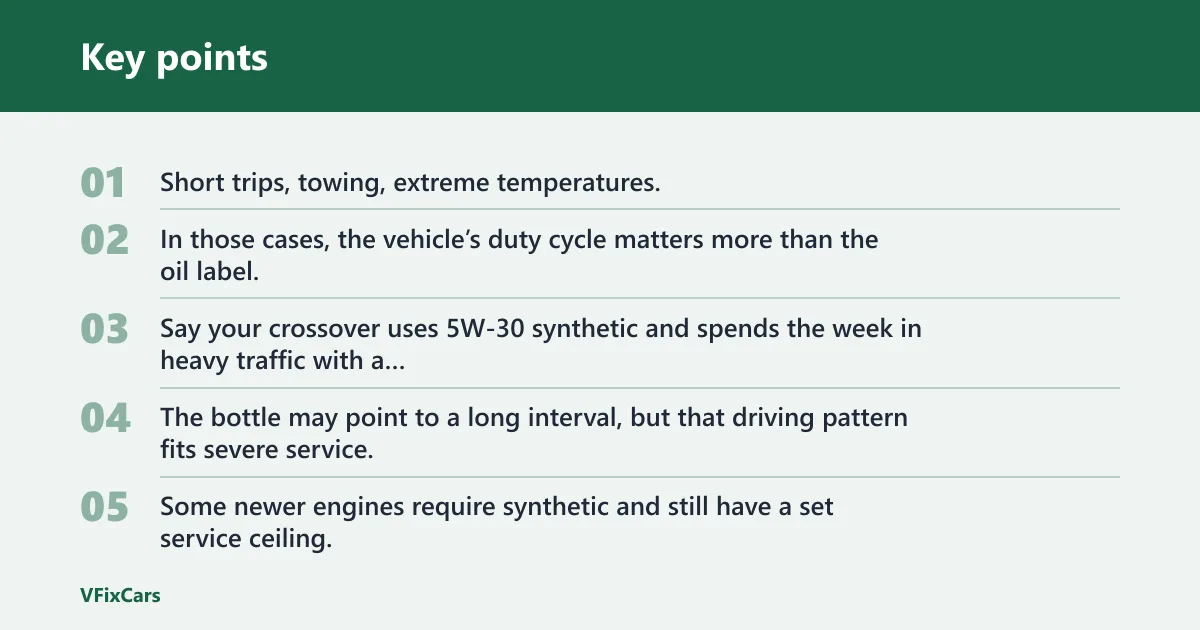
Synthetic is not a free pass for hard use. Short trips, towing, extreme temperatures, and stop-and-go traffic can cut the usable interval well below the longer end of the synthetic range. In those cases, the vehicle’s duty cycle matters more than the oil label.
Say your crossover uses 5W-30 synthetic and spends the week in heavy traffic with a 2-mile school run each morning. The bottle may point to a long interval, but that driving pattern fits severe service, so the shorter schedule is the safer one.
When the vehicle limits the interval
Some newer engines require synthetic and still have a set service ceiling. Others rely on an oil life monitor instead of a fixed mileage number. If the manual or monitor says to change sooner, the longer synthetic interval does not apply.
Is conventional oil still fine?
Conventional oil can still work for some older or lower-stress engines when the manual allows it. It usually supports 3,000-5,000 mile intervals, but it is less tolerant of heat and often needs more frequent changes in severe use. The upfront cost is lower, but the service window is shorter.
When conventional oil makes sense
Older engines, gentle driving, and short service intervals can make conventional oil a reasonable choice. It may fit a vehicle that sees modest mileage, mild weather, and no towing, as long as the owner’s manual allows that oil type and viscosity.
Why heat and short trips shorten its window
Heat breaks conventional oil down faster, and short trips stop it from fully warming and shedding moisture. That mix is why city driving and winter use often push conventional oil toward the lower end of its range. The shortest limit should win.
What counts as severe driving?
Severe driving means the oil sees harsher conditions than the normal schedule assumes. Stop-and-go traffic, short trips, winter cold starts, towing, heavy loads, and high-heat operation all shorten oil life. If your routine includes several of those patterns, the severe-service schedule is the safer one.
Stop-and-go traffic
Frequent idling and repeated acceleration keep the engine hot without giving the oil the easy life of steady cruising. Virginia Tire & Auto lists stop-and-go traffic and big-city commutes as severe driving examples, which is why urban use often needs the shorter interval.
Short trips and winter starts
Short winter trips are hard on oil because the engine may never stay hot long enough to drive off moisture. That is one reason a vehicle can need service by time long before it reaches a mileage target. Cold starts also make synthetic’s better flow useful.
Towing, loads, and high heat
Towing and heavy loads raise oil temperature and stress. High ambient heat does the same. If the manual separates normal and severe service, these conditions belong in the severe column and should shorten the interval accordingly.
Oil life monitors versus fixed mileage
An oil life monitoring system does not guess from the odometer alone. It estimates remaining life from engine temperature, load, RPM, and trip length, then tells you when service is due. Many alerts arrive around 15-20% remaining life, and the monitor must be reset after the oil change.
Why 15-20 percent remaining matters
That remaining-life range is a warning zone, not a full interval. It means the oil is nearing the end of its usable window based on real driving patterns. If the manual says the monitor applies, follow it instead of waiting for a round mileage number.
Resetting the monitor after service
Resetting matters because the system needs a fresh starting point. If it is not reset, the next service alert can come too early or too late. The reset procedure is vehicle-specific, so check the manual or the in-car menu after every oil change.
Choose synthetic if…
Choose synthetic if your manual requires it, if your vehicle has an oil life monitor that points to a longer service window, or if your driving includes severe conditions like stop-and-go traffic, towing, winter cold starts, or repeated high heat. Synthetic is also the better fit when you want the longer interval potential and the engine spec allows it.
Choose conventional oil change interval if…
Choose the conventional oil change interval if your manual allows conventional oil, your engine is older or low-stress, and your driving pattern is mild enough that shorter intervals are acceptable. It can be the practical low-cost option when you do not need the extra thermal margin or the longer mileage window.
Frequently asked questions
How long can you go between oil changes with synthetic oil?
Many cars on synthetic can go 7,500 to 10,000 miles or more, but the manual and the driving pattern still set the ceiling. If the vehicle calls for severe service, short trips, towing, or an oil life monitor, follow that shorter limit first.
How long can you go between oil changes with conventional oil?
Conventional oil usually supports 3,000-5,000 mile intervals. That range shrinks with severe driving, cold-weather short trips, or heavy loads, and it still stops at the owner’s manual or the one-year time cap if those come first.
Is the 3,000-mile oil change rule still valid?
Not as a universal rule. It is outdated for many modern cars, especially those that use synthetic oil or an oil life monitor. Some older engines or severe-duty situations may still land near that number, but you should not treat it as the default for every vehicle.
Does severe driving mean I need to change oil sooner?
Yes. Severe driving usually shortens the interval because the oil sees more heat, more idling, more moisture, or more load. Stop-and-go traffic, short trips, winter starts, towing, and heavy loads are the clearest reasons to use the severe-service schedule.
Should I follow the owner’s manual or the oil life monitor?
Follow both, but use the one that reaches the limit first. The manual sets the engine’s required viscosity and service schedule, while the oil life monitor estimates remaining life from driving conditions. If the monitor says service is due and the manual allows it, service the car.
Can I use synthetic oil for longer intervals in an older car?
Sometimes, but only if the manual allows it and the engine is in good shape. High-mileage oil may help with burn-off or leaks in vehicles over 75,000 miles, yet it does not automatically extend the interval. The safest limit still comes from the manual, duty cycle, or time.
What is the maximum time to go between oil changes if I drive very little?
A common maximum is 12 months regardless of mileage. Low-mileage driving does not stop oil from aging, and moisture can build up during short or infrequent trips. If the manual gives a shorter time limit, use that one instead.
Does oil type matter as much as the viscosity grade?
No. Both matter, but viscosity grade comes first because it is the engine-specific requirement. Synthetic versus conventional affects durability and service life, while the viscosity grade determines whether the oil matches the engine’s design. Use the correct grade before you compare brands or oil types.