What Torque Wrench Range Is Best for Home Car Maintenance?
For most home car maintenance, a 3/8-inch torque wrench in the 10–100 ft-lb range is often a practical single-tool choice, but anything below about 15 ft-lb or above 90–100 ft-lb can get too coarse. Wrong torque can strip fasteners, warp parts, or leave wheels and brakes unsafe. This guide maps common jobs to wrench ranges and shows the best two-wrench setup for true home-garage coverage.
This guide is part of our Torque wrench: how to choose and use one series.
What torque range fits home car maintenance?
What one wrench can cover well
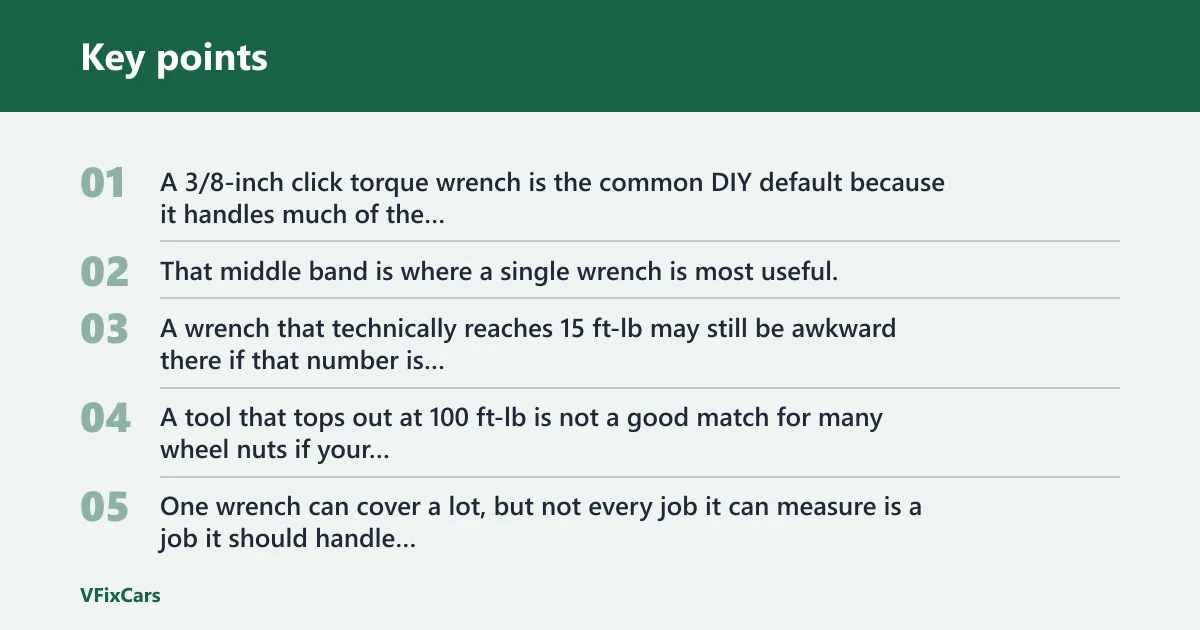
A 3/8-inch click torque wrench is the common DIY default because it handles much of the middle ground: brake work, many engine-bay fasteners, and oil drain plugs. That middle band is where a single wrench is most useful, because it can hit the target and still sit near the center of its scale.
The low end matters. A wrench that technically reaches 15 ft-lb may still be awkward there if that number is near the bottom of its range. The same problem shows up at the top end. A tool that tops out at 100 ft-lb is not a good match for many wheel nuts if your vehicle calls for more than that.
Where a single wrench starts to fall short
One wrench can cover a lot, but not every job it can measure is a job it should handle well. Spark plugs and valve cover bolts often sit in low torque bands, and many of those fasteners are specified in inch-pounds rather than ft-lb. That is where a 1/2-inch wrench becomes too coarse, even if the number on the scale looks possible.
Picture a common first-timer mistake: a 1/2-inch wrench is set to 18 ft-lb for a spark plug because the spec reads close to that number. The wrench clicks, but the scale is still coarse enough that the setting is harder to trust than a lower-range tool built for small fasteners.
Why the low end of the scale matters
Torque wrench accuracy is not only about the printed range. A wrench used near the bottom of its scale is harder to read, harder to repeat, and easier to mistrust. That is why the best home setup is often one medium-range wrench plus a small-range wrench, rather than one oversized tool doing everything.
| Job | Typical torque band | Recommended drive size | Single wrench safe? | Too low for this wrench |
|---|---|---|---|---|
| Lug nuts | 70 to 100 ft-lbs | 1/2-inch | Yes, with a 1/2-inch wrench sized for wheel work | A 3/8-inch wrench is usually too small or too close to its top end |
| Brake caliper bolts | 25 to 50 ft-lbs | 3/8-inch | Yes | A 1/4-inch wrench is usually too light for this job |
| Oil drain plugs | 20 to 30 ft-lbs | 3/8-inch | Yes | A 1/4-inch wrench is often too small for comfortable use |
| Spark plugs | 15 to 25 ft-lbs | 1/4-inch or 3/8-inch low-range tool | Sometimes, but a low-range wrench is better | A 1/2-inch wrench is too coarse for many spark plug jobs |
| Valve cover bolts | 5 to 10 ft-lbs | 1/4-inch | Only with a low-range wrench | A 3/8-inch or 1/2-inch wrench is usually too coarse here |
| Suspension bolts | Vehicle-specific, often high torque | 1/2-inch | Usually no, unless the manual keeps the spec in the wrench’s range | A 3/8-inch wrench may run out of capacity before the spec is reached |
| Axle nuts | Vehicle-specific, often high torque | 1/2-inch | Usually no for a single medium wrench | A 3/8-inch wrench is often too small for this fastener class |
What torque wrench size is best for most car jobs?
The best size for most car jobs is usually 3/8-inch. It is the most common all-rounder for many car jobs, and it fits the middle of the home-maintenance range better than a 1/2-inch wrench. A 1/4-inch tool is better for small, delicate fasteners, and a 1/2-inch tool is better for larger, heavy-duty bolts.
1/4-inch drive for very small fasteners
A 1/4-inch drive torque wrench is the right class for very small fasteners, low torque settings, and delicate engine parts. Valve cover bolts are the clearest example in this article’s job map. If your work leans toward small housings, trim fasteners, or low-ft-lb settings, start here.
3/8-inch drive for general maintenance
The 3/8-inch drive is the most common all-rounder for many car jobs. It covers brake caliper bolts, oil drain plugs, and many engine-bay fasteners without forcing you into the top or bottom edge of the wrench’s range. For one-tool ownership, this is usually the first buy.
1/2-inch drive for higher-torque jobs
A 1/2-inch drive is used for larger, heavy-duty bolts. Lug nuts are the obvious example, and suspension and axle fasteners often push in that direction as well. If wheel service is part of your regular maintenance, a 1/2-inch wrench quickly becomes the safer second purchase.
- Check the vehicle service manual for the exact torque value before choosing a wrench.
- Match the job to the smallest drive size that still fits the torque band.
- Keep low-torque work near a low-range wrench, not at the bottom of a large one.
- Use 1/2-inch capacity for wheel and other heavy-duty fasteners.
- Buy a tool with clear scale markings and a grip that stays steady in your hand.
Can one torque wrench handle spark plugs and wheel nuts?
Usually, no single wrench does both jobs well. Spark plugs often need inch-pound tools or a low-range torque wrench, while wheel nuts usually need higher torque and a 1/2-inch drive. A wrench can reach both numbers on paper and still be a poor fit in practice because the low end and high end are each weak points.
Why spark plugs often need inch-pound tools
Spark plugs are listed at 15 to 25 ft-lbs in the guide table, but many engines specify spark plugs in inch-pounds or with a narrow low-torque window. That means a big wrench is not automatically the right answer. If the service manual gives inch-pounds, use a wrench that reads in that unit.
Why wheel nuts push you toward higher capacity
Wheel lug nuts are listed at 70 to 100 ft-lbs here, and many vehicles sit in that band or above it. That is enough torque that a small wrench may feel cramped, especially near its upper limit. A 1/2-inch wrench gives you the capacity and control that wheel service calls for.
The overlap problem in the middle
Some people try to buy one mid-range wrench and call it done. That works for a while, especially if brake work and oil changes are the main tasks. The trouble starts when the same wrench is asked to cover both tiny engine fasteners and wheel hardware. The number may fit. The tool choice may not.
Suppose your garage jobs are mostly oil changes, brake pads, and occasional spark plugs. A 3/8-inch wrench handles the oil drain plug and many caliper bolts well, but it still leaves spark plugs and wheel nuts at opposite ends of what a single tool can do comfortably. That is where a second wrench earns its keep.
When is a torque wrench too low or too high?
A torque wrench is too low when the fastener needs more torque than the wrench can provide. It is too high when the job sits near the bottom of the wrench’s scale or requires finer control than the tool can realistically give. The best reading is usually one taken in the middle of the range, not at an edge.
Too low for the fastener
If the fastener calls for more torque than the wrench can deliver, stop and move up in size. That matters for lug nuts, suspension bolts, and axle nuts. A tool at its limit is harder to read and easier to doubt, and that is the wrong place to be on a wheel or chassis fastener.
Too high for the fastener
If the fastener is tiny or fragile, a larger wrench becomes too coarse. That is the case for valve cover bolts and many small engine-bay fasteners. Over-tightening can strip threads, distort parts, or break bolts. Under-tightening can let parts loosen or fail. Either error creates avoidable work.
Why middle-of-scale use is easier to trust
Middle-of-scale use is easier to repeat, easier to read, and easier to explain to yourself when you return to the same job later. That is why a 3/8-inch wrench is such a strong daily choice. It keeps the common jobs away from the weak ends of the scale.
Click, digital, or beam torque wrench?
Many DIY owners choose a click torque wrench because it is familiar, compact, and easy to use. Digital wrenches add an LCD display and often beep or vibrate at the target torque. Beam wrenches are simpler, with a needle and scale, but they are usually less convenient for fast, repeatable automotive work.
Click torque wrench basics
A click torque wrench gives an audible click at the preset torque stopping point. That makes it the common DIY default. It is the easiest style to use for wheel nuts, brake fasteners, and general service work if you want a simple mechanical tool.
Digital torque wrench basics
A digital torque wrench shows the value on an LCD and often adds beep or vibration alerts. That feedback can help when you want a clear readout and a more obvious warning at the target. It is a strong option if you prefer electronic feedback over a purely mechanical click.
Beam torque wrench basics
A beam torque wrench uses a needle and scale. It is simple, and it can be a good backup, but reading the scale takes more attention. For routine home maintenance, many readers will find a click wrench easier to use and easier to trust.
What should you check before buying?
Check the readable scale, the grip, the calibration evidence, and the torque values in your service manual before you buy. A wrench with clear markings and a solid handle is easier to use correctly. A calibration certificate is also a good trust signal, especially if you want a tool that was checked against a traceable standard.
Readability and grip
Choose a wrench with clear scale markings and a handle that sits well in your hand. If the markings are hard to see, or the handle slips in your hand, the tool becomes harder to set accurately. That matters more than a fancy finish or a long feature list.
Calibration certificate
Ask whether the wrench includes a calibration certificate. That document shows the tool was checked against a traceable reference at the factory or during sale. It does not replace your own care, but it does add confidence that the wrench started within spec.
ISO 6789-1:2017
ISO 6789-1:2017 is a calibration standard often used as a reference for torque wrench testing. If a product or seller mentions this standard, it signals that calibration is being tied to a recognized process. That is worth paying attention to, especially on a tool you plan to keep for years.
Service manual torque values
Your vehicle service manual should override generic ranges every time. Exact torque specifications are job-specific, and the manual is the place to verify them. Use ft-lb or N·m values as printed, and convert only when you must. If the manual gives inch-pounds, stay in inch-pounds.
Frequently asked questions
What torque wrench range do I need for basic car maintenance?
For basic car maintenance, a 3/8-inch wrench in the middle torque band is the most useful first buy. It covers many brake, oil, and engine-bay jobs without living at the edge of its scale. Check the service manual first, then match the tool to the job list.
Is a 1/2-inch torque wrench too big for home use?
No. A 1/2-inch wrench is not too big if you work on lug nuts, suspension fasteners, or other higher-torque hardware. It is too coarse for many small engine fasteners, though. That is why it works better as a second wrench than as the only wrench.
Do I need both 3/8-inch and 1/2-inch torque wrenches?
If you do brake work, oil changes, and wheel service, yes, both can make sense. The 3/8-inch wrench covers the middle jobs, while the 1/2-inch wrench covers lug nuts and other heavy-duty fasteners. That two-wrench setup is more practical than forcing one tool to do both ends.
What torque range covers lug nuts and brake work
Lug nuts usually need higher torque than brake fasteners. In this article’s table, lug nuts sit at 70 to 100 ft-lbs, while brake caliper bolts sit at 25 to 50 ft-lbs. That split is why a 3/8-inch wrench is fine for brake work, but a 1/2-inch wrench is better for wheels.
What is the best torque wrench range for a home garage?
The best home-garage setup is usually a 3/8-inch wrench for general maintenance plus a 1/2-inch wrench if you service wheels or suspension. If you want only one wrench, start with the 3/8-inch option. It covers the broadest set of common jobs without being too specialized.