OBD2 scanner vs code reader: what’s the difference?
A code reader names stored fault codes only; an OBD2 scanner adds live data, pending codes, and often module functions, so choose the scanner if you need diagnosis beyond a check-engine light. Using the wrong tool can send you after the wrong sensor, clearing codes before you find the cause, and buying parts you do not need. This guide explains what each tool can identify, what it can only name, and when live data or module access matters.
This guide is part of our OBD2 scanner guide: how to choose and use one series.
OBD2 scanner vs code reader: the core trade-off
The trade-off is depth, not the sticker on the box. A basic code reader is mainly built to retrieve diagnostic trouble codes, while an OBD2 scanner adds live data, freeze-frame data, and, on many models, access to more than engine codes. That extra information matters most when the fault is intermittent or the symptom is broader than a check-engine light.
| Decision factor | OBD2 scanner | Code reader | Winner |
|---|---|---|---|
| Fault-code retrieval | Reads and clears DTCs | Reads and clears engine fault codes | Tie |
| Live sensor data | Usually available | Usually limited or absent | OBD2 scanner |
| Freeze-frame data | Often available | May be available on some models | OBD2 scanner |
| ABS, SRS, transmission, body module access | Possible on advanced models | Usually not covered | OBD2 scanner |
| Price and simplicity | Higher cost, more menus | Lower cost, simpler use | Code reader |
Fault-code retrieval
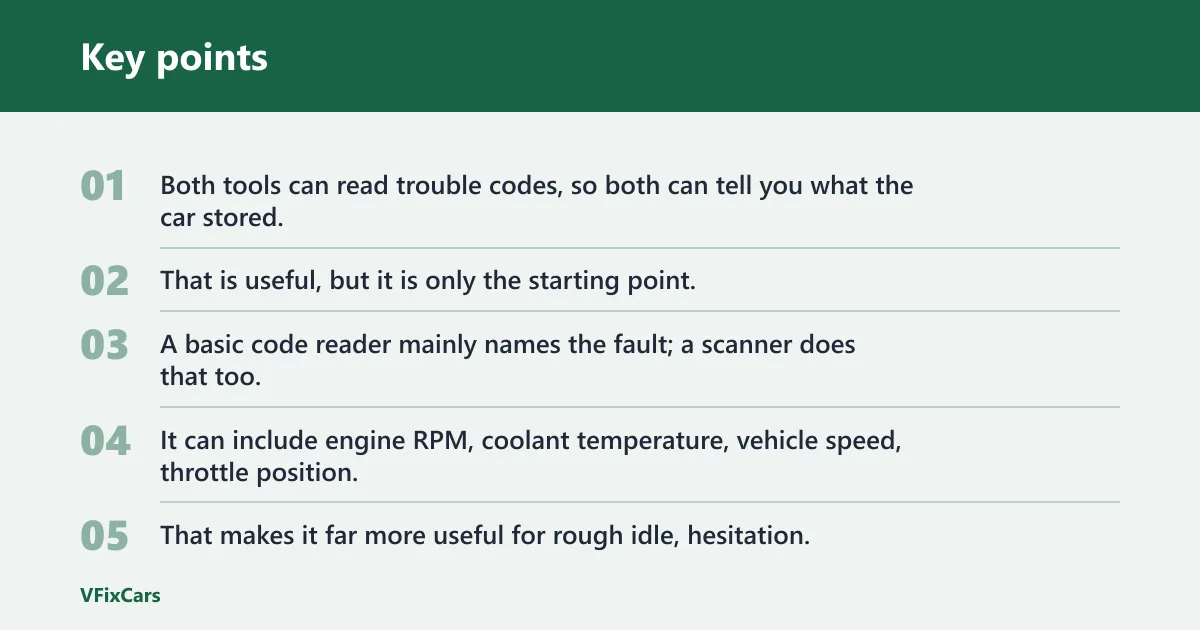
Both tools can read trouble codes, so both can tell you what the car stored. That is useful, but it is only the starting point. A basic code reader mainly names the fault; a scanner does that too, then adds more context.
Live sensor data
Live data is the main practical upgrade. It can include engine RPM, coolant temperature, vehicle speed, throttle position, fuel trims, oxygen sensor data, and mass airflow information. That makes it far more useful for rough idle, hesitation, and intermittent misfire diagnosis.
Module coverage
Many products sold as scanners still vary a lot in module access. Advanced scanners may access ABS, SRS, transmission, and body modules, but not every scanner does. A code reader is usually limited mainly to emissions-related powertrain diagnostics.
Cost and simplicity
A code reader is cheaper and easier to use because it does fewer things. That simplicity is useful if you only want a quick answer for a check-engine light. The hidden cost appears when the fault is outside engine emissions systems and the tool cannot go any farther.
📊 A basic code reader may display a code such as P0300 or P0420. Source: OBD2 Scanner vs Code Reader: What’s the Difference and Which One Do….
What can a code reader do?
A code reader can retrieve diagnostic trouble codes, clear check-engine lights on many vehicles, and sometimes display limited live data or I/M readiness. It is useful for quickly answering why the check engine light is on, but it usually has fewer advanced functions than a scanner and is often focused on emissions-related powertrain faults.
Read diagnostic trouble codes
The core job is code retrieval. A basic OBD-II code reader may display a code such as P0300 or P0420, which tells you which system or circuit is unhappy. It does not, by itself, prove the failed part.
Clear check-engine lights and related codes
Yes, a code reader can often clear check engine lights on many vehicles. That can be handy after a repair or after confirming the fault is gone. Clearing a code before diagnosis, though, can erase clues that would have helped.
Show limited live data on some models
Some readers show basic live data, though the feature set may be limited. If a tool cannot show key values under load or at idle, it cannot help much with an intermittent fault. That is where scanner-level data becomes more useful.
Check I/M readiness on some models
I/M readiness monitors tell you whether the emissions system has completed its self-checks. That matters before an emissions test because a cleared code can reset monitors to not ready. Some basic tools show this, but not all do.
What can an OBD2 scanner do that a code reader cannot?
An OBD2 scanner adds live data, freeze-frame data, and often broader module access, so it can move from naming a fault to testing it. Some advanced models also support actuator tests, module identification, special functions, service resets, coding, and adaptations, which a code reader usually cannot do.
Show live sensor data while the engine runs
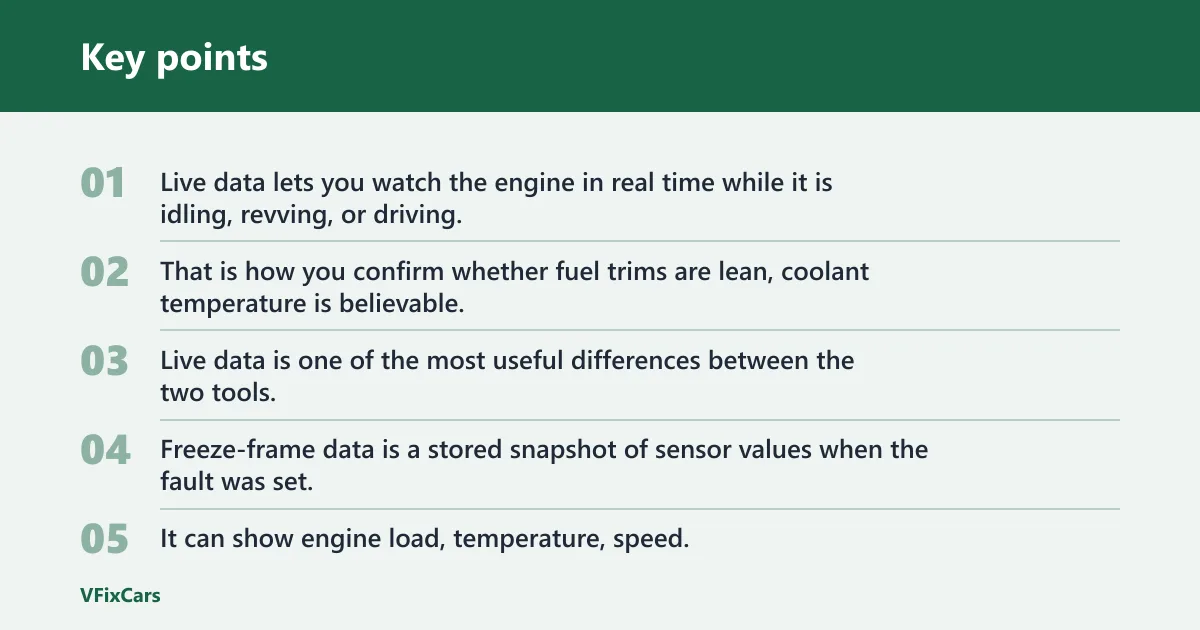
Live data lets you watch the engine in real time while it is idling, revving, or driving. That is how you confirm whether fuel trims are lean, coolant temperature is believable, or throttle position changes smoothly. Live data is one of the most useful differences between the two tools.
Provide freeze-frame data for the fault event
Freeze-frame data is a stored snapshot of sensor values when the fault was set. It can show engine load, temperature, speed, and other values at the moment the code appeared. That helps with faults that do not happen every time you start the car.
Read more than powertrain codes on many vehicles
On many vehicles, a scanner with enhanced coverage can access ABS, SRS, transmission, and body modules. Basic OBD-II code readers are mainly limited to engine-related emissions systems. That difference matters when the warning light is not the check-engine light.
Support bi-directional controls and service functions
Advanced scanners may command components on and off, which helps test solenoids, actuators, and valves. They may also offer oil reset, TPMS reset, throttle relearn, EPB service mode, and battery registration. Those features can save time on the right job and do nothing for the wrong one.
Can a code reader diagnose a rough idle, misfire, or hesitation?
Not fully. A code reader can name the stored code, but rough idle, misfire, and hesitation usually need live data or freeze-frame data to verify what the engine was doing. A scanner with live data can identify why a code exists more often than a reader can.
Why the code name alone is not enough
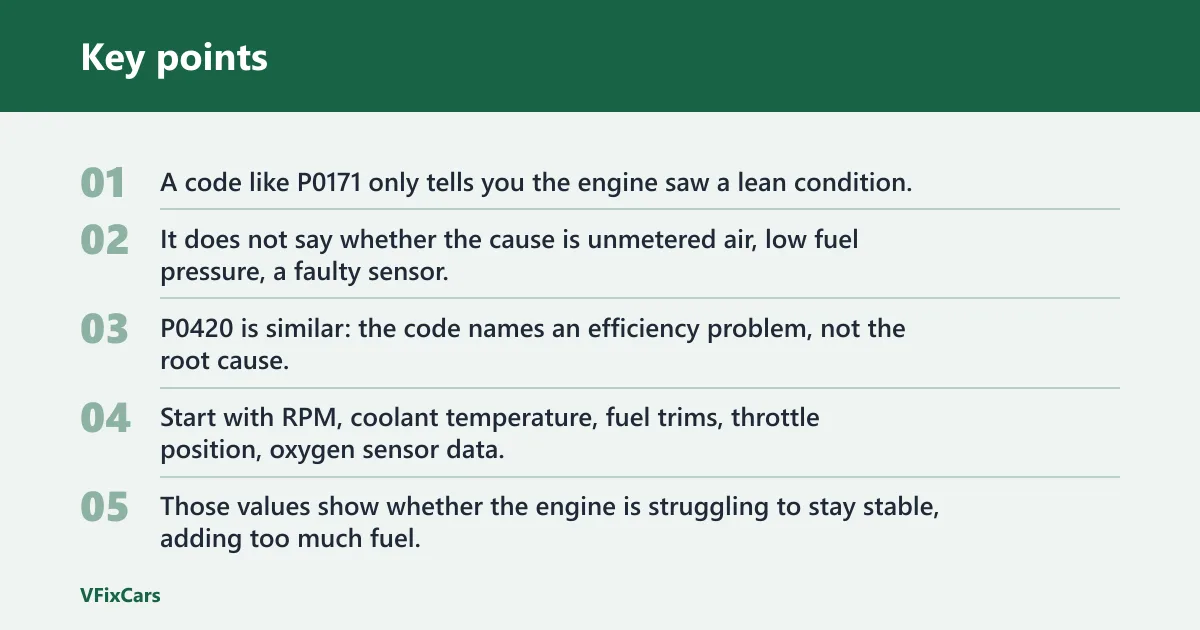
A code like P0171 only tells you the engine saw a lean condition. It does not say whether the cause is unmetered air, low fuel pressure, a faulty sensor, or an exhaust leak. P0420 is similar: the code names an efficiency problem, not the root cause.
Which live data values to check first
Start with RPM, coolant temperature, fuel trims, throttle position, oxygen sensor data, and mass airflow information. Those values show whether the engine is struggling to stay stable, adding too much fuel, or reacting to bad airflow input. For intermittent misfire, look at misfire counters if the scanner provides them.
When freeze-frame data helps and when it does not
Freeze-frame data helps when the fault is intermittent because it captures the conditions at the moment the code stored. It is less useful if the fault happens only under a different load, speed, or temperature range than the snapshot. In that case, live data during a road test matters more.
Say your compact sedan idles at 650 rpm, then stumbles only after a hot restart in a parking lot. A code reader may tell you P0301 and stop there. A scanner can show fuel trims, coolant temperature, and misfire activity while the problem is present, which is far more useful.
What’s the minimum tool for each symptom type?
The minimum tool depends on the fault category. For a check-engine-only problem, a code reader can be enough. For intermittent faults, ABS or SRS warnings, emissions-test prep, or service resets, a scanner with the right module access is the safer choice.
Check-engine-only faults
If the only light on is the check engine light and the issue is straightforward, a code reader may be enough to start. It can tell you the stored code and sometimes clear it after repair. For deeper troubleshooting, a scanner is better.
Intermittent faults
Intermittent faults usually need live data and freeze-frame data. Without those, you may know the code name but not the conditions that caused it. That makes a reader a poor fit for problems that come and go.
ABS and SRS warning lights
ABS module and SRS / airbag module diagnostics usually require enhanced or manufacturer-specific access. A basic OBD-II reader does not normally cover those systems. A scanner with the right module support is the minimum sensible tool.
Emissions readiness and service resets
If you need I/M readiness before an emissions test, either tool may help if it supports readiness monitors. If you need oil reset, TPMS reset, throttle relearn, EPB service mode, or battery registration, you need a scanner with service functions. A reader usually stops too early.
Decision matrix: choose the minimum tool for the fault
This matrix maps common symptoms to the smallest tool level that can handle the job. It keeps the choice tied to diagnosis depth, not marketing labels. The right answer is the tool that can see the system you are actually trying to inspect.
| Symptom or task | Check-engine-only faults | Intermittent faults | ABS/SRS lights | Emissions readiness | Service resets |
|---|---|---|---|---|---|
| Minimum tool | Code reader | OBD2 scanner | OBD2 scanner with enhanced module access | Code reader or scanner with I/M readiness | OBD2 scanner with service functions |
| Why | It can read and clear engine fault codes | It can show live data and freeze-frame data | Basic readers usually do not access those modules | Readiness monitors matter before a test | Reset procedures are advanced scanner tasks |
| Common example | P0420 after a long commute | Rough idle that comes and goes | ABS light after wheel-speed sensor failure | After battery disconnect or cleared codes | Oil reset after maintenance |
A common first-timer mistake is buying for the label instead of the fault category. A cheap reader can be perfect for a one-time check-engine light, then useless when the car develops an ABS light or an intermittent hesitation. That is the hidden cost of the wrong tool.
Choose OBD2 scanner if… / Choose code reader if…
Choose an OBD2 scanner if you need live data, freeze-frame data, readiness monitors, broader module access, or service functions. Choose a code reader if you only want basic check-engine-light work and do not need to go beyond engine fault codes. The winning tool is the one that can reach the system you need to diagnose.
Choose OBD2 scanner if…
You are chasing rough idle, hesitation, intermittent misfire, lean codes, or repeated emissions faults. You also need a scanner if the vehicle has ABS, SRS, transmission, or body warnings, or if you want service resets and active tests. That is where deeper diagnosis starts.
Choose code reader if…
You mainly want a quick code name, a basic clear function, and possibly a readiness check. It is a practical choice for simple check-engine-only faults, especially on older vehicles with no other warning lights. It keeps cost and complexity low.
When the lower-cost tool becomes the expensive mistake
If the fault needs live data or module access, a reader can waste time and lead to wrong parts. A code such as P0300, P0171, or P0420 is not enough to buy parts confidently. In those cases, the cheaper tool often costs more in misdiagnosis.
Frequently asked questions
What is the difference between an OBD2 scanner and a code reader?
A code reader mainly retrieves diagnostic trouble codes, while an OBD2 scanner adds live data, freeze-frame data, and often broader module access. The real difference is diagnosis depth. A reader names the fault; a scanner gives you more of the information needed to test the cause.
Can a code reader clear check engine lights?
Yes, a basic code reader can usually clear check engine lights and related engine fault codes. That is useful after a repair or after confirming a fault is gone. Clearing the code too early can erase clues, so it should come after diagnosis, not before it.
Does an OBD2 scanner show live data?
Yes, most scanners can show live data, and that is one of their biggest advantages. Live data may include RPM, coolant temperature, vehicle speed, throttle position, fuel trims, oxygen sensor data, and mass airflow information. It is the key feature for drivability problems.
Will a basic code reader read ABS or airbag codes?
Usually no. Basic OBD-II readers are mainly limited to emissions-related powertrain diagnostics and do not normally cover ABS or SRS / airbag modules. Those warning lights usually need an enhanced scanner with the right module coverage for the vehicle.
What can an advanced OBD2 scanner do that a code reader cannot?
An advanced scanner can often read live data, provide freeze-frame data, access more modules, and run service functions or bi-directional tests. Some models also support actuator tests, coding, and adaptations. Those functions let you verify faults instead of only naming them.
When is a code reader enough, and when do I need a scanner?
A code reader is enough for a simple check-engine-light job where you only need the code name and maybe a clear function. You need a scanner when the fault is intermittent, when you need readiness monitors, or when the vehicle has ABS, SRS, transmission, or service-reset needs.
What features should I look for if I want to diagnose a drivability problem?
Look for live data, freeze-frame data, fuel trims, oxygen sensor data, coolant temperature, throttle position, and airflow data. If the problem is intermittent, make sure the tool can record or review data while the engine runs. A scanner with those features gives you the best chance of finding the cause.