What Is the Best Multimeter for Automotive Use?
A good automotive multimeter should generally have true RMS, about 0.01 V DC resolution, at least 10 MΩ input impedance, and fused current capability around 10 A; for parasitic draw, choose a meter with a low-amp mA range and leads that are easy to place. A weak meter can send you down the wrong diagnostic path and cost you time, batteries, or parts. This guide helps you pick the right multimeter for battery, charging, parasitic draw, and sensor checks by task, price, and features.
Quick picks
Match the meter to the job, not the logo on the case. For basic car troubleshooting, an auto-ranging meter with continuity, diode test, and a clear display is enough. For modern vehicle electronics and charging-system work, true RMS, 10 MΩ input impedance, and better lead handling matter more.
| Best for | Pick | Why it fits | Key spec to look for | What you can skip |
|---|---|---|---|---|
| Mixed automotive diagnostics | Innova 3340 | Built for common car checks, with auto-range, reverse polarity protection, alternator tests, and 10 MegOhm impedance | Auto-range; alternator test; 10 MegOhm impedance | Premium logging features if you only do basics |
| Basic car troubleshooting | Value automotive meter with battery LEDs | Fast for battery, fuse, and ground checks without a steep price | Voltage, resistance, continuity, diode test; battery check LEDs | RPM, duty cycle, and temperature |
| ECU-safe and advanced work | Fluke 88-5 88V | Stronger safety headroom for demanding electrical work and signal checks | CAT III to 1000V and CAT IV to 600V; frequency to 200 kHz; % duty cycle | Automotive-only extras if you also need a home meter |
| General home and auto use | Fluke 115 | Compact true RMS meter with easy reading and solid everyday voltage testing | CAT II 600 volts; 6000-count backlit screen; AC and DC voltage to 600V | Alternator test and other car-specific functions |
Fluke 115
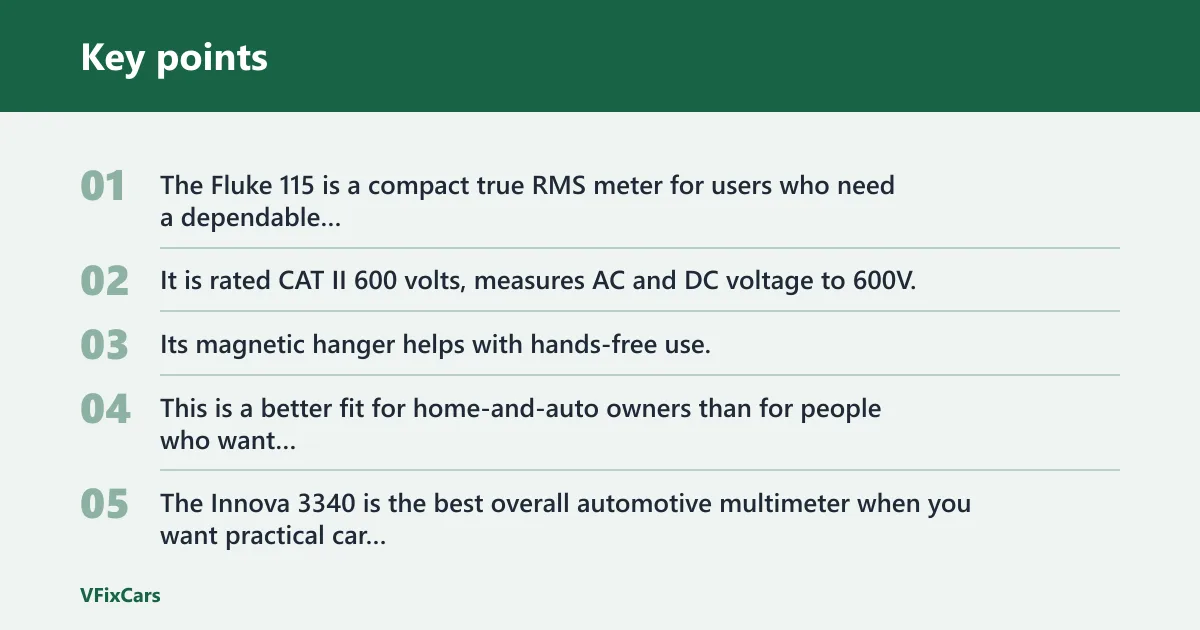
The Fluke 115 is a compact true RMS meter for users who need a dependable general-purpose tool that also handles car basics. It is rated CAT II 600 volts, measures AC and DC voltage to 600V, measures AC and DC current to 10 amps, and has a 6000-count backlit screen.
Its magnetic hanger helps with hands-free use, and the listed battery life is 400 hours without backlight. It also carries a 3-year warranty. This is a better fit for home-and-auto owners than for people who want automotive-specific tests like alternator analysis or duty cycle.
Innova 3340
The Innova 3340 is the best overall automotive multimeter when you want practical car diagnosis instead of lab-style electrical work. It includes auto-range, reverse polarity protection, alternator tests, and 10 MegOhm impedance. That makes it a strong choice for battery, charging, and many under-hood checks.
It is a better fit than a basic home meter when you want built-in automotive functions without jumping to a premium price tier. The tradeoff is that it is still a job-focused tool, so it does not replace a higher-end meter for deeper electronics work.
Fluke 88-5 88V
The Fluke 88-5 88V is the premium pick for advanced vehicle electrical work. It is rated CAT III to 1000V and CAT IV to 600V, and it measures frequency to 200 kHz and % duty cycle. Those features matter when you need better signal analysis on modern vehicle circuits.
This is the meter to consider when your work goes beyond simple battery and fuse checks. It is more than many DIY owners need, but it becomes easier to justify if you frequently diagnose sensors, control signals, or intermittent electrical faults.
Budget automotive meter
A budget automotive meter is the right call if you mainly check battery voltage, continuity, fuses, grounds, and simple sensor power. Look for auto-ranging, a backlit display, battery check LEDs, and a continuity test that responds quickly enough to spot a dead fuse without lagging.
Skip automotive extras you will not use. RPM, duty cycle, temperature, and alternator functions add cost, but they do not help if your real work is finding a blown fuse or a bad ground.
What is the best multimeter for automotive use?
The best multimeter for automotive use is the one that matches the diagnostic job you actually do. For general car troubleshooting, a good auto-ranging meter with 10 MΩ input impedance and fast continuity is enough. For ECU-safe electronics work or signal checks, true RMS and better safety ratings become more important.
Top pick by diagnostic job
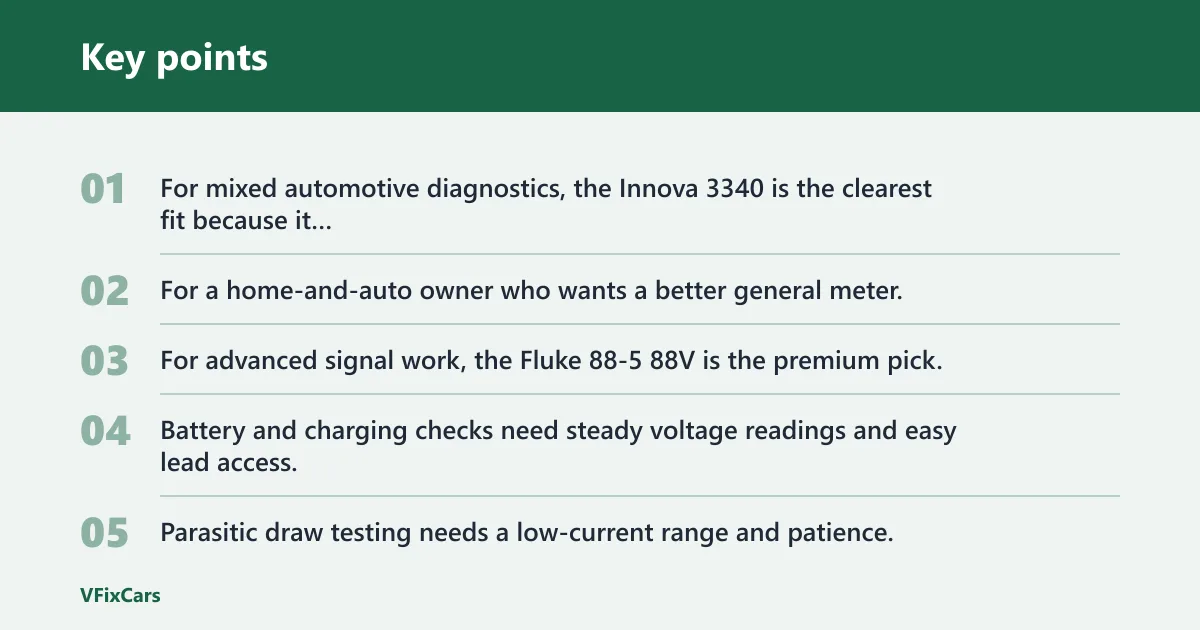
For mixed automotive diagnostics, the Innova 3340 is the clearest fit because it combines auto-range, alternator tests, reverse polarity protection, and 10 MegOhm impedance. For a home-and-auto owner who wants a better general meter, the Fluke 115 is a strong option. For advanced signal work, the Fluke 88-5 88V is the premium pick.
Why one meter does not fit every car task
Battery and charging checks need steady voltage readings and easy lead access. Parasitic draw testing needs a low-current range and patience. Sensor work may need duty cycle, frequency, or better accuracy on non-sinusoidal signals. One meter can do all of that only if its feature set matches the job.
Say your battery keeps dying after sitting overnight. A meter that only gives coarse voltage readings may show 12 volts and still miss a parasitic draw problem. A meter with a low-amp mA range and good probe handling gets you to the fault faster.
Which automotive multimeter is best for beginners?
A good automotive multimeter for beginners is usually an auto-ranging meter with a clear display, continuity test, diode test, and simple lead storage. Auto-ranging removes manual range selection, which reduces wrong settings. A fast continuity response matters too, because you want a near-instant signal when checking fuses, wiring, and grounds.
Features that make a meter easier to use
Look for auto-ranging, backlighting, and a display that is easy to read under a hood or in a dim cabin. Battery check LEDs are useful on value meters because they give a quick status read without forcing you through more complex settings. A magnetic hanger or stable stand also helps when both hands are busy.
What beginners can skip at first
You can skip alternator test, duty cycle, temperature, and frequency if your work is limited to battery checks, blown fuses, and basic wiring faults. Those features are helpful later, but they should not be the reason you buy a meter for the first time. A good beginner meter should feel simple, not crowded.
Is a Fluke multimeter worth it for car work?
A Fluke multimeter is worth it for car work when you need stronger safety ratings, reliable build quality, and better signal measurement on electronics-heavy jobs. It is usually overkill for casual battery checks, but it becomes easier to justify when you want one meter for both home and auto use.
Where premium meters pay off
Premium meters make more sense when you work on modern vehicles with sensitive electronics, frequent intermittent faults, or control-signal testing. The Fluke 88-5 88V adds CAT III to 1000V and CAT IV to 600V plus % duty cycle.
Where a budget meter is enough
If you mainly check battery voltage, continuity, and simple grounds, a lower-cost automotive meter is often enough. The money saved can go toward better test leads, back-probing tools, or a battery charger. Those accessories often matter as much as the meter for real-world diagnostics.
A common first-timer mistake is buying a feature-heavy meter, then using stiff leads and slow probes that make every under-hood test annoying. Good lead storage and flexible test leads can matter as much as a long feature list.
Best automotive multimeter for charging-system checks
For charging-system checks, the best automotive multimeter is one with clear DC voltage reading, min/max hold, and an alternator test if you want a faster workflow. You are looking for stable readings while the engine idles and while electrical loads change. That is where a slow meter becomes annoying very quickly.
Alternator test features to look
An alternator test feature saves time because it gives a built-in way to evaluate charging behavior instead of making you step through every reading manually. That is why automotive-specific meters like the Innova 3340 get recommended for charging-system work. They are built to make that job less tedious.
Why min/max hold helps with unstable charging readings
Min/max hold catches fluctuating readings that a live display can miss. That matters when a voltage dip appears only when the radiator fan starts or the rear defroster kicks in. If the meter updates slowly, the drop may vanish before you see it.
Automotive multimeter decision matrix
This matrix maps the common car jobs to the minimum meter spec needed. Use it to avoid paying for features you will not use. It also shows where a basic meter is enough and where a more capable one prevents wrong readings or ECU loading risk.
| Car job | Minimum meter spec | Recommended features | Optional features | Unnecessary features |
|---|---|---|---|---|
| Battery and charging-system work | DC voltage, auto-ranging, backlit display, 10 A fused current | Alternator test, min/max hold, true RMS, 10 MegOhm impedance | Battery check LEDs, temperature, magnetic hanger | Duty cycle, RPM, frequency if you only test batteries |
| Fuses, grounds, and continuity checks | Fast continuity test, resistance, diode test | Auto-ranging, loud or quick continuity response, probe storage that keeps leads ready | Backlight, battery LEDs | Alternator test, duty cycle, temperature |
| Sensor and injector signal work | True RMS, frequency, duty cycle, stable low-voltage reading | Min/max hold, clear display, 10 MegOhm impedance | Backlight, magnetic hanger | Battery LEDs, alternator test unless you also check charging |
| Parasitic draw and ECU-safe testing | Low-amp mA range, 10 MegOhm impedance, fused current input | Min/max hold, good lead access, auto-ranging | True RMS, temperature for related checks | Heavy automotive extras that do not improve low-current draw testing |
What features should an automotive multimeter have?
An automotive multimeter should have auto-ranging, fast continuity, solid input impedance, and a display you can read in poor light. True RMS is important for non-sinusoidal signals and modern vehicle electronics, but it is not mandatory for every owner. The right feature set depends on whether you are doing basic checks or deeper electronics work.
Auto-ranging, true RMS, and input impedance
Auto-ranging helps beginners avoid the wrong setting. True RMS helps when the signal is not a clean sine wave, which is common in modern vehicle electronics. 10 MegOhm input impedance helps reduce ECU loading risk, which matters when you probe sensitive circuits that should not be burdened by the meter itself.
Continuity speed, duty cycle, temperature, and battery LEDs
Continuity test speed matters because fuses, wiring, and grounds are often checked in seconds, not minutes. Duty cycle helps with injector and some sensor signal checks. Temperature measurement can help with HVAC or cooling-system diagnosis. Battery check LEDs are a quick-read convenience on value meters, not a core requirement.
Safety ratings and display quality
CAT safety ratings help describe how much surge environment a meter is designed for, with CAT II, CAT III, and CAT IV used in different electrical contexts. Do not treat the rating as a substitute for correct lead handling or proper setup. A bright display, backlight, and readable digits still matter under a hood.
Start by matching the meter to the jobs you actually do. Basic car troubleshooting needs voltage, resistance, continuity, and diode test. ECU-safe electronics work benefits from true RMS and 10 MegOhm impedance. Charging-system testing is easier with alternator test and min/max hold. One meter can cover home and auto use if it has enough safety margin and a clear display.
Budget vs premium tradeoffs
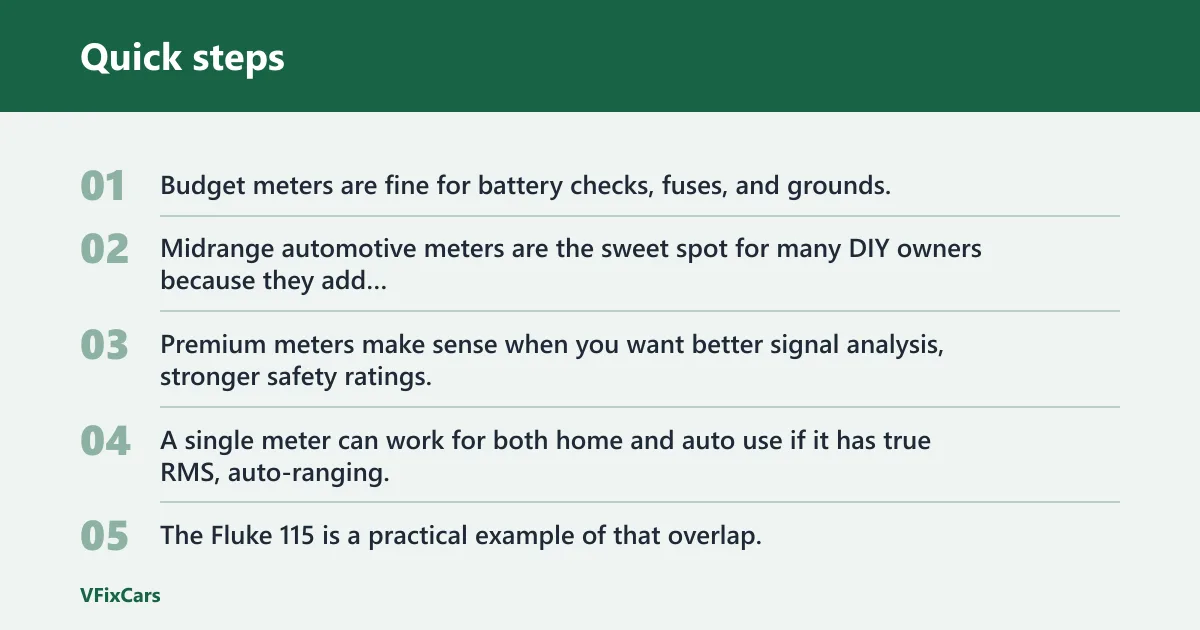
Budget meters are fine for battery checks, fuses, and grounds. Midrange automotive meters are the sweet spot for many DIY owners because they add auto-range and automotive-specific functions without pushing the price too far. Premium meters make sense when you want better signal analysis, stronger safety ratings, or one tool for more demanding electrical work.
When one meter can cover home and auto use
A single meter can work for both home and auto use if it has true RMS, auto-ranging, a backlit screen, and enough voltage and current capability for both jobs. The Fluke 115 is a practical example of that overlap. If you need alternator testing or duty cycle, a car-focused meter may still be the better second tool.
Practical issues that competitors often skip
Slow display refresh can hide brief faults. A sluggish continuity beep can make fuse testing frustrating. Awkward probe storage can turn a simple job into a search for missing leads. These details do not sound exciting, but they affect how often you actually reach for the meter.
Frequently asked questions
What is the best budget multimeter for automotive use?
The best budget automotive multimeter is one that covers voltage, resistance, continuity, and diode test without adding features you will not use. Look for auto-ranging, battery check LEDs, and a readable display. For simple car work, that is usually enough to diagnose common faults accurately.
Can one multimeter work for both home and auto use?
Yes. A good general meter can cover both if it has true RMS, auto-ranging, and enough voltage and current capability. The Fluke 115 fits that role better than many car-only tools. If you later need alternator test or duty cycle, add a more automotive-focused meter.