What Is an OBD2 Scanner and What Does It Do?
An OBD2 scanner reads your car’s diagnostic trouble codes and live data from the engine and emissions system, so you can find why the check engine light is on. Without it, you risk guessing parts and paying for repairs that do not fix the fault. This guide explains what the tool can tell you, what it cannot, how to read the results, and when to stop before replacing anything.
Quick answer
An OBD2 scanner is a tool that talks to the car’s onboard diagnostic system and pulls out fault codes, sensor data, and readiness status. It translates the warning light into usable information. It shows the fault area, but it does not replace diagnosis.
On most vehicles built after 1996, OBD2 is the standard diagnostic interface. The scanner plugs into the car’s 16-pin OBD2 port and asks the vehicle computer for stored data. Basic tools focus on engine and emissions faults. More capable tools can reach other modules, too. (Motortrend)
That distinction matters. OBD2 is not the same as full manufacturer diagnostics. A basic reader may tell you the code and little else. A dealer-level or make-specific tool can often see more systems, more test data, and more service functions.
How does an OBD2 scanner work?
An OBD2 scanner connects to the 16-pin port below the driver-side dashboard and communicates with the vehicle computer using supported OBD-II protocols. In most vehicles today, ISO 15765, also called CAN bus, is the common protocol. The car must be OBD-II compliant for the tool to read standard data.
One common setup step is turning the ignition on but not starting the engine. That wakes the control modules so the scanner can query them. Some tools draw power from the OBD2 port, while others use their own battery. Bluetooth OBD2 scanners instead pair with a smartphone app.
Once connected, the scanner asks the computer for stored codes and other data. It can also request live sensor readings, readiness status, and, on some tools, special test results. The exact menu depends on the scanner tier and the vehicle’s support.
Where the port is and when to plug
The port is usually below the driver-side dashboard, near the steering column or lower trim panel. You do not need to remove the dash. Find the 16-pin connector, plug in the scanner, then switch the ignition to the on position if the tool asks for it.
What does an OBD2 scanner tell you?
An OBD2 scanner tells you what the vehicle computer stored, what the engine and emissions sensors are reporting now, and whether emissions monitors have run. That gives you a strong starting point. It does not automatically name the failed part, and it does not explain every cause on its own.
Diagnostic trouble codes
The main output is the Diagnostic Trouble Code, or DTC. The vehicle computer stores it when a test fails. Basic scanners may show only a code such as P0171 or P0456. Those codes point to an area, such as a lean condition or an evaporative emissions leak.
The check engine light, also called the malfunction indicator lamp, can come on for many different reasons. One code does not equal one failed part. A single code may point to a wiring issue, a vacuum leak, a sensor fault, or a problem that only appears under certain conditions.
Freeze frame data
Freeze frame data is a snapshot of sensor readings at the moment the fault was recorded. It can include engine load, coolant temperature, speed, and fuel-trim data, depending on the vehicle and scanner. That snapshot helps you see the conditions present when the problem set the code.
Live data and PIDs
Live data means sensor readings shown in real time. The parameters are called PIDs, or parameter IDs. A scanner can show engine speed, fuel trims, coolant temperature, oxygen sensor data, and other live values, but the amount varies by tool. More capable scanners show more PIDs and let you watch them while the engine runs.
Suppose a P0171 code sets and the live fuel-trim numbers are high at idle but improve at higher rpm. That pattern suggests an intake leak or a metering issue, not a random bad part. The code starts the search. The live data helps narrow it.
Readiness monitors
Readiness monitors indicate whether the emissions self-checks have completed. That matters after repairs or after codes are cleared. If monitors are not ready, an inspection may fail even if the check engine light is off. A scanner can show which monitors still need drive time.
What an OBD2 scanner cannot tell you
An OBD2 scanner cannot confirm a bad part just because a code is present. It can identify the fault area, but you still need testing before buying parts. That may mean checking wiring, smoke-testing for leaks, confirming sensor power and ground, or comparing live readings to expected behavior.
Basic readers may miss ABS, SRS, transmission, and body-system faults. They may also leave out freeze frame data, detailed live data, and service functions. Those limits are normal for entry-level tools. They are also why code interpretation errors cause misdiagnosis.
A common first-timer mistake is replacing an oxygen sensor after seeing a mixture code. The code may be caused by an intake leak, a fuel delivery issue, or a downstream effect from another fault. Clearing the code and driving away does not prove the repair worked.
OBD2 scanner capability matrix
This comparison shows what the main scanner types can do. It helps you match the tool to the job instead of paying for features you will not use.
| Task | Basic code reader | Bluetooth app scanner | Bidirectional scan tool |
|---|---|---|---|
| Read codes | Yes | Yes | Yes |
| Clear codes | Usually yes | Usually yes | Yes |
| View freeze frame data | Sometimes | Often | Yes |
| Live data | Limited | Often wider | Yes, with more channels |
| Readiness monitors | Yes | Yes | Yes |
| ABS/SRS access | Usually no | Sometimes, app-dependent | Often yes |
| Service resets | Usually no | Sometimes, app-dependent | Often yes |
| Actuator tests | No | Rarely | Yes |
| Battery testing | Usually no | Sometimes, app-dependent | Sometimes, model-dependent |
| Vehicle compatibility | Most 1996-and-newer OBD2 vehicles | Most 1996-and-newer OBD2 vehicles | Wider, but more vehicle-specific limits |
| App dependence | No | Yes | No |
| Update needs | Low to moderate | App and firmware updates | Frequent updates likely |
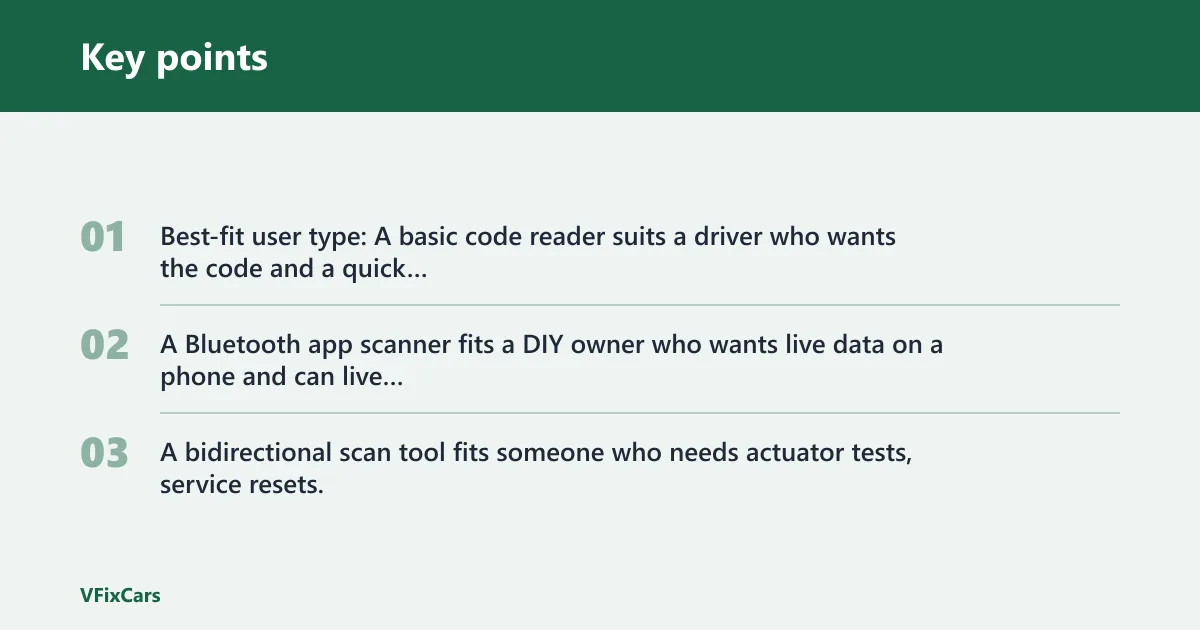
Best-fit user type: A basic code reader suits a driver who wants the code and a quick check. A Bluetooth app scanner fits a DIY owner who wants live data on a phone and can live with app dependence. A bidirectional scan tool fits someone who needs actuator tests, service resets, and broader system access.
Can an OBD2 scanner clear the check engine light?
Yes, many OBD2 scanners can clear codes after the problem is fixed. That is normal. Advanced OBD2 scanners can clear codes after the problem is fixed, and many basic readers can do the same for engine-related faults. Clearing the code turns the light off for the moment.
Clearing the code does not fix the cause. If the fault remains, the light can return after the next drive cycle. Clearing codes can also hide an unresolved problem or reset readiness monitors in a way that affects an inspection. Use the clear function after repair, not as the repair.
That caution matters because a stored code may be tied to an emissions fault that needs confirmed testing. If the light comes back, the original problem was not solved. If the light stays off but monitors are not ready, the vehicle may still fail a test.
Does my car support OBD2?
Most vehicles manufactured after 1996 support OBD2, but coverage can vary by market, model, hybrid system, and EV platform. Standard OBD2 works on the engine and emissions side, yet some newer vehicles need extra checks for broader module access. The scanner may read basics while missing some manufacturer-specific data.
The simplest check is the port itself. If the car has the standard 16-pin connector below the driver-side dashboard, it likely supports OBD2 for standard engine and emissions diagnosis. That does not guarantee every feature will work, especially on newer hybrids and EVs.
For hybrids and EVs, standard OBD2 coverage can be incomplete for traction battery, inverter, or charging-related functions. A tool may still read emissions-related data where applicable, but broader diagnostics often need a make-specific or more capable scan tool.
What is a good OBD2 scanner to buy?
A good OBD2 scanner for a DIY owner reads codes, shows live data, displays freeze frame data, and checks readiness monitors without making the menus confusing. If you only need the check engine light, a basic reader can be enough. If you want more detail, choose a tool with stronger live-data support.
Bluetooth OBD2 scanners are often cheaper and portable. They pair with a smartphone and can be handy if you prefer app-based graphs and data logs. Handheld tools are better if you want a screen that works without a phone and less dependence on app support. Neither type is universally better.
Bidirectional scan tools are worth the higher price when you need actuator tests, service resets, ABS/SRS access, or broader system coverage. They are overkill for someone who only wants to pull a P0171 code once in a while. They make sense when diagnosis is more than a quick code check.
What to look for before you buy
- Confirm it supports your model year and region.
- Check whether it reads engine codes only or also ABS and SRS.
- Look for freeze frame, live data, and readiness monitors if you plan to diagnose faults.
- Decide whether you want a standalone screen or a phone app.
- Check whether updates are free, paid, or required for newer models.
- Make sure it matches your goal: quick code lookup, deeper diagnosis, or service work.
Frequently asked questions
What is a good OBD2 scanner?
A good OBD2 scanner is one that fits the job you actually need done. For a check engine light, that means code reading, freeze frame data, live data, and readiness monitors. If you need ABS, SRS, actuator tests, or resets, choose a higher-tier tool instead of a basic code reader.
Is it worth buying an OBD2 scanner?
Yes, for many DIY owners it is worth it. OBD2 scanners can save money by avoiding diagnostic fees and by helping you avoid parts guesses. The value drops if you only use it once and never need live data or monitor checks. For repeated warning lights, it pays for itself faster.
What does an OBD2 scanner do?
An OBD2 scanner reads DTCs, shows sensor data, and reports readiness status through the vehicle’s diagnostic port. It helps you see why the check engine light is on and whether a repair changed the data. It does not tell you the whole story by itself.
Where is the OBD2 port located?
The OBD2 port is usually below the driver-side dashboard, close to the steering column or lower trim area. It is a 16-pin connector. If you cannot find it right away, check near the fuse panel or under a small cover on the lower dash.