How to Use a Torque Wrench for Beginners
Set the torque wrench to the exact spec in your car’s manual, hand-tighten the fastener first, then pull until the wrench clicks once, not past it. Wrong units or over-tightening can strip threads, warp brake parts, or loosen wheels. This guide covers unit matching, correct lug-nut sequence, and the checks that catch mistakes before they damage your car.
This guide is part of our Torque wrench: how to choose and use one series.
What a torque wrench does
A torque wrench applies a set turning force to a fastener. That matters because a bolt or nut can be too loose or too tight, and both can cause trouble on car parts.
Check the vehicle manual, service data, or the part itself for the torque spec. Many specs are written in Nm, some in ft-lb, and smaller fasteners may use in-lb. If the spec gives a range, follow the service procedure for that range; do not pick a target by feel.
For cars, this is not abstract. Wheel lug nuts, bracket bolts, drain plugs, and cover bolts all depend on the right value, and some also depend on dry threads, lubricated threads, washers, or sealant.
What you need before you start
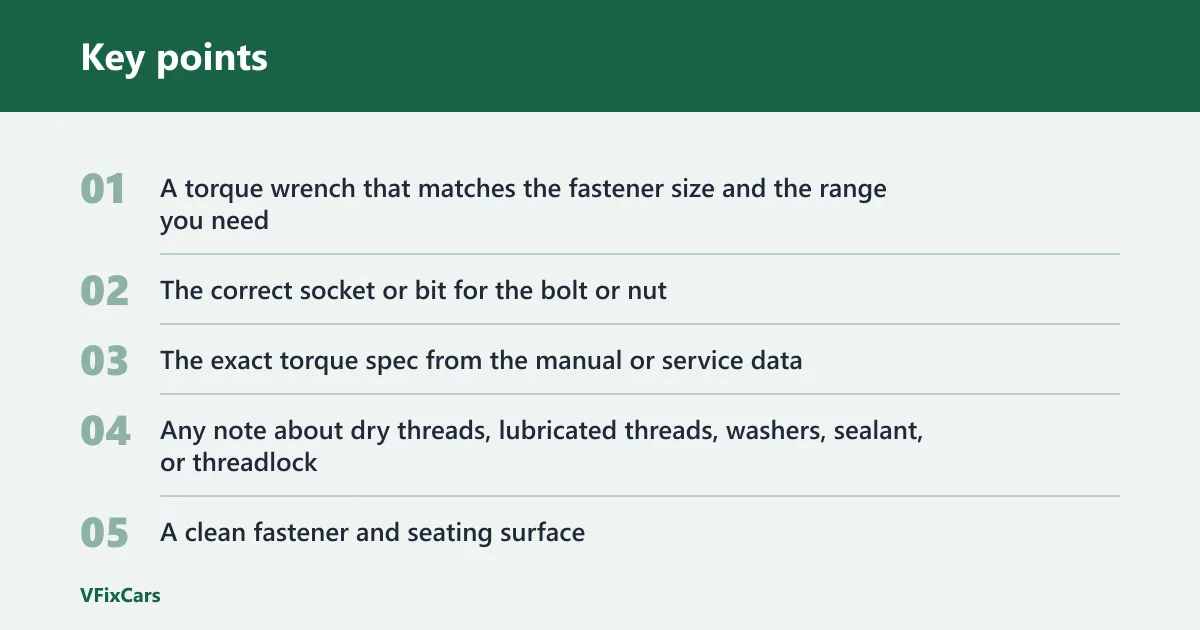
- A torque wrench that matches the fastener size and the range you need
- The correct socket or bit for the bolt or nut
- The exact torque spec from the manual or service data
- Any note about dry threads, lubricated threads, washers, sealant, or threadlock
- A clean fastener and seating surface
Choose the wrench type that fits the job. You set it with a dial at the base, and it clicks at the target torque. Digital models show the value on a screen and may beep or light up. Beam wrenches use a pointer and scale. Preset wrenches stay fixed at one value and are often used for about 5 Nm jobs.
Do you really need to use a torque wrench?
Yes, for any fastener with a published torque spec that affects safety, sealing, or part life. Wheel lug nuts are the clearest example. Brake brackets, engine covers, oil drain plugs, and suspension fasteners also need the correct setting instead of “tight enough.”
You can tighten a bolt by feel, but car service data exists for a reason. A torque wrench helps prevent stripped threads and overtightening, and it also helps avoid under-tightening that can let a part move or leak.
Jobs where the tool matters most
Use it any time the manual lists a torque value and the fastener holds a wheel, seal, bracket, or cover. If the part lists a torque range, follow the exact procedure tied to that range. If the part lists a maximum, do not assume a lower target unless the service data says so.
How do you set a torque wrench?
Set the wrench to the exact unit and value called for by the vehicle data. Match Nm to Nm and ft-lb to ft-lb. Do not convert by feel. If you must convert for planning, use a calculator, then set the wrench in the same unit it displays.
Hold the wrench by the grip, not the head. On a click-type wrench, turn the base dial to the target value, then lock it if the model has a lock. On a digital wrench, enter the value on the screen. On a beam wrench, zero the pointer before use.
Use the right unit
Nm and ft-lb are common on car fasteners, and in-lb shows up on smaller bolts. A value like 10 Nm is far below 10 ft-lb, so unit mix-ups can give a bad result even when the number looks close.
Confirm the wrench is ready
Check that the socket is fully seated, the wrench is on the tightening setting, and the fastener was already started by hand. A preset wrench should already be fixed to its one value. A digital wrench should show the target clearly before you pull.
How do you use a torque wrench for beginners?
Start every bolt or nut by hand, then tighten in the vehicle’s required pattern until the wrench signals once. If a fastener feels gritty, binds, or never reaches the signal, stop and inspect the threads, washer, and mating surface before forcing it. For wheels, use a star or crisscross order unless the manual gives a different sequence.
Follow the correct tightening order
Wheel lug nuts should be tightened in a star pattern so the wheel seats evenly. Some brake or cover assemblies also need a specific sequence or multi-step tightening. If the service data calls for 2 steps, do both steps in order rather than jumping straight to final torque.
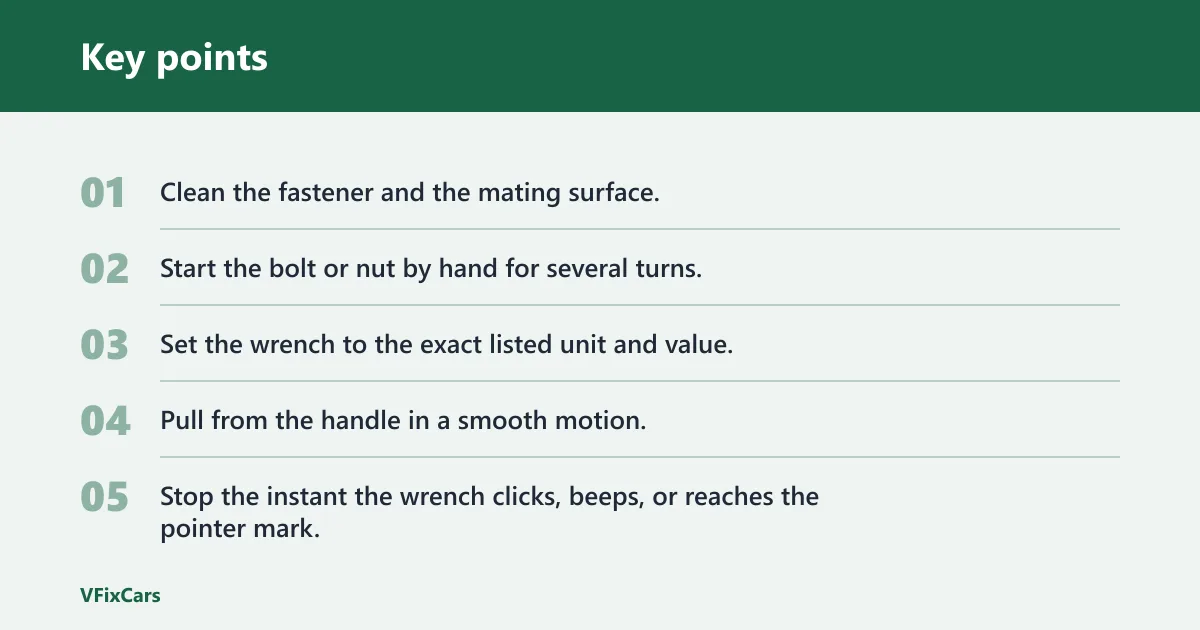
- Clean the fastener and the mating surface.
- Start the bolt or nut by hand for several turns.
- Set the wrench to the exact listed unit and value.
- Pull from the handle in a smooth motion.
- Stop the instant the wrench clicks, beeps, or reaches the pointer mark.
- Move to the next fastener in the required pattern.
- Recheck only if the manual says to do so.
A common example is to say your wheel lug nuts are listed at about 110 Nm. Tighten them in a star pattern, first by hand, then with the wrench set to 110 Nm, and stop at the first click. A second pull after the click can push the load past the target and work against the point of using the tool.
Suppose a bracket bolt is listed at 18 ft-lb and the wrench never clicks after a steady pull. Stop there. Back the bolt out, check for crossed threads, damaged threads, or paint and debris at the seat, then restart by hand before trying again.
Torque wrench checklist
| Task | What good looks like | Common mistake | Units | Stop and inspect |
|---|---|---|---|---|
| Wheel lug nuts | Hand-started, tightened in star order, wrench set to the manual value, stopped at the first click | Using a random pattern or pulling again after the click | Nm or ft-lb | Stop if the socket slips, a nut feels rough, or the wheel does not seat flat |
| Bracket bolts | Threads start smoothly, any washer or thread treatment matches the spec, final pull lands on the listed torque | Mixing dry and lubricated settings or forcing a bolt that binds | Nm, ft-lb, or in-lb | Stop if the bolt feels wrong, cross-threads, or the wrench never signals |
| Cover bolts | Fastener is started by hand, tightened in a light even sequence, and stopped at the specified torque | Using a large wrench on a small fastener or skipping the order | Often in-lb or low Nm | Stop if the threads bind, the bolt head cams out, or the cover sits unevenly |
Common mistakes
Wrong units are a frequent beginner error. A spec in Nm is not the same as a spec in ft-lb, and inch-pounds are common on smaller fasteners. If the number looks too small or too large for the job, recheck the unit before you touch the wrench.
Skipping hand-starting can damage threads before the torque wrench ever comes into play. If a bolt will not thread in smoothly for several turns by hand, back it out and inspect it. Forcing it with the wrench hides the real problem.
Using the wrench to loosen fasteners is poor practice. FindBuyTool says not to use a torque wrench to loosen fasteners, and that warning is worth following because the tool is meant for accurate tightening, not stubborn removal.
Another mistake is ignoring thread condition. Some specs assume dry threads, while others call for lubricant, threadlock, or sealant. That detail changes the clamping load, so the spec and the thread condition have to match.
If the wrench never clicks
Back off and inspect the fastener. A wrench that never signals usually means the bolt is binding, the socket is slipping, or the fastener is already damaged. Do not add force just to make the tool signal.
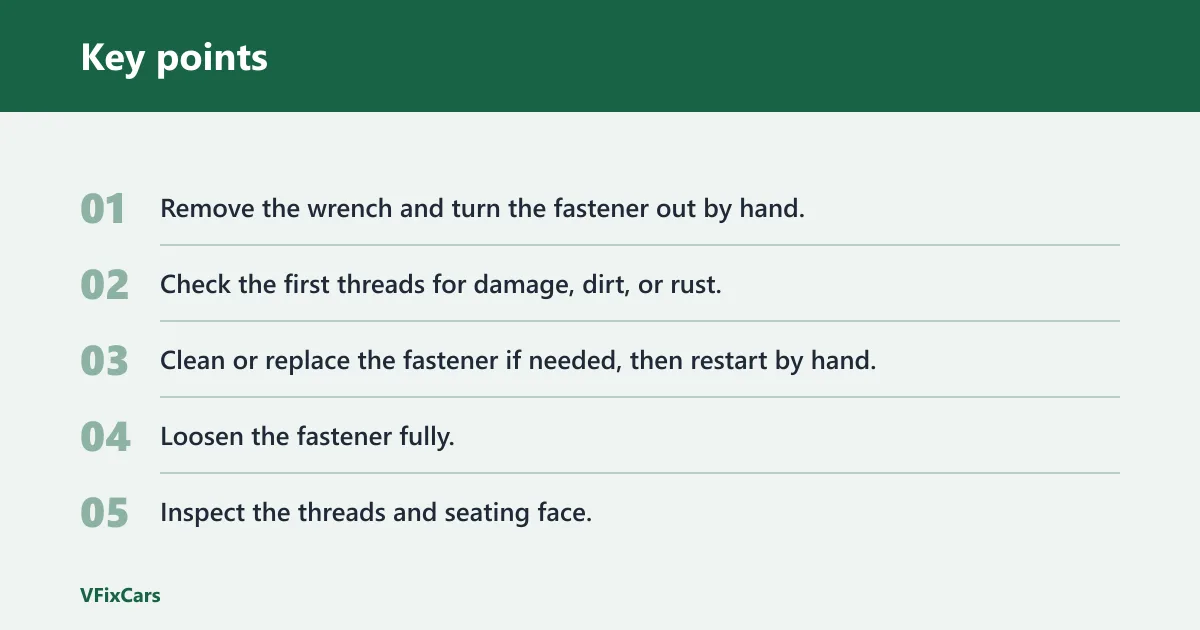
- Remove the wrench and turn the fastener out by hand.
- Check the first threads for damage, dirt, or rust.
- Clean or replace the fastener if needed, then restart by hand.
If the fastener feels wrong
Stop immediately if the feel changes suddenly, the bolt turns unevenly, or the head rocks in the socket. That can point to crossed threads, a missing washer, or a part that is not seated flat. No torque setting fixes that.
- Loosen the fastener fully.
- Inspect the threads and seating face.
- Confirm the exact spec, thread condition, and sequence in the service data.
How to store and keep it accurate
After use, return the setting to minimum if the maker calls for that. Lifehacker advises backing the torque all the way down for storage. Keep the wrench clean, do not drop it, and wipe dirt and rust from the ratchet head.
Calibration matters too. A wrench that has been dropped, left loaded, or used heavily should be checked on a regular schedule. The exact interval depends on the tool maker, but the risk is highest when the wrench is stored at a high setting or handled roughly.
Frequently asked questions
What do you use a torque wrench for?
Use it to tighten fasteners to a specified value when clamping load matters. On cars, that usually means wheel lug nuts, brake and suspension brackets, oil drain plugs, and covers with low torque values. It helps prevent under-tightening, stripped threads, and damage to sealed joints.
Should you hand-tighten before using a torque wrench?
Yes. Hand-start the bolt or nut first so the threads engage cleanly and the fastener seats without cross-threading. The torque wrench is for final tightening, not for forcing the first turns. If the threads do not start smoothly by hand, something is wrong.
Why should you stop when a torque wrench clicks?
The click means the target torque has been reached. Pulling beyond that point adds extra load and can over-tighten the fastener, which is exactly what the tool is meant to prevent. One clean signal is the finish line, not a cue to lean harder.