What Size Torque Wrench Do You Need for Lug Nuts?
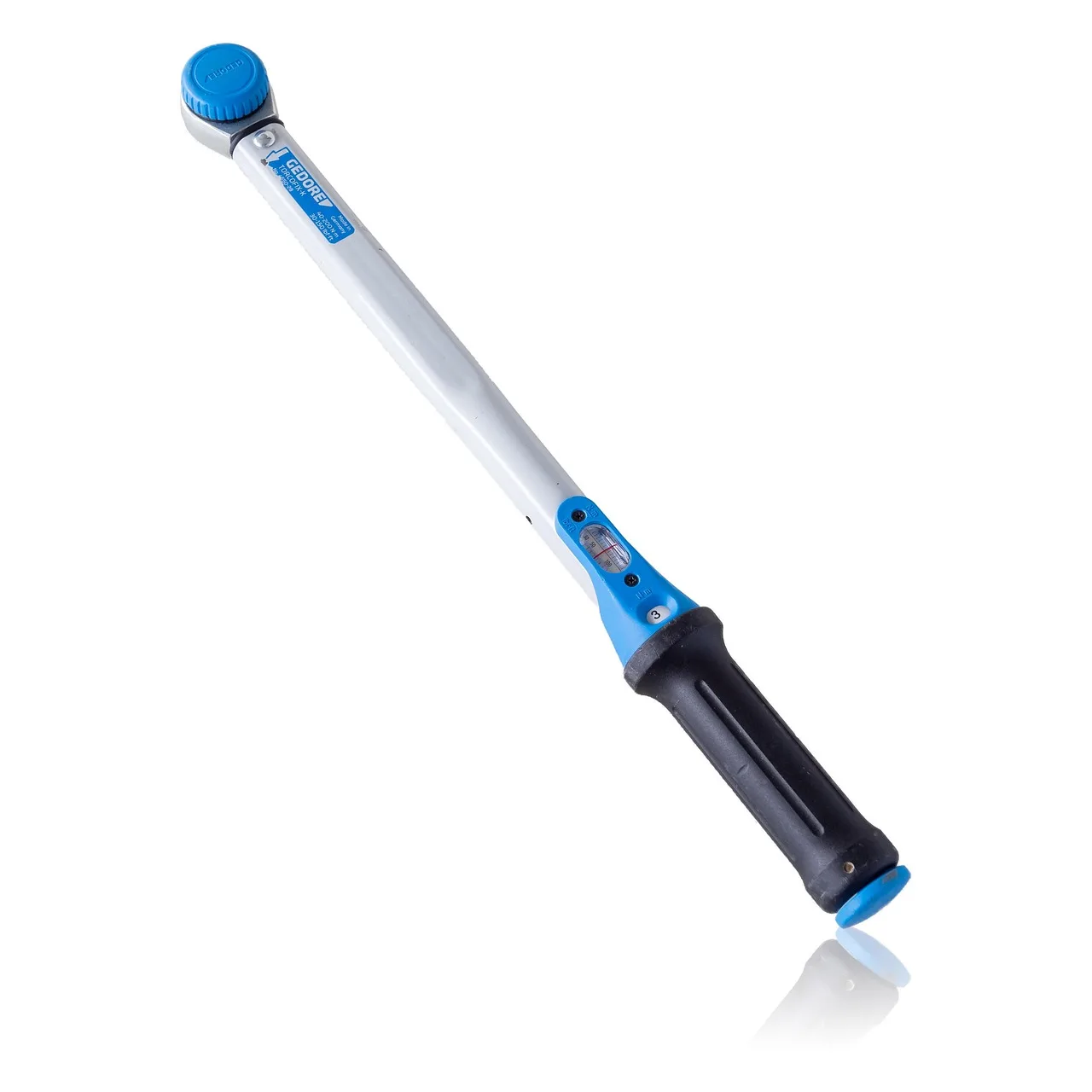
For most car lug nuts, a 1/2-inch drive torque wrench is often a practical choice because it covers many common lug torque settings; use a wrench whose working range includes your required lug torque value. Wrong torque can warp rotors, loosen wheels, or strip studs. This guide shows how to match lug nut specs to drive size and torque range, plus how to set and use the wrench correctly.
This guide is part of our Torque wrench: how to choose and use one series.
What size torque wrench do you need for lug nuts?
Match the wrench to the vehicle’s lug nut torque specification, not the badge on the fender. Torque wrench size means drive size, while the key point is whether the wrench’s usable range puts your target torque in the middle of the scale, where most tools are meant to work best.
What your lug nut torque spec tells you
The lug nut torque specification is set by the vehicle maker and belongs in the owner’s manual or service data. It can change with wheel design, lug nut style, and fastener size, so one model may use more than one value across trims or wheel packages.
Check the unit carefully. Most wheel specs are listed in ft-lb or Nm, and you should use the exact unit shown or convert it deliberately. Do not guess between units. A torque wrench set in the wrong scale can leave you far outside the intended clamping load.
What size torque wrench do i need for lug nuts

For most passenger cars and light SUVs, a 1/2-inch drive torque wrench is the best default because it fits common wheel torque values and accepts the lug sockets used on most cars. A 3/8-inch drive wrench can work for smaller torque specs if the target value sits comfortably within its rated range.
When a 1/2-inch drive is the right choice
A 1/2-inch drive is common for wheel work because many lug nut specs fall in a range where the tool is easy to read and not close to its limit. That matters. A wrench used too near either end of its range is harder to control and easier to misuse.
When a 3/8-inch drive is enough
Some smaller cars specify lower lug torque values, and a 3/8-inch torque wrench can be suitable if that value lands in the middle portion of the wrench scale. If the spec is near the top of a 3/8-inch wrench, step up to a 1/2-inch model instead.
When a larger drive is unnecessary
You usually do not need a larger drive for passenger-car lug nuts. Bigger drives are aimed at higher-torque fasteners. For wheel work, the better question is not “largest drive available,” but “which drive size gives me the correct range and the correct socket fit?”
Use the wrench in its middle range
For wheel work, it is generally better to keep the target torque somewhere in the middle of the wrench’s scale, rather than near the low end or the maximum. That is the practical match point. It gives you better readability, better control, and less reason to use the wrench outside its intended zone.
How to spot a bad match
If your lug spec is 76 lb-ft and the wrench starts at 50 lb-ft, that can work only if the scale still places 76 in a comfortable middle zone. If the same spec sits at the very bottom of a 150 to 250 lb-ft wrench, it is the wrong tool for the job.
Picture a sedan with a 89 lb-ft wheel spec and a 25 to 250 lb-ft wrench. The number is technically on the scale, but it is buried low. A 30 to 150 lb-ft or 40 to 200 lb-ft wrench makes more sense because the target torque is easier to set accurately.
Proof table: match torque band, drive size, and socket
The table below maps common lug torque bands to a practical wrench choice. Use it as a buying filter, then confirm the exact number in your owner’s manual or service data before tightening any wheel.
| Common lug torque band | Best drive size | Socket type | Works in mid-range? | Notes |
|---|---|---|---|---|
| 60 to 80 lb-ft | 3/8-inch or 1/2-inch | Standard deep or shallow socket, depending on wheel design | Yes, if the target sits between about 20% and 80% of the scale | Common on some smaller cars; check that the wrench is not too large for the value. |
| 80 to 120 lb-ft | 1/2-inch | Standard wheel socket; thin-wall if the lug recess is tight | Yes, on many common 1/2-inch torque wrenches | This is the most common passenger-car wheel range. |
| 120 to 140 lb-ft | 1/2-inch | Deep socket if the lug nut sits recessed; thin-wall for alloy wheels when needed | Usually yes, if the wrench scale starts low enough and the value is not near max | Some SUVs and trucks land here; confirm the exact spec before choosing the tool. |
| 140 to 160 lb-ft | 1/2-inch | Correct wheel socket with enough wall clearance for the wheel | Maybe | Use a 1/2-inch wrench only if this torque falls well inside its working band. |
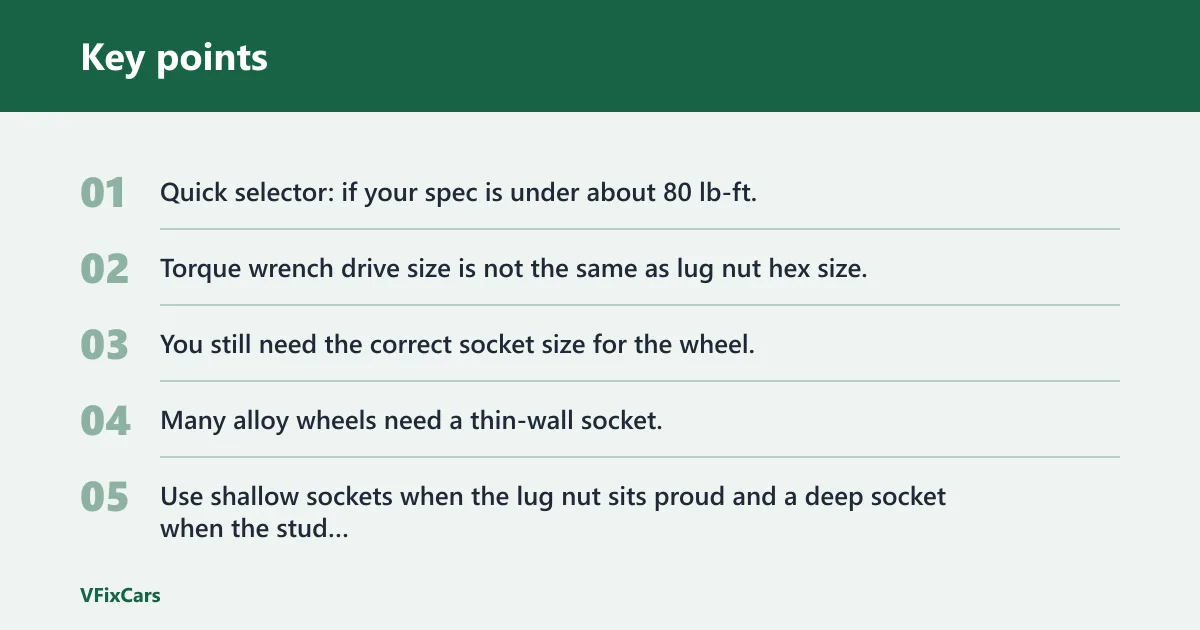
Quick selector: if your spec is under about 80 lb-ft, a 3/8-inch wrench may fit if the scale range is right; if your spec is around 80 to 140 lb-ft, start with a 1/2-inch drive; if your spec is outside the middle of either tool’s range, pick the other size.
Which socket fits matters too
Torque wrench drive size is not the same as lug nut hex size. You still need the correct socket size for the wheel. Many alloy wheels need a thin-wall socket, and some locking lug nuts need a matching special socket with enough clearance to reach the fastener cleanly.
Use shallow sockets when the lug nut sits proud and a deep socket when the stud protrudes or the wheel design recesses the nut. If the socket bottoms out before seating on the lug nut, the torque reading becomes unreliable.
Do you need a torque wrench for lug nuts?
Yes. Final wheel tightening should generally be done with a torque wrench because wheel retention depends on consistent clamping load, not feel alone. Correct torque also helps reduce the chance of brake rotor runout from uneven clamping force, which can happen when a wheel is tightened unevenly or over-tightened.
Why guesswork is a poor substitute
Impact tools, breaker bars, and feel alone do not tell you when the correct torque has been reached. A wheel can feel “tight” and still be wrong. Under-tightening risks movement. Over-tightening can distort parts or make future removal difficult.
A common first-timer mistake is cranking every lug nut down with an impact wrench and calling it done. That is the wrong final step. The impact tool is for removal or rough snugging only, then the final torque belongs to the torque wrench.
How to tighten lug nuts the right way
Start by hand-threading each lug nut so you do not cross-thread the studs. Then snug the nuts in a star or cross pattern, which helps spread clamping force more evenly across the wheel face. Final tightening should still follow the same pattern.
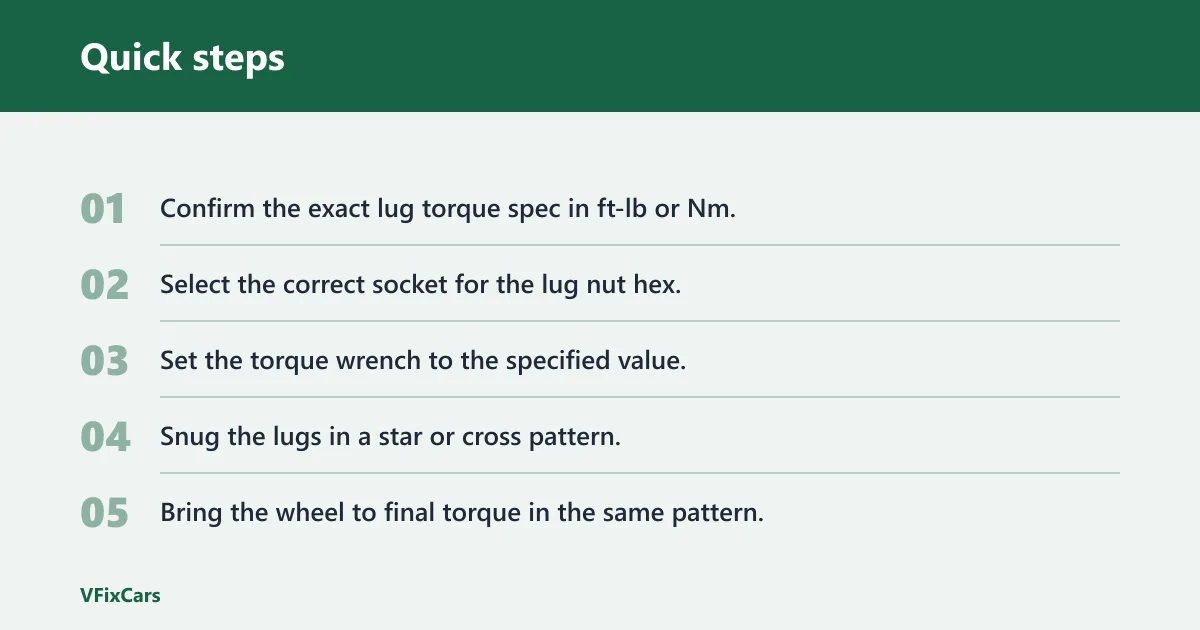
- Confirm the exact lug torque spec in ft-lb or Nm.
- Select the correct socket for the lug nut hex.
- Set the torque wrench to the specified value.
- Snug the lugs in a star or cross pattern.
- Bring the wheel to final torque in the same pattern.
- If the service procedure calls for it, recheck torque after the car is back on the ground.
How to set and use the wrench correctly
Click-type, beam, and digital torque wrenches all work for wheel service, but they feel different. Click wrenches are the common choice for lug nuts. Beam wrenches show torque by pointer and scale. Digital wrenches display the setting electronically and may help when you need a clear readout.
Use the wrench squarely on the fastener. Pull smoothly. Do not add a cheater pipe. Do not keep pulling after the click, beep, or indicated value. If the lug is beyond the tool’s range, switch tools rather than forcing it.
What size impact wrench do you need to remove lug nuts?
Removal torque is not the same as installation torque. A lug nut may need substantial force to remove, so a cordless, electric, or air impact wrench can help with taking wheels off. Final tightening still needs a torque wrench, because impact tools do not measure the final clamping load accurately.
Air, electric, and cordless impact tools
For wheel work, the key question is whether the tool can break loose the fasteners without damaging them. Socket fit still matters. Use an impact-rated socket for removal, then verify the final torque with a torque wrench after installation.
Do not assume a stronger impact tool is better for wheel work. More output can remove stuck lugs faster, but it also makes it easier to overdo removal and damage threads or lug seats if the socket is wrong or the tool is used carelessly.
What size torque wrench do i need
If you are buying one wrench for general car work plus lug nuts, a 1/2-inch drive with a range that covers your wheel spec and common chassis fasteners is the safest starting point. If your car’s lug torque is lower, and the wrench still keeps that value in the middle of its scale, a 3/8-inch model can be the better fit.
Practical buyer rule
Buy the wrench that puts your exact lug spec in the useful middle of the dial, not the wrench with the biggest maximum number. Then make sure the socket set includes the correct lug hex, plus a thin-wall option if your alloy wheels or locking lugs need one.
Frequently asked questions
what size impact wrench do you need for lug nuts
For removal, the tool size matters less than whether it can break the nuts loose without damaging them. Air, electric, and cordless impact wrenches can all work. Use an impact socket for removal, then finish with a torque wrench set to the vehicle’s specified value.