What Happens If You Use the Wrong Motor Oil? Signs & Fixes
A small one-time top-off of the wrong oil may not cause immediate damage, but if you added a larger amount, used the wrong viscosity, or the oil light came on, it is wise to correct it before driving hard. Left in place, the wrong oil can starve parts, raise wear, overheat the engine, and turn a cheap drain-and-refill into a costly repair. This guide explains what matters, when to stop driving, and how to choose between monitoring, an immediate oil change, or a tow.
This guide is part of our Motor oil guide: how to choose the right oil series.
What happens if you use the wrong motor oil?
The short answer: an engine usually does not fail at once, but wrong oil can start a wear process that grows with time, heat, and load. The main risks are excess friction, poor cold-flow, a thin oil film at operating temperature, and deposits such as varnish and sludge.
Why a one-time misfill is different from long-term use
A one-time mistake is often a triage problem, not an emergency rebuild. The damage path starts when the wrong oil stays in the engine and the vehicle is driven long enough for lubrication to be compromised. That is when premature wear and costly damage become more likely.
Wrong oil can create excess friction in engine parts. It can also build varnish on pistons and harmful sludge that restricts oil flow. Those problems build slowly, which is why the first step is usually to correct the fill before symptoms stick around.
What parts of the engine are most sensitive to the mistake
Parts that depend on a stable oil film are the first concern: bearings, crankshaft surfaces, valves, pistons, and turbocharger bearings if the engine has a turbo. These parts do not all fail at once, but they face more risk when the oil is too thick, too thin, or outside the required spec.
Modern engines can be less forgiving than older ones because tighter clearances, turbochargers, and longer drain intervals may leave less room for error. That is why the owner’s manual matters more than bottle color or marketing language.
How the wrong viscosity changes oil flow
Viscosity is the oil’s thickness, and the SAE grade tells you how that oil behaves in cold starts and at operating temperature. Oil that is too thick flows more slowly. Oil that is too thin may not adequately protect bearings, crankshaft, valves, and pistons.
In plain terms, thick oil can delay lubrication when the engine first starts. Thin oil can leave too little protection once the engine is hot and under load. The correct SAE grade matters because the same engine can need quick cold-start flow and strong hot protection.
Too thick at cold start
When oil is too thick, it moves more slowly through galleries and across bearing surfaces. That matters most on startup and in icy weather, when oil needs to reach critical parts quickly. Thick oil may fail to lubricate well during cold starts or icy weather.
If the engine sounds rough for the first few seconds, or the valvetrain is louder than usual, that is a clue that oil flow may be delayed. It is not proof by itself, but it is enough to avoid hard driving until the oil is corrected.
Too thin when the engine is hot
Thin oil can reduce the protective film when the engine is hot, towing, climbing grades, or running at highway load. The result is more metal-to-metal contact risk, which means more friction and more wear over time.
That is why “close enough” is not always close enough. A difference that seems minor on the bottle can matter once the engine reaches full temperature or spends long periods at high load.
What happens if you mix different types of engine oil?
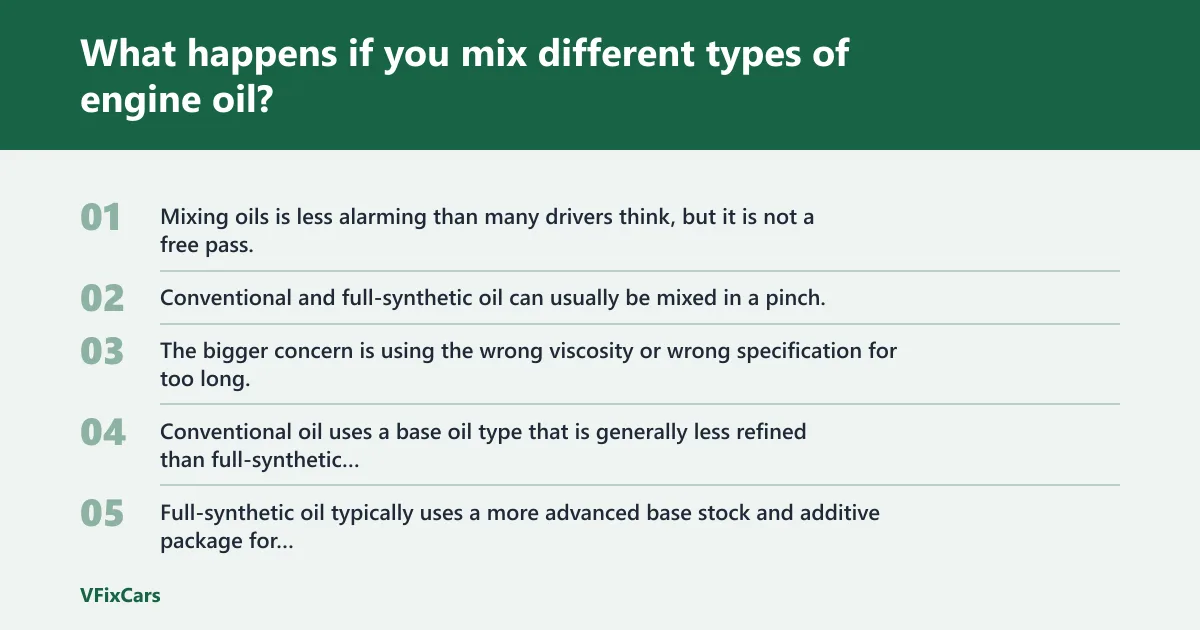
Mixing oils is less alarming than many drivers think, but it is not a free pass. Conventional and full-synthetic oil can usually be mixed in a pinch, especially if the viscosity grade is the same. The bigger concern is using the wrong viscosity or wrong specification for too long.
Conventional oil mixed with full-synthetic oil
Conventional oil uses a base oil type that is generally less refined than full-synthetic oil. Full-synthetic oil typically uses a more advanced base stock and additive package for longer life and better protection. Mixing them is usually less risky than driving long periods on the wrong viscosity.
That said, mixing does not erase the service limits of the cheaper or shorter-life oil in the blend. If the vehicle calls for full-synthetic oil, a partial top-off with conventional oil is often better than running low, but it should still be corrected promptly.
Mixing different viscosities
Mixing different viscosities can move the final blend away from the engine’s required SAE grade. That is why mixing different blends and viscosities should be avoided when possible. The farther the oil drifts from the manual’s requirement, the more the flow and protection balance can change.
Say your car takes 0W-20 and you added 5W-30 by mistake during a top-off. The engine may still run, but the final mix is no longer the same as the specified oil. That is a reason to inspect the level, avoid hard driving, and plan a prompt oil change.
When mixing is tolerable and when it is a bad idea
Mixing same-quality oil with the same SAE viscosity from different brands is less concerning. The manual still matters first, but a compatible top-off of the correct grade is a different problem from a true spec mismatch. The risk rises when the blend changes viscosity, service category, or diesel versus gasoline rating.
Mixing becomes a bad idea when the engine needs a specific API grade, a diesel-rated oil, or a manufacturer approval that the replacement oil does not meet. In those cases, the bottle may fit the engine physically but still miss the required performance standard.
What happens if you put the wrong oil in your car one time?
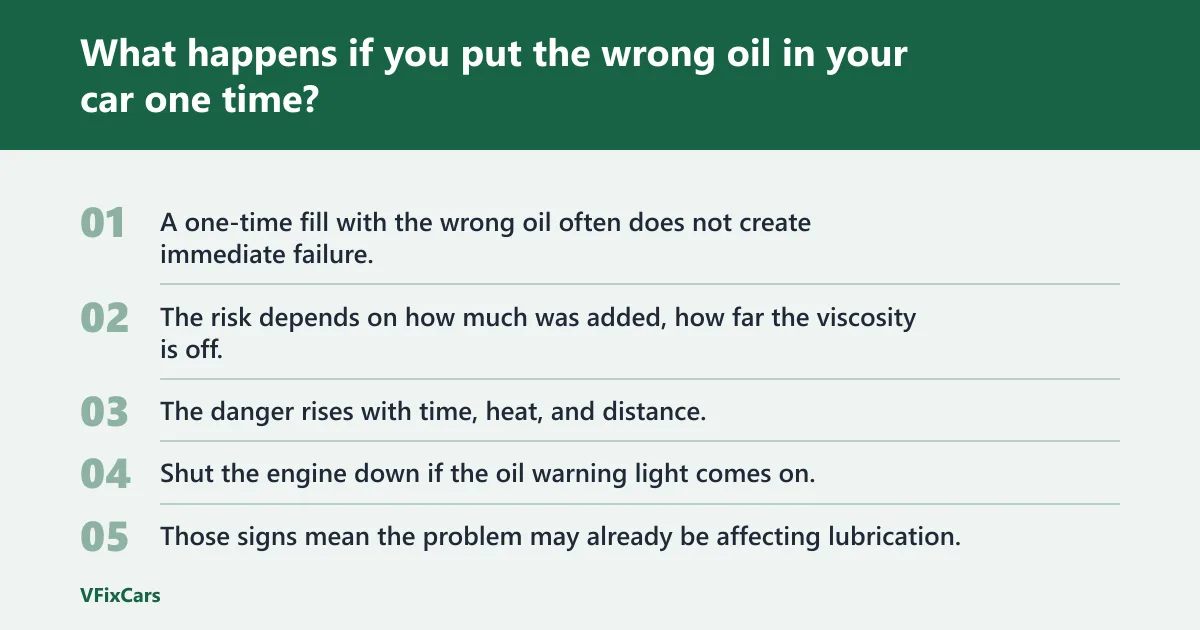
A one-time fill with the wrong oil often does not create immediate failure. The risk depends on how much was added, how far the viscosity is off, and whether the car is driven gently or loaded hard before the mistake is corrected. The danger rises with time, heat, and distance.
Immediate shutdown symptoms that mean you should stop driving
Shut the engine down if the oil warning light comes on, the engine starts making loud knocking or rattling noises, or the oil pressure seems unusual. Those signs mean the problem may already be affecting lubrication, and continued driving can turn a correction job into a repair job.
Also stop if the engine suddenly smells hot or burns oil, or if the check engine light appears along with rough running after the misfill. Those are not automatic proof of oil failure, but they are enough to avoid guessing.
Driveability changes you can watch for over the next few miles
Common clues include rough starting, louder valvetrain noise, burning smell, oil leaks, reduced MPG, warning lights, and changes in engine smoothness. None of those symptoms proves damage by itself, but they make the mistake more urgent.
A common first-timer mistake is to drive “just to see if it clears up.” That is the wrong test. If the car is already showing symptoms, the safer move is to check the level, verify the spec, and decide whether to drain or tow.
Why damage risk rises with heat, load, and distance
Wrong oil can sit quietly for a short time and still create trouble later. The longer it stays in the engine, the more chance it has to produce excess friction, varnish, and sludge. Heat and heavy load speed that process up.
That is especially important for turbo engines, hybrids with frequent start-stop cycles, and diesel engines with aftertreatment systems. Those designs can expose oil to more stress or make the engine more sensitive to the wrong spec.
| Wrong oil triage | Immediate action | Driveability risk | Change oil now or tow? |
|---|---|---|---|
| One quart off | Check the dipstick or oil level, confirm what was added, and avoid hard driving | Usually low if the level is still safe and the added oil matches the spec | Change oil now if the grade or spec is wrong; tow if the oil light is on or the engine sounds abnormal |
| Wrong viscosity | Stop aggressive driving and verify the SAE grade in the owner’s manual | Moderate to high, especially in cold starts or high-heat driving | Change oil now; tow if there is oil pressure warning, knocking, or a severe mismatch |
| Synthetic/conventional mix | Confirm the final viscosity and whether the oil still meets the required spec | Usually low to moderate if the viscosity and spec still align | Change oil soon; tow only if the engine has symptoms or the level is wrong |
| Diesel/gasoline mismatch | Stop and verify the API grade and vehicle spec before driving further | Moderate to high, especially in modern emissions-equipped vehicles | Change oil now; tow if the engine is already running poorly or the warning light is on |
Which engines are at higher risk?
Modern turbo engines, hybrids with frequent start-stop use, and diesel engines with EGR, particulate filters, and catalytic converters can be less forgiving of the wrong oil. These systems place more demand on oil quality, cold flow, and the correct performance specification.
Modern turbo engines
Turbo engines run hotter around the turbocharger and depend on stable oil flow. Wrong viscosity can be more harmful here because thick oil may move too slowly at startup, while thin oil may not protect well under heat and load. That raises wear risk in a high-stress part of the engine.
Hybrids with frequent start-stop cycles
Hybrids can start and stop often, which means the oil must protect the engine repeatedly during warm-up and shutdown. Oil that is too thick can be slower to circulate after each restart. That can increase friction on parts that see many short trips and repeated restarts.
Diesel engines with EGR and particulate filters
Diesel and gasoline oil grades are not always interchangeable. Wrong oil may cause premature EGR failure, congest particulate filters, and clog catalytic converters. API grade and vehicle specification matter here, not just the bottle color or broad marketing terms.
For diesel engines with aftertreatment systems, the wrong oil can create ash and deposit problems that show up later as emission-system faults. Those repairs can be far more expensive than a prompt drain-and-refill.
What happens if you use the wrong weight oil in your car?
Using the wrong weight oil can change how quickly the oil reaches parts on startup and how well it protects when hot. If it is too thick, it flows more slowly. If it is too thin, it may not adequately protect bearings, crankshaft, valves, and pistons.
How far off is too far?
The answer depends on the engine and the manual, not on a guess from the label. In general, the closer the fill stays to the required SAE grade, the less risky the mistake is. A small top-off that still leaves the engine within spec is a different problem from a full drain filled with the wrong grade.
That is why the owner’s manual is the safest source for the correct oil. It gives both the viscosity requirement and the specification requirement, which is what many drivers miss when they focus only on “weight.”
What happens if you use the wrong type of engine oil?
Wrong type means more than just thickness. It can mean the wrong service category, the wrong API grade, or the wrong gasoline versus diesel oil. That matters because some engines need specific performance standards to protect the engine and the emissions system.
API oil grades and vehicle specs
API oil grades are performance and specification standards, not just generic labels. A bottle can list a familiar viscosity and still miss the required grade for the engine. The owner’s manual should be the first reference for both SAE viscosity and the needed specification.
If the manual requires a certain gasoline or diesel rating, follow that requirement. Bottle color, package wording, or “universal” marketing terms are not enough to prove compliance.
Why gasoline and diesel oils are not always interchangeable
Gasoline and diesel oils are built around different engine demands. A diesel engine with EGR, a particulate filter, or a catalytic converter can react badly to the wrong formulation. The wrong oil may lead to premature EGR failure, particulate filter clogging, or catalytic converter clogging.
That is why a diesel/gasoline mismatch is more serious than a simple top-off with the wrong brand. The problem is not the container; it is the performance standard the engine needs.
How soon should you change it after a mistake?
Change the oil and filter promptly after you discover a wrong fill, especially if the viscosity or specification is wrong. The longer it stays in the engine, the more time it has to create wear, deposits, or lubrication problems. If the oil light is on or the engine sounds abnormal, stop driving first.
When to drain and refill right away
Drain it right away if the wrong viscosity is a clear mismatch, if the diesel/gasoline spec is wrong, or if the engine has warning lights or rough operation. The owner’s manual is the first reference, and the correction should match both the SAE grade and the required specification.
Why the oil filter should usually be changed too
Oil change and filter service is the practical stopgap remedy after wrong oil use. It is usually cheaper than engine repair, and the filter can hold contaminated or mismatched oil that you do not want to leave in the system. Replacing the filter reduces the chance of carrying the mistake forward.
When towing is the safer call than driving
If the oil pressure warning light is on, if the engine is knocking, or if the mistake appears to be a serious fuel mismatch in a newer emissions-equipped vehicle, towing is often safer than trying to limp it home. Driving under those conditions can raise the damage risk quickly.
Suppose a turbo sedan was filled with the wrong viscosity and now shows a burning smell plus louder startup noise. That is not a good candidate for a long drive. A short, careful move to a safe spot may be reasonable; a long trip is not.
Frequently asked questions
Can you mix different types of oil?
Sometimes, yes. Same-quality oil with the same SAE viscosity from different brands is less concerning, and conventional oil mixed with full-synthetic oil is usually less risky than running the wrong viscosity. Mixing different blends and viscosities should still be avoided when possible.
How soon should you change it if you used the wrong oil?
As soon as practical, and immediately if the viscosity or specification is clearly wrong. Change the oil and filter promptly before symptoms or damage develop further. If the oil light is on, the engine is noisy, or the mismatch is severe, tow the vehicle instead of driving it.