
Synthetic vs Conventional Oil: Which Should You Use?
Use the oil grade and approvals in your manual; choose full synthetic for turbos, direct injection, sub-0°F starts, towing, or long drain intervals, and conventional or synthetic blend only when it allows. Pick the wrong type or interval and you risk sludge, timing-chain wear, cold-start scuffing, turbo coking, higher oil use, or a denied warranty claim. Below, you’ll get a symptom-and-driving-style decision tree for climate, mileage, design, and budget, plus when a blend is the safer middle ground.
| Decision factor | Synthetic | conventional oil | Winner |
|---|---|---|---|
| Manual-required specs and approvals | Works only if the bottle matches the required viscosity and API, ILSAC, or maker approval | Works only if the bottle matches the required viscosity and API, ILSAC, or maker approval | tie |
| Cold starts and winter flow | Flows faster at startup and reaches bearings, chains, and valvetrain parts sooner in freezing weather | Usually slower in deep cold, especially in heavier allowed grades | Synthetic |
| High heat, towing, and turbo load | Better high-temperature stability and less oxidation under heavy heat load | More likely to thin, oxidize, and leave deposits sooner under severe heat | Synthetic |
| Short trips, stop-and-go, and sludge resistance | Better deposit control and sludge resistance when the engine runs contaminated oil longer | More prone to sludge and oxidation in repeated short-trip service | Synthetic |
| Upfront oil price | Generally more expensive | Lower upfront cost | conventional oil |
| Annual running cost when longer intervals are approved | Often competitive because fewer changes may offset higher oil cost | Can cost more per year if the vehicle needs more frequent changes | Synthetic |
| Best fit use case | Turbo engines, severe service, very cold or hot climates, newer cars with longer approved intervals | Simple non-turbo engines in mild climates with short approved intervals and low annual mileage | Synthetic |
The core trade-off
The real choice is not “best oil” in the abstract. It is lowest risk for your exact engine, climate, and service pattern after the manual has already narrowed the field by viscosity grade and specification.
AAA found synthetic engine oils performed an average of 47 percent better. That does not make conventional oil wrong for every vehicle, but it explains why Synthetic keeps winning once heat, cold starts, towing, stop-and-go traffic, and turbocharger load enter the picture.
Manual specs come first
Oil type is secondary to the bottle meeting the required standard. If the manual calls for a certain viscosity and API, ILSAC, or manufacturer approval, missing that requirement can matter more than choosing Synthetic versus conventional oil.
Cold-start flow and viscosity behavior
Viscosity grade and oil type work together, but they are not the same choice. In a grade like 0W-20 or 5W-30, the first number and the “W” describe cold-flow behavior, while the second number describes viscosity at operating temperature.
Synthetic oil reaches tight clearances faster after a cold start and cuts cranking drag in freezing weather. That matters most with repeated short trips, overnight outdoor parking, or long cranking in deep winter.
Heat, oxidation, and deposit control
Under sustained heat, the difference gets larger. Synthetic oil resists thickening and oxidation longer, leaves fewer deposits in hot areas, and holds up better during turbo use, mountain driving, long idle periods, and heavy-load towing.
Upfront price versus annual cost
Conventional oil wins the receipt total. Synthetic oil is generally more expensive than conventional oil, and conventional oil costs about 10 percent less than synthetic in the supplied pricing benchmark. (Thedrive)
That does not settle annual cost. If the manual allows a longer interval on Synthetic, fewer oil changes can offset the higher bottle price, especially once filter and labor are counted.
What is the difference between synthetic, conventional, and blend oil?
Conventional oil starts with the lowest upfront cost and can still be the right choice for some simple engines, but it usually needs shorter drain intervals and is less stable at temperature extremes. Synthetic uses chemically engineered or highly refined base stocks for better cold flow, heat stability, oxidation resistance, and sludge control. A blend sits between them, but there is no single fixed blend formula.
Conventional motor oil
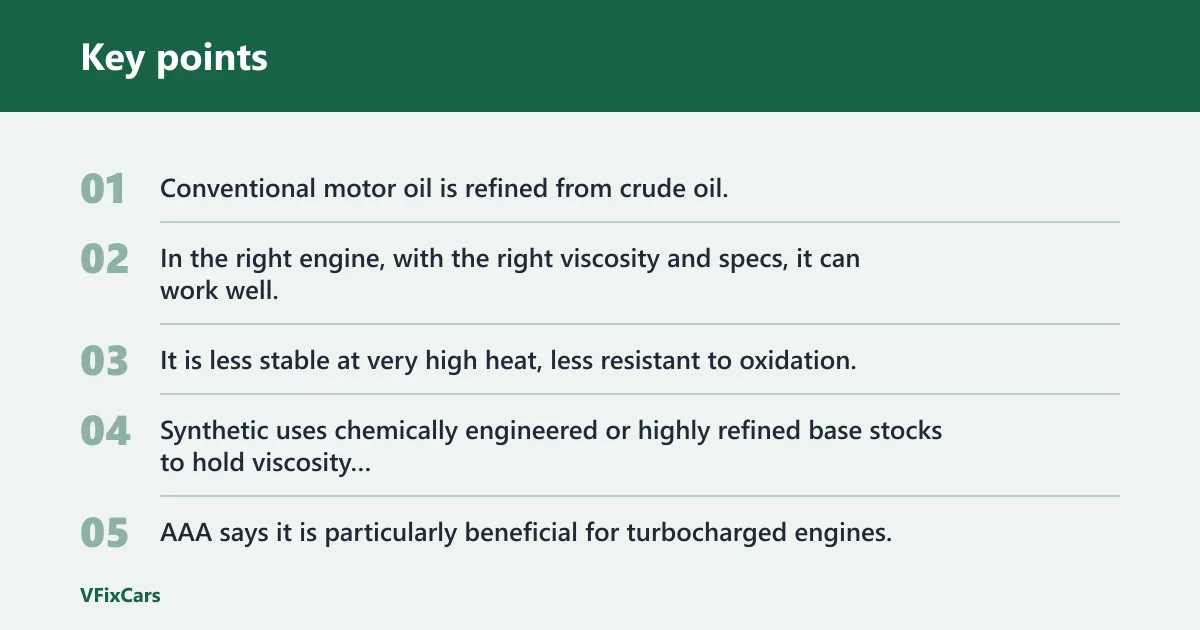
Conventional motor oil is refined from crude oil. In the right engine, with the right viscosity and specs, it can work well, especially in older non-turbo vehicles that have short manufacturer-recommended oil change intervals and live in mild climates.
Its trade-off is service margin. It is less stable at very high heat, less resistant to oxidation, and more prone to sludge than Synthetic when the vehicle sees short trips, heavy traffic, towing, or hot-weather load.
Synthetic motor oil
Synthetic uses chemically engineered or highly refined base stocks to hold viscosity more consistently and resist breakdown under stress. AAA says it is particularly beneficial for turbocharged engines, and it also helps vehicles in stop-and-go traffic, when towing heavy loads, and in extreme hot or cold conditions.
That advantage is mechanical, not magical: faster cold flow, stronger high-heat stability, and better resistance to deposits that can form around rings, timing components, and turbo bearings.
Synthetic blend oil
Synthetic blend uses a mix of conventional and synthetic base stocks. It sits in the middle on price and performance, but no industry rule sets one exact synthetic percentage, so one brand’s blend is not automatically equal to another’s.
Modern cars may need synthetic blend or full synthetic for longer intervals. A blend makes the most sense when the manual permits it and the vehicle sees moderate use rather than constant towing, deep cold, or turbo heat.
Which matters more: oil type or the spec on the bottle?
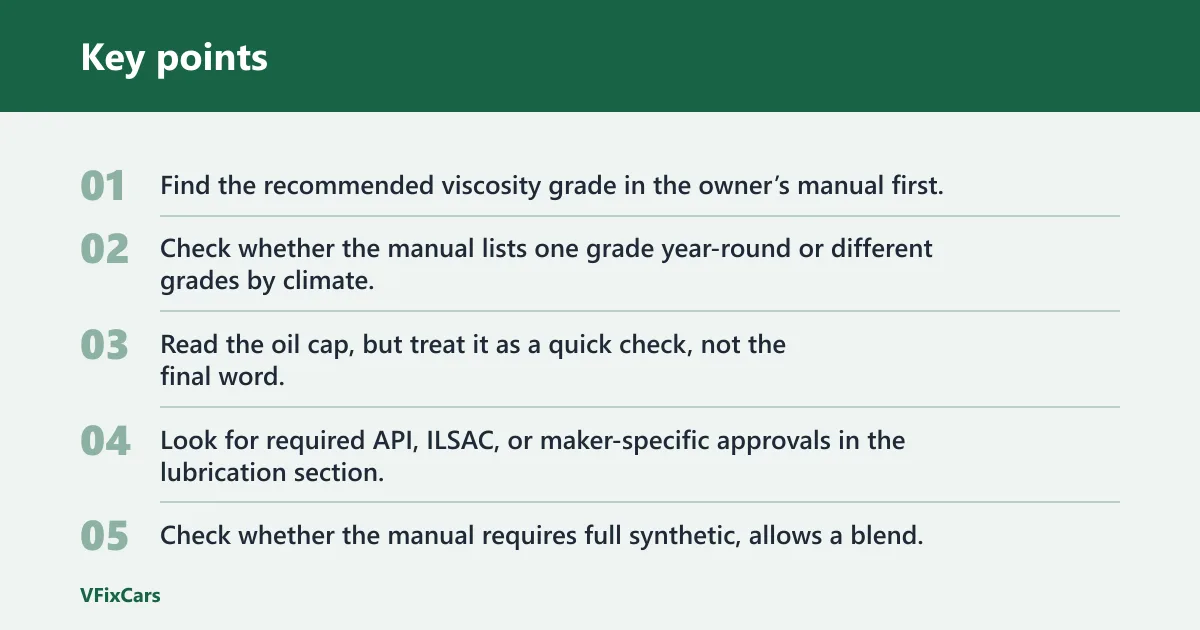
The spec on the bottle matters more because it is the non-negotiable filter before oil type even enters the discussion. Start with the owner’s manual, then verify the oil cap’s viscosity grade, then check the maintenance schedule for normal versus severe service. If the bottle misses the required spec, neither Synthetic nor conventional oil is the safe choice.
How to read the owner’s manual, oil cap, and maintenance schedule
- Find the recommended viscosity grade in the owner’s manual first.
- Check whether the manual lists one grade year-round or different grades by climate.
- Read the oil cap, but treat it as a quick check, not the final word.
- Look for required API, ILSAC, or maker-specific approvals in the lubrication section.
- Check whether the manual requires full synthetic, allows a blend, or permits conventional oil.
- Read the maintenance schedule and separate normal service from severe service.
- Match the oil filter to the planned interval, especially if longer Synthetic intervals are approved.
- Keep receipts and record mileage if the vehicle is under warranty.
Viscosity grades like 0W-20 and 5W-30
The first part of the grade addresses cold-flow behavior. A 0W oil is generally reported to flow better in cold starts than a 5W oil with the same hot viscosity, which may help reduce startup scuffing in winter.
The second number addresses viscosity at operating temperature. That hot-side grade is there for bearing clearances, oil pressure targets, and valvetrain protection, so changing it without manual approval is a bigger mistake than choosing the “wrong” oil type.
API, ILSAC, and manufacturer approvals
API and ILSAC marks are baseline checks, not automatic permission slips. Many engines also require a maker-specific approval, and that requirement can be stricter than a general API service category.
A common first-timer mistake is buying a bottle that says the right viscosity on the front label, then missing the required approval on the back. The engine may run, but the warranty and service risk sit with the owner.
Warranty and severe-service risks
Typical newer cars may have a 7,500-mile oil change interval. That number only matters if the manual or oil life monitor allows it, and severe-service use can cut that interval sharply.
Severe service usually includes repeated short trips, stop-and-go traffic, prolonged idling, dusty operation, towing, and extreme temperatures. In those conditions, the safer move often shifts toward Synthetic even when conventional oil is technically allowed.
Is synthetic oil better for your driving conditions?
Synthetic is better when your driving pattern keeps oil dirty longer, runs the engine hotter, or asks for reliable flow during cold starts. That includes short trips, stop-and-go traffic, heavy loads, very hot or cold weather, and turbocharged engines. Conventional oil remains a valid option mainly when the engine is simple, the climate is mild, and the approved interval is short anyway.
Short trips, stop-and-go traffic, and long idle time
Short trips are hard on oil because fuel dilution, moisture, and soot stay in the crankcase when the engine rarely reaches full operating temperature for long. Synthetic’s stronger oxidation and sludge resistance matter here.
The same source says synthetic oil helps vehicles in stop-and-go traffic. That fits the way repeated heat soak, idle time, and low-speed airflow stress the oil even when mileage stays low.
Highway commuting, towing, and heavy loads
Steady highway driving is easier on oil than short-hop commuting, but long high-speed heat cycles still stress conventional oil more than Synthetic. Once towing or sustained mountain grades enter the picture, Synthetic becomes the safer pick because heat stability matters more than bottle price.
The same source says synthetic oil helps when towing heavy loads. That is especially relevant for SUVs, pickups, and vans that also idle, climb, or sit in traffic after a hard pull.
Very cold starts and very hot climates
Cold weather exposes flow limits. Very hot weather exposes oxidation limits. Synthetic improves the margin on both ends.
Picture a compact crossover parked outside overnight at sub-0°F, then used for a four-mile commute with two long lights. The safest pick is the manual-approved Synthetic grade because startup flow is the main stress point, not long-run viscosity alone.
Turbocharged engines and newer tighter-tolerance engines
Turbochargers cook oil in a small, fast-spinning bearing housing after boost and shutdown. That is why AAA says Synthetic is particularly beneficial for turbocharged engines.
Many newer engines also pair turbocharging with direct injection, tighter clearances, and longer approved maintenance intervals. In that group, Synthetic is often the lowest-risk choice even before climate and driving severity are considered.
Can you switch, mix, or step down to conventional oil?
Yes, you can switch between Synthetic and conventional oil or mix them in a pinch, but only if the viscosity and required specifications still match the manual. The real danger is not the switch itself. It is stepping down to an oil that no longer fits the engine’s approval, drain interval, or service severity.
Switching from conventional to synthetic
Switching upward is usually straightforward. Synthetic oil and conventional oil can be freely switched if specs are met.
If the engine is old and dirty, the switch may reveal existing seepage or wash away deposits that were masking worn seals. That is not proof that Synthetic damaged the engine; it is a sign that the old sealing margin was already weak.
Switching from synthetic to conventional
Stepping down is safe only when the manual allows conventional oil in the required grade and approval. If the car was designed around synthetic-only specs, a downgrade can shorten the safe interval or fail the manufacturer requirement.
Suppose a newer turbo sedan calls for a maker-specific approval available only in full synthetic on the shelf at your parts store. In that case, conventional oil is not a bargain. It is the wrong product.
Mixing oils for topping off or emergencies
Mixing synthetic and regular oil is okay if each meets the manual. That makes top-offs and emergency fills manageable when exact brand matching is impossible.
Still, mixed oil is a temporary compromise, not a strategy. At the next planned service, return to one correct full-fill oil and a filter that matches the intended interval.
Older engines, seals, gaskets, and leak myths
Synthetic does not create healthy seals and then somehow make them fail. What happens in older engines is usually one of three things: existing seal wear was already there, old sludge had been slowing a seep, or gasket aging reached the point where any change in detergent action made the problem easier to spot.
That means oil choice should follow condition, not myth. If an older engine already has active leaks, heavy consumption, or years of neglected service, the first question is repair and interval discipline, not whether Synthetic is “too slippery.”
Oil choice decision matrix
| Driving pattern | Engine type | Mileage/condition | Climate | Manual requirement | Safest choice | Why this is the lowest-risk pick |
|---|---|---|---|---|---|---|
| Short trips, stop-and-go, long idle time | Non-turbo | Any mileage, no major leaks | Any | Allows all three | Synthetic | Best sludge and oxidation resistance when contamination stays in the oil longer |
| Highway commuting, light load | Non-turbo | Higher-mileage but stable | Mild | Allows conventional oil | conventional oil | Low stress use, short approved intervals, and low annual mileage can make the lower upfront cost sensible |
| Towing, mountain grades, summer hauling | Non-turbo or turbo | Any mileage | Hot | Allows Synthetic | Synthetic | Heat stability matters more than bottle cost |
| Mixed commuting and weekend errands | Non-turbo | Mid-mileage, clean, no seepage | Moderate | Allows blend | Synthetic blend | Useful middle ground when the vehicle is not severe-service most of the time |
| Seasonal vehicle with long storage and short annual mileage | Non-turbo | Older but well maintained | Variable | Allows conventional oil | Synthetic | Better resistance to oxidation and startup stress after sitting |
| Daily use with repeated cold starts | Any | Any mileage | Very cold | Allows required Synthetic grade | Synthetic | Better cold-start flow reduces startup wear risk |
| Normal driving, low yearly miles | Older non-turbo | Higher-mileage, slight dampness but no active leak | Mild | Allows conventional oil | conventional oil | Can be fully acceptable if intervals stay short and the engine does not face heat or cold extremes |
| Any mixed use | Turbocharged | Any mileage | Any | Requires synthetic or maker approval only met by synthetic | Synthetic | Turbo heat load and approval requirements leave little room for downgrades |
Lowest-risk choices by vehicle segment
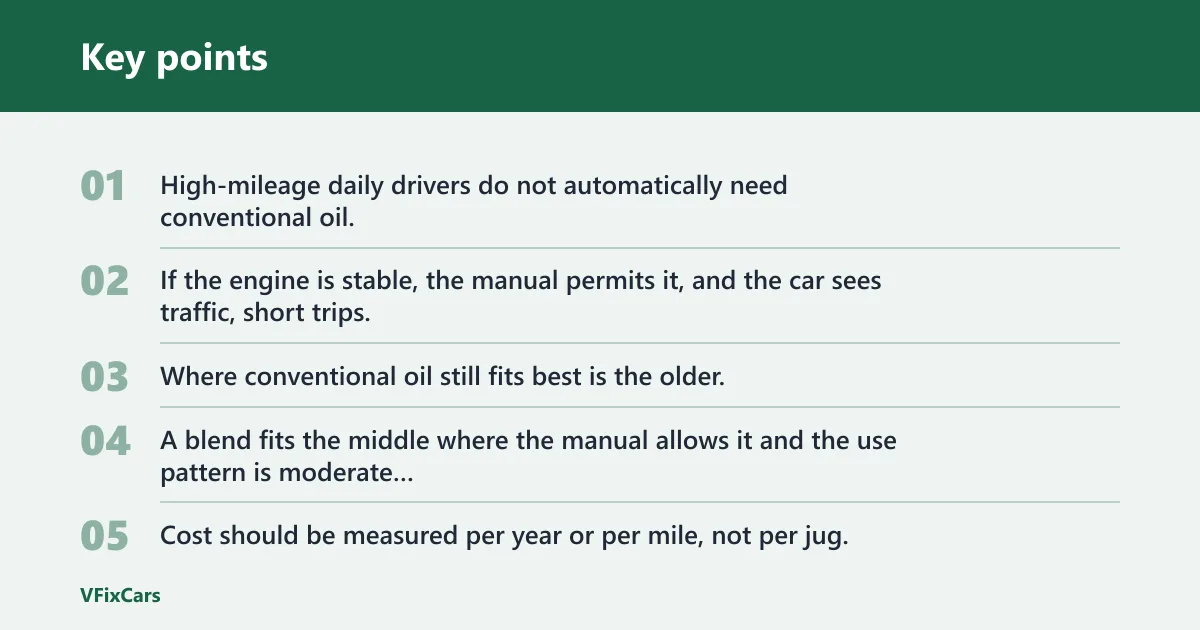
High-mileage daily drivers do not automatically need conventional oil. If the engine is stable, the manual permits it, and the car sees traffic, short trips, or weather extremes, Synthetic is often the safer call.
Where conventional oil still fits best is the older, non-turbo car in a mild climate that gets easy use, low annual miles, and short approved service intervals. A blend fits the middle where the manual allows it and the use pattern is moderate rather than severe.
Annual cost comparison
Cost should be measured per year or per mile, not per jug. Here is a worked example for a driver covering 12,000 miles per year in a vehicle that allows up to a 7,500-mile interval on Synthetic, while the owner chooses conservative 4,000-mile severe-service changes on conventional oil.
| Annual cost item | Synthetic | conventional oil | Notes |
|---|---|---|---|
| Oil per change | $36.00 | $32.40 | Uses the supplied benchmark that conventional oil is 10 percent less |
| Filter per change | $12.00 | $9.00 | Longer intervals call for a filter intended for that interval |
| Labor per change | $25.00 | $25.00 | Same shop fee in this example |
| Changes per year | 2 | 3 | Example only; the manual and oil life monitor control the real interval |
| Annual total | $146.00 | $199.20 | Synthetic comes out lower in this scenario |
| Cost per mile at 12,000 miles/year | $0.0122 | $0.0166 | Synthetic costs less per mile in this example |
That will not be true for every car. If the manual requires short intervals no matter what, or if the vehicle only sees easy use and very low yearly mileage, conventional oil may still cost less overall.
Choose Synthetic if… / Choose conventional oil if…
Choose Synthetic if…
- Your engine is turbocharged or the required approval is available only in Synthetic.
- You drive short trips, heavy traffic, tow, idle a lot, or see very hot or very cold weather.
- Your vehicle’s approved interval is longer and you plan to use a matching filter.
- You want the lowest-risk choice for deposit control, cold-start flow, and heat stability.
Choose conventional oil if…
- Your manual allows it in the exact viscosity and required specification.
- Your vehicle is an older non-turbo design used in a mild climate with easy driving.
- You follow shorter oil change intervals and do not ask the engine to tow, idle, or heat-soak often.
- Low annual mileage keeps yearly service count low enough that the lower upfront cost still wins.
Choose synthetic blend oil if…
- Your manual permits a blend and the vehicle does not live in severe service.
- You want some extra temperature and deposit margin without jumping to full Synthetic.
- You drive mixed suburban miles rather than constant towing, deep-cold starts, or turbo heat.
Frequently asked questions
Is synthetic oil better than conventional oil for my car?
Usually yes if the car is turbocharged, sees short trips, heavy traffic, towing, or temperature extremes. No if “better” means only cheaper upfront for a simple older engine in mild use. The deciding factors are the manual’s specs, the vehicle design, and how severe the service really is.
Can I use conventional oil instead of synthetic oil?
Only if the manual allows conventional oil in the exact viscosity and required approvals. If the vehicle specifies full synthetic, a maker-specific approval only found on Synthetic, or a service pattern that clearly falls into severe use, stepping down raises risk even if the engine seems to run normally.
Can I switch from synthetic to conventional oil safely?
Yes, if the replacement oil still meets every manual requirement for viscosity and specification. The switch itself is not the problem. The problem is using conventional oil where the engine, interval, climate, or warranty requirement really calls for Synthetic or for an approval conventional oil does not meet.
Does synthetic oil cause leaks in older engines?
No, Synthetic does not create seal damage on its own. What it can do is reveal pre-existing seepage, especially where worn seals or sludge deposits had been masking a leak path. If an older engine already has wet gaskets, the issue is condition and maintenance history, not a blanket ban on Synthetic.
How often should I change synthetic vs conventional oil?
Follow the manual and the oil life monitor, then adjust for severe service when the schedule says to. Synthetic often supports longer approved intervals, while conventional oil usually fits shorter ones, but there is no universal mileage rule that overrides the vehicle’s schedule and filter requirement.
Is synthetic oil worth the extra cost?
It often is once change frequency, filter choice, labor, climate, and driving severity are added up. In the worked example above, Synthetic costs more per change but less per year. If your car is lightly used, non-turbo, and approved for short intervals on conventional oil, the extra cost may be unnecessary.