Oil Change vs Oil Filter Change: Do You Need Both?
Change both if the oil is old or overdue; a filter-only fix is enough only when the oil is still fresh and the filter is wrong, clogged, or leaking. Skipping the right fix can leave dirty oil in place or trigger low oil pressure. This guide shows how to choose between oil, filter, or both.
| Decision factor | Oil change | oil filter change | Winner |
|---|---|---|---|
| Oil age and contamination | Replaces aged, heat-stressed, or dirty oil | Leaves old oil in place | Oil change |
| Fixes a wrong or leaking filter | Usually fixes it if the service includes a new filter | Direct fix for the fault | oil filter change |
| Removes sludge and trapped debris | Drains contaminated oil from the sump | Only helps if the oil is still clean enough to keep | Oil change |
| Cost efficiency for routine service | Higher than a filter-only fix | Cheaper when oil is still serviceable | oil filter change |
| Best fit for overdue maintenance | Matches overdue oil, time-based service, and severe use | Usually not enough on its own | Oil change |
| Best fit for fresh oil with a bad filter install | Works, but may be more than needed | Right-size repair | oil filter change |
Oil and filter basics
What engine oil does and why it ages
Engine oil cuts friction, carries heat away, and keeps moving parts apart. Heat, pressure, and contamination break it down, so mileage is only part of the picture; time matters too, even if you drive little. Common oil types include conventional, synthetic, synthetic blend, and high-mileage.
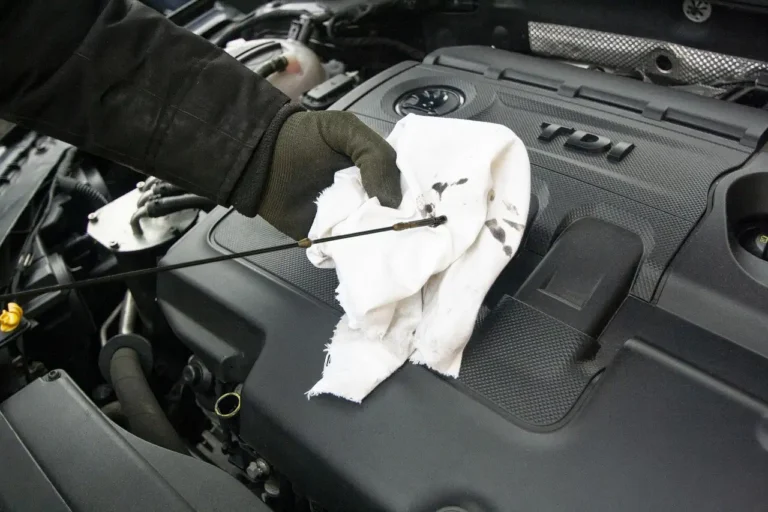
A dipstick check on level ground tells you whether the oil level and condition look acceptable. Dark brown oil can still be normal in some engines, but gritty oil, a burned smell, or visible sludge calls for service. Consumer Reports says to check oil at least once a month or every other fill-up.
What the oil filter catches
The oil filter traps debris and contaminants before they go back through the engine. Auto Hub Community says filters can trap particles as small as 20 to 40 microns, which is why a clogged or badly installed filter can matter quickly. If the filter clogs, oil may bypass the media to keep flow going, but that is a fallback, not a cure.
Most small cars hold about 3.5 to 5 liters of oil, while an oil filter usually holds only 200 to 500 milliliters. That small volume is one reason a filter change alone can make sense in narrow cases, but not when the oil itself is old or contaminated.
Why the two are usually serviced together
Oil and filter are a matched service. FixMyCar says engine oil and filter changes are typically done together every 3,000 to 5,000 miles, and a filter change with the oil should cost only slightly more. That makes the combined service the cleanest choice when the oil has aged out.
A common first-timer mistake is to treat a warning light as one universal order. Some service reminders track mileage and driving severity, while others track oil life, and some lamps point to a fault code instead of routine maintenance.
Do you need both?
Yes when the oil is old, dirty, or past the interval that fits the vehicle’s manual or service minder. A filter-only repair is generally a fit for a narrower case: the oil is still fresh, but the filter is wrong, leaking, clogged, or badly installed. Top-up is separate again; it adds oil level, not a full renewal.
When old oil means both parts should be changed
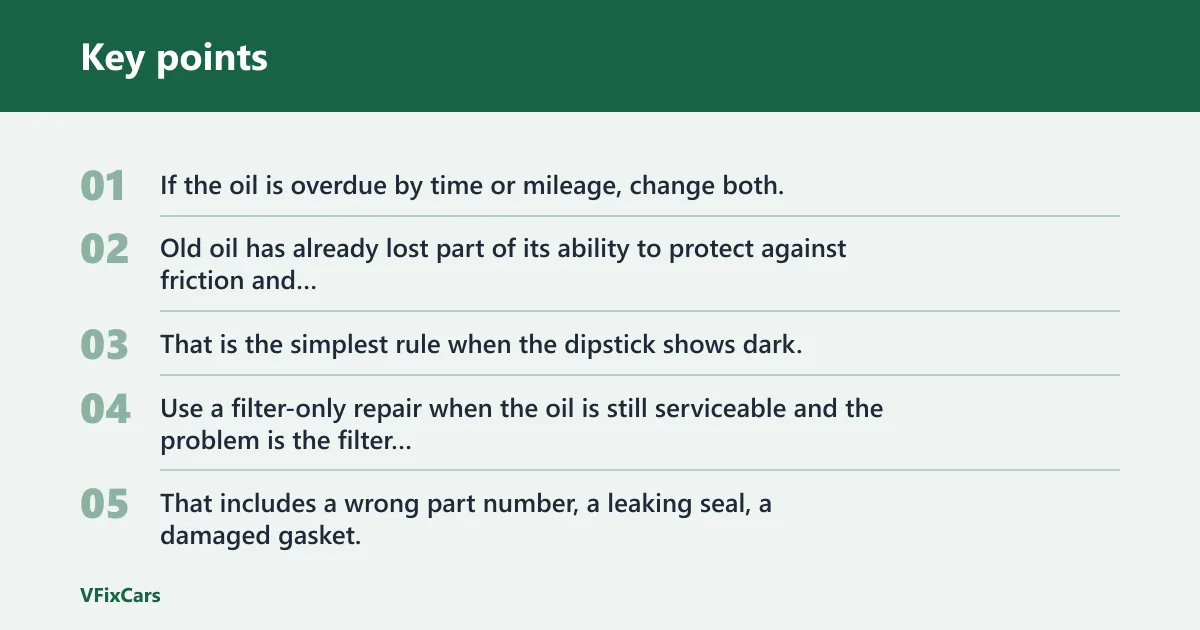
If the oil is overdue by time or mileage, change both. Old oil has already lost part of its ability to protect against friction and contamination, and a new filter cannot restore oil that has aged out. That is the simplest rule when the dipstick shows dark, gritty oil or the service minder says the oil life is low.
When a filter-only fix can be enough
Use a filter-only repair when the oil is still serviceable and the problem is the filter itself, not the lubricant. That includes a wrong part number, a leaking seal, a damaged gasket, or a filter that was installed poorly and is seeping after a recent oil change. It is a repair, not routine maintenance.
When topping up is the right move
Top up when the oil level is low but the oil still looks usable and the service interval is not yet due. The same source notes that some cars need oil topped off between changes, and top-ups are cheaper than oil changes. Topping up restores level; it does not drain dirty oil or replace the filter. (Consumerreports)
Suppose the dipstick is just below the minimum mark after a long motorway trip, but the oil is otherwise clean and the manual interval is not close. Adding the correct oil to the full mark is the right short-term move. A full oil change can wait if there are no other symptoms.
Oil filter decision matrix
| Scenario | Oil age/mileage | Filter condition | Recommended action |
|---|---|---|---|
| Fresh oil but wrong filter installed | Recent oil change, within interval | Wrong part fitted | oil filter change |
| Dark oil and clogged filter | Overdue by time or mileage | Clogged or bypassing | Oil change |
| Recent oil change with leaking seal | Fresh oil, recently serviced | Seal leak or pinched gasket | oil filter change |
| Severe-duty driving with no symptoms yet | Interval may be shortened by short trips, loads, dust, or traffic | No visible fault yet | Oil change |
| Low dipstick level, oil still clean | Still within service life | No filter complaint | Oil top-up |
| New filter needed after bad install | Fresh oil | Cross-threaded, loose, or double-gasketed | oil filter change |
| Oil smells burnt and looks gritty | Aged out | May also be clogged | Oil change |
| Service minder requests routine maintenance | Due by system logic or manual | No filter fault known | Oil change |
These rows separate the three decisions that get blurred most often. If the oil is still good but the filter is wrong or leaking, choose the oil filter change. If the level is the only issue, top up.
How to read the dipstick and service minder
Checking oil level on level ground
Park on level ground and follow the owner manual for the correct check method. Some cars want the engine off for a few minutes; others have a specific hot or cold check. A clean dipstick reading should sit between the minimum and maximum marks.
- Park on level ground.
- Switch off the engine and wait as directed by the manual.
- Pull the dipstick, wipe it, reinsert it fully, then pull it out again.
- Check the level and look at the color and feel.
- Top up only if the level is low and the oil still looks serviceable.
What dark, brown, or gritty oil means
Dark oil alone is not automatic proof of trouble. The same source says dark oil is not always bad, but oil should be changed when worn or aged out. Gritty oil, thick sludge, or a strong fuel smell is a stronger warning than color alone.
Picture a compact car that has only done a few thousand miles but sits in short-trip city use. The oil may darken quickly because of condensation and repeated warm-up cycles, and the service interval can come sooner than the odometer suggests.
What the dashboard reminder can and cannot tell you
A service minder is useful, but it is not all the same thing. The same source says some reminders track mileage and driving severity, while others may be tied to oil life or maintenance scheduling. A warning lamp is a prompt to check the manual, not a one-step answer.
If the dashboard says service is due, use the owner manual plus the dipstick. If the oil level is low, top up first. If the oil is old or the reminder is paired with time and mileage due, schedule a full oil change.
When to change oil and filter
Mileage and time intervals
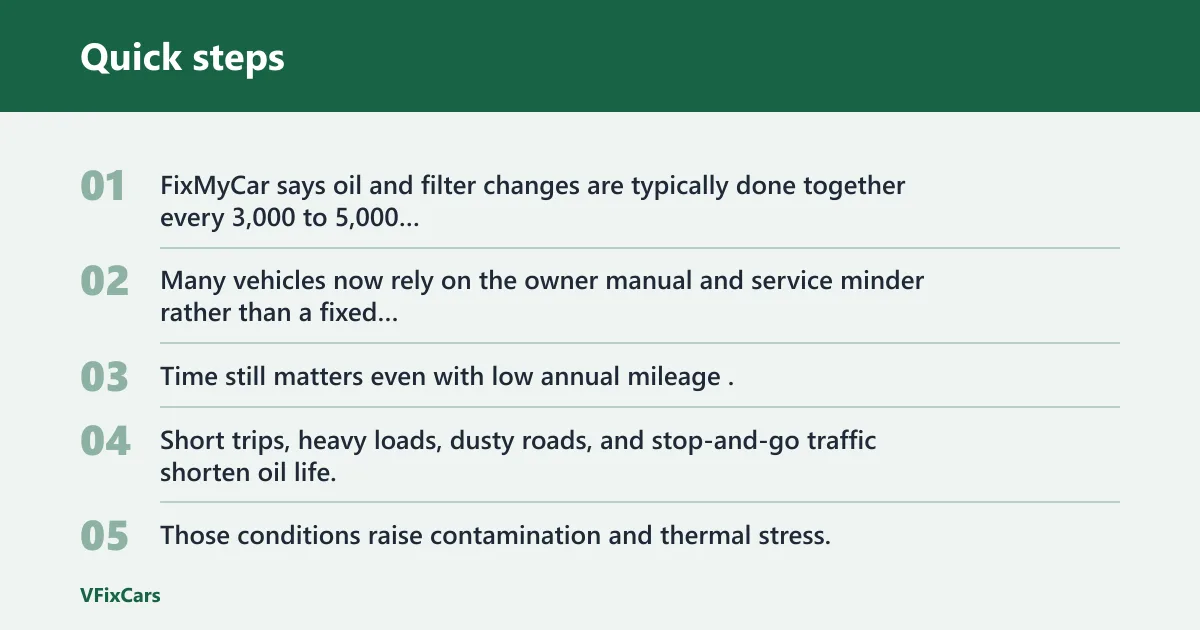
The same source says oil and filter changes are typically done together every 3,000 to 5,000 miles, but modern schedules can be longer or shorter depending on the engine and oil type. Many vehicles now rely on the owner manual and service minder rather than a fixed old-rule interval. Time still matters even with low annual mileage.
Why severe driving shortens the interval
Short trips, heavy loads, dusty roads, and stop-and-go traffic shorten oil life. Those conditions raise contamination and thermal stress, so the oil ages faster and the filter works harder. If the vehicle lives in those conditions, do not wait for symptoms before checking service timing.
How owner manual guidance fits modern service schedules
The manual comes first because it matches the engine design, oil spec, and service logic for that model. A dashboard reminder may support that schedule, but it does not replace it. If the manual says a different interval from a habit-based rule, follow the manual.
Can you change only the oil filter?
Yes, but only in narrow cases. If the oil is still fresh and the fault is the filter itself, changing only the oil filter can solve the problem without draining healthy oil. If the oil is old, contaminated, or overdue, a filter-only service leaves the main problem untouched.
Cartridge and spin-on filter differences
Spin-on filters usually thread off as a sealed canister. Cartridge filters often sit in a housing with an element and O-rings. The housing design matters because access, sealing surfaces, and residual oil can make a filter-only repair more or less practical on a given vehicle.
Housing residue and sealing surfaces
Cartridge housings can hold residual oil, old O-rings, and debris on the sealing surface. If those are not cleaned and fitted correctly, a fresh filter can still leak. That is why a filter-only fix needs the right part, the right seal, and proper seating.
When a filter-only service is justified
Choose it when the oil is still within its useful life, the level is fine, and the only issue is the filter or its installation. A recent oil change with a leaking seal is the cleanest example. A wrong filter, a pinched gasket, or a loose housing also fits this path.
Oil top-up versus full service
Top-up is the cheapest move because it adds oil, not a full drain-and-refill. That matters when the level is low but the oil is still serviceable. It is not a substitute for maintenance when the oil has aged out or the filter is clogged.
What top-up fixes
Top-up restores oil level back to maximum. That can quiet a low-oil warning, reduce aeration risk, and keep the pump fed. It is useful when the engine has a small, normal consumption rate between services.
What top-up cannot fix
Top-up does not remove contaminants, old additives, or wear metals. It also does not correct a bad filter, a leak at the housing, or a service interval that is already overdue. If the oil is dirty or the filter is suspect, topping up only postpones the real repair.
How much oil capacity matters
Capacity changes the practical impact of each decision. With a small-car system that holds about 3.5 to 5 liters, adding a little oil can make a visible difference on the dipstick. A filter housing may only hold 200 to 500 milliliters, so a filter-only service is small compared with a full oil service.
Choose Oil change if…
Choose Oil change if the oil is old, dark and gritty, overdue by the manual, or exposed to severe driving conditions that shorten service life. It is also the right pick when the service minder points to routine maintenance and you do not have a separate filter fault to isolate.
Choose oil filter change if…
Choose oil filter change if the oil is still fresh but the filter is wrong, leaking, badly installed, or clearly the source of the problem. This is the repair path for a recent service that needs correction, not a routine replacement of aged oil.
Choose top-up only if…
Choose a top-up only when the dipstick shows a low level, the oil still looks serviceable, and the service interval is not yet due. The same source notes that some cars need oil topped off between changes. That is a level fix, not a maintenance reset.
Frequently asked questions
Do you need to change the oil filter every time you change the oil?
Usually, yes. Changing the filter with the oil is the normal practice because the filter has collected debris from the old oil, and FixMyCar says the added cost should be only slightly more. A filter change alone is only reasonable when the oil is still fresh and the filter is the problem.
Can you change just the oil filter without draining the oil?
Yes, if the oil is still serviceable and the filter needs correction or replacement. That is common after a bad install, a wrong part, or a leaking seal. It is not the right answer when the oil itself is overdue, dirty, or contaminated.
What happens if you change the oil but not the filter?
The new oil can pick up debris left in the old filter and housing. That limits the benefit of the service and may shorten the life of the fresh oil. If the filter is clogged, flow can be restricted or routed through bypass mode, which is not ideal for engine protection.
How often should an oil filter be changed?
Most owners should change it with the oil, which FixMyCar says is typically every 3,000 to 5,000 miles for the broad rule of thumb it cites. Modern vehicles may use different intervals based on the owner manual or service minder, especially with synthetic oil and variable maintenance schedules.
Is it okay to top up oil instead of doing a full oil change?
Yes, but only when the oil is still good and the issue is level, not age. The same source notes that some cars need oil topped off between changes. Topping up is cheaper than a full oil change, but it does not replace dirty oil or an overdue filter.
What signs mean the oil filter is clogged or overdue?
Warning signs include low oil pressure, a filter that looks damaged or poorly fitted, oil leaks at the housing, and service history that shows the filter has been left in place too long. A clogged filter can also force oil into bypass mode, which reduces filtration quality.
Can a dirty oil filter cause low oil pressure or engine damage?
Yes, if it is clogged enough to restrict flow or if it is installed badly and leaks oil. The same source says most passenger cars normally run around 20 to 60 PSI, so a filter problem that affects flow can matter. Low pressure and contaminated oil together raise the risk of wear.