Why Is Tire Rotation Important?
Tire rotation matters because it evens out wear across all four tires. That helps preserve grip, steering response, and tire life. Many vehicles call for a rotation interval in the roughly 5,000- to 8,000-mile range, but the owner’s manual sets the rule. Skip it, and one axle can wear faster, tire life drops, and wet traction suffers. This guide explains why rotation matters, how wear patterns differ by drivetrain and tire type, and what warranty wording to check.
Why tire rotation matters
Tire rotation matters because tire wear rarely stays even. Front tires often wear faster since they handle most steering and braking load, so the vehicle can slowly develop mismatched tread depths that change grip and response. Once that wear pattern starts, the problem can spread into noise, pull, vibration, and shorter tire life.
How uneven wear starts
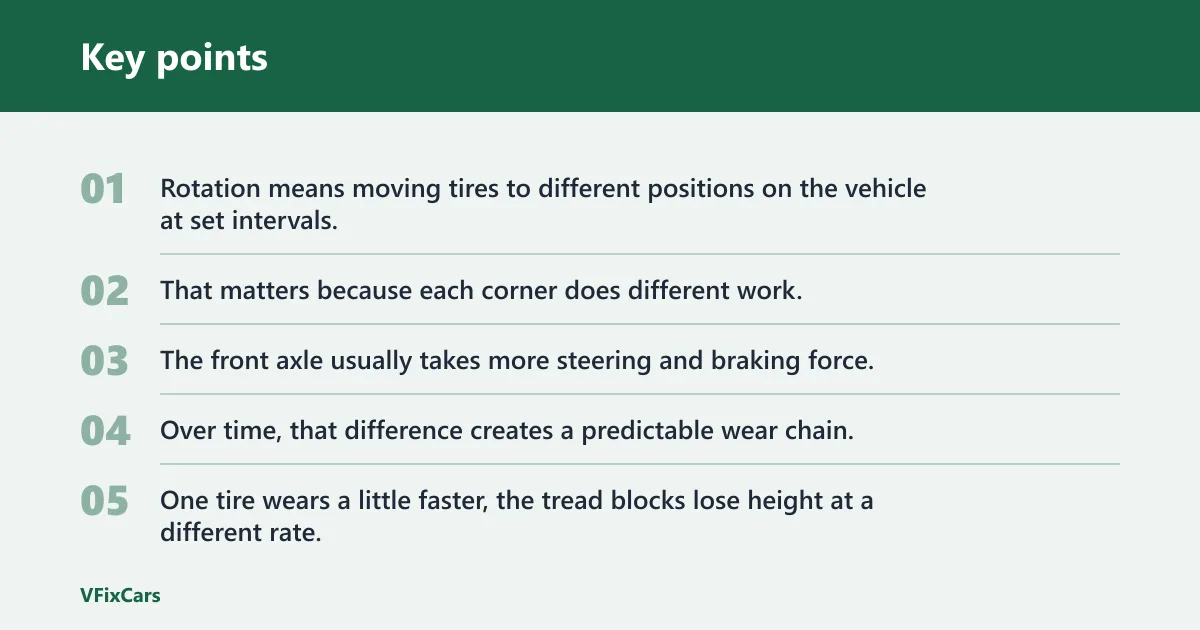
Rotation means moving tires to different positions on the vehicle at set intervals. That matters because each corner does different work. The front axle usually takes more steering and braking force, while the rear axle may carry a different share of load and road scrub. Over time, that difference creates a predictable wear chain.
That chain is simple. One tire wears a little faster, the tread blocks lose height at a different rate, and the set stops behaving as evenly. The result is not always dramatic at first. But the car may begin to feel less settled in wet turns, less precise on center, or more prone to vibration as the mismatch grows.
How wear affects traction and handling
Uneven tire wear can reduce traction and handling because tires with less tread depth cannot clear water as well and may lose bite sooner under braking or cornering. A front-heavy wear pattern can also change how the car responds to steering input. In plain terms, the car may feel less predictable.
Suppose your front pair is worn much more than the rear pair on a front-wheel-drive sedan. The car may still drive normally on dry pavement, yet it can develop more road noise and feel less stable in rain because the tread mismatch is no longer doing the same work at each end.
How skipped rotation creates a wear cascade
Skipped rotation can turn a routine service into a chain of symptoms. Uneven wear can lead to drag, which can reduce gas mileage. It can also make balancing problems more obvious and can hide damage or embedded objects until they become harder to ignore. That is why the service visit matters, not just the tire swap.
Tire wear and performance

Tire wear affects more than tire life. When tread depth differs from corner to corner, the vehicle can pick up noise, pull slightly to one side, or vibrate at speed. Longer stopping behavior can also appear if one tire set has less usable tread or poorer water evacuation than the other set.
Why front tires often wear faster
Front tires often wear faster because they do most steering and braking. On many vehicles they also carry more of the workload during weight transfer when slowing down. That extra stress means the front pair can lose tread before the rear pair, even if the vehicle is driven carefully and the alignment is close to spec.
How wear can affect braking feel
When the tires do not match well, braking feel can change. The vehicle may still stop, but the driver can notice less consistent response as the worn tires reach their limit sooner. This is one reason rotation is tied to performance, not just tire life. It helps keep the whole set working at a similar level.
How mismatch can cause noise, pull, or vibration
Noise often increases when tread blocks wear unevenly or cup. Pull can happen when one side of the vehicle has more grip or a different rolling resistance. Vibration can appear when the tread wear pattern makes one tire harder to balance. A rotation visit can reveal whether rebalancing is needed.
| Driving condition | Likely effect if rotation is skipped | What you may notice |
|---|---|---|
| Front-heavy daily driving | Front tires wear faster | Pull, steering change, more front noise |
| Wet-road commuting | Uneven tread depth | Less confident wet grip |
| Long highway use | Tread mismatch builds slowly | Vibration at speed, more hum |
| Older tires with low tread | Wear pattern becomes harder to hide | Shorter stopping behavior, more sensitivity to balance |
How often should you rotate?
A common interval is about 5,000 miles, but the owner’s manual is the primary source for your vehicle’s schedule and pattern. Many manufacturers also list a wider range, often around 5,000 to 7,500 miles, and some vehicles fall outside that depending on drivetrain, tire type, and driving conditions.
Why 5,000 miles is common
Bridgestone recommends rotating tires as recommended by the manufacturer, or every 5,000 miles, and many drivers line it up with an oil change. That makes the service easier to remember, but the interval itself should still come from the manual or tire documentation when those instructions are more specific.
How the owner’s manual changes the answer
Your owner’s manual may specify both a rotation pattern and an interval. That matters because not every vehicle wears tires the same way. The manual is the first place to check when you want the right answer for your car, especially if the vehicle has staggered fitment, directional tires, or a specialized drivetrain.
How driving conditions and tire type change the interval
Passenger cars may need rotation every 5,000 to 8,000 miles. SUVs and light trucks may go 7,500 to 10,000 miles. Those ranges are not a license to wait longer on every vehicle; aggressive driving, heavy loads, frequent short trips, and soft-compound tires can all shorten the practical interval.
A common first-timer mistake is assuming the front tires can stay in place until one side starts vibrating or pulling. By then, the wear pattern may already be locked in. Rotation works best before the mismatch becomes large enough to feel in the steering wheel or hear as road noise.
Rotation patterns and limits
Rotation patterns matter because tire wear is not symmetrical across every axle or tire type. The right pattern depends on drivetrain, tire design, and whether the tires are directional or staggered. Some patterns can be used widely, while others only fit certain vehicles or tire setups.
Front-to-back pattern
A front-to-back pattern moves tires on the same side between axles. This is often the simplest option when tire design allows it. It can help even out the front-axle wear seen on many vehicles without changing the tire’s rotation direction or side position.
Side-to-side pattern
Side-to-side rotation swaps left and right tires on the same axle. This is sometimes used on specific tire setups, but it is not always suitable for directional tires because directional tread is designed to roll in one direction. Check the sidewall markings before using this pattern.
Cross-pattern options
Cross-pattern rotation moves tires across the vehicle as well as front to rear. This can help balance wear on many non-directional setups, especially where the drivetrain or tire wear pattern calls for a more complete swap. The owner’s manual should tell you whether a cross-pattern is approved.
When directional or staggered tires restrict rotation
Directional tires are made to roll in one direction, so some rotation patterns are off-limits. Staggered setups, where the front and rear tire sizes differ, may limit rotation even more. In those cases, the correct answer may be a partial rotation or no rotation at all. The manual and tire sidewall guide that decision.
Is rotation necessary for your drivetrain?
Yes, but the details depend on drivetrain. FWD, RWD, AWD, and EVs do not always wear tires in the same way, and the approved pattern can differ too. The question is not whether rotation matters in principle. The question is how often and in what pattern your vehicle needs it.
FWD schedules and wear concerns
For FWD vehicles, the front tires usually wear faster because they handle steering, braking, and much of the drive force. That makes rotation especially useful. If the fronts are left in place too long, the tread mismatch can become obvious in wet traction, braking feel, and steering response.
RWD schedules and wear concerns
RWD vehicles often load the rear tires more heavily during acceleration, but the front tires still do much of the steering and braking. That means wear can still become uneven, just in a different pattern. The manual may recommend a different route for the tires than a front-drive vehicle would use.
AWD and EV checks
AWD vehicles often need closer attention because mismatched tread depth can matter more to the system. EVs can also be hard on tires because of vehicle weight and instant torque. For both, rotation timing and pattern should follow the owner’s manual, and some manufacturers are stricter about tire size and tread matching than others.
Tire rotation checklist
Rotation should not be only a position change. A proper visit is also a quick tire health check. Bridgestone notes that rotation is a chance to check air pressure, tread depth, and vibration-related rebalancing issues, and AutoEMC notes it is also a chance to look for nails, dry rot, and other damage.
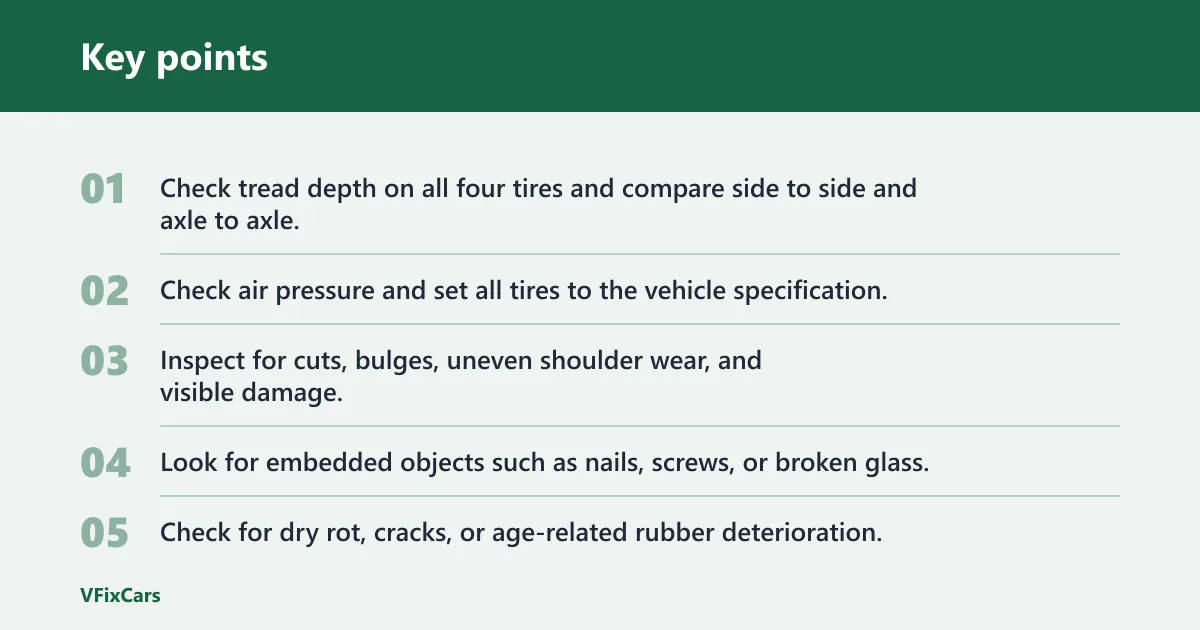
- Check tread depth on all four tires and compare side to side and axle to axle.
- Check air pressure and set all tires to the vehicle specification.
- Inspect for cuts, bulges, uneven shoulder wear, and visible damage.
- Look for embedded objects such as nails, screws, or broken glass.
- Check for dry rot, cracks, or age-related rubber deterioration.
- Note any vibration, pull, or noise that may point to balancing or alignment work.
- Use the manual-approved rotation pattern and document the service if warranty coverage depends on it.
When balancing or alignment may matter
Rotation can reveal a problem that was easy to ignore before. If vibration shows up after the tires change positions, or if the wear pattern is already uneven, the next step may be balancing or alignment. Rotation does not fix those issues by itself, but it often exposes them sooner.
Do I really need rotation now?
| Drivetrain | Tire type | Tread mismatch | Vibration | Recent alignment work | Warranty requirement | Recommended next action |
|---|---|---|---|---|---|---|
| FWD | Non-directional | Yes | No | No | Yes | Rotate now; document service |
| RWD | Non-directional | No | Yes | No | No | Rotate and check balance |
| AWD | Directional | Yes | No | Yes | Yes | Check manual first; use only approved pattern |
| EV | Non-directional | No | Yes | No | Unknown | Rotate and inspect for uneven wear |
Simple yes/no scoring rule: give yourself 1 yes for each of these signs: visible tread mismatch, vibration, over-5,000 miles since the last rotation, or a manual or warranty requirement for service. If you have 2 or more yes answers, rotation is due now. If you have 1 yes, check the owner’s manual and tire condition before waiting. If you have 0 yes answers, follow the manual interval.
Does rotation affect fuel economy?
Yes, but the effect is indirect. Unevenly worn tires can create drag, and drag can reduce gas mileage. Rotation does not create a fuel-economy miracle. It simply helps prevent the mismatch that makes a tire harder to roll than the rest of the set, especially when wear has become uneven enough to matter.
How mismatched wear adds drag
When one tire wears differently, it can roll with more resistance than the others. That extra resistance is drag. A small difference may be hard to notice at first, but over time the vehicle may need a little more effort to keep moving smoothly, especially if the wear pattern is widespread across the axle.
Why the gain is indirect
Rotation helps by keeping tread wear more even, not by changing engine efficiency. The fuel benefit comes from avoiding the extra resistance that a badly worn or mismatched tire set can create. That is why the claim should stay modest: rotation may help preserve mileage when uneven wear would otherwise add drag.
When poor alignment matters more
If the vehicle is out of alignment, rotation alone will not solve the root cause. A poor alignment can continue to create fast, uneven wear even after the tires are moved. That is why a rotation visit should include a look for pull, abnormal wear, and any reason the tires are wearing unevenly in the first place.
What happens if you don’t rotate your tires?
If you do not rotate your tires, the wear pattern usually becomes more uneven, and the vehicle may develop noise, pull, vibration, and shorter tire life. In some cases the difference also becomes visible in wet traction and braking response. The longer rotation is delayed, the more the mismatch can affect daily driving.
Say your compact SUV runs 235/55R18 tires and the front pair is much more worn after repeated city commuting. The steering may begin to feel less precise, and the front end may make more noise on rough pavement. That is the wear chain showing up in normal driving, not a sudden failure.
Some tire warranties also require documented proof of rotation service. Missing that service can affect coverage if a wear-related issue is later claimed. The exact language varies, so the tire maker’s maintenance requirement matters as much as the mileage interval.
Frequently asked questions
Why is tire rotation important for vehicle performance?
Tire rotation is important for vehicle performance because it helps keep tread depth closer across all four tires. That supports steadier traction, more consistent steering response, and more predictable braking feel. When the wear pattern is ignored, the vehicle can become noisier, less balanced, and less stable in wet conditions.
Why is tire rotation important in vehicle maintenance?
Tire rotation is important in vehicle maintenance because it is one of the cheapest ways to interrupt a predictable wear pattern before it turns into a bigger problem. It also creates a regular inspection point for pressure, tread depth, embedded objects, dry rot, and early vibration issues that may need rebalancing.
Is tire rotation necessary for AWD?
AWD vehicles often need rotation because matched tread depth matters more to the system than it does on some other drivetrains. The exact interval and pattern depend on the vehicle, so the owner’s manual should be the first reference. Some AWD systems are sensitive to tire mismatch, so delay can matter more.
Is tire rotation necessary for FWD?
FWD vehicles usually benefit from rotation because the front tires carry heavy steering, braking, and drive loads. Those tires often wear faster than the rear pair. Regular rotation helps keep the front and rear wear more even, which can reduce pull, improve consistency, and slow the march toward replacement.
Is tire rotation necessary for RWD?
RWD vehicles also need rotation because the rear tires do not wear in exactly the same way as the fronts. The rear pair may see more acceleration load, while the front pair still handles steering and braking. Rotation helps keep the wear pattern balanced and makes noise or vibration easier to spot.
Does tire rotation improve gas mileage?
Tire rotation can help gas mileage indirectly by reducing the drag created by uneven wear. It does not usually create a dramatic mpg change by itself. The larger benefit is that it prevents a worn or mismatched tire from working harder than the rest, which can otherwise add rolling resistance.
What is the reason for tire rotation?
The reason for tire rotation is to spread wear so one axle does not age much faster than the other. That helps preserve traction, handling consistency, and tire life. It also gives a regular chance to catch pressure issues, damage, embedded objects, and wear problems before they become expensive.