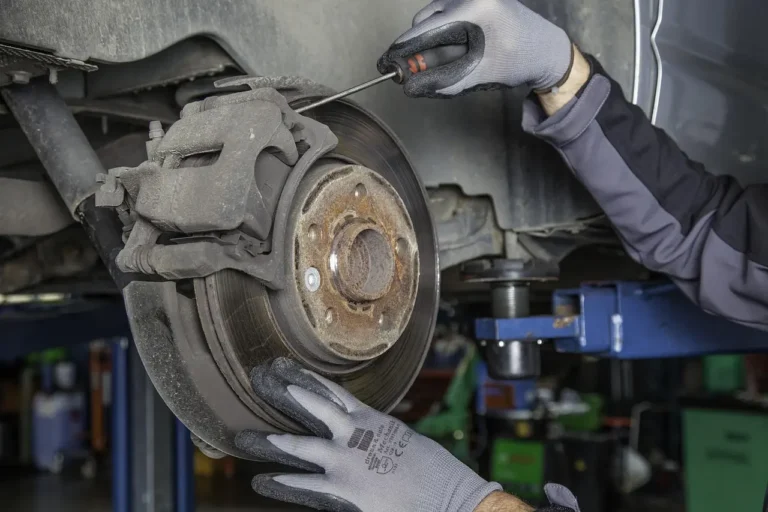
Why do tires wear on the outside? Common causes and fixes
Outer-edge tire wear usually points to different faults by pattern: both outer shoulders worn on one tire points to chronic underinflation, while one side or one axle points more often to alignment or worn suspension, especially excess positive camber or toe-out. Ignore it, and tire life drops fast, while wet grip falls with it. This guide shows how to read the wear pattern and choose the next check.
This guide is part of our Tires: how to choose safe tires for your car series.
What outside-edge tire wear looks like
Outside-edge wear means the outer shoulder of the tread is shallower than the rest of the tire. It differs from center wear, which points more toward overinflation, and from inside-edge wear, which often tracks with camber or toe problems on the opposite side of the tread.
Start by comparing left to right and front to rear. Measure tread depth in the worn zone and in the center with a gauge in mm or 32nds. If one shoulder is much lower than the rest, the pattern matters more than the exact mileage.
Outer shoulder wear vs inside-edge wear
Outer shoulder wear usually means the tire is running on its outside edge too much. Inside-edge wear usually means the opposite geometry problem, where the wheel leans inward or scrubs at a different angle. A tire with wear on both edges at once is a different clue and often points to pressure or load issues.
How to tell wear from one tire to the next
Look for symmetry. Both fronts worn on the outside, only one rear, or only the left front each suggest different causes. A common first-timer mistake is to blame all four tires on the same fault when the wear is telling you which axle or corner is misbehaving.
📊 The article says new tires should be driven carefully for the first 150-200 miles. Source: Why Do New Car Tires Wear Out So Fast? Best 3 Lines.
Why do tires wear on the outside?
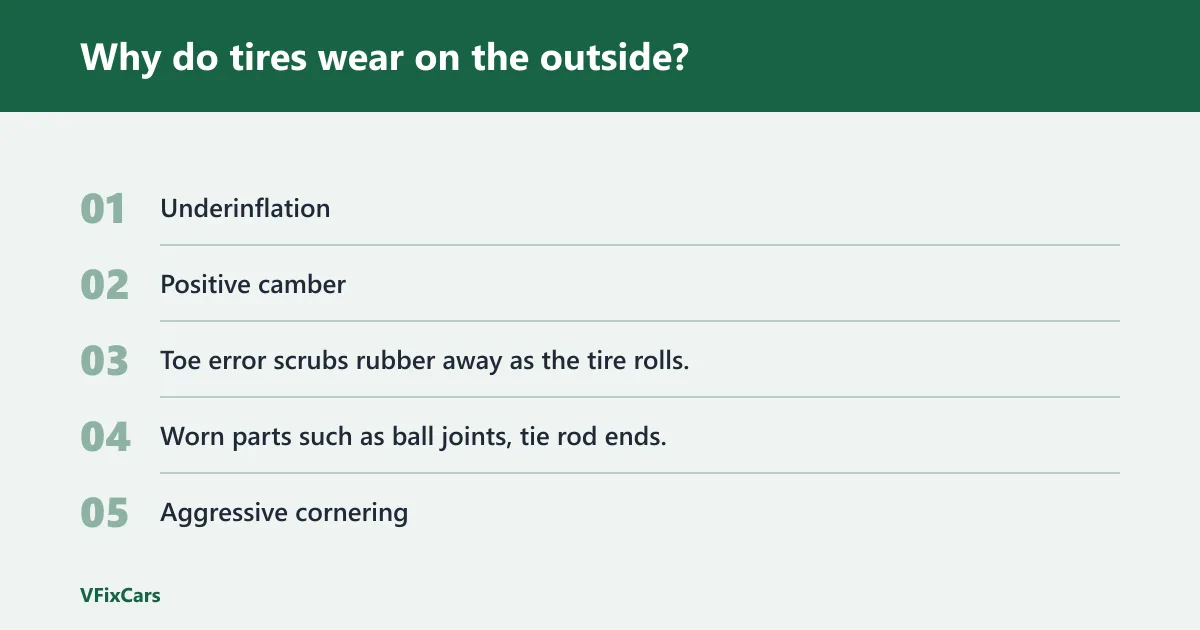
Outside wear usually comes from the tire leaning or scrubbing in a way that loads the outer shoulder too much. Incorrect pressure, alignment faults, and worn steering or suspension parts are the main causes. The wear location matters more than the fact that the tire is simply “worn.”
The most common causes at a glance
- Underinflation spreads the contact patch outward and loads the shoulders.
- Positive camber puts more load on the outside edge.
- Toe error scrubs rubber away as the tire rolls.
- Worn parts such as ball joints, tie rod ends, or control arms let the angles drift under load.
- Aggressive cornering, hard braking, and repeated pothole hits speed the damage.
Why wear location matters more than the wear itself
Outside wear on both front tires is not the same diagnosis as outside wear on one rear tire. Alignment issues can set each wheel at a different angle, which changes the wear pattern. Outside tire wear can also point to caster trouble or wrong tire pressure.
Use wear location to narrow the fault
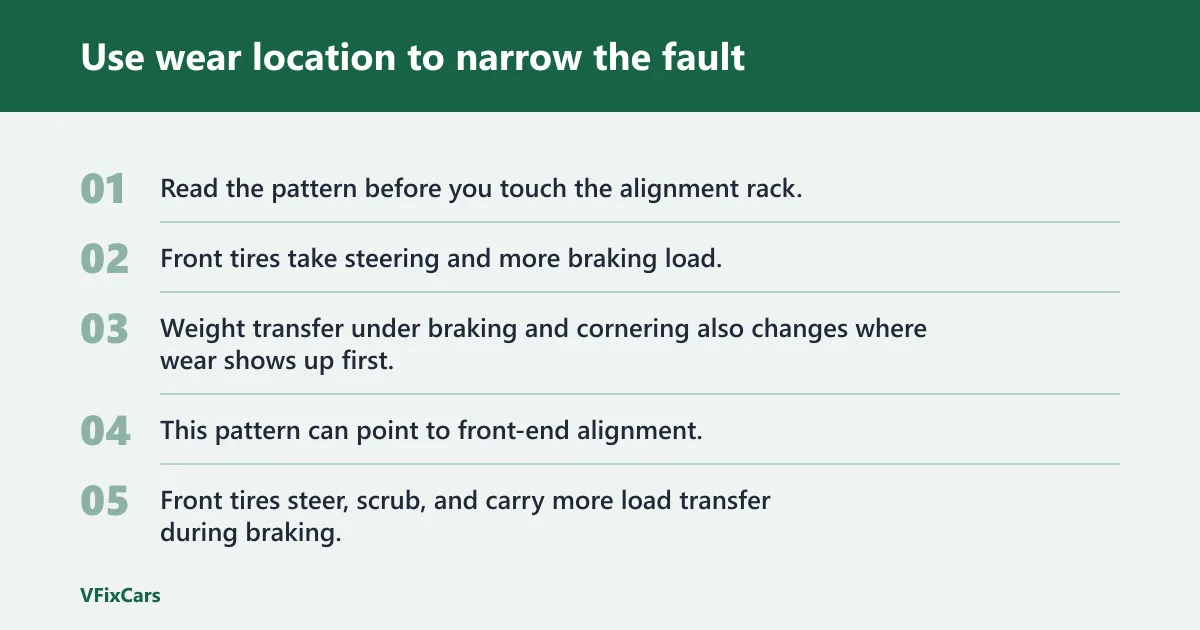
Read the pattern before you touch the alignment rack. Front tires take steering and more braking load, while rear tires usually wear less unless they are carrying a load, have a geometry issue, or are being pushed hard by rotation neglect. Weight transfer under braking and cornering also changes where wear shows up first.
Both front tires worn on the outside
This pattern can point to front-end alignment, especially too much positive camber or toe-out, along with possible steering play. Front tires steer, scrub, and carry more load transfer during braking, so small faults show up faster here than at the rear.
Both rear tires worn on the outside
Rear outer wear is more likely to point to rear camber, rear toe, or heavy loading. It is also common on vehicles that tow, carry cargo often, or run with rear suspension wear. Trailer-specific wear can be similar, especially if the trailer is overloaded or misaligned.
One side only
One-sided wear is a strong clue for a side-specific alignment issue, bent component, or a suspension part with play. The source connects one-sided tread wear to wheels pointing inward or outward. Road crown can add a slight bias, but it does not usually explain severe one-sided outer wear by itself.
Inside and outside edges worn together
That pattern usually points to underinflation, though harsh cornering and repeated impacts can contribute. When both shoulders are low and the center still has more tread, the tire flexes too much across its width and the contact patch is not being supported correctly.
Cupping or feathering instead of a clean outer shoulder
Cupping and feathering usually suggest looseness, bounce, or a toe problem rather than a simple pressure issue. Feathering feels sharp in one direction and smooth in the other. Cupping looks like repeating dips or scallops and often goes with worn dampers, loose joints, or tire imbalance.
How alignment angles affect outer-edge wear
Wheel alignment uses specialized equipment to measure wheel angles. The main alignment angles are toe, camber, and caster. Each changes a different part of tire wear, and each leaves a different clue when outer shoulders start going thin.
Toe: what it changes and how it wears tires
Toe is whether the wheels point inward or outward when seen from above. Too much toe-out can scrub the outer shoulders during straight-ahead driving, and toe-in can create a different wear pattern. Toe errors often create feathering or rapid edge wear because the tire is dragged sideways as it rolls.
Camber: positive and negative angles
Camber is the inward or outward tilt of the wheel when viewed from the front. Positive camber can lean the top of the tire outward and put more load on the outer shoulder. Negative camber leans it inward and usually favors inside-edge wear. Excess camber on one side often creates one-sided outer wear.
Caster: what it affects and why it matters less for direct tread wear
Caster is the forward or rearward tilt of the steering axis. It affects steering feel, self-centering, and straight-line stability more than it affects direct tread wear. A caster problem can still be part of an outside-wear complaint, but it usually shows up alongside other faults, not alone.
Can tire pressure cause outside wear?
Yes. Tire pressure can change where the tread carries the load, and outside-edge wear can result from the wrong pressure. Use the pressure listed on the driver-door placard or in the owner’s manual. Check pressure at least once a month and before long trips.
Underinflation vs overinflation
Underinflation lets the tire flex more and can push the shoulders into the road, increasing shoulder wear. Overinflation reduces the contact patch and can concentrate wear toward the center. If both edges are wearing, underinflation is the first pressure problem to rule out.
How to check the recommended PSI
- Check the driver-door placard or the vehicle owner’s manual for the recommended PSI.
- Measure pressure when tires are cold.
- Set all tires to the specified value, not a guess.
- Recheck after a short drive if the tires were warm during the first reading.
How often to check pressure
Check pressure at least once a month and before long trips. That interval catches slow leaks, seasonal changes, and underinflation before the shoulders start to disappear. If the vehicle carries heavy loads or tows often, pressure checks should happen more often.
Could suspension or steering wear be the cause?
Yes. Worn suspension parts like ball joints, tie rod ends, or control arms can lead to outside tire wear. These parts can let the wheel change angle under braking, cornering, or bumps, which means the tire no longer stays in the position the alignment set.
Ball joints and control arms
Ball joints and control arms should hold the wheel in the correct position. Excess play can let the camber shift under load and wear the outer shoulder. Look for torn boots, grease leakage, clunks over bumps, or a wheel that does not track steadily over uneven pavement.
Tie rod ends and steering play
Tie rod ends control toe. If they are loose, the wheels can toe in or out as you steer and as the suspension moves. That movement often shows up as feathering, wandering, a vague steering wheel, or wear that seems to appear faster than a normal alignment issue.
What looseness or damage looks like during inspection
Jack the vehicle safely, support it correctly, and check for movement at the wheel and joint locations. Any clunk, visible shift, torn boot, or uneven movement is a red flag. Suspension wear is often the reason an alignment will not stay in spec for long.
Outer-edge wear diagnostic table
Use this table to map the wear location to the most likely cause, the first check, and the next action. It is a diagnostic shortcut, not a substitute for measuring pressure, tread depth, and alignment angles.
| Wear pattern | Likely cause | First check | Next action |
|---|---|---|---|
| Both fronts worn on the outside | Front toe or camber, or front suspension wear | Check PSI, inspect tie rods and ball joints, compare tread depths | Schedule alignment and inspect worn parts before aligning |
| Both rears worn on the outside | Rear camber/toe issue, load carrying, or rear suspension wear | Check load history, PSI, and rear joint or bushing play | Inspect rear alignment and suspension condition |
| One side only | Bent component, side-specific alignment fault, or road-impact damage | Compare left-right camber and tire depth | Inspect the affected corner and get an alignment check soon |
| Inside and outside edges worn together | Underinflation | Verify cold PSI against the placard | Correct pressure and inspect for leaks or damaged valves |
| Cupping or feathering | Toe error, loose steering parts, worn shocks or struts | Feel tread in both directions and check for play | Repair looseness, then align and rotate tires |
How do I stop outer-edge tire wear from coming back?
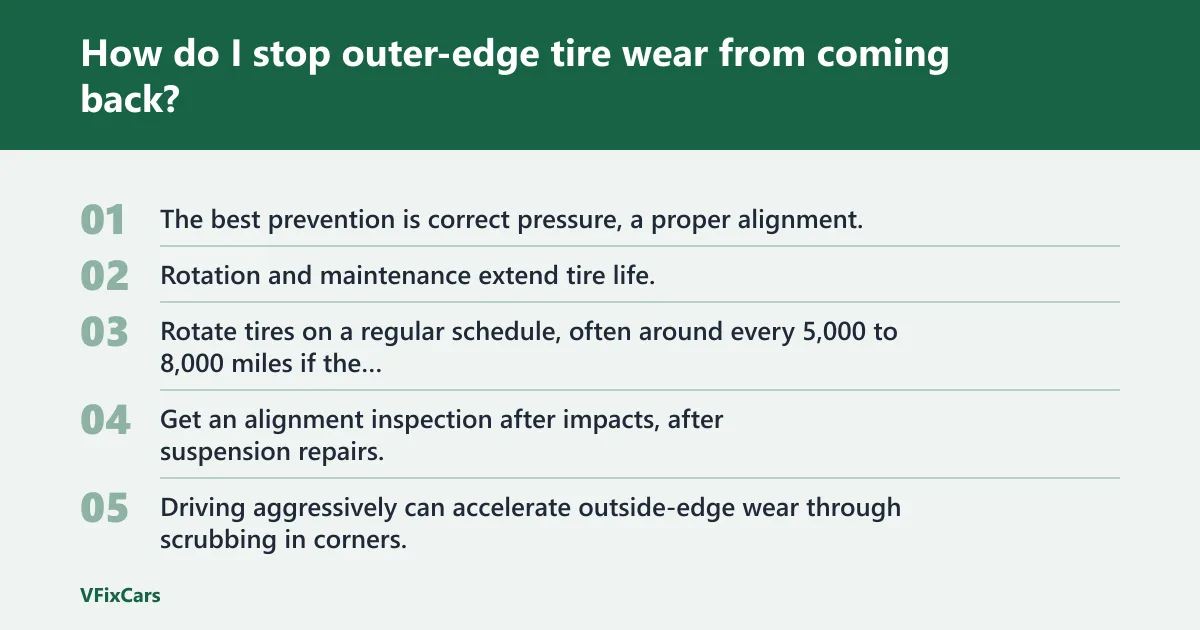
Stop the cause first, then protect the fix. The best prevention is correct pressure, a proper alignment, and a steering and suspension system with no looseness. Rotation and maintenance extend tire life, and regular inspection helps catch the early pattern before the shoulder gets thin.
Rotation and maintenance intervals
Rotate tires on a regular schedule, often around every 5,000 to 8,000 miles if the vehicle maker allows that interval. Check tire pressure at least once a month. Get an alignment inspection after impacts, after suspension repairs, or whenever the steering wheel starts to pull or sit off-center.
Driving habits that can make the pattern worse
Driving aggressively can accelerate outside-edge wear through scrubbing in corners. Hard braking, hard cornering, and repeated pothole hits all add heat, flex, and scrub. Heavy loads can do the same, especially at the rear axle or on trailers. Road crown can also add a mild bias, but it rarely explains severe wear alone.
When wear is urgent and when it is monitorable
If outer wear has reached the wear bars, if cords are visible, or if tread depth is badly uneven across one tire, replacement is urgent. If the tread is still above the wear bars but the shoulder is clearly dropping faster than the rest, service the cause soon and recheck after correction.
For example, a front tire may show more tread in the center than on the outer shoulder while the matching tire on the other side still has more even tread depth. That split points away from normal aging and toward an alignment or suspension fault, not generic wear.
Picture a lightly loaded pickup with both rear tires wearing on the outside, plus a rear-end bounce over expansion joints. That mix points you toward rear alignment, rear suspension bushings, and pressure before blaming driving alone. If the truck also tows, the load history matters even more.
Frequently asked questions
Why do tires wear on the outside edge?
Outside-edge wear usually happens when the tire runs with too much positive camber, the wrong toe setting, low pressure, or looseness in steering or suspension parts. The outer shoulder carries more load than it should, so that edge wears faster than the center.
What does it mean when your tires wear on the outside?
It usually means the tire is being loaded or scrubbed on its outer shoulder. On one tire, that can point to pressure or a damaged corner. On both tires on the same axle, it more often points to alignment or a shared suspension problem.
Can incorrect tire pressure cause outside tire wear?
Yes. Underinflation can load the shoulders and wear both edges faster, while the wrong pressure can distort the contact patch enough to create uneven shoulder wear. Check cold pressure at least once a month and before long trips, then set it to the placard value.
Can wheel misalignment make tires wear on the outside edge?
Yes. Misalignment can point the wheels inward or outward and change how the tread scrubs the road. Toe and camber are the main alignment angles to suspect first. Caster can contribute to an outside-wear complaint, but it is less likely to be the only cause.
When tires wear on the outside, is it an alignment issue or suspension issue?
It can be either, and often both. Alignment sets the angle, but worn ball joints, tie rod ends, or control arms let that angle move while driving. If the alignment will not stay in spec or the wear returns quickly, inspect suspension parts before re-aligning.