Can You Drive with a Bad Fuel Injector?
Yes, but only for a short, low-load trip to a shop if the engine still runs smoothly enough; a flashing check-engine light, strong shaking, or fuel smell means stop driving. Ignoring it can overheat the catalytic converter, wash down cylinder walls, and turn a repair into a tow and a much larger bill. This guide shows the symptoms that allow a limp, the signs that make driving unsafe, and the conditions that demand immediate shutdown.
Driving with a leaking injector risks engine damage
Fuel injector triage table
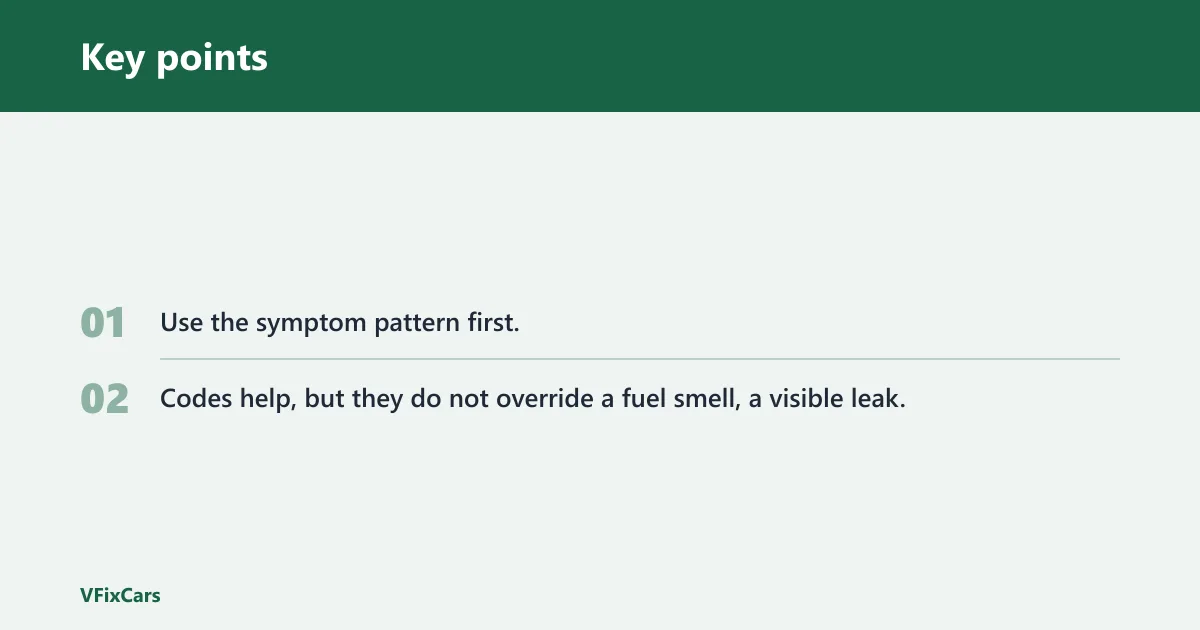
Use the symptom pattern first. Codes help, but they do not override a fuel smell, a visible leak, or a flashing check engine light.
| Symptom pattern | Likely injector failure mode | Drive / drive only to shop / tow now |
|---|---|---|
| Solid CEL | Often a mild clog, intermittent electrical fault, or a mixture issue that has not become severe yet. | Drive only to shop if the engine runs smoothly. A solid light means the fault is stored, but it is not the same warning as a flashing light. It still needs diagnosis before load or distance increases. |
| Flashing CEL | Serious misfire from a dead, intermittent, or severely fuel-starved cylinder. | Tow now. A flashing light is a stop-driving warning tied to serious misfire risk. Unburned fuel can overheat the catalytic converter fast. |
| Fuel smell | Leaking injector, failed seal, or stuck-open injector. | Tow now. Fuel vapor means an over-rich condition or an external leak, both of which raise fire risk and can contaminate the oil. |
| Visible leak | Seal failure, cracked injector body, rail leak, or damaged O-ring. | Tow now. Any visible fuel near the rail or injector seals is a stop-driving-now condition because it can ignite. |
| Rough idle only | Mild clog, deposit-related spray problem, or one-cylinder imbalance. | Drive only to shop if the engine stays predictable and does not shake hard. Rough idle can still become a misfire under load. |
| Hard start | Clogged injector, leaky injector that floods a cylinder after shutdown, or GDI coking on direct-injection engines. | Drive only to shop if the engine starts and runs cleanly afterward. Hard starting on its own is often short-range, but repeated flooding or a lean start can get worse. |
| Black smoke | Leaking or stuck-open injector causing a rich condition. | Tow now if the smoke is heavy or the engine shakes. Rich running can overheat the catalytic converter and wash fuel into the oil. |
| Lean misfire | Clogged injector, restricted spray, or a cylinder not getting enough fuel. | Drive only to shop if the misfire is light and stable. Do not continue if the engine knocks, loses power, or the light flashes. |
| One-cylinder misfire | Electrical injector failure, clogged injector, or an injector that is not opening consistently. | Drive only to shop if it is mild and the car stays controllable. One cylinder is easier to limp than multiple cylinders, but it can still damage the catalytic converter if you keep driving hard. |
What a bad injector changes
A fuel injector meters fuel to each cylinder. When it clogs, leaks, sticks open, or fails electrically, the engine can run rich, run lean, or stop fueling one cylinder properly. That changes combustion quality right away. The result can be rough idle, hesitation, and poor fuel economy, plus a misfire, black smoke, or a lean knock under load.
Clogged, leaking, stuck-open, and electrical failures
A clogged injector limits fuel flow and can create a lean mixture, hesitation, misfire, and knock under load. A leaking or stuck-open injector adds too much fuel, which can cause black smoke, fuel smell, and catalytic converter overheating. An electrical injector failure can leave a cylinder dead or intermittent.
Seal or O-ring failure is different from internal injector wear. It can leak fuel outside the engine, usually near the rail or injector body. That is not a nuisance fault. It is a fire hazard.
Why rich and lean mixtures matter
A rich condition wastes fuel and can send unburned fuel into the exhaust. A lean condition can run hot enough to stress engine components and may trigger knock under load. Both can start as a drivability complaint and end as a roadside failure if you keep asking the engine for power.
Say your sedan idles almost normally in the driveway, but it stumbles when you pull into traffic and the check engine light stays on. That points more toward a short limp-to-shop case than a drive-anywhere case, because the problem shows up under load instead of at idle.
Is it safe to keep driving?
Only if the engine still runs smoothly enough to stay controlled and the symptoms stay mild. Short, low-load driving may be acceptable for a nearby shop, but highway speed, hills, hot weather, traffic, and heavy throttle can sometimes turn a manageable injector fault into a misfire, overheating, or a stranded car.
Highway load versus stop-and-go traffic
Highway load keeps the engine under steady demand for longer periods. If the injector is already marginal, that can expose a lean misfire or rich misfire that was not obvious in the driveway. Stop-and-go traffic is not harmless either, because repeated idle-to-throttle transitions can make a rough-running cylinder worse.
Hills, hot weather, and heavy throttle
Climbing hills or merging hard increases fuel demand. A clogged injector that seems tolerable at idle may not supply enough fuel when load rises. Hot weather adds another problem: heat-soaked components and extra cooling demand reduce the margin you have before a misfire becomes a shutdown.
Suppose you need to drive three miles to a local repair shop on flat streets, and the engine is steady except for a solid check engine light. That is a very different decision from trying to drive 25 miles on the freeway with a flashing light and a fuel odor. Distance is usually less important than load and symptom severity.
What codes and data tell you
Codes help narrow the cylinder, but they do not prove the injector is the only fault. Use them with symptoms. That keeps you from blaming an injector when the real issue is a coil, spark plug, vacuum leak, or compression loss.
Misfire codes and injector circuit codes
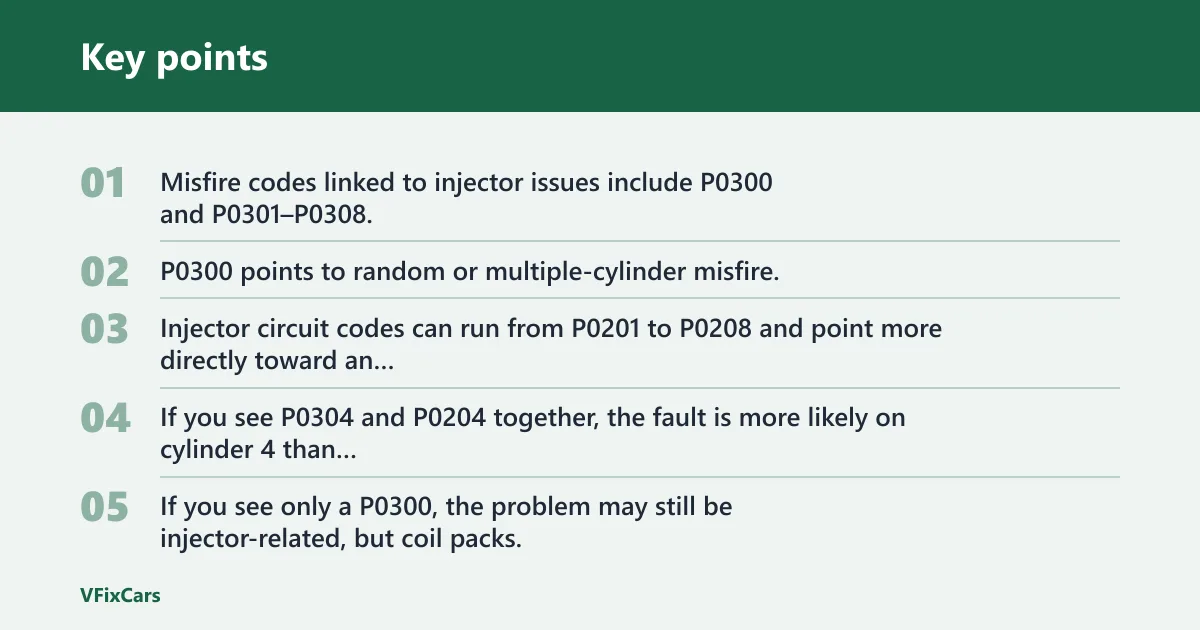
Misfire codes linked to injector issues include P0300 and P0301–P0308. P0300 points to random or multiple-cylinder misfire. P0301–P0308 point to a specific cylinder. Injector circuit codes can run from P0201 to P0208 and point more directly toward an electrical fault in a cylinder-specific injector circuit.
If you see P0304 and P0204 together, the fault is more likely on cylinder 4 than elsewhere. If you see only a P0300, the problem may still be injector-related, but coil packs, plugs, vacuum leaks, or compression problems need attention too.
Fuel trim data: STFT and LTFT
Fuel trim data helps show whether the engine is compensating for too little or too much fuel. Lean clues include P0171 and P0174. Rich clues include P0172 and P0175. Short-term fuel trim, or STFT, moves quickly. Long-term fuel trim, or LTFT, shows the longer correction trend.
High positive trims usually mean the computer is adding fuel to correct a lean condition. High negative trims usually mean it is pulling fuel out because the engine is running rich. That pattern can support a clogged injector or a leaking injector, but it does not replace physical inspection.
| Code or data | What it tends to suggest | What to check next |
|---|---|---|
| P0300 | Random or multiple-cylinder misfire | Coils, plugs, vacuum leaks, fuel delivery, compression |
| P0301–P0308 | Misfire on one named cylinder | Injector, coil, plug, compression, wiring |
| P0201–P0208 | Injector circuit fault on one cylinder | Injector connector, wiring, ECM command, injector itself |
| P0171 / P0174 | Lean trend | Clogged injector, air leak, weak fuel delivery |
| P0172 / P0175 | Rich trend | Leaking injector, stuck-open injector, fuel pressure issue |
When does injector damage get worse?
The risk climbs when you keep driving after the engine starts misfiring, running rich, or leaking fuel. Secondary damage is usually more expensive than the injector itself. The catalytic converter is the big one. Fuel dilution in engine oil and hydrolock are less common, but they are much more serious when they happen.
Catalytic converter damage from misfire and rich running
Misfires send unburned fuel into the exhaust. A leaking or stuck-open injector can do the same thing in a richer way. That extra fuel can overheat the catalytic converter. A converter replacement often costs far more than a single injector repair, so delay can turn a smaller job into a larger one.
Fuel dilution in engine oil
If an injector leaks after shutdown or dribbles too much fuel during operation, fuel can get into the oil. Watch for a rising oil level or a gasoline smell on the dipstick. Thin, fuel-contaminated oil protects bearings and cylinder walls poorly, so this is not a symptom to ignore.
Hydrolock in an extreme stuck-open case
Hydrolock is the extreme case. If a stuck-open injector pours liquid fuel into a cylinder, the piston may try to compress liquid instead of air. That can stop the engine abruptly and can cause severe internal damage. It is uncommon, but when the engine suddenly will not crank after a flooding event, it needs immediate attention.
Bad injector symptoms and diagnosis
Do not assume every rough-running engine has a bad injector. Coil failures, worn plugs, vacuum leaks, and compression problems can create very similar symptoms. The safe move is to match the symptom pattern, read the codes, and inspect for leaks before you decide to drive again.
Ruling out lookalikes
A single-cylinder misfire can come from the injector, but it can also come from a bad coil or spark plug. A vacuum leak often leans out more than one cylinder and can mimic injector trouble. Low compression can also set a misfire code without any injector fault at all.
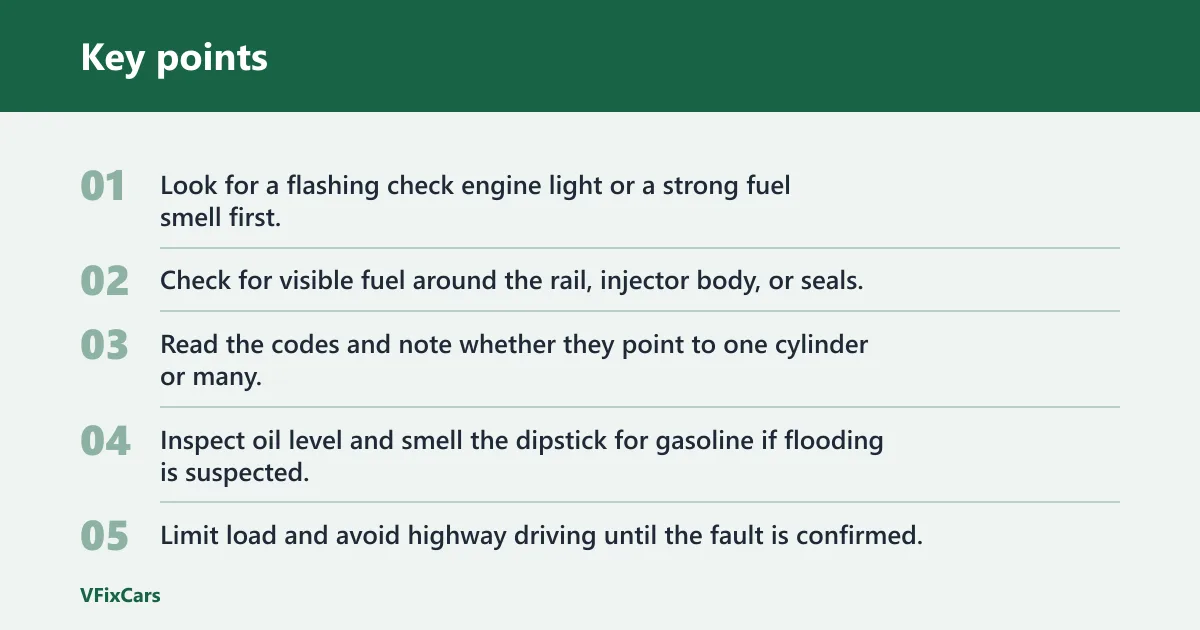
- Look for a flashing check engine light or a strong fuel smell first.
- Check for visible fuel around the rail, injector body, or seals.
- Read the codes and note whether they point to one cylinder or many.
- Inspect oil level and smell the dipstick for gasoline if flooding is suspected.
- Limit load and avoid highway driving until the fault is confirmed.
GDI coking and cold-start rough idle
GDI injector coking is a deposit problem on direct-injection engines. It can disturb spray quality and cause cold-start misfire, rough idle, and high emissions. That fault may look minor once the engine warms up, which is why cold-start behavior matters. A car that clears up after a few minutes can still need injector cleaning or replacement.
A common first-timer mistake is to clear the code and keep driving because the idle feels almost normal. If the same cylinder misfires again on the next cold start, the underlying fault is still there. Clearing the light does not repair a leaking, clogged, or electrically failed injector.
Frequently asked questions
Can you drive with a bad fuel injector?
Sometimes, but only for a short, low-load trip if the engine runs smoothly and there is no fuel smell, flashing light, or visible leak. If the car shakes, loses power, or misfires under throttle, treat it as a tow situation instead of a drive-it-home situation.
What happens if you drive with a bad fuel injector?
You can make a small injector fault worse. Continued driving may turn a rough idle into a hard misfire, overheat the catalytic converter, or contaminate the engine oil with fuel. If the injector leaks externally, the risk becomes fire-related rather than just mechanical.
Can you drive with a clogged fuel injector?
Only if the engine still runs cleanly enough to be controlled safely and the fault is mild. A clogged injector can cause a lean mixture, hesitation, misfire, and knock under load. Hills, highway speed, and heavy throttle make that risk rise fast.
How long can you drive with a bad fuel injector?
There is usually no safe universal distance. A mild fault may allow a very short trip to a shop, while a flashing light, fuel smell, or visible leak means you should not drive at all. Distance matters less than whether the engine stays smooth and the symptoms stay stable.
Can you drive with one bad fuel injector?
Sometimes, yes, if it is only one cylinder and the engine remains predictable. One-cylinder problems are often less severe than multiple-cylinder misfires, but they still can damage the catalytic converter if you keep driving hard or at highway load. One bad injector is still a repair, not a pass.
What happens if you keep driving with a bad fuel injector?
The fault can spread from a drivability issue to a no-start, a damaged catalytic converter, or fuel-diluted oil. In a leaking or stuck-open case, the engine can run very rich or flood a cylinder. In an extreme case, liquid fuel can lead to hydrolock.