Where Is the Mass Airflow Sensor Located in a Car?
The mass airflow sensor is usually in the intake tract, after the air filter box and before the throttle body, often bolted into the air duct or air box housing with a wiring connector on top or the side. Find the wrong sensor and you can chase rough idle, lean codes, and bad replacement parts. This guide shows how to spot it by intake layout, housing shape, connector location, and airflow direction so you can confirm the MAF fast.
MAF sensor location map
Start with the air filter housing, then follow the intake path toward the engine. On most modern gasoline-powered vehicles, the MAF sensor sits in the air intake system, and most cars place it in the section between the engine air filter housing and the throttle body. That puts it upstream of the throttle body and intake manifold, where it can measure the incoming air before the ECU calculates fuel delivery.
Naturally aspirated engine layouts
On a naturally aspirated engine, the cleanest clue is the route from the air filter box to the throttle body. The MAF is commonly in that run, either in a plastic tube or bolted to the air cleaner housing itself. If you can see the throttle body, look before it, not on the manifold side.
Turbocharged intake layouts
Turbocharged engines can move the sensor to a different spot. Some place the MAF before the turbo inlet, while others put it in the intake duct ahead of the turbo or near the airbox. That means the usual “between filter and throttle body” rule still helps, but the sensor may be farther from the engine than expected.
Airbox-mounted and tube-mounted setups
Some vehicles mount the MAF inside the air filter box, and others mount it in the intake tube. The difference matters because one layout uses the airbox wall as the mounting point, while the other uses the ducting between the airbox and engine. In both cases, the sensor still sits in the airflow path, not on the intake manifold. (Wikihow)
Where is my MAF sensor?
Start at the engine air filter box, which is usually a black plastic housing near the front or side of the engine bay. Follow the intake tube from that box toward the throttle body. The MAF is often the first sensor body in that path, and it usually has an electrical connector and either screws or clips holding it in place.
Look for a compact black housing or a probe-style unit. On many cars, the connector is on the top or side of the housing. If the ducting runs directly to the throttle body, the MAF is usually somewhere before that point, not after it.
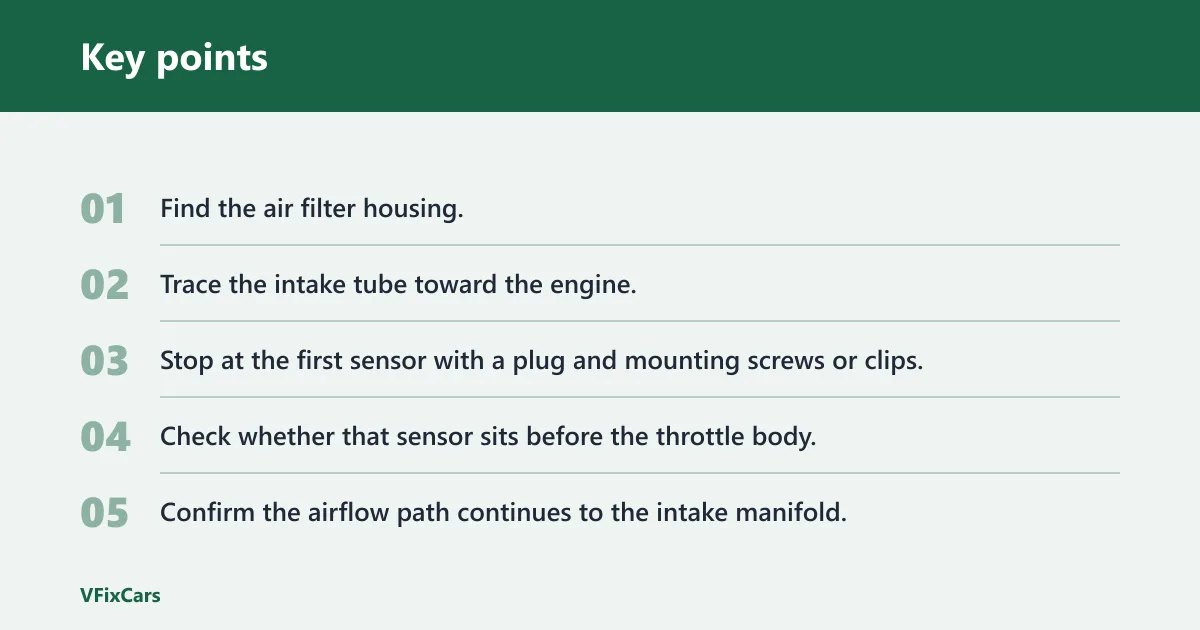
- Find the air filter housing.
- Trace the intake tube toward the engine.
- Stop at the first sensor with a plug and mounting screws or clips.
- Check whether that sensor sits before the throttle body.
- Confirm the airflow path continues to the intake manifold.
How do I find the MAF sensor under the hood?
Use the airbox and throttle body as landmarks. The MAF sensor can usually be located by following the air box and throttle body visually, then checking the tubing between them. If the intake tract has a corrugated snorkel section, look for a sensor housing where that duct meets the rigid airbox or tube.
Say your 2.0L four-cylinder has a black air cleaner box on the left side of the bay and a single rubber intake tube leading to the throttle body. The MAF is likely mounted in that tube or clipped to the airbox outlet, not on the intake manifold. That one visual check avoids a lot of wrong-part guessing.
What is the MAF connected to?
The MAF is connected to the intake system and to the engine wiring loom. Mechanically, it sits in the air path that runs from the air filter housing toward the throttle body. Electrically, it sends airflow data through a connector and loom to the ECU, which uses that data to calculate fuel delivery.
Air filter box to intake tube
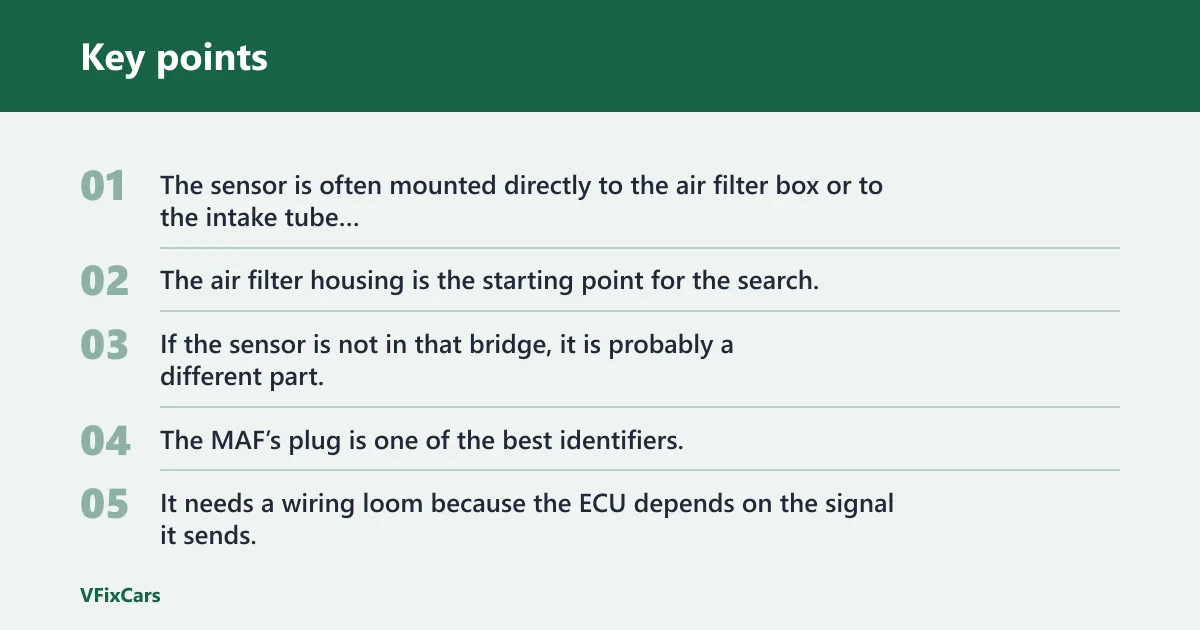
The sensor is often mounted directly to the air filter box or to the intake tube attached to it. The air filter housing is the starting point for the search, and the intake tube is the bridge to the engine. If the sensor is not in that bridge, it is probably a different part.
Wiring harness to the ECU
The MAF’s plug is one of the best identifiers. It needs a wiring loom because the ECU depends on the signal it sends. A MAP sensor can also have a connector, but the location is different. A MAF is tied to the intake airflow path; a MAP sensor is usually tied to manifold pressure on the intake manifold itself.
Downstream relationship to the throttle body
The throttle body is downstream of the MAF on most vehicles, and the intake manifold comes after the throttle body. That order matters. If the part you found is on or after the manifold, it is not the MAF. If it is before the throttle body in the intake tract, it is worth a closer look.
Which way does the MAF go?
The MAF should face the same direction as the airflow through the intake tract. Many housings have an airflow arrow or molded marking, and the sensor element must align with that direction. If it is reversed, the reading can be wrong because the sensor is designed to measure air moving through a specific side of the housing. (Motortrend)
Read the airflow arrow or molded marking
Check the sensor body and the plastic tube around it for an arrow, “AIR FLOW,” or a molded direction mark. That marking points from the air filter side toward the engine side on most layouts. If the marking is missing, use the intake path: filter box, then MAF, then throttle body.
Match the sensor shape to the housing
Some MAF sensors are a small black square that bolts to the side of the airbox. Others are probe-style inserts that sit inside the intake duct. The shape should fit the housing one way only. If the connector or sensing element looks forced, spun, or cocked at an odd angle, the sensor may be installed incorrectly.
What happens if it is reversed
A reversed MAF can cause rough idle, hesitation, fuel trim issues, or trigger a check engine light. That can lead to poor idle quality, hesitation, fuel trim problems, or a check engine light. A common first-timer mistake is reinstalling the sensor by bolt pattern alone and ignoring the airflow arrow, especially after cleaning the intake tube.
How to tell the MAF from the MAP sensor
The MAF sits in the intake tract before the throttle body on most cars, while the MAP sensor usually mounts on the intake manifold. That one location difference is the easiest way to separate them. The MAF measures air entering the engine; the MAP sensor is positioned after the throttle body, where manifold vacuum or pressure is measured.
Location on the intake tract
If the sensor is on the airbox, intake tube, or pre-turbo inlet, it is much more likely to be the MAF. If it is bolted directly to the intake manifold, it is usually the MAP. The manifold sits after the throttle body, so that spot is the wrong side of the airflow path for a MAF.
Typical housing and connector differences
The MAF often looks like a compact black housing or a probe-style unit with a thick connector. The MAP is usually a smaller pressure sensor attached to the manifold with a short plug and one or two fasteners. Both have wiring connectors, so the mounting point matters more than the plug alone.
Why MAP sits elsewhere
The MAP sensor needs manifold pressure information, so it belongs on the intake manifold or very near it. That is why it does not sit between the air filter and throttle body on the main intake duct. If you are checking a sensor on the manifold, you are usually looking at the wrong part for a MAF search.
Where mass airflow sensor decision table
Use this table when the intake layout is unclear. It starts with the engine setup, then narrows the likely MAF location, the visual clue, and the part most often mistaken for it.
| Engine layout | Likely sensor location | Visual clue | Common confusion point |
|---|---|---|---|
| Naturally aspirated | Between the air filter housing and throttle body | Black airbox near the front or side of the bay, with a sensor in the duct | MAP sensor on the intake manifold |
| Turbocharged | Before the turbo inlet or in the intake duct ahead of the turbo | Sensor sits farther from the throttle body than expected | Boost plumbing and bypass valves |
| Airbox-mounted | Inside or attached to the air filter housing | Compact black square with a thick connector on the airbox | IAT sensor integrated into the MAF housing |
| Tube-mounted | In the plastic or rubber intake tube | Probe-style insert or bolted sensor in the duct | Resonator or intake noise chamber |
Not the MAF if…
- It is bolted to the intake manifold instead of the intake duct.
- It has no place in the airflow path from the air filter housing to the engine.
- It looks like a small pressure sensor rather than a larger airflow housing.
- It sits after the throttle body on the manifold side.
- It is a separate IAT sensor mounted only to measure intake air temperature, unless the IAT is built into the MAF assembly.
What to inspect after you find it
Once you find the MAF, inspect the nearby intake parts before you stop. Cracked ducts, loose clamps, and air leaks near the housing can cause bad readings even when the sensor itself is fine. The MAF cannot measure air that sneaks in through a split hose or a loose connection after the air filter box.
Cracked ducts and loose clamps
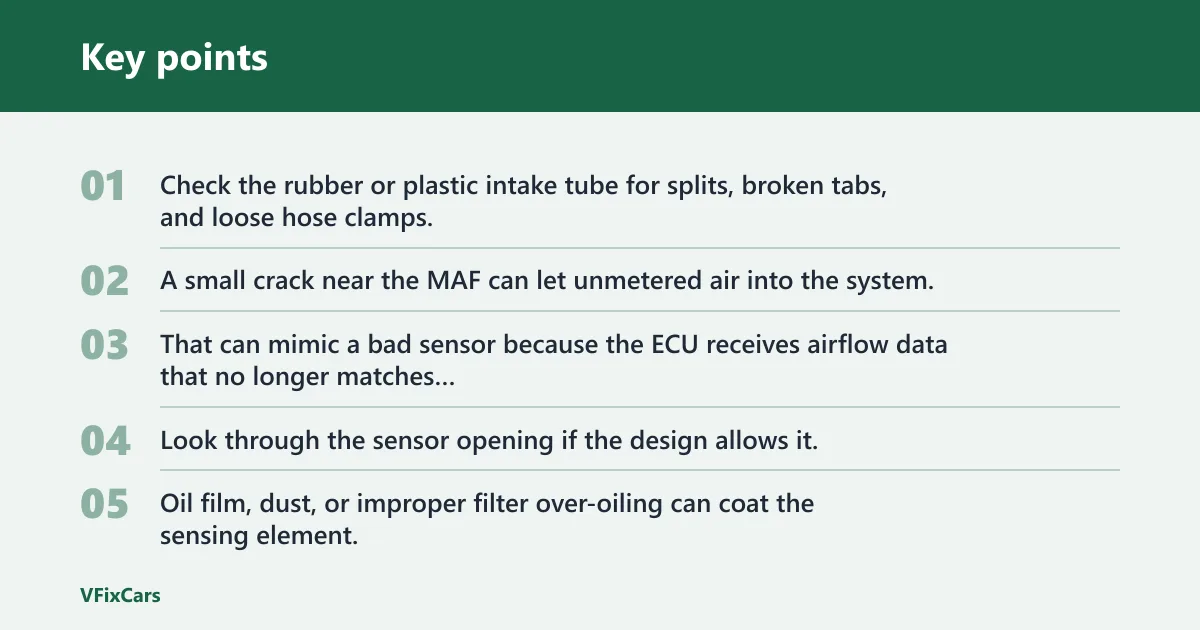
Check the rubber or plastic intake tube for splits, broken tabs, and loose hose clamps. A small crack near the MAF can let unmetered air into the system. That can mimic a bad sensor because the ECU receives airflow data that no longer matches the air actually reaching the engine.
Dirty sensor elements
Look through the sensor opening if the design allows it. Oil film, dust, or improper filter over-oiling can coat the sensing element. Do not scrape the element. If cleaning is needed, use the correct sensor-safe cleaner and keep the airflow opening aligned as it was before removal.
Air leaks near the housing
Inspect the seam where the MAF meets the airbox or tube. If the housing is not sealed, the sensor can read the wrong amount of air. A leak on the intake side often shows up as rough idle, hesitation, or a lean condition because the ECU relies on MAF data to meter fuel.
Suppose the sensor is inside the airbox and the intake tube has a loose clamp near the throttle body. The MAF may still be easy to spot, but the loose clamp can make the engine run poorly even though the sensor is in the right place. Finding the part and checking the nearby ducting should happen together.
Frequently asked questions
Where is my mass airflow sensor located?
On most cars, it is in the intake tract between the air filter housing and the throttle body. Start at the black airbox near the front or side of the engine bay, then follow the intake tube. The MAF is usually the sensor with an electrical connector and mounting screws or clips.
What is the mass air flow sensor connected to?
It is connected to the intake system and the engine wiring loom. Mechanically, it sits in the path from the air filter box to the throttle body. Electrically, the loom sends its signal to the ECU, which uses that airflow information to calculate fuel delivery.
Which way does the mass airflow sensor go?
It should face the airflow direction through the intake tract. Look for an arrow, “AIR FLOW,” or a molded mark on the sensor body or tube. If the sensor is reversed, the ECU may get an incorrect reading and the engine can run poorly.
How do I tell the MAF sensor from the MAP sensor?
Use location first. The MAF is usually in the intake duct before the throttle body, while the MAP sensor usually mounts on the intake manifold. If the part is on the manifold side, it is generally not the MAF, even if the connector looks similar.
Why is my MAF sensor inside the air filter box on some cars?
Some vehicles integrate the MAF into the air filter box so it can measure air right as it leaves the air cleaner housing. That layout is still part of the intake tract. You will usually see the sensor as a compact black square attached to the airbox with a thick connector.