Floor Mats vs Floor Liners: What’s the Difference?
Floor mats cover the carpet surface. Floor liners often have raised edges and deeper channels that can help hold spills, slush, and grit before they reach carpet padding; choose floor liners if you want liquid kept away from the underlay. Left there, a spill can soak the underlayment, trap moisture, and leave odor, staining, or corrosion in hidden areas. This guide explains the design difference, where each works best, and how to choose one for daily driving and bad weather.
| Factor | Floor mats | floor liners | Winner |
|---|---|---|---|
| Containment | Flatter surface; basic spill protection | Deeper molded shape with raised sidewalls | floor liners |
| Fit and coverage | Often universal or semi-custom | Usually custom-fit to year, make, model, and trim | floor liners |
| Cleaning | Easy to vacuum; may hold grit in carpet-like surfaces | Usually easier to rinse and dump out wet debris | floor liners |
| Appearance | Lower profile; carpet mats look more factory-like | Bulkier, more utilitarian | Floor mats |
| Cost | Lower cost | Higher cost | Floor mats |
Floor mats vs floor liners: the core trade-off
Floor mats are the simpler, flatter option. Floor liners are built to contain mess, with raised edges that help stop liquid and debris from running past the edge and into carpet padding.
The real question is not “which covers the floor?” Both do. The question is where the mess goes after it hits the edge. A mat protects the visible surface. A liner is meant to trap the spill before it reaches hidden carpet layers.
What each product covers
A floor mat is a flatter removable layer that covers the main foot contact area. It is often universal or semi-custom and gives basic spill protection at a lower price.
A floor liner is more deeply molded and usually extends higher along the sides. That extra depth matters when water, slush, or mud keeps moving after the first splash.
Where protection ends at the edge
This is the failure mode most comparisons skip. A flat mat can catch the first splash, but liquid can run off the edge and disappear into carpet padding, where it stays wet longer than the surface does.
That hidden moisture can leave odor or staining, and in some cases it reaches areas you do not see until the carpet is lifted. Raised edges and shaped channels help keep water and grit on the mat or liner until you remove it.
Side-by-side comparison
The two products are not interchangeable. The comparison only works if you separate surface coverage from containment, then check fit and retention hardware before price or appearance.
Coverage and containment
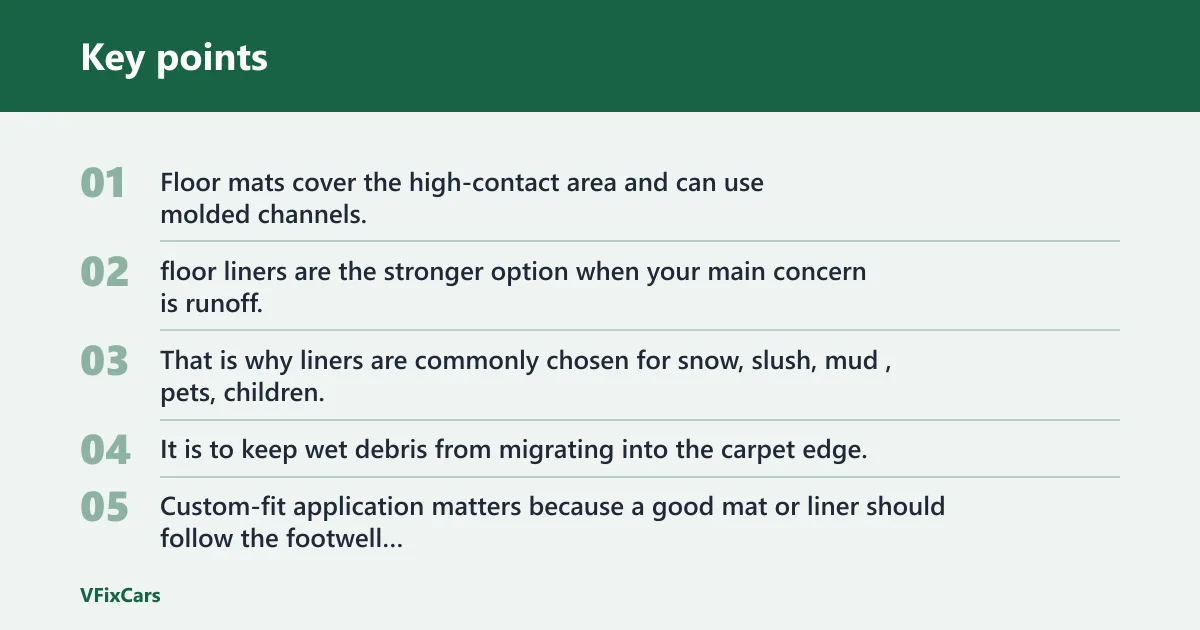
Floor mats cover the high-contact area and can use molded channels, but they usually have no or minimal walls. floor liners are the stronger option when your main concern is runoff, because the raised sidewalls are built to hold material in place longer.
That is why liners are commonly chosen for snow, slush, mud, pets, children, and work boots. The goal is not only to catch dirt. It is to keep wet debris from migrating into the carpet edge.
Fit, retention, and pedal clearance
Custom-fit application matters because a good mat or liner should follow the footwell and line up with factory anchors. Retention hardware such as hooks, clips, grommets, and factory anchors helps prevent shifting.
Driver-side security is a safety issue, not a small detail. If a mat or liner creeps forward, it can interfere with pedal travel. Before buying, check the product’s anchor points, edge coverage, and whether the driver-side shape leaves clear room around the accelerator and brake.
Cleaning, appearance, and cost
Cleaning depends on what is sitting on the product. Dry dust and crumbs may vacuum quickly from either one, but wet grit is usually easier to rinse from a liner with deeper channels.
Appearance and price usually favor mats. Carpet mat options look softer and more factory-like, while all-weather floor mat options stay flatter and lower-profile than liners. Price also tends to be lower for mats than for custom-fit liners, which is why dry commuting often does not need the more expensive option.
Why raised sidewalls matter
Raised sidewalls are the main reason floor liners cost more and protect more. They help contain liquid and debris before it reaches the carpet edge, instead of leaving that material to spread under the mat.
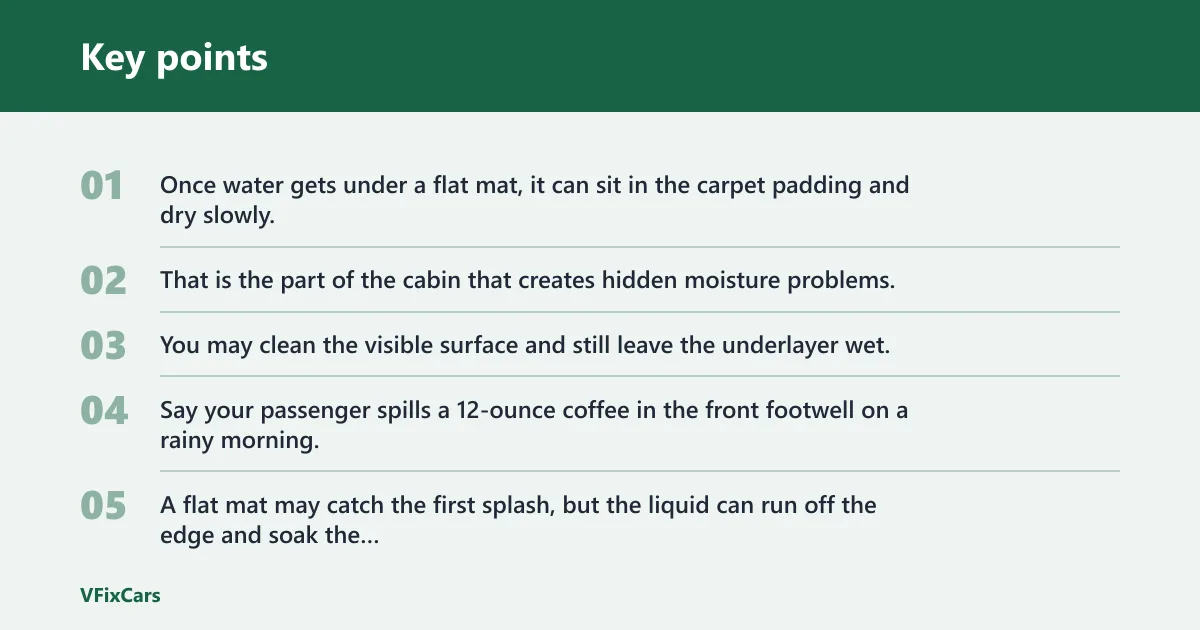
Once water gets under a flat mat, it can sit in the carpet padding and dry slowly. That is the part of the cabin that creates hidden moisture problems. You may clean the visible surface and still leave the underlayer wet.
Say your passenger spills a 12-ounce coffee in the front footwell on a rainy morning. A flat mat may catch the first splash, but the liquid can run off the edge and soak the carpet edge under the mat. A liner with raised sidewalls is designed to hold that spill until you remove and empty it.
A common first-timer mistake is choosing the cheapest mat set for a wet climate because the floor “looks covered.” Coverage is not the same as containment. The edges decide whether the mess stays on top or disappears into the padding.
Are floor liners better than floor mats in snow?
Yes, floor liners are usually the better choice in snow because they are built to contain meltwater, slush, and salt before those materials spread under the edge. Floor mats can work in light winter use, but deeper containment matters when boots bring in repeated wet debris.
Snow is not just dry powder. It becomes water as the cabin warms, which makes overflow more likely. A liner’s raised walls and molded channels are the main advantage here, especially when you track in slush from parking lots or curbside streets.
Slush, meltwater, and salt
Slush is the hard case for flat products. It moves, melts, and keeps spreading. Shaped channels and raised edges help hold that material until you can dump or rinse it out.
Salt adds another reason to prefer liners. It leaves residue, and residue is easier to manage when the product contains the wet mess instead of spreading it across the carpet edge.
TPE liners vs rubber mats in cold weather
Premium liners often use TPE, and some manufacturers position TPE as odor-free and pliable in very cold temperatures. One published claim places that pliability down to -50°F, while another says its TPE emits no odor from -4°F to 167°F.
Rubber is common in floor mats and can carry a new-rubber smell. It may also stiffen in cold weather. That does not automatically make rubber a bad choice, but it does matter if you want the product to stay flexible in winter and keep its shape around the footwell.
Do floor mats and floor liners fit every car the same way?
No. Custom-fit products are generally shaped for a specific year, make, model, and often trim. That matters because the footwell, anchor points, and pedal area vary enough that a one-size-fits-all piece may leave gaps or shift out of position.
A universal mat can be fine for basic coverage, but it is less exact. If you care about edge coverage and safety, fit is part of the decision, not an afterthought.
What to check at anchors, edges, and pedals
- Confirm that the product matches your year, make, model, and trim.
- Look for factory anchors, hooks, clips, or grommets that line up with the vehicle.
- Check driver-side clearance around the accelerator and brake pedals.
- Inspect the outer edge for coverage near the dead pedal and sill.
- Make sure the product sits flat after installation and does not curl or ride up.
WeatherTech FloorLiner is a common example of a vehicle-specific liner positioned as a premium custom-fit option. The important point is not the brand itself. It is the fit philosophy: deep contouring, raised edges, and model-specific coverage rather than a universal slab.
Suppose an SUV has deep carpeted wells and exposed seat rails, making a custom floor liner a better fit than a loose universal mat. A universal mat may cover the center area but leave the edge close to the pedals. A custom-fit liner is more likely to match the shape and keep the edge where it belongs.
Which is easier to clean?
Floor liners are usually easier to clean when the mess is wet grit, mud, or slush, because you can remove and rinse them more easily. Floor mats can be quicker for dry dust or crumbs, especially carpet mats that vacuum well.
The better choice depends on the debris. If your mess is dry, either can be simple. If it is wet and sticky, a deeper liner usually saves more effort because it contains the mess rather than spreading it out.
Rinse, shake out, or vacuum
Rinse works best for liners that have channels and a water-resistant surface. Shake-out works for loose debris, though deep channels can still hold grit at the corners.
Vacuum is often the fast answer for carpet mats and dry-road use. Once mud or meltwater enters the fibers, vacuuming becomes less effective than removal and rinsing.
Drying time and odor concerns
Drying time affects odor. If moisture stays in carpet or under a mat, it can lead to stale smells. A liner that keeps most of the liquid on top is easier to empty and dry before the moisture reaches the padding.
That matters most in closed cabins and cold weather, where evaporation is slower. A product that looks clean may still be holding moisture where you cannot see it.
Floor mat decision matrix
This matrix scores five real-world use cases on spill containment, pedal safety, cleaning effort, appearance, and cost. The picks reflect the use case, not a blanket winner for every driver.
| Use case | Floor mats | floor liners | Winner |
|---|---|---|---|
| Dry commuter | Containment 2/5, safety 4/5, cleaning 4/5, appearance 5/5, cost 5/5 | Containment 5/5, safety 4/5, cleaning 4/5, appearance 3/5, cost 2/5 | Floor mats |
| Rainy-city driver | Containment 3/5, safety 4/5, cleaning 3/5, appearance 4/5, cost 5/5 | Containment 5/5, safety 4/5, cleaning 4/5, appearance 3/5, cost 2/5 | floor liners |
| Snowy climate | Containment 2/5, safety 4/5, cleaning 3/5, appearance 4/5, cost 5/5 | Containment 5/5, safety 4/5, cleaning 4/5, appearance 3/5, cost 2/5 | floor liners |
| Pet owner | Containment 2/5, safety 4/5, cleaning 3/5, appearance 4/5, cost 5/5 | Containment 4/5, safety 4/5, cleaning 4/5, appearance 3/5, cost 2/5 | floor liners |
| Family hauler | Containment 3/5, safety 4/5, cleaning 3/5, appearance 4/5, cost 5/5 | Containment 5/5, safety 4/5, cleaning 4/5, appearance 3/5, cost 2/5 | floor liners |
Dry commuter
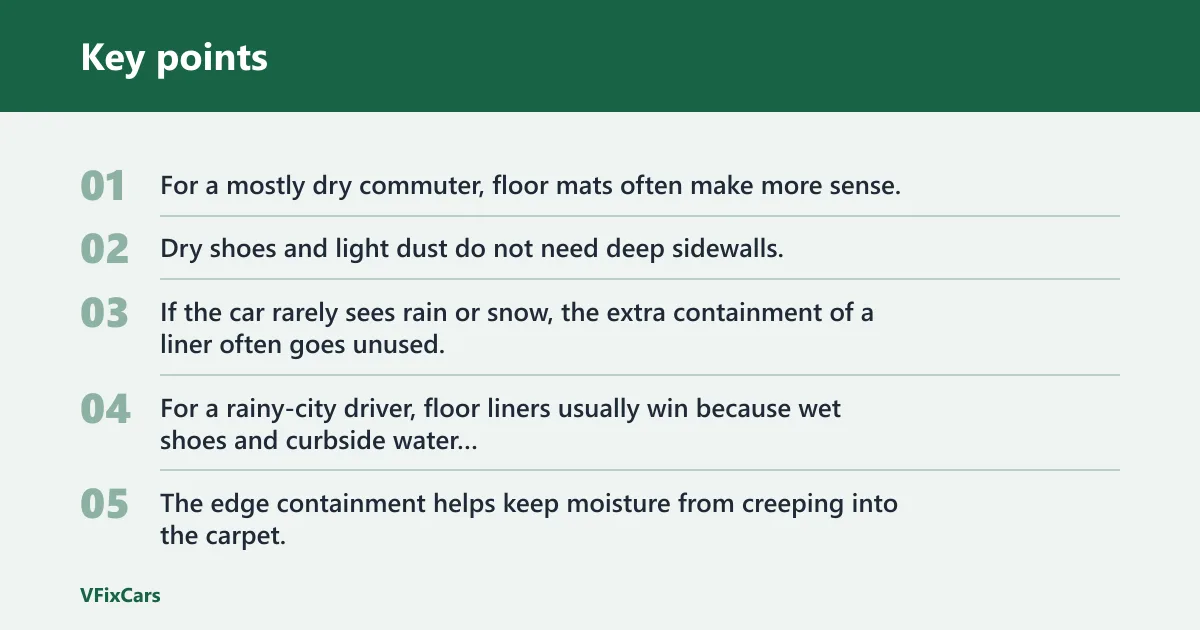
For a mostly dry commuter, floor mats often make more sense. Dry shoes and light dust do not need deep sidewalls, so the lower cost and softer appearance matter more.
If the car rarely sees rain or snow, the extra containment of a liner often goes unused.
Rainy-city driver
For a rainy-city driver, floor liners usually win because wet shoes and curbside water are common. The edge containment helps keep moisture from creeping into the carpet.
If you regularly step into the car with soaked shoes, the lower-profile mat is the weaker choice.
Snowy climate
For a snowy climate, floor liners are the clearer pick. Meltwater, slush, and salt are exactly the conditions where raised sidewalls pay off.
If the vehicle is used all winter and not just for short trips, the containment gap between the two becomes more important.
Pet owner
For a pet owner, floor liners usually work better in the cargo or rear footwell because they handle wet paws, fur, and tracked-in dirt more cleanly. A mat can be enough for a clean, short-haired pet in mild weather, but it gives up containment quickly once moisture is involved.
A mixed setup often makes sense here: liners in the rear or cargo area, mats up front if the driver cabin stays relatively dry.
Family hauler
For a family hauler, floor liners are the safer bet when spills, snack crumbs, and wet shoes happen often. Kids create mixed debris, and mixed debris is where containment matters most.
If the vehicle sees school runs, sports gear, and rain boots, the liner’s deeper shape is usually worth the extra cost.
Choose Floor mats if… / Choose floor liners if…
Choose Floor mats if you drive mostly in dry weather, want a lower price, prefer a softer or more factory-like look, or only need basic protection from dust and light spills. They fit best when the mess stays light and dry.
Choose floor liners if you deal with snow, slush, mud, pets, children, work boots, or repeated spills and want to keep liquid away from carpet padding. They also make more sense if you want deeper coverage and a vehicle-specific fit.
A mixed setup can be smart. Use floor liners in front where the driver’s feet and spill risk are highest, and use mats in the rear if those seats see lighter use. That approach keeps cost down without giving up containment where it matters most.
Frequently asked questions
What’s the difference between floor mats and floor liners?
Floor mats are flatter removable layers that cover the main foot contact area. Floor liners are more deeply molded, usually with raised sidewalls and deeper channels, so they contain spills and debris better before those materials reach carpet padding.
Can floor mats and floor liners be used together?
Yes, in some vehicles and some use cases. A common mixed setup is liners in the front footwells and mats in the rear, or liners in the cargo area and mats in the cabin. The key is to keep each piece properly anchored and compatible with the vehicle.
Which is easier to clean: floor mats or floor liners?
For wet debris, floor liners are usually easier because you can remove and rinse them and let the channels dump out the mess. For dry dust or crumbs, floor mats can be quicker to vacuum, especially carpet mats that do not hold as much standing water.
Do floor liners fit every car the same way?
No. Custom-fit liners are shaped for a specific year, make, model, and often trim. Universal products may cover the floor, but they usually do not match the footwell or anchor points as precisely, which affects both coverage and safety.
What should I check before buying a custom-fit liner?
Check vehicle match first, then inspect anchor compatibility, pedal clearance, and edge coverage near the door sill and dead pedal. A custom-fit liner should sit flat, stay locked down with factory hardware, and leave clear room for the accelerator and brake.