
Universal vs custom-fit floor mats: which should you buy?
Buy universal floor mats only if you can live with trimming and a fit gap. For daily driving, wet weather, or work use, custom-fit mats are usually the better buy because they protect pedal clearance, retention, and edge coverage. Poor fit can slide, curl, trap water, or interfere with pedals. This guide compares fit, safety, material, price, and when each type makes sense.
Comparing Fit, Safety, and Price
The main choice is simple: universal mats trade precision for price and availability, while custom-fit mats trade higher cost for contour match, retention-point alignment, and tighter coverage. If the footwell is forgiving and the vehicle use is low-risk, universal can be fine. If pedal clearance, edge containment, or daily weather protection matter, custom-fit is the safer filter.
| Decision factor | Universal | custom-fit floor mats | Winner |
|---|---|---|---|
| Fit to floor pan | Broad sizes and shapes; may leave gaps | Designed around the floor pan shape and contours of a specific vehicle | custom-fit floor mats |
| Pedal-area safety | Depends on trimming and placement; more risk of slide or curl | Better match to gas, brake, or clutch area and retention layout | custom-fit floor mats |
| Coverage and containment | Usually less edge-to-edge coverage | Better coverage, including sidewalls and dead pedal area | custom-fit floor mats |
| Price and availability | Lower cost and quick availability | Usually more expensive and vehicle-specific | Universal |
| Cleanup after wet use | Can be fine, but gaps may let water and grit slip past the mat | Better containment of slush, mud, salt, and debris | custom-fit floor mats |
| Long-term value | Good only when the fit risk stays low | Often better if you would otherwise replace a cheap mat that shifts or curls | custom-fit floor mats |
Fit to the floor pan and footwell
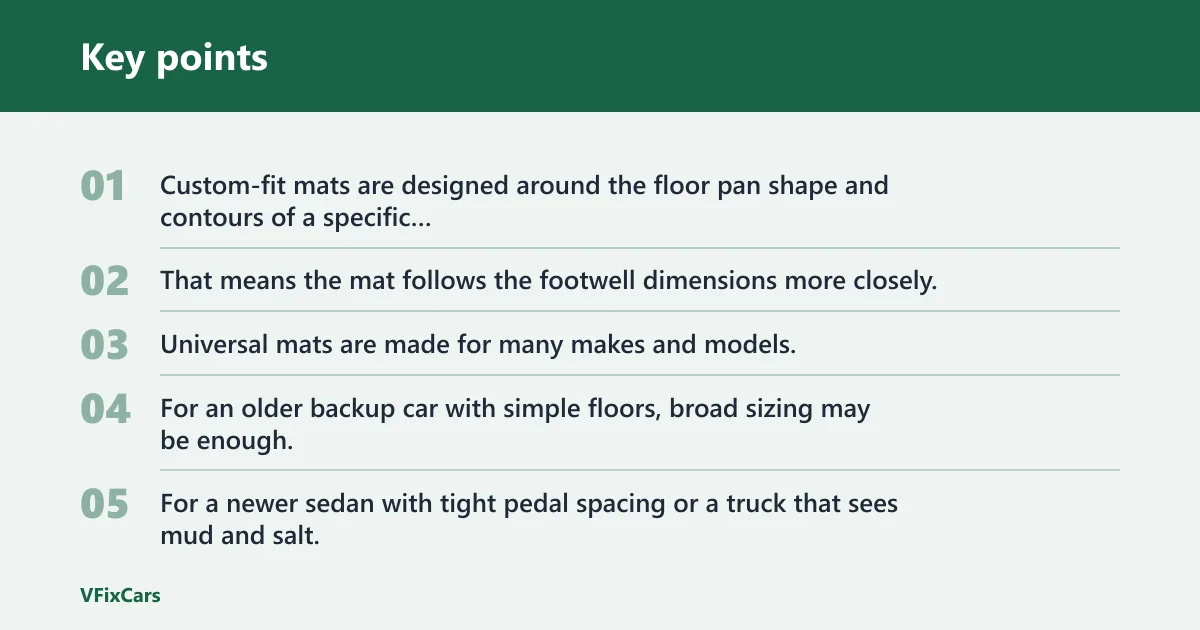
Custom-fit mats are designed around the floor pan shape and contours of a specific vehicle. That means the mat follows the footwell dimensions more closely, including side edges and molded areas that a broad universal mat may miss. Universal mats are made for many makes and models, so they allow a wider fit range and a wider gap risk.
Why the winner changes by use case
For an older backup car with simple floors, broad sizing may be enough. For a newer sedan with tight pedal spacing or a truck that sees mud and salt, fit matters much more than a low sticker price. A mat that looks acceptable on day one can still be the wrong choice if it moves under the pedals after a week.
Example scenarios
Say your compact sedan has a narrow driver footwell and a floor-mounted retention post near the accelerator. A universal mat may sit close enough at first, then shift after repeated entry and exit. A custom-fit mat is less likely to wander into the pedal zone or leave a strip of carpet exposed at the edge.
Suppose your backup hatchback is only used for short errands in dry weather. The floor is flat, the retention setup is basic, and exact coverage is less important. In that case, a universal mat can make sense if you accept a modest fit gap and check it often.
What do universal floor mats fit well, and where do they fall short?
Universal floor mats fit broad vehicle groups because they come in common sizes and shapes, and they focus on flexibility, quick availability, and lower cost. They can work well in low-risk interiors with generous footwell space. Their weak point is the edge: coverage gaps, lift, and trimming trade-offs are more likely when the floor pan is complex.
Common shapes and sizes
Universal mats are usually flat or semi-contoured pieces meant to cover a general front footwell or rear bench area. That general design helps them fit many makes and models, but it also means the mat may stop short of the dead pedal area or sit away from the rocker panel. The result is a broader fit window with less precision.
Where they fall short
The shortfall shows up at the edges and around retention points. If the mat is too large, trimming may help; if it is too small, trimming will not add coverage. On vehicles with deep footwells or pronounced contours, a universal mat may leave carpet exposed where water and grit collect.
Why curl, slide, or trimming changes the result
Material choice matters here. Softer mats may curl at the edges, while stiffer mats may resist curling but not sit flat in a shaped footwell. Trimming can remove a flap or improve clearance, yet it can also weaken edge coverage and make the mat more likely to move if it no longer matches the floor pan.
Why custom-fit floor mats usually fit better
Custom-fit mats are built around the floor pan shape and contours of a specific vehicle or vehicle range. They often line up with factory retention hooks, clips, posts, or anchor points, and they may cover more of the footwell, including the sidewalls and dead pedal area. That tighter match is why they usually fit better than universal mats.
Factory retention points and compatibility
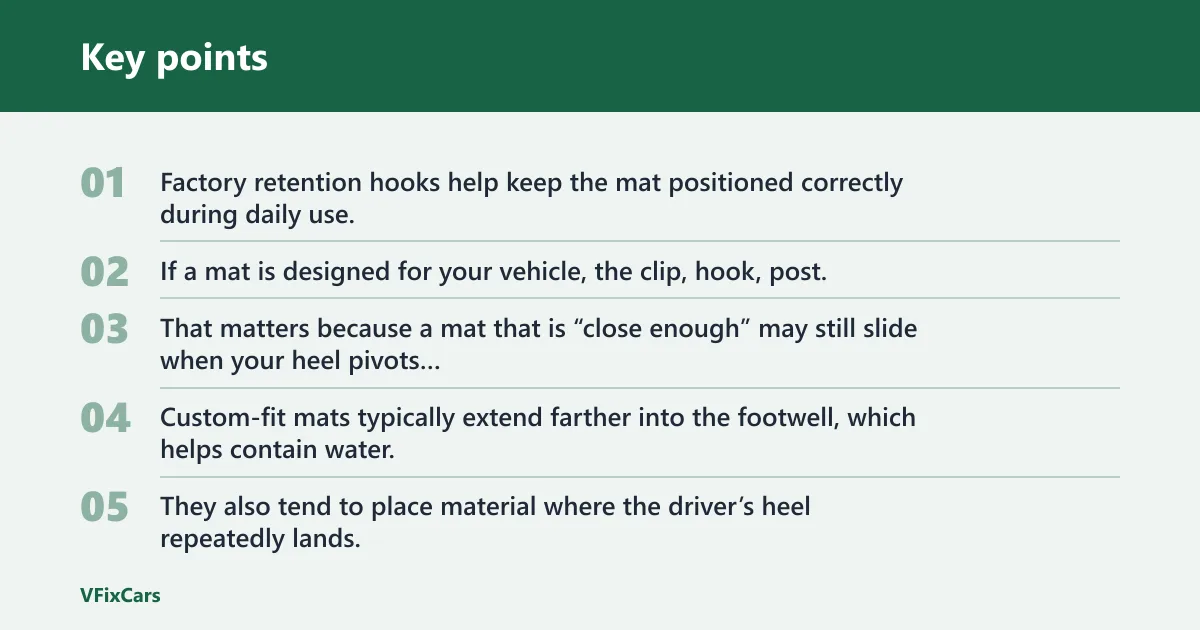
Factory retention hooks help keep the mat positioned correctly during daily use. If a mat is designed for your vehicle, the clip, hook, post, or anchor-hole pattern is more likely to line up without force or guesswork. That matters because a mat that is “close enough” may still slide when your heel pivots or when the floor gets wet.
Edge-to-edge coverage and heel wear
Custom-fit mats typically extend farther into the footwell, which helps contain water, mud, salt, and debris. They also tend to place material where the driver’s heel repeatedly lands, which matters for wear in the heel pad area. A mat that covers that zone better can last longer and keep the carpet underneath from getting crushed.
Material interactions with fit
Material stiffness changes how the mat sits. A very soft mat may wrinkle or curl when it is not shaped for the footwell, while a thicker molded mat can hold its form better if the fit is correct. That is one reason custom-fit mats often look and act closer to original equipment: the material and the shape are chosen together.
Which type of floor mat is safer for the pedals?
Custom-fit mats may be safer around the pedals because they are shaped around the gas, brake, or clutch pedal area with the vehicle’s contours and retention points in mind. Fitment affects safety near the pedal area, and mats that slide forward, bunch up, or curl near pedals can be a hazard. Universal mats need a careful check before you trust them there.
Clearance checks that matter
Look for enough space around the accelerator, brake, and clutch so the mat cannot touch the pedal travel path. A mat should not rise into the pedal swing area or sit so high at the front edge that your shoe can catch it while moving between pedals. If the driver-side fit feels crowded, choose the vehicle-specific option.
Signs the mat is wrong for the driver footwell
If the front edge creeps forward, the heel area rides up, or the mat shifts when you pivot your foot, the fit is not stable enough. A mat that bunches at the lower dash, folds near the dead pedal, or hides a retention post is also a poor match. Those are warnings, not minor annoyances.
Which type of floor mat is better for snow, mud, and rain?
Custom-fit mats may be better for snow, mud, and rain because they can provide more edge containment and cover more of the footwell. That helps keep water, salt, slush, sandy boots, and jobsite dirt from spreading onto the carpet. Universal mats can still help, but they rely more on the footwell being simple and the driver being careful.
Water, salt, and slush containment
In wet weather, the goal is containment. A mat with better side coverage and a stable fit keeps meltwater and road salt on the mat instead of letting them run to the carpet edge. That matters because repeated wetting can stain carpet, stiffen backing material, and leave salt residue where your shoes and heel rest.
Mud, sand, and jobsite dirt cleanup
For muddy boots or sandy shoes, a higher-sided custom-fit mat usually makes cleanup easier because debris stays in one place. A universal mat may still catch the bulk of the mess, but loose edges give fine grit more places to escape. If your vehicle sees regular jobsite use, coverage beats convenience.
Why edge height matters
Edge height is not cosmetic. Higher edges can help trap melted snow and slush during the drive and may make it easier to clean out later. Lower edges can work in dry conditions, but they are less forgiving when the weather changes mid-day and the floor gets wet again and again.
Decision table: which mat type fits each vehicle use case?
Use the vehicle and the job first, then buy the mat. A low-risk interior can live with broader sizing, but a vehicle that sees salt, kids, tools, or daily commuting usually needs a more exact fit. The table below turns that into a buying filter.
| Vehicle / use case | Recommended mat type | Safety risk | Coverage need | Value rationale |
|---|---|---|---|---|
| Daily commuter | custom-fit floor mats | Moderate, because pedal clearance matters every day | Medium to high | Better fit reduces shift, curl, and cleanup hassle |
| Snow-belt family car | custom-fit floor mats | High, because wet shoes and repeated entry raise slip risk | High | Edge containment and retention are worth the extra cost |
| Work truck | custom-fit floor mats | High, because jobsite dirt and heavier boot traffic stress fit | High | Better containment and heel-pad durability support daily use |
| Older beater | Universal | Low to moderate, if the pedal area is open and simple | Low to medium | Lower cost makes sense when the car’s floor and retention setup are basic |
| Leased car | custom-fit floor mats | Moderate, because you want stable placement without carpet wear | Medium to high | Better appearance and coverage help protect the interior at turn-in |
| Backup vehicle | Universal | Low, if the car sees short, light-duty trips | Low | Quick availability and lower cost fit the use case |
Daily commuter
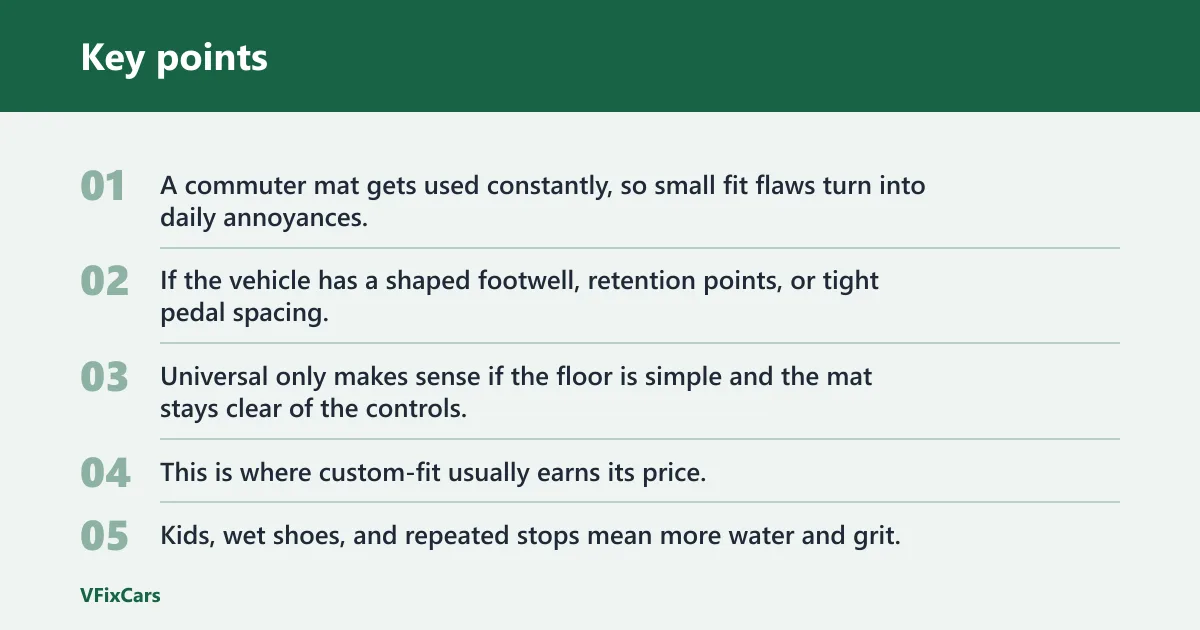
A commuter mat gets used constantly, so small fit flaws turn into daily annoyances. If the vehicle has a shaped footwell, retention points, or tight pedal spacing, custom-fit is the safer long-term choice. Universal only makes sense if the floor is simple and the mat stays clear of the controls.
Snow-belt family car
This is where custom-fit usually earns its price. Kids, wet shoes, and repeated stops mean more water and grit, and the floor needs stronger containment at the edges. A universal mat can work in a pinch, but it is more likely to leave a wet strip along the carpet side.
Work truck
Work trucks see heavy boots, dirt, and regular entry and exit. If the truck has a molded floor and factory anchors, a vehicle-specific mat keeps the driver side more secure and easier to clean. Universal mats can be practical for older trucks with basic floors, but only if they do not block pedal travel.
Older beater
An older vehicle with a plain footwell and limited value can be a good match for a universal mat. The point is to cover the floor without spending more than the car needs. Even then, check for bunching near the pedals and make sure the mat does not block any anchor or hook that is already there.
Leased car
Leased cars reward clean coverage and stable fit. A custom-fit mat is usually the better buy because it looks more factory-like and helps prevent carpet wear that can matter at return time. Universal mats can be acceptable only if they stay flat, clear the pedals, and do not leave obvious gaps.
Backup vehicle
A backup vehicle usually sees short trips and light use, so universal mats often make sense. The key is simple: low risk, quick availability, and lower cost. If the backup car starts seeing winter duty or longer commutes, the case for custom-fit grows quickly.
Choose universal floor mats if… / Choose custom-fit floor mats if…
Choose universal floor mats if your vehicle has a simple footwell, the pedal area is roomy, and you mainly want low-cost coverage for short, light-duty use. Choose custom-fit floor mats if pedal clearance, factory retention points, edge containment, or a near-OE look matter more than saving money.
Choose universal floor mats if…
- Your vehicle is an older car or truck with a basic footwell.
- You need a quick, lower-cost solution for a backup vehicle.
- You can check fit often and accept some trimming or edge gap.
- The car sees mostly dry-weather use and low boot traffic.
Choose custom-fit floor mats if…
- Your driver footwell is tight around the gas, brake, or clutch area.
- You want better coverage around sidewalls, the dead pedal, and carpet edges.
- The vehicle sees snow, rain, mud, or jobsite dirt on a regular basis.
- You want compatibility with factory retention hooks, posts, or anchor holes.
What should I check before buying floor mats?
Check the floor pan shape, the retention setup, and the pedal area before you buy. The right mat should match the footwell dimensions, line up with factory retention points, and stay clear of the gas, brake, and clutch pedals. A low price is not a good deal if the mat shifts or curls.
- Confirm whether the mat is universal or vehicle-specific.
- Match the mat to your vehicle’s retention hooks, clips, posts, or anchor holes.
- Check driver-side clearance around the gas, brake, and clutch pedals.
- Look for enough coverage at the dead pedal and side edges.
- Choose a material that stays flat and resists curl in your climate.
- Review whether the mat is intended for winter use, work use, or light daily use.
How do I know if a mat will use my factory retention points?
You know by checking whether the mat is shaped and punched for the same hook, post, clip, or anchor-hole layout as your vehicle. Factory retention hooks help keep the mat positioned correctly during daily use, so compatibility should be listed clearly. If the mat needs force, adapters, or guesswork, it is the wrong match.
What to look for in the listing
Look for explicit mention of the vehicle year, make, model, trim, and transmission when the pedal layout differs. The mat should name the retention type, not just say it is “secure.” If the product only lists a broad range of vehicles, expect more fit risk and check the driver side carefully.
Frequently asked questions
Are universal floor mats good enough for my car?
They can be good enough when the floor is simple, the vehicle is older, and the use is light. Universal mats usually come in common sizes and shapes, so they work best when you can accept some edge gap and check that the mat stays flat, clear of the pedals, and properly positioned.
Do custom-fit floor mats really fit better than universal mats?
Yes, because custom-fit mats are designed around the floor pan shape and contours of a specific vehicle. They usually cover more of the footwell, line up with retention points, and leave less exposed carpet. That tighter match also lowers the chance of curling or slide near the pedals.
Are custom-fit floor mats worth the extra money?
They usually are if you drive in wet weather, want better edge containment, or care about long-term fit. The extra cost often pays back through less movement, better cleanup, and less carpet wear. If the vehicle is a backup car with light use, universal may be enough.