High-Mileage Motor Oil: Is It Worth It for Older Cars?
High-mileage motor oil is worth paying extra for only if an older gasoline engine has mild seepage, light oil use, or minor seal hardening; if it burns or leaks oil badly, fix the mechanical problem instead. Ignoring that line wastes money and can delay the repair that actually stops the loss. This guide explains which symptoms favor high-mileage oil, when standard synthetic is enough, and when you should skip additives and repair the engine.
This guide is part of our Motor oil guide: how to choose the right oil series.
What high-mileage motor oil is designed to do
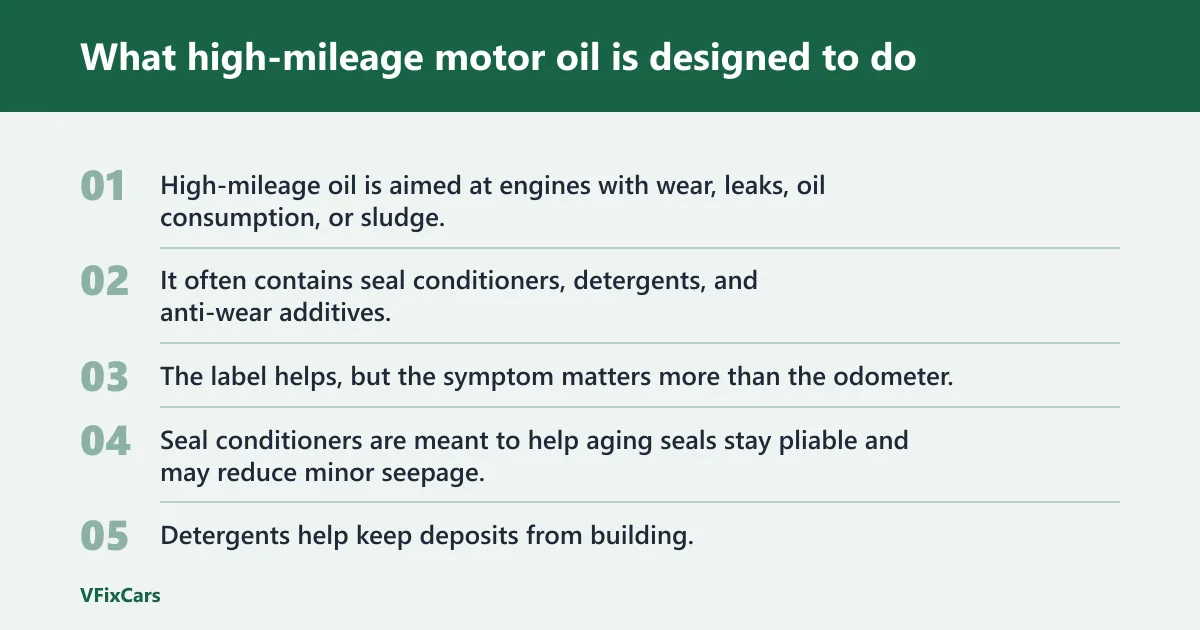
High-mileage oil is aimed at engines with wear, leaks, oil consumption, or sludge. It often contains seal conditioners, detergents, and anti-wear additives, and it is commonly marketed for higher-mileage engines. The label helps, but the symptom matters more than the odometer.
Typical ingredient differences
Seal conditioners are meant to help aging seals stay pliable and may reduce minor seepage. Detergents help keep deposits from building, and anti-wear additives support metal-to-metal protection. That package can help, but it does not replace a gasket, a PCV fix, or a ring repair.
Common mileage range on labels and what that really means
Many high-mileage products are labeled for engines around 75,000 miles, and some guides mention higher-mileage engines in general. That range is marketing shorthand, not a rule. A well-kept engine at 90,000 miles may need nothing special, while a tired 140,000-mile engine may need repair first.
What it can help with, and what it cannot fix
High-mileage oil can help with mild seepage, light consumption between changes, and some sludge control. It cannot rebuild worn rings, reseal a cracked gasket, or cure a failed PCV system. If the engine is losing a quart quickly, oil alone is the wrong answer.
📊 The manual lists a recommended oil weight such as 10W-30. Source: Motor Oil for Cars.
Should you choose oil by mileage alone?
No. Mileage is a rough clue, not a decision rule. An engine with 80,000 miles may have tight seals and no measurable oil use, while a 180,000-mile engine may still be stable enough to run a normal oil that matches the manual. Judge symptoms first.
Why the symptom-first rule matters
If the engine is clean, dry, and holding oil, paying extra for a high-mileage blend often buys little. If you see a light film at a valve cover or need small top-offs between changes, the formula may be worth trying before you open the engine. The issue, not the badge on the bottle, should lead.
Simple decision rule
- Check the owner’s manual viscosity and service rating first.
- Look for the actual problem: seepage, light consumption, heavy consumption, or none.
- Match the oil choice to the symptom.
- If the engine needs frequent top-offs, diagnose the cause before spending more on oil.
Say your sedan has 112,000 miles and a faint oily line around the valve cover, but the dipstick barely moves between 5,000-mile changes. That is the kind of case where high-mileage oil can be a sensible try. A truck that leaves spots on the driveway every morning needs a repair path, not a label change.
Does high-mileage oil stop leaks or oil use?
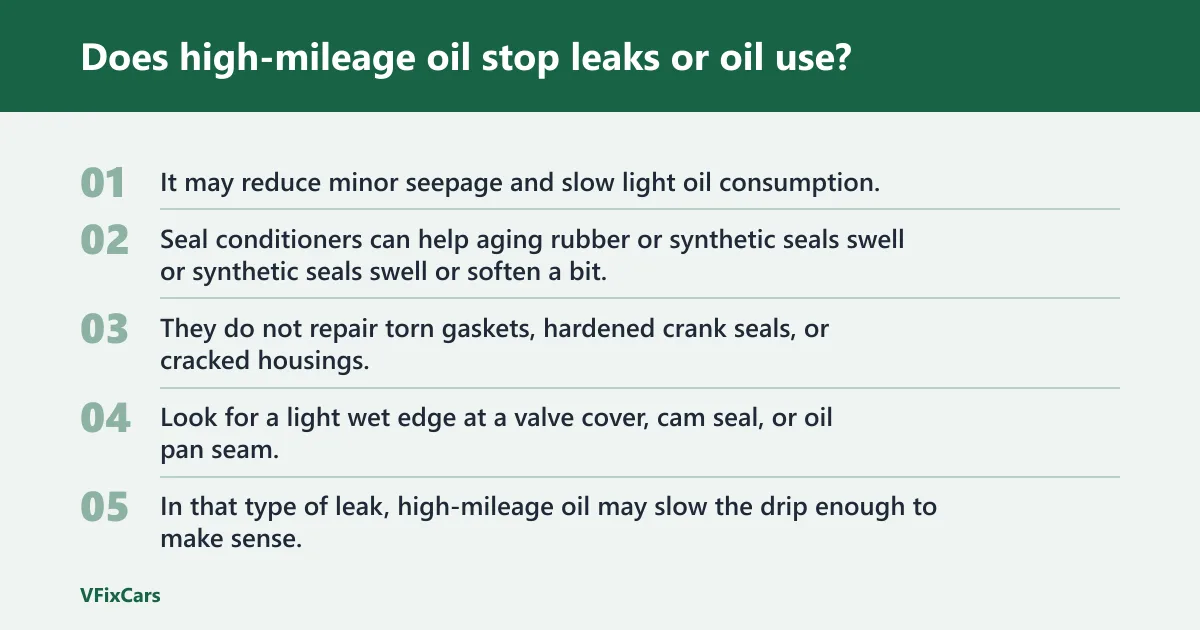
It may reduce minor seepage and slow light oil consumption, but it is not a seal replacement. Seal conditioners can help aging rubber or synthetic seals swell or soften a bit, which may shrink a damp spot. They do not repair torn gaskets, hardened crank seals, or cracked housings.
Minor seepage and aging seals
Look for a light wet edge at a valve cover, cam seal, or oil pan seam. In that type of leak, high-mileage oil may slow the drip enough to make sense. If the leak is active enough to leave puddles, the engine needs diagnosis and likely parts replacement.
Light oil consumption between changes
Some engines consume oil because of age, heat, deposits, or mild wear. High-mileage oil may help a little by reducing evaporation or slowing minor seepage past aging seals. It will not repair worn rings, worn valve seals, or a stuck PCV valve that is pulling oil where it should not go.
Heavy oil loss, smoke, or puddles
Blue smoke from the tailpipe, rapid dipstick loss, or fresh spots under the car point to a mechanical problem. In those cases, high-mileage oil can delay the real fix while the problem gets worse. Repair first, then choose the oil that matches the manual.
Use the manual’s viscosity and service rating first
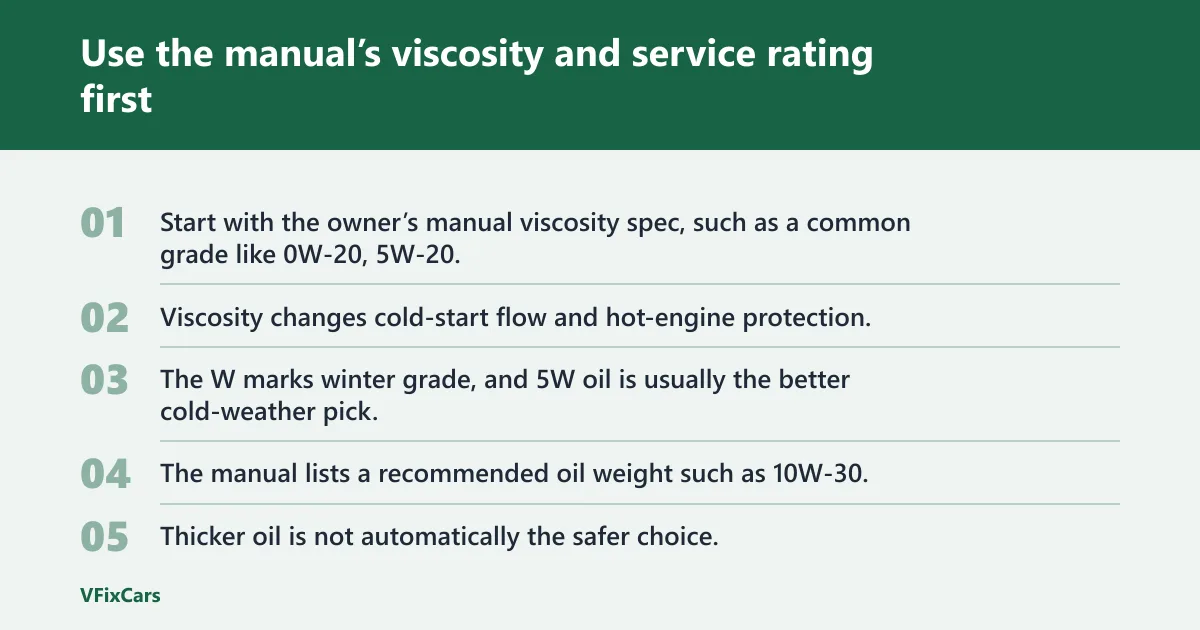
Start with the owner’s manual viscosity spec, such as a common grade like 0W-20, 5W-20, 5W-30, or 10W-30, even on an older car. Viscosity changes cold-start flow and hot-engine protection. The W marks winter grade, and 5W oil is usually the better cold-weather pick.
How to match 0W-20, 5W-30, or 10W-30 to the engine
The manual lists a recommended oil weight such as 10W-30, and that recommendation still matters. Thicker oil is not automatically the safer choice. If the engine was built for 0W-20, a heavier grade can slow cold flow and may not protect better in daily use.
Why cold-start flow matters in older cars too
Older engines still need fast oil circulation on startup, especially in cold weather. A 5W oil flows better at low temperatures than a thicker winter grade, which helps reach bearings and valvetrain parts sooner. Hot protection still matters, but the correct spec balances both sides.
API SP and ILSAC GF-6 on the bottle
Look for current API gasoline ratings such as SP on the container, along with the API starburst or doughnut. That symbol shows the oil has met tested engine-protection and wear standards. Many passenger-car oils also carry ILSAC GF-6, which is generally associated with resource-conserving formulations for modern gasoline engines.
High-mileage oil can come in common viscosities like 0W-20, 5W-20, 5W-30, and 10W-30. That means you can often get the high-mileage label without stepping outside the factory grade. The right bottle is the one that matches both the symptom and the spec.
Is synthetic oil better than high-mileage oil for an older car?
Sometimes yes, sometimes no. Regular synthetic is often the better buy when the engine has no leak or only needs the correct viscosity and current service rating. High-mileage oil is more relevant when the engine has minor seepage or light consumption and the added cost is justified.
When regular synthetic is the better buy
If the engine is clean, holds oil, and meets the manual with a current API rating, standard synthetic can be the smarter choice. It may flow better in cold weather, and it is not automatically bad for older engines. The key is spec match, not age alone.
Why synthetic does not automatically cause leaks
Synthetic oil can reveal existing leaks because it may clean deposits or flow through weak spots more readily, but it does not create a leak out of nowhere. A worn seal was already failing. If a switch exposes the problem, the oil is revealing it, not causing it.
When a synthetic high-mileage formula makes sense
If the engine already calls for synthetic, a high-mileage synthetic blend or full synthetic can be a reasonable next step when the issue is mild seepage or light consumption. That gives you the right viscosity, current service rating, and a formula aimed at aging seals.
When repair is the better value than oil additives
Repair is the better value when the problem is mechanical, not chemical. Failed gaskets, worn rings, valve seals, and PCV faults need parts and labor. If you are topping off often, the cost of extra oil can pile up fast and still leave the problem untouched.
Failed gaskets and seals
A hardened valve cover gasket, rear main seal, or oil pan gasket needs replacement if it is leaking beyond a light sweat. Seal conditioners may help a marginal seal, but they cannot close a split gasket or restore a crushed sealing surface.
Worn rings, valve seals, and PCV faults
Heavy oil burning often comes from ring wear, valve seal wear, or a PCV system fault. Those problems can cause smoke, fouled plugs, and repeated top-offs. High-mileage oil may slow the rate a little, but it does not reverse the root cause.
Frequent top-offs versus a real repair cost
If you are adding oil often, the math changes. A bottle that costs more than regular oil can still be cheaper than constant top-offs, but only when the issue is mild. Once the engine needs frequent additions, diagnosis usually beats buying better oil.
Decision matrix: when high-mileage oil is worth it
Use mileage as a context clue, then judge the symptom. The matrix below treats high-mileage oil as a symptom-based option, not a default upgrade. If the engine is healthy and meets the manual, regular oil is usually enough.
| Mileage band | Observed issue | Likely cause | Worth the cost or repair first? |
|---|---|---|---|
| Under 75,000 | None | Normal operation | Usually skip high-mileage oil; follow the manual and buy the correct viscosity. |
| 75,000 to 100,000 | Minor seepage | Aging seals or gasket hardening | Worth trying if the leak is light and the cost is lower than immediate repair. |
| 75,000 to 150,000 | Light consumption | Wear, deposits, heat, or mild seal loss | Worth trying if top-offs are occasional; diagnose if the rate keeps rising. |
| 100,000 to 200,000+ | Heavy consumption | Worn rings, valve seals, or PCV fault | Repair first; oil alone is unlikely to solve the problem. |
| Any mileage | None | Engine is stable and dry | Usually not worth paying extra just for the label. |
Picture a 200,000-mile car that runs clean but leaves a small damp ring at the timing cover. That is a fair case for a high-mileage formula. Picture a 95,000-mile car that smokes on acceleration and needs a quart every week. That one needs diagnosis, not a different bottle.
Frequently asked questions
Is high-mileage motor oil worth it for an older car?
It is worth it only when the engine shows mild seepage, light oil consumption, or minor seal hardening and the manual’s viscosity still fits. If the engine has heavy leaks or burning, high-mileage oil is usually a temporary bandage, not the fix that saves money over time.
At what mileage should you start using high-mileage oil?
Many products are generally recommended at 75,000 miles, but mileage alone should not decide it. A clean, dry engine at 80,000 miles may not need it, while a 60,000-mile engine with light seepage might benefit. Use symptoms and the manual first.
Does high-mileage oil stop oil leaks?
It can reduce minor seepage in aging seals, and that is often the main reason people buy it. It will not repair a failed gasket, split seal, or damaged housing. If the leak leaves puddles or gets worse quickly, repair the source instead.
Can high-mileage oil reduce oil burning and consumption?
It may help with light consumption by slowing seepage or supporting aging seals, but it does not fix worn rings, bad valve seals, or a faulty PCV system. If the engine needs regular top-offs or sends blue smoke out the exhaust, a mechanical diagnosis is the next step.
Is high-mileage oil better than regular synthetic oil?
Not always. Regular synthetic is often the better buy when the engine has no leak and just needs the correct viscosity and current API rating. A synthetic high-mileage oil makes sense when you want synthetic performance plus seal conditioners for a mild leak or light oil use.
Will high-mileage oil work if my manual calls for 0W-20 or 5W-30?
Yes, if the bottle matches the manual’s viscosity and service rating. High-mileage oils are sold in common grades like 0W-20, 5W-20, 5W-30, and 10W-30. The label should not override the factory spec, because viscosity still controls cold-start flow and hot protection.
Does synthetic oil cause leaks in older engines?
No. Synthetic oil does not automatically create leaks. It can reveal leaks that were already there by flowing through weak seals or cleaning away deposits that were masking them. If a switch exposes seepage, the seal was already failing and needs attention.