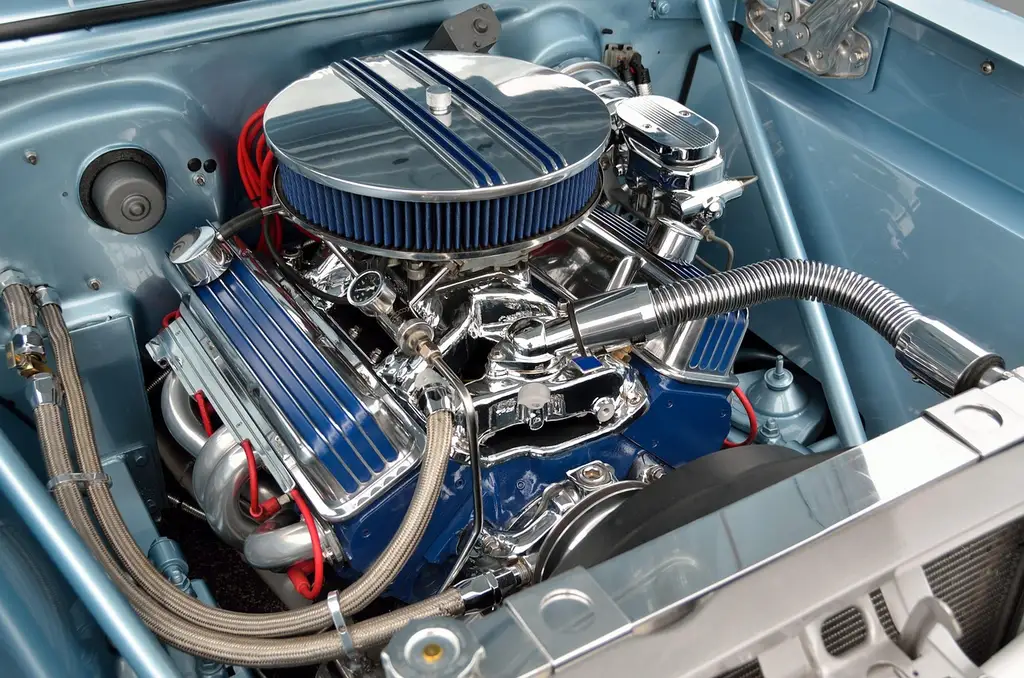
What Motor Oil Does My Car Need?
Your car needs the oil grade and specification listed in the owner’s manual, or the exact factory-equivalent spec tied to your VIN; the cap label is a quick check, not the final authority. The wrong viscosity or spec can increase wear, trigger warnings, or affect warranty coverage. This guide shows a fast lookup path that cross-checks the manual, VIN or registration lookup, and oil-cap label so you can buy the right oil without guessing.
Oil lookup table
Use the manual first, then confirm with a VIN or registration lookup if the handbook is missing. The cap label can help you avoid an obvious mistake, but it usually confirms only a narrow part of the answer. The table below shows what each source can reliably tell you.
| Lookup input | What it can confirm | What it may not confirm |
|---|---|---|
| Owner’s manual | Viscosity grade, oil capacity, and required API, ACEA, or ILSAC standard | It may be missing in a used car, and it may not be the fastest route if you already have the VIN |
| VIN | Exact oil spec tied to the vehicle build, usually through a dealership or parts lookup | By itself it does not tell you the oil level in the engine right now |
| Registration plate | Vehicle identity for an online or dealership lookup, often enough to reach the correct spec | It usually needs a make, model, year, or engine size check to avoid a wrong match |
| Oil cap label | Often the viscosity grade, and sometimes a reminder of a factory oil spec | It does not always confirm capacity, and it may not list the full standard requirement |
| Dealership parts or service department | Exact oil spec, often from make, model, year, engine size, or VIN | It still depends on the details you give them being correct |
- Check the owner’s manual first.
- Confirm the viscosity grade and any API, ACEA, or ILSAC spec.
- Use the VIN or registration if the manual is missing.
- Read the oil-cap label as a quick cross-check.
- Ask a dealership or independent mechanic if the details conflict.
- After filling, verify the level on the dipstick.
What does your owner’s manual say?
The owner’s manual is the main source for the oil grade and quantity your engine needs. It tells you how much oil to use, what type is best, and often the exact standard to buy. If the manual is missing in a used car, use the VIN or registration details to recover the factory spec.
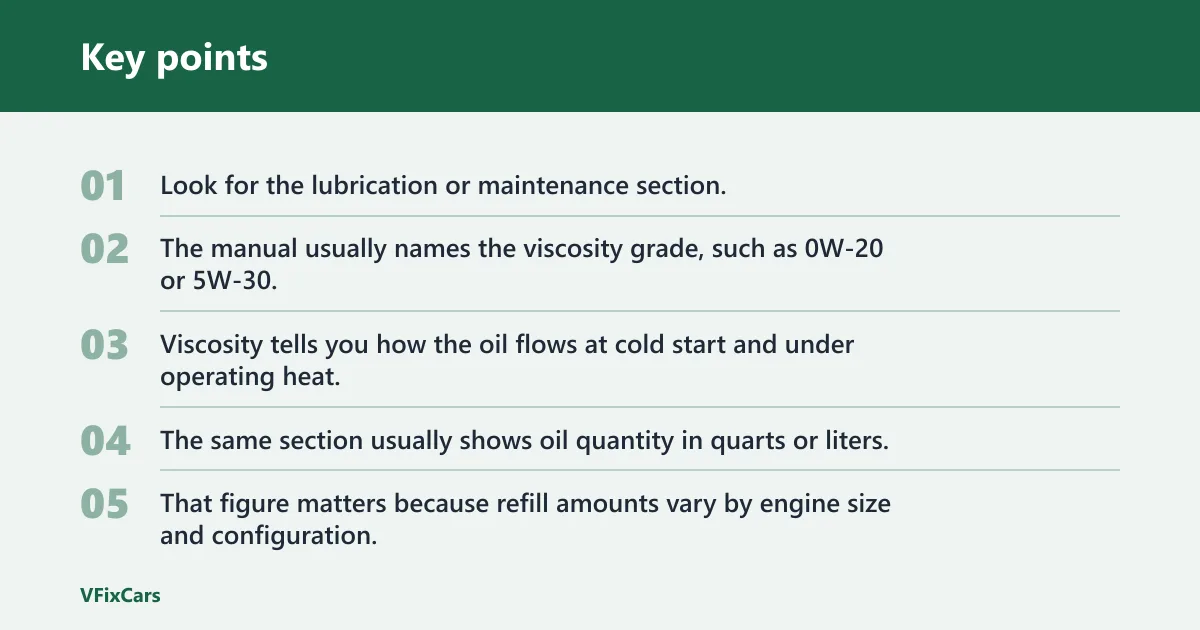
Where the oil grade is listed
Look for the lubrication or maintenance section. The manual usually names the viscosity grade, such as 0W-20 or 5W-30, and may add a manufacturer-specific oil standard. That combination matters. Viscosity tells you how the oil flows at cold start and under operating heat, while the standard tells you whether the oil meets the engine’s required performance level.
Where the capacity is listed
The same section usually shows oil quantity in quarts or liters. That figure matters because refill amounts vary by engine size and configuration. Most today’s engines hold between five and six quarts of oil. Compact four-cylinder engines can hold as little as four quarts. A big truck engine could hold up to eight or nine quarts.
What the manual may also specify
The manual may specify API, ACEA, or ILSAC standards, and it may note whether synthetic oil is required. That detail matters for turbocharged engines, stop-start systems, hybrids, petrol engines, and diesel engines, because the same viscosity grade can still fail to meet the required service category. A correct viscosity alone is not enough.
Can you find it by VIN or reg?
Yes. A VIN lookup or registration lookup can get you to the exact oil spec when the manual is missing or the engine details are unclear. Dealerships may need the car model, year, and make to help, and they may also ask for the engine size. If you do not know the car details, the VIN can be used instead.
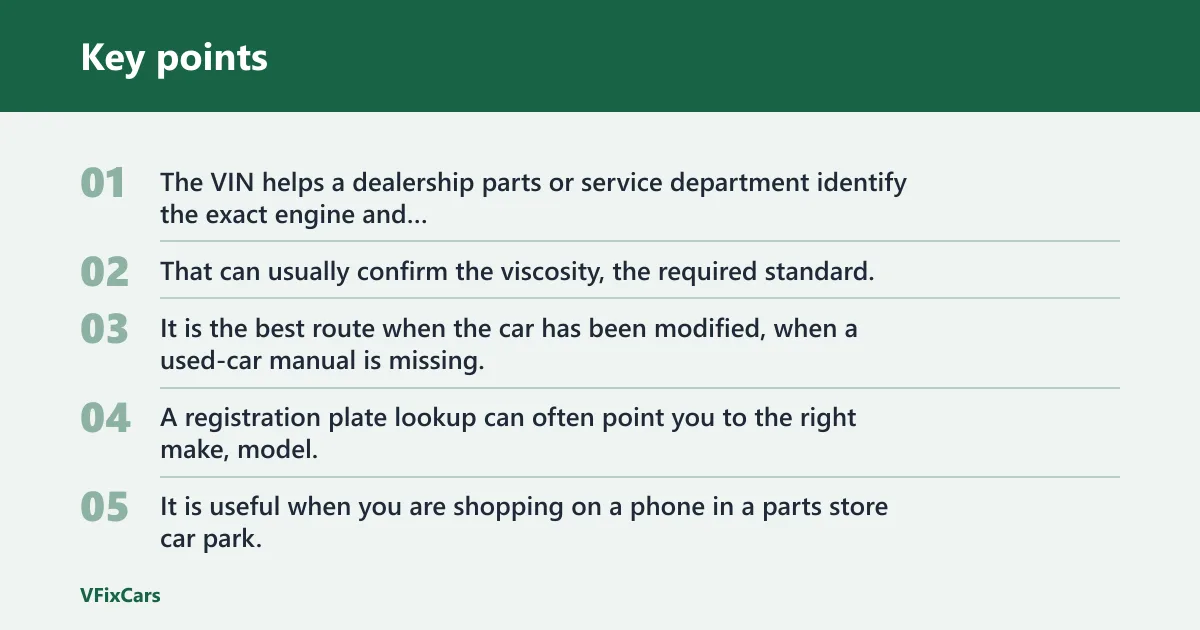
What a VIN lookup can confirm
The VIN helps a dealership parts or service department identify the exact engine and factory oil requirement. That can usually confirm the viscosity, the required standard, and sometimes the oil capacity. It is the best route when the car has been modified, when a used-car manual is missing, or when the badge on the tailgate does not match the actual engine.
What a registration lookup can confirm
A registration plate lookup can often point you to the right make, model, and year so you can narrow the oil spec quickly. It is useful when you are shopping on a phone in a parts store car park. Still, if the model was sold with several engines, add engine size before you buy anything.
When to add engine size
Add engine size whenever one model came with more than one petrol, diesel, turbocharged, hybrid, or stop-start engine. The wrong engine code can lead to the wrong oil standard even if the viscosity looks right. That may not stop the car from running immediately, but it can still leave the oil invalid for the engine spec or warranty claim.
Say your registration lookup returns a 1.5-litre turbo petrol hatchback with two factory oil options. The cap says 5W-30, but the manual for that engine line requires a specific ACEA category. In that case, the cap confirms the viscosity direction, while the manual or VIN lookup supplies the standard that actually matters.
How to read the oil cap
The oil-filler cap is a helpful cross-check, not the final word. It usually tells you the viscosity grade the engine expects, and sometimes it shows a factory oil symbol or a standard. It does not always list capacity, and it can be wrong if a previous owner replaced it with the wrong part or if the engine has been modified.
What the cap usually tells you
Many caps print the recommended viscosity, such as 0W-20 or 5W-30. That is useful because viscosity affects cold-start flow and operating protection. A lower winter number helps oil circulate sooner in cold conditions. The second number reflects how the oil behaves when hot.
What the cap does not tell you
The cap usually does not tell you the full oil capacity, and it may not spell out the exact API, ACEA, or ILSAC standard. That is why the cap should only confirm the manual or VIN result. If the cap says one viscosity and the manual says another, trust the manual or the VIN-based factory spec.
When the cap and manual disagree
If they disagree, treat the cap as the weaker source. Use the VIN or dealership lookup to settle the mismatch before you buy oil. A cap can be swapped, but the factory engine requirement does not change. That is especially important on diesel engines and turbocharged petrol engines, where the wrong oil category can be a poor fit even when the grade looks familiar.
What oil type does your engine need?
Your engine needs the viscosity grade and the service standard together, plus the right oil type if the maker requires one. Oil type usually means synthetic, synthetic blend, or conventional. Modern engines often call for synthetic, especially where heat, turbocharging, stop-start use, or hybrid cycling puts more stress on the oil.
Viscosity grades such as 0W-20 and 5W-30
0W-20 and 5W-30 are common viscosity grades, but they are not interchangeable unless the manufacturer lists both. The first number with W matters for cold flow. The second number matters once the engine is hot. Use the exact grade listed for your vehicle, not a close guess based on weather alone.
API, ACEA, and ILSAC standards
These standards matter because they describe the oil’s performance, not just its thickness. API is common on many petrol and diesel oils. ILSAC is often seen on modern petrol engines that call for fuel-economy-focused oils. ACEA is widely used for European-spec vehicles and can be especially important on diesel, turbocharged, and long-drain applications.
Synthetic, blend, or conventional
Synthetic oil is a common recommendation in modern engines and may be required by the manufacturer. Synthetic blend sits between synthetic and conventional, but it is not a universal substitute for a full synthetic requirement. Conventional oil may suit some older engines, but it can be unsuitable where synthetic is specified. Do not assume the cheaper oil is acceptable just because the viscosity matches.
Picture a hybrid that starts and stops the engine often in traffic. It may need a low-viscosity synthetic oil with a specific ILSAC or ACEA requirement because repeated cold starts stress the lubricant. The same grade in a conventional oil may not satisfy the maker’s spec, even if the engine seems to run normally at first.
How much oil should it take?
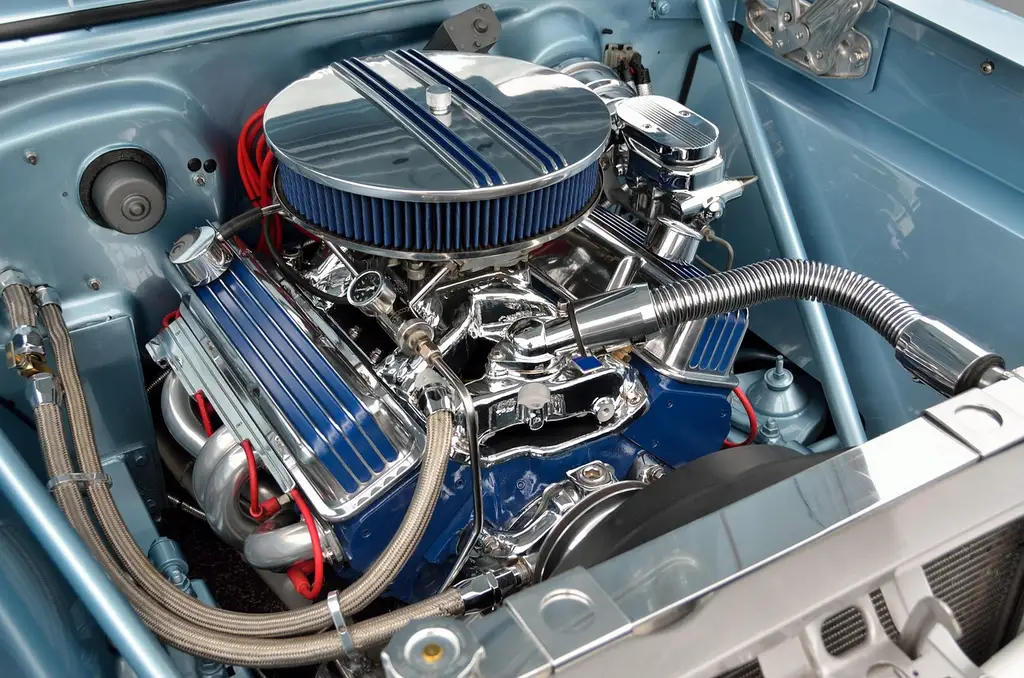
Oil capacity varies by engine size and configuration, so refill amounts must come from the manual, VIN lookup, or dealership data. Overfilling can aerate the oil and create foaming, while underfilling can leave the engine short of lubrication. After any fill, the dipstick is the final check for the actual level.
Why capacity varies by engine
Different engines have different sump sizes, oil passages, and filter layouts. That is why the same model badge can hide different fill quantities. Most today’s engines hold between five and six quarts of oil, but compact four-cylinder engines can hold as little as four quarts, while a big truck engine could hold up to eight or nine quarts.
How to refill without overfilling
Add oil in small steps, then pause before topping up. If the manual lists a capacity with and without filter, use the correct figure for the service you are doing. Overfilling is a problem because the crankshaft can whip air into the oil, which reduces lubrication quality. Underfilling is a problem because the pump can uncover the pickup under hard cornering or braking.
How the dipstick confirms the level
Check the dipstick on level ground and follow the maker’s instruction for engine temperature if one is given. The oil level should always read between the two lines on the dipstick. Those marks may be labeled Full and Add. If the level is below Add, add oil slowly. If it is above Full, remove excess oil.
A common first-timer mistake is to top up until the stick looks “nice and full” above the upper mark. That can leave the engine overfilled after the oil settles. A second mistake is to trust a low warning light after a short trip and add too much before the engine has fully drained back to the sump. The dipstick settles the question.
Frequently asked questions
What motor oil does my car need?
Your car needs the viscosity grade, oil standard, and oil type listed in the owner’s manual or confirmed by a VIN-based lookup. Start there, then use the oil cap as a check. If the manual is missing, a dealership or mechanic can match the vehicle by make, model, year, and engine size.
What engine oil does my car need?
It needs the exact oil spec the manufacturer assigned to that engine, not a close substitute. That usually means the right viscosity plus an API, ACEA, or ILSAC requirement, and sometimes synthetic oil. The manual is the first place to look, then the VIN or registration details if the manual is gone.
What kind of oil does my car need?
Your car may need synthetic, synthetic blend, or conventional oil, but the answer depends on the engine and the spec listed for it. Modern engines often call for synthetic. Do not choose by price alone. The wrong oil type can be out of spec even when the label shows the right viscosity grade.
What engine oil does my car need by reg?
A registration plate lookup can narrow the make, model, and year, which often gets you to the correct oil spec quickly. If more than one engine was offered, add engine size or VIN before buying oil. That extra step matters on turbocharged, diesel, hybrid, and stop-start models.
What kind of oil does my car take synthetic or conventional?
Check the manual or VIN lookup first, because the answer is not interchangeable. Synthetic is often required in newer engines, especially where heat and stop-start use are common. Conventional oil may still suit some older engines, but it should only be used if the manufacturer allows it.
What kind of oil and filter does my car need?
The oil spec comes from the manual or VIN, while the filter must match the engine and service interval. Some vehicles need a filter that is designed for the exact engine family or housing size. Use the vehicle details when ordering both items, and confirm the oil level on the dipstick after the change.