What Makes One Car Battery Better Than Another?
A better battery matches your car’s group size and terminal layout, meets or exceeds the required CCA, and, for stop-start cars, has the correct AGM or EFB type. Pick the wrong one and you can end up with slow cranking, shorter life in heat or cold, charging faults, and fitment problems that waste money. This guide compares cranking power, reserve capacity, recharge speed, cycle life, and vehicle-fit checks so you can judge value beyond price.
The specs that decide which battery fits your car
Battery quality is a trade-off, not a badge. A good battery for one car may be a poor fit for another if it has the wrong size, terminal layout, or charging profile. The real differences show up in starting power, reserve capacity, recharge speed, cycle durability, and how well the battery handles heat, cold, and vibration.
Trade-offs that matter
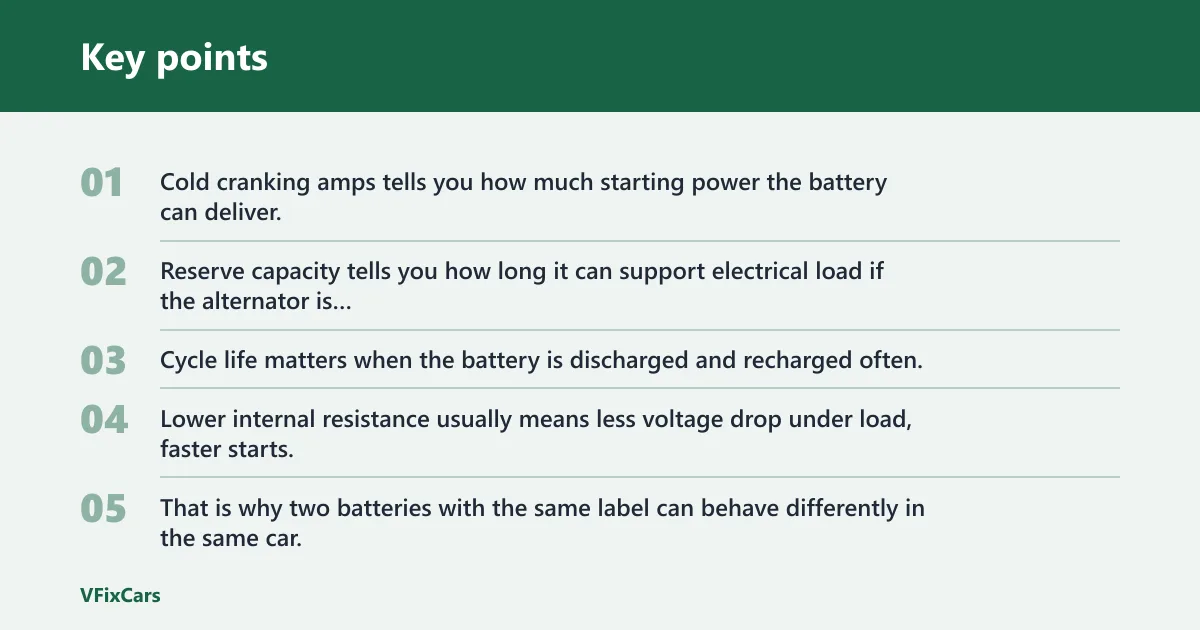
Cold cranking amps tells you how much starting power the battery can deliver, especially in cold weather. Reserve capacity tells you how long it can support electrical load if the alternator is not doing all the work. Cycle life matters when the battery is discharged and recharged often, as in stop-start use or repeated short trips.
Internal resistance matters too. Lower internal resistance usually means less voltage drop under load, faster starts, and better acceptance of charging current. That is why two batteries with the same label can behave differently in the same car.
Why price and brand are not enough
Two batteries can cost the same and still suit very different jobs. One may advertise a higher CCA but have weaker reserve capacity or poorer cycle life. Another may recharge faster and cope better with shallow daily discharge, even if its peak cranking number is lower.
Say your sedan gets used for a 12-minute commute, with the heater fan, rear defrost, and infotainment on every trip. A battery with decent CCA but weak reserve capacity can be a bad fit, because the short drive does not give the alternator much time to recover charge.
Why fitment matters as much as the label
Battery group size, terminal layout, hold-down style, and polarity must match the vehicle manual. A battery that looks “better” on paper is no help if the case does not fit the tray, the posts are reversed, or the cranking spec does not match the car’s demand.
Battery types you will compare
Lead-acid batteries
Lead-acid batteries are still common in older vehicles and standard cars. They usually have the lowest upfront cost and work well for basic electrical demand. The trade-off is shorter life than newer chemistries, especially when the battery is repeatedly drained or the vehicle sees lots of short trips.
Traditional flooded designs are common, and some vehicles use EFB, a slightly upgraded version of lead-acid used in some start-stop vehicles. Gel cell batteries are less common in most vehicles.
AGM batteries
AGM batteries are sealed and maintenance-free. They recharge faster than standard lead-acid batteries, handle deeper discharges better than standard flooded lead-acid, and perform well in extreme temperatures. That makes them a strong match for vehicles with stop-start systems or heavier electrical loads.
AGM also tends to cope better with repeated accessory use, because it tolerates deeper cycling without falling apart as quickly as a basic flooded battery.
LiFePO4 batteries
LiFePO4 batteries use lithium iron phosphate chemistry. They are much lighter than traditional batteries, have low internal resistance, deliver high current with low voltage drop, and can last 2–4 times longer. They can also maintain close to full rated capacity during cranking.
That sounds ideal, but fitment and vehicle compatibility matter more here than with lead-acid or AGM. A lithium battery that does not match the car’s charging system, battery management needs, or low-temperature behavior is poor value, even if the label looks impressive.
Which specs matter most on a label?
The most useful label numbers are the ones that map to a real job. CCA tells you whether the battery can spin the engine in cold weather. Reserve capacity tells you how long it can keep supporting the car’s electrical load. Internal resistance hints at how well the battery will hold voltage under stress and accept charge afterward.
Cold cranking amps and cold starts
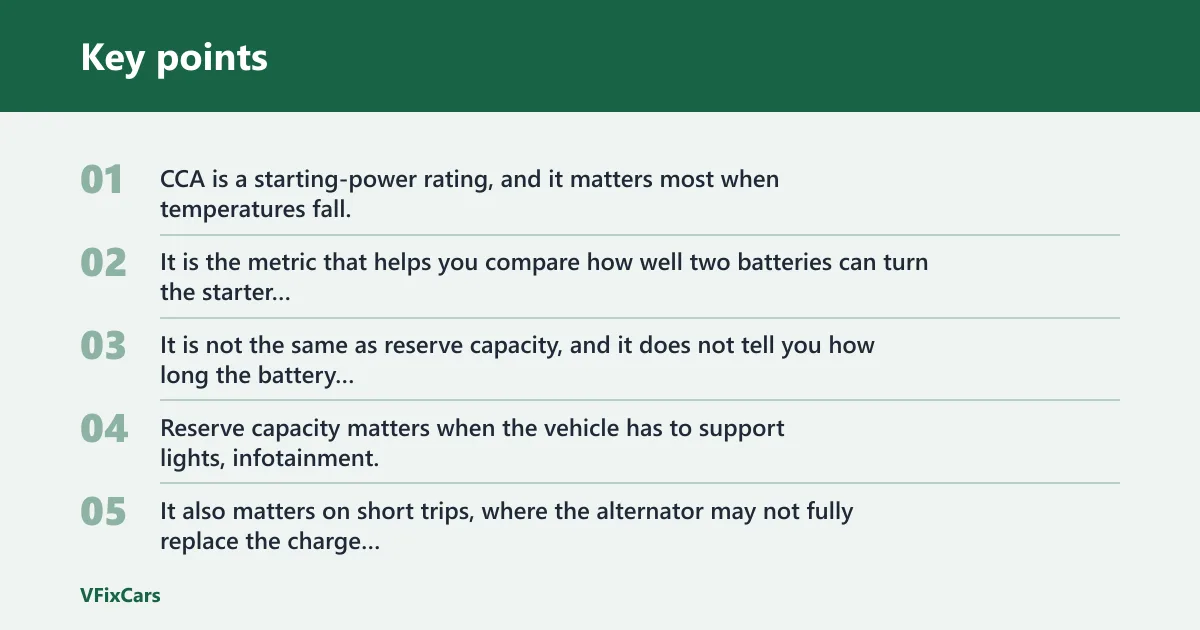
CCA is a starting-power rating, and it matters most when temperatures fall. It is the metric that helps you compare how well two batteries can turn the starter motor under cold load. It is not the same as reserve capacity, and it does not tell you how long the battery can power accessories.
Reserve capacity and accessory use
Reserve capacity matters when the vehicle has to support lights, infotainment, blower fans, door modules, or other loads with less alternator help. It also matters on short trips, where the alternator may not fully replace the charge used during starting. A higher reserve capacity can reduce stress in those patterns.
Internal resistance and recharge behavior
Lower internal resistance generally means less voltage drop during cranking and better charging response. That helps with fast starts and can improve how quickly the battery accepts energy after a start. It also matters in stop-start use, where the battery is asked to recover and deliver power repeatedly.
Picture a truck with a diesel engine, winter mornings, and lots of short hops between job sites. A battery with strong CCA but poor recharge behavior may start well one day and feel tired the next, because the driving pattern never gives it enough time to recover fully.
Does AGM beat standard lead-acid?
AGM is often better than standard flooded lead-acid when the vehicle has stop-start operation, a high accessory load, or frequent deep discharge. It recharges faster, handles deeper discharge better, and usually survives more demanding use patterns. That said, a basic flooded battery can still be the better buy for simpler vehicles.
Where AGM is worth the extra cost
Choose AGM when the vehicle manual calls for it, when the car has stop-start, or when you use many electrical accessories. It also makes sense for drivers who see a lot of short-trip use, because faster recharge and better cycle durability can reduce premature failure.
Where standard lead-acid still makes sense
If the car is an older model with modest electrical demand and no stop-start system, a standard flooded battery may be enough. In that case, paying extra for AGM can be wasted spend if the vehicle does not use the added cycling and recharge performance.
How stop-start changes the decision
Stop-start systems raise the cycle burden on the battery. That is why many of these vehicles benefit from AGM or, in some cases, EFB. A conventional flooded battery can wear out early because the system keeps asking it to supply and recover power far more often than a non-stop-start car.
When do lithium batteries make sense?
LiFePO4 can make sense when low weight, fast charging, and long service life are top priorities, and the vehicle is compatible with lithium charging and protection needs. It is often a good fit for some performance builds, specialty use, or vehicles designed around lithium. It is not a universal upgrade.
Where lithium fits well
Lithium is attractive when weight savings matter and the vehicle can support the chemistry correctly. Its low internal resistance, high current delivery, and strong service life can justify the cost in the right application. It can also be appealing when repeated starts and rapid recharge are expected.
Where lithium is poor value
LiFePO4 is usually poor value for a normal car that simply needs a reliable replacement battery. If the vehicle is not designed for lithium, the added cost may buy little practical benefit. Compatibility issues can also erase the advantage, especially in cars with smart charging or battery monitoring systems.
Compatibility checks before you buy
Check the manual for chemistry requirements, group size, terminal layout, and cranking spec. Confirm whether the vehicle expects AGM, EFB, or standard flooded lead-acid. If the car uses battery monitoring or smart charging, do not assume a lithium battery will be a drop-in replacement.
Battery comparison checklist
Use this checklist to compare any battery on the shelf or product page. Give each factor a score from 1 to 5, then weight the categories that matter most for your use case. A battery with strong CCA but weak reserve capacity may still be the wrong buy for short-trip driving or accessory-heavy use.
| Decision factor | Score band | What it means | Best for |
|---|---|---|---|
| CCA | 1-2 | Low starting reserve for cold starts | Warm-climate, low-demand cars |
| CCA | 3 | Meets standard demand | Typical daily commuter |
| CCA | 4-5 | Strong starting power margin | Cold climates, diesel, trucks, SUVs |
| Reserve capacity | 1-2 | Limited support under load | Simple cars with short electrical loads |
| Reserve capacity | 3 | Balanced support | Mixed driving and normal accessories |
| Reserve capacity | 4-5 | Longer support under load | Short-trip, accessory-heavy, stop-start use |
| Cycle life | 1-2 | Weak tolerance for repeated discharge | Occasional-use vehicles |
| Cycle life | 3 | Average daily-use durability | Standard commuter cars |
| Cycle life | 4-5 | Better deep-discharge tolerance | Stop-start, accessory-heavy, short-trip use |
| Recharge speed | 1-2 | Slower recovery after starting | Low-demand, longer-drive vehicles |
| Recharge speed | 3 | Normal recovery | General use |
| Recharge speed | 4-5 | Faster recovery after load | Stop-start, frequent accessory use |
| Internal resistance | 1-2 | More voltage drop under load | Light-duty, low-stress applications |
| Internal resistance | 3 | Normal cranking behavior | Most standard cars |
| Internal resistance | 4-5 | Lower voltage drop, stronger cranking response | Cold starts and rapid recharge use |
| Vibration resistance | 1-2 | Basic resistance | Smooth-road, low-vibration use |
| Vibration resistance | 3 | Normal durability | Typical passenger vehicles |
| Vibration resistance | 4-5 | Better durability in rough use | Trucks, SUVs, rough roads, work use |
| Temperature performance | 1-2 | Weak in heat or cold | Mild climates only |
| Temperature performance | 3 | Average seasonal behavior | Moderate climates |
| Temperature performance | 4-5 | Better extreme-weather performance | Very hot or very cold climates |
| Warranty | 1-2 | Short coverage window | Low-cost replacement where risk is low |
| Warranty | 3 | Typical coverage | Balanced purchase |
| Warranty | 4-5 | Stronger coverage terms | Premium purchases where support matters |
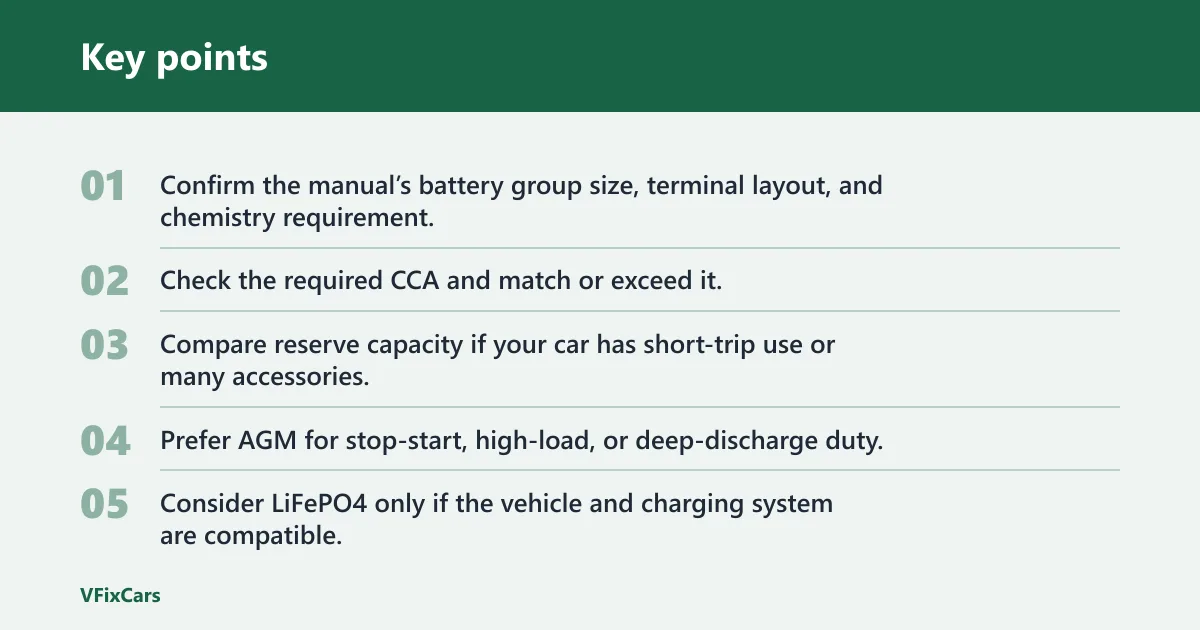
- Confirm the manual’s battery group size, terminal layout, and chemistry requirement.
- Check the required CCA and match or exceed it.
- Compare reserve capacity if your car has short-trip use or many accessories.
- Prefer AGM for stop-start, high-load, or deep-discharge duty.
- Consider LiFePO4 only if the vehicle and charging system are compatible.
Which battery fits your car and driving?
The right choice depends on how the vehicle is used, not just how it is built. A daily commuter, a cold-climate truck, and a stop-start compact all ask for different strengths. The best battery is the one that matches those demands with the least compromise.
Daily commuter versus short-trip driver
For a normal daily commuter, a standard lead-acid battery may be enough if the electrical load is modest and the car is not stop-start. For short-trip driving, reserve capacity and recharge speed matter more, because the battery may spend more time partially charged.
Cold-climate driver versus hot-climate driver
Cold weather puts more pressure on starting power, so higher CCA and lower internal resistance matter more. Hot weather speeds aging, so temperature performance and battery quality become more important over time. AGM often handles both ends of the range better than a basic flooded battery.
Stop-start car, truck, SUV, or accessory-heavy vehicle
Stop-start cars usually need higher cycle durability, which is why AGM or EFB is often the right answer. Trucks and SUVs often need more power to crank the engine, and larger vehicles may also carry heavier electrical loads. In those cases, pay attention to cranking spec, reserve capacity, and vibration resistance together.
A common first-timer mistake is buying a battery with excellent CCA for a work SUV, then ignoring reserve capacity and fitment. The battery starts well on day one, but the wrong case size or weak load support turns it into an expensive mismatch.
Frequently asked questions
What actually makes one car battery better than another?
A better battery is the one that matches your vehicle’s fitment and electrical demand with the least compromise. Look at CCA, reserve capacity, cycle life, recharge speed, internal resistance, and temperature performance together. A higher price only matters if those specs fit your use case.
Is AGM better than a standard lead-acid battery?
AGM is often better for stop-start vehicles, short-trip driving, and cars with heavy electrical loads because it is sealed, maintenance-free, recharges faster, and tolerates deeper discharge better. Standard lead-acid is still fine for many older cars with modest demand and no stop-start system.
Are lithium car batteries worth the extra cost?
LiFePO4 can be worth the cost if the vehicle is designed for it and weight savings, fast charging, or long service life matter. For many normal road cars, though, it is unnecessary. Check compatibility first, or the extra spend may buy little practical benefit.
Does a battery with higher CCA last longer?
Not necessarily. Higher CCA means stronger starting power, especially in cold weather, but it does not automatically mean longer life. Longevity depends more on cycle life, recharge behavior, heat resistance, vibration resistance, and whether the battery suits the vehicle’s charging system and driving pattern.
What battery type is best for stop-start cars?
AGM is often the best fit for stop-start cars because it handles repeated cycling better than standard flooded lead-acid and recharges faster. Some vehicles use EFB instead. Always check the manual, since stop-start systems raise battery stress far more than a normal commuting pattern.
Why do some batteries perform better in cold weather?
Cold weather slows chemical reaction inside the battery and raises starting load, so batteries with higher CCA and lower internal resistance usually perform better. AGM often does well in extreme temperatures, and batteries with stronger reserve and recharge behavior also recover more reliably after cold starts.