LED vs Halogen Headlights Lifespan: Which Lasts Longer in a Car?
LED headlights usually last longer than halogen bulbs in a car, often 5–10 years versus 1–3 years, but hot housings, weak cooling, or poor fit can shrink that advantage fast. If you ignore lifespan, you keep replacing bulbs, lose night visibility, and pay more labor. This guide compares service life, what shortens each type, and which setup lasts longer in daily driving.
| Factor | LED | halogen headlights lifespan | Winner |
|---|---|---|---|
| Typical service life | Common claims range from 20,000 to 50,000 hours, with some quality LEDs listed at 10,000 to 30,000 hours. | Typically 500 to 1,000 hours, with long-life versions at roughly 1,000 to 2,000 hours. | LED |
| Real-world failure pattern | Usually dims first, then flickers or loses output if the driver electronics or thermal control fails. | Often burns out suddenly when the filament breaks. | LED |
| Fitment sensitivity | Needs the right housing optics, rear clearance, dust cap space, and cooling path. | More tolerant of the original halogen housing design. | halogen headlights lifespan |
| Heat management | Depends on heat sinks, fans, airflow, and enough room behind the lamp. | Runs hotter at the bulb, but has no separate cooling hardware to fail. | halogen headlights lifespan |
| Best fit for frequent night driving | Usually the better long-run choice if the lamp is OEM LED or a well-designed retrofit in a compatible housing. | Works well for lower-mileage drivers, especially when the car sees limited night hours. | LED |
LED vs halogen lifespan at a glance
LED usually wins on lifespan, but the gap is not automatic. Halogen bulbs are simpler and cheaper upfront, while LED systems last far longer only when heat, fitment, and sealing are handled well.
Typical hour ranges
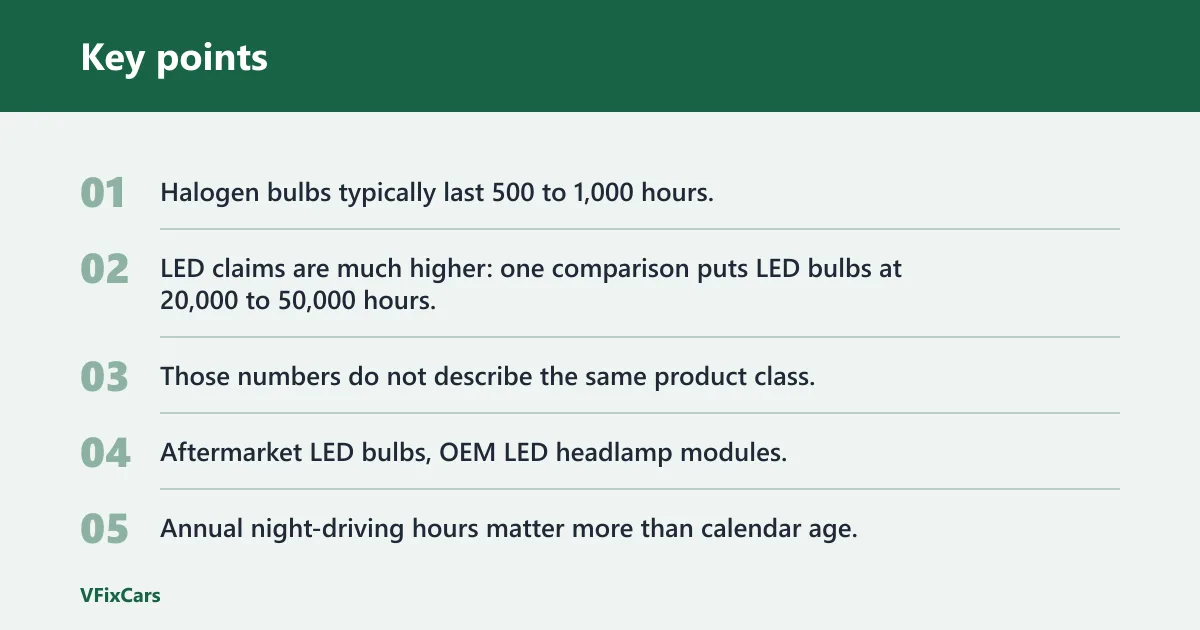
Halogen bulbs typically last 500 to 1,000 hours, and long-life halogens can reach roughly 1,000 to 2,000 hours. LED claims are much higher: one comparison puts LED bulbs at 20,000 to 50,000 hours, while another gives quality LEDs at 10,000 to 30,000 hours.
Those numbers do not describe the same product class. Aftermarket LED bulbs, OEM LED headlamp modules, and halogen replacement bulbs wear differently, and they fail under different housing conditions.
What those hours mean in years of night driving
Annual night-driving hours matter more than calendar age. A driver who uses headlights for about 300 hours a year would burn through a 1,000-hour halogen in about 3.3 years, while a 20,000-hour LED would last about 66.7 years on paper.
That paper math still needs reality checks. Cooling, voltage quality, moisture, and housing design usually end the run before the clean hour rating does, especially with retrofit LEDs in a tight or poorly vented lamp.
Why the longer-life winner depends on the setup
LED wins in most well-matched systems because the light source has no filament to snap. But the housing has to suit the LED’s heat path and beam pattern, or the system can run hot, glare badly, and fail sooner than the rating suggests.
Halogen can be the smarter buy in a reflector housing built for halogen light distribution, especially if access is easy and you want a low-cost bulb that is simple to replace. The right answer depends on the lamp design, not just the bulb type.
Headlight lifespan table
| Type | Estimated hours | 300 hours/year | 600 hours/year | 1,000 hours/year | Notes |
|---|---|---|---|---|---|
| Halogen bulb | 500–1,000 | 1.7–3.3 years | 0.8–1.7 years | 0.5–1.0 years | Filament wear, vibration, and thermal cycling; sudden outage when the filament breaks. |
| Long-life halogen | 1,000–2,000 | 3.3–6.7 years | 1.7–3.3 years | 1.0–2.0 years | Lower stress than high-output halogens; still heat-limited and still can fail suddenly. |
| Aftermarket LED bulb | 10,000–30,000 | 33.3–100 years | 16.7–50 years | 10.0–30 years | Heat sink or fan must fit; poor airflow, wrong optics, and bad sealing often decide real life first. |
| OEM LED module | 20,000–50,000 | 66.7–166.7 years | 33.3–83.3 years | 20.0–50 years | Usually tied to thermal design and electronics; output often drops gradually before full failure. |
Do LED headlights last longer than halogen?
Yes, LED headlights usually last longer than halogen in real use, sometimes much longer. The catch is that the longest life comes from the right housing, enough cooling, and healthy vehicle electrical parts; a poor retrofit can erase much of the advantage.
Where LED usually wins
LED wins when the car uses an OEM LED module or a quality LED designed for the housing. Solid-state light sources do not have a glowing filament that snaps from vibration or repeated heating and cooling, so they can run far longer in the right setup.
When halogen can be the smarter choice
Halogen can be the better buy if you need a simple replacement, your housing is built for halogen optics, or the rear of the lamp has very little room. A long-life halogen may beat a cheap retrofit LED that runs hot, fits badly, or causes glare.
Why housing design changes the answer
Headlamp housings are designed around a specific light source. A filament and an LED do not emit light from the same place, so the beam pattern, glare control, and cutoff can change if you swap in the wrong type.
Dust caps and rear clearance matter too. If the LED’s heat sink or fan sits too close to the cap or the housing wall, heat buildup goes up and lifespan usually goes down.
Why halogen bulbs wear out sooner
Halogen bulbs wear out sooner because a filament ages every time it heats up and cools down. Vibration makes that worse, which is why bulbs on rough roads, short-trip cars, or high-use lamps often fail sooner than the package claim suggests.
Filament wear and thermal cycling
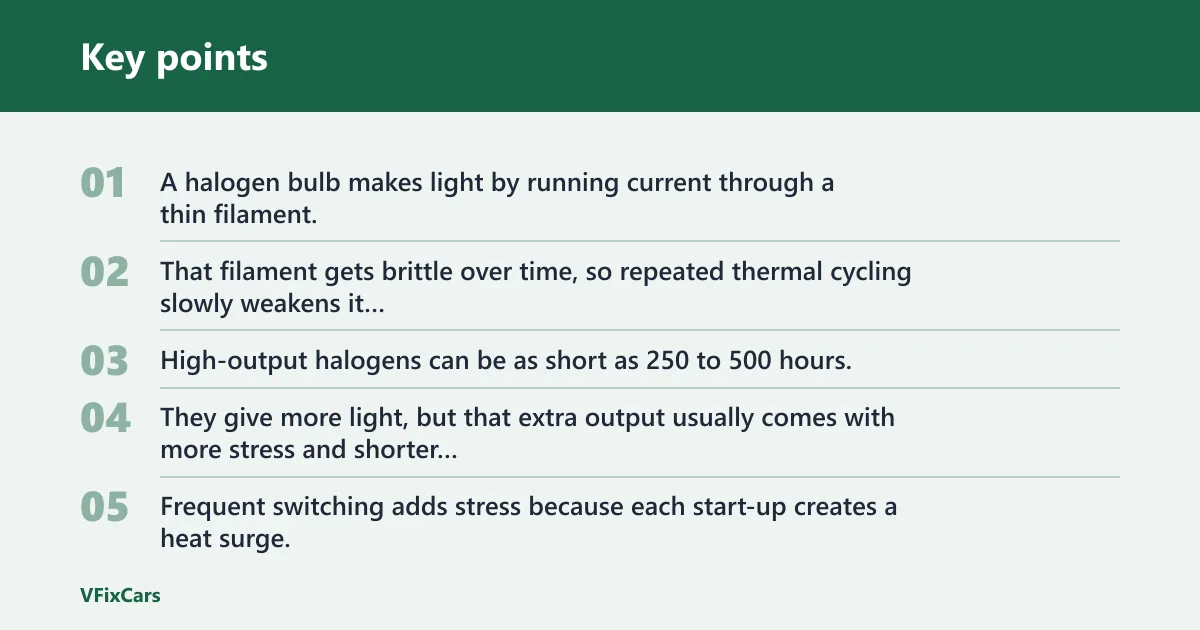
A halogen bulb makes light by running current through a thin filament. That filament gets brittle over time, so repeated thermal cycling slowly weakens it until it breaks.
High-output halogens can be as short as 250 to 500 hours. They give more light, but that extra output usually comes with more stress and shorter life.
Vibration, short trips, and repeated switching
Frequent switching adds stress because each start-up creates a heat surge. Short trips can be hard on halogens if the bulbs never settle into a steady operating pattern before they are switched off again.
A commute of about 12 minutes each way, with the headlights switched on and off four times a day, creates many thermal cycles. The bulb sees many thermal cycles even if the car does not rack up huge mileage, so the filament can age faster than the odometer suggests.
Sudden burnout versus gradual dimming
Halogen failure is often abrupt. The filament breaks, the circuit opens, and the bulb goes dark with little warning.
That difference matters for planning. If a halogen headlight is getting old, replacement is often a preventive move rather than a wait-for-failure decision.
Why LED headlights can fail early
LEDs usually last longer, but thermal control is the main limit. If the lamp runs too hot, the LED chips, driver electronics, or cooling parts can age faster, and the bulb or module may dim, flicker, or fail early.
Thermal management limits
LEDs make less waste heat at the light source than halogens, but they still need a path for heat to leave the lamp. That is why heat sinks, fans, and airflow matter so much for LED life.
One comparison notes that halogens waste around 90% of energy as heat. LED retrofits commonly use about 15 to 20 watts, which can help reduce power draw, but only if the heat is carried away from the driver and chips.
Driver electronics and fan failures
Many LED lamps rely on driver electronics, and some use cooling fans. Either part can fail before the LEDs themselves wear out, so the weak point may not be the light source at all.
OEM LED headlamp modules are often rated at 70% of initial brightness, or L70. That means the lamp may still work after long use, but output can fall enough that the car no longer lights the road as well as it did at the start.
Overheating, moisture, and poor fitment
Overheating shortens life faster than most drivers expect. Moisture ingress can also corrode connectors and driver boards, especially when seals are damaged or dust caps are missing.
Picture a retrofit LED that fits into a halogen reflector with almost no rear clearance. The fan has little room to breathe, the cap does not seal properly, and condensation starts after wet weather; the driver may see flicker first, then uneven output, then failure.
What shortens headlight lifespan?
Several parts of the car affect headlight life beyond the bulb itself. Housing optics, electrical health, sealing, and driving pattern all shape how long the lamp lasts in real use.
Housing optics and rear clearance
Halogen housings are built for a filament at a specific position. LED replacements may fit physically but still produce a poor beam pattern if the source position does not match the reflector or projector design.
Rear clearance also matters because many LED retrofits use a heat sink or fan behind the bulb. If that space is tight, cooling suffers and the lamp can run hotter than intended.
Vehicle electrical condition
Voltage spikes and poor grounds shorten bulb life. Driver electronics and ballasts can also fail, so a healthy charging system matters for both halogen and LED setups.
Compatibility with the vehicle’s bulb monitoring system matters too. Some cars watch current draw closely, and an LED retrofit that confuses the system may flicker, trigger warnings, or cycle too often.
Moisture ingress and damaged seals
Damaged seals and missing caps let water and humid air into the housing. That moisture can fog the lens, corrode connectors, and harm LED electronics faster than it harms a simple halogen bulb.
Driving pattern and daytime running light use
Night-driving hours determine the replacement interval. A car used mostly for long night commutes will reach its hour limit far faster than one that only sees occasional darkness.
Frequent cycling and daytime running light use also matter. If a lamp is switched on and off many times a day, or if the car keeps the front lighting active for long periods, wear accumulates sooner.
Are aftermarket LEDs worth it?
Aftermarket LEDs can be worth it if the housing, cooling, and electrical system are a good match. They are a poor choice if the lamp is cramped, the beam pattern suffers, or the installation leaves the housing poorly sealed.
Aftermarket bulbs versus OEM LED modules
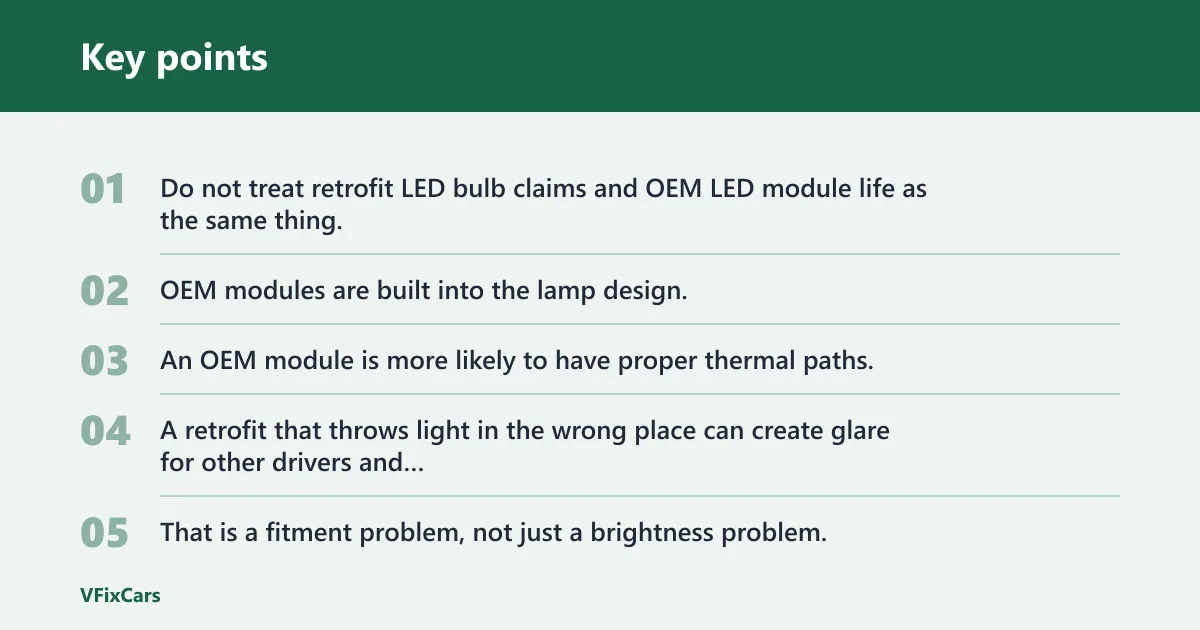
Do not treat retrofit LED bulb claims and OEM LED module life as the same thing. OEM modules are built into the lamp design, while retrofit bulbs have to work inside a housing that was not always designed for them.
That difference matters for durability. An OEM module is more likely to have proper thermal paths, while a retrofit may live or die by clearance, fan quality, and how well the lamp is sealed after installation.
Beam pattern, glare, and legal concerns
A retrofit that throws light in the wrong place can create glare for other drivers and still leave the road poorly lit for you. That is a fitment problem, not just a brightness problem.
Legal and road-use rules also matter because a bulb that is not approved for the housing may be illegal or may fail inspection in some places. A bad fit can also trap heat and shorten lifespan, so legality and durability often point in the same direction.
When a long-life halogen is the better buy
A long-life halogen is often the better choice if you want low cost, simple installation, and predictable beam shape in a halogen housing. It may be the practical answer for a driver who does not want cooling hardware, adapter rings, or monitoring errors.
A common first-timer mistake is buying a cheap LED kit for a reflector housing with little rear space. The lamp may install, but the beam scatters, the cap no longer seals well, and the promised lifespan never arrives.
- Match the bulb type to the housing design instead of choosing by wattage alone.
- Keep dust caps, seals, and rear covers in place so moisture stays out.
- Make sure heat sinks and fans have enough room to move air.
- Check battery, charging voltage, and ground connections if bulbs fail early.
- Replace aging halogens in pairs if one has already reached the end of its typical life.
- Choose a long-life halogen over a cheap retrofit LED if the lamp is cramped or poorly vented.
Choose LED if…
Choose LED if you drive at night often, your car uses OEM LED modules, or the retrofit is designed for your exact housing with enough cooling space. LED is also the better pick if you want the longest service life and fewer bulb changes over time.
Choose halogen headlights lifespan if…
Choose halogen headlights lifespan if you want the simplest replacement, the lowest upfront cost, or a bulb that fits a halogen housing without cooling hardware. Long-life halogen makes sense when the car has limited rear clearance, a poor retrofit fit, or only modest night-driving use.
Frequently asked questions
How many hours do halogen headlights last compared with LED?
Actual life depends on cooling, housing fit, and electrical health.
Why do LED headlight bulbs fail early?
LEDs usually fail early because the heat is not managed well, the driver electronics fail, or moisture gets into the housing. A tight installation can also block airflow or leave the fan too close to a cap or wall, which raises temperature and shortens life.
Are LED headlights worth it if I drive mostly at night?
Yes, if the LED is matched to the housing and cooling is adequate. A driver who racks up many night hours gets more value from long service life, but a poor retrofit can erase that benefit with glare, flicker, or early failure.
Do halogen bulbs burn out suddenly like LEDs?
Halogen bulbs often burn out more suddenly because the filament breaks and the light stops at once. LED failure is more often gradual, with dimming or flicker before complete loss, although a driver board or fan can still fail without much warning.
Can aftermarket LED bulbs last as long as factory LED headlights?
Usually not in the same conditions. OEM LED modules are built into the lamp design and often have better thermal control, while retrofit bulbs depend on housing space, cooling, and sealing. A good retrofit can last a long time, but the claim is less predictable than an OEM module.
Which headlight type lasts longest in real life?
In real life, OEM LED modules usually last longest when the car and lamp were designed for them. After that comes a good aftermarket LED in a compatible housing, then long-life halogen, then standard halogen. Fitment, heat, and moisture can shift the order quickly.