Can You Use a Car Seat Without the Base?
Yes, you can use many infant car seats without the base if the seat is approved for baseless installation and you follow the carrier’s belt path and recline rules exactly. A poor install can let the seat move too much, tilt at the wrong angle, or reduce how well the harness and shell can protect in a crash. This guide shows when the base is optional, when it is mandatory, and how to install safely in taxis, grandparents’ cars, and travel situations.
Why the base is designed for convenience
Yes, sometimes infant seats are built for both base and no-base use. The answer depends on the infant car seat model, because some seats are built for both base and no-base use, while others need to stay paired with their removable base. If the manual allows a baseless install, you secure the carrier with the vehicle seat belt and follow the seat’s belt path and recline instructions.
What the base changes
The base mainly changes convenience. It lets you click the infant seat in and out without reinstalling each time, which helps with daily drop-offs and short errands. A base also gives you a stable platform already adjusted for the seat, but it does not replace the need to read the manuals and verify a correct fit in each vehicle.
Think of the base as a convenience part, not a universal requirement. The car seat itself still has to be approved for the method you use, and the vehicle has to allow the needed belt or anchor setup. If the seat is not approved for a no-base install, forcing it with the wrong method does not make it safe.
📊 Good Housekeeping noted the Chicco KeyFit 35 is hard to install without a base. Source: Caranddriver.
When is the base optional?
The base is optional only when the infant seat manual says that the carrier can be installed without it. In that case, you use the vehicle seat belt through the correct belt path. Compatibility matters here, because the seat, the base, and sometimes even the vehicle can change what is allowed and how the seat must sit.
Why the exact model matters
Do not assume one brand follows the same rule across its line. Compatibility varies by product model, and some bases work with multiple infant seats while others do not. That matters for families who borrow a second vehicle or switch between cars, because the label on the shell and the manual control the setup, not the brand name alone.
For example, a Chicco KeyFit 35 may be hard to install without its base, even though it is still an infant seat with a removable base. That is a practical issue, not a rule by itself. The real question is whether that specific seat and carrier combination is allowed without the base and can be tightened correctly in your vehicle.
Compatible base and seat pairing
A compatible base and seat pairing is not universal. Some infant seats fit only their matched base, and some brands sell multiple bases for different vehicles. Before buying extras or swapping parts between cars, confirm the exact model numbers in both manuals. A base that locks one infant seat securely may not fit another from the same brand.
Suppose your family has one infant seat for a sedan and a minivan. The sedan may allow a no-base seat belt install for airport days, while the minivan uses the base every day. That can work only if the manual allows both methods and each vehicle can deliver a tight install at the correct belt path.
When is the base required?
The base is required whenever the manufacturer says the carrier must be used with its base. That applies even if a different infant seat from another brand can be installed without one. Do not assume lower anchors, UAS, or LATCH will solve that problem, because the allowed method comes from the car seat manual first and the vehicle manual second.
Why lower anchors/UAS may be off-limits
There are two rear-facing installation options: UAS and seat belt. But that does not mean both are allowed for every setup. Canada says you cannot use UAS for infant seats installed without the removable base, and the car seat manual may forbid it elsewhere too. For a base-free install, the vehicle seat belt is the method to check first.
Lower anchors, UAS, and LATCH are designed for child car seats and can simplify some rear-facing installs, but they are not a substitute for the rules in the manual. If the seat is being used without its base, do not guess. Read the infant seat manual and the vehicle manual before you route anything through the seat.
What to check in the manuals
Read both manuals before installation. The car seat manual tells you whether the carrier may be installed without the base, which belt path to use, and whether a lock-off or other belt-locking method is built into the seat. The vehicle manual tells you how to lock the seat belt, and whether the seating position can accept the setup you want.
Children must be buckled up in a child car seat made for their height and weight. That makes the manual check more than paperwork. It tells you whether the carrier itself is correct for the child, whether the recline range fits the seat, and whether the vehicle can support the install method you are planning to use.
Use car seat decision table
| Seat type | Allowed installation methods | Whether lower anchors/UAS can be used | Common mistake to avoid | Best use case for travel, Uber, or secondary vehicles |
|---|---|---|---|---|
| Infant seat with removable base that allows no-base installation | Vehicle seat belt without the base; base install when the base is available | Only if the manual allows UAS for that exact rear-facing setup | Using the wrong belt path or forgetting to lock the belt | Travel days, taxis, airport transfers, grandparents’ cars |
| Infant seat with removable base that requires the base | Base-only installation in the approved vehicle positions | Use only if the manual allows the base to be installed with UAS | Trying to install the carrier directly with the seat belt | Primary vehicle where the base stays installed |
| Infant seat with a dedicated carrier and no removable base option | Follow the seat’s fixed installation method as listed by the manufacturer | Only if the manual specifically permits it | Assuming all infant seats work the same way | Non-travel use where the same vehicle is used most days |
| Any infant seat in a vehicle with uncertain compatibility | Only the method named in both manuals | Do not assume UAS is acceptable | Skipping the vehicle manual because the seat “looks like it fits” | Use after confirming the exact model pairing |
How do you install it safely without the base?
Use the vehicle seat belt through the correct belt path, then lock the belt as directed in the vehicle manual. Check the rear-facing recline angle on a level surface, and make sure the seat moves about no more than 2.5 cm, or 1 inch, side to side and front to back at the belt path.
Use the vehicle seat belt
When the base is off, the seat belt is the usual method. Thread it through the belt path marked for no-base installation, then tighten it while removing slack from the correct section of the belt. If the vehicle requires the belt to lock at the retractor, do that exactly as the manual describes. If the seat has its own lock-off, use it as directed.
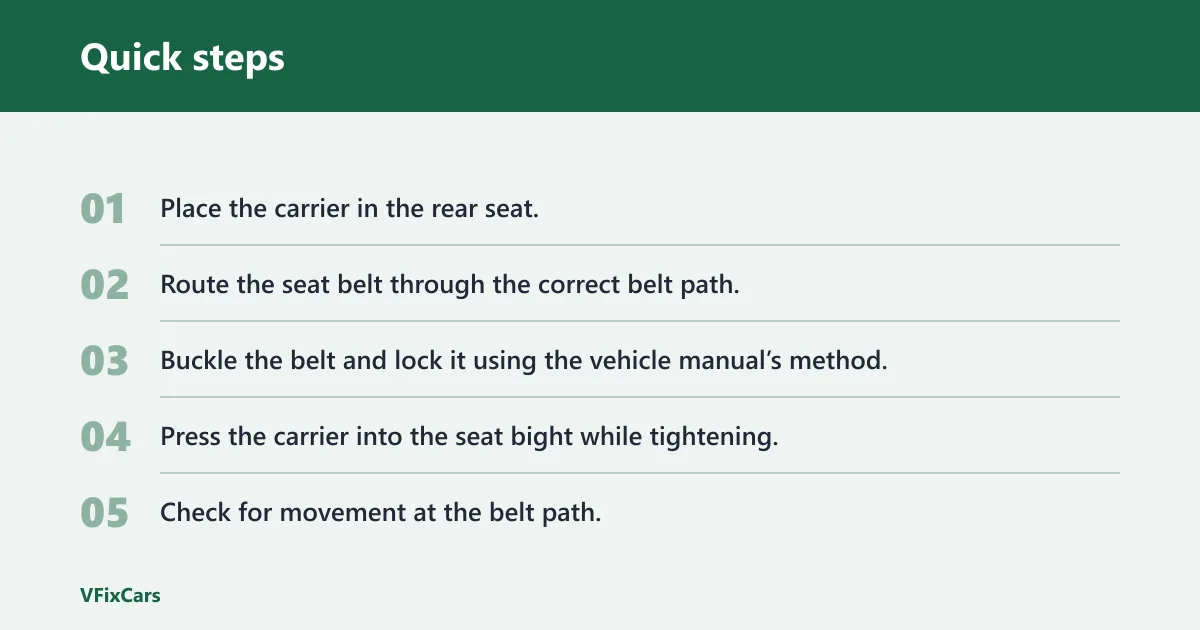
- Place the carrier in the rear seat.
- Route the seat belt through the correct belt path.
- Buckle the belt and lock it using the vehicle manual’s method.
- Press the carrier into the seat bight while tightening.
- Check for movement at the belt path.
- Verify the recline angle and harness fit.
Check recline angle and tightness
A rear-facing seat is set at an angle to support a child’s neck in a sudden stop or crash. That angle matters because the child’s airway must stay open. Check it on a level surface, then confirm the carrier still sits within the manufacturer’s angle range after tightening. A seat that is too upright or too reclined can be wrong even if it feels tight.
The seat should not move more than 2.5 cm when checked side-to-side and front to back. Test it at the belt path, not at the top of the shell or the handle. A loose seat can feel stable from one angle and still fail the actual movement check where it matters most.
A common first-timer mistake is tightening the belt at the top of the carrier, then discovering the belt path still shifts more than 2.5 cm. The fix is usually to press down near the belt path, remove slack there, and lock the belt again according to the vehicle manual. Small changes at the wrong spot do not count.
Confirm rear-seat placement
Keep the rear-facing seat in the back seat. Front airbags can injure children, so the rear seat is usually the default place unless the vehicle and car seat manuals give different instructions for a specific exception. If the center seat is available and allows a correct install, that can be a good location, but anchor availability and belt routing may vary.
Can you use one in taxis or Ubers?
Yes, if the car seat model allows a baseless install and you can secure it correctly with the vehicle seat belt. That is why base-free use matters for taxis, rideshares, airport transfers, and any day when the base stays at home. The method is the same: correct belt path, locked belt, rear seat, and checked recline.
Travel days and airport transfers
Travel is where a baseless install is most useful. You may not want to carry the base through an airport or reinstall it in every hired vehicle. A seat that can be installed without the base gives you one carrier, one belt path, and one procedure to repeat. That said, speed never replaces the manual.
Suppose you land late and need a rideshare to the hotel. If the infant seat allows no-base use, you can install it in the back seat with the seat belt in a few minutes. If the seat requires the base, the taxi or Uber is not the place to improvise, because an unapproved setup is still an unapproved setup.
Grandparents’ cars and other secondary vehicles
Secondary vehicles are a common reason to learn this method. A grandparent’s sedan, a neighbor’s pickup, or a spare car used once a week may not have a permanent base. In that case, the seat belt method can be practical, as long as the seat manual allows it and the vehicle can lock the belt properly.
Check the fit before the first trip, not at curbside with a sleeping baby waiting. Some cars have short belt stalks, awkward buckle positions, or center seats with limited room for a safe install. The seat may still work, but only after you confirm the belt path, the lock, and the recline on that exact vehicle seat.
Frequently asked questions
Can you use a car seat without the base?
Sometimes. Many infant seats allow it, but only if the manual approves that exact model for baseless use. In that setup, the carrier is installed with the vehicle seat belt, not the base. If the manual does not allow it, do not treat the carrier as interchangeable with every other infant seat.
Can you put a car seat without the base?
Yes, if the seat is designed for it and you use the correct belt path. The vehicle belt has to be locked the way the vehicle manual says, and the seat still needs the right rear-facing recline. A quick visual check is not enough; test the movement at the belt path.
Can you use a baby car seat without the base?
For some baby car seats, yes. The more important question is whether your exact model allows it and whether the vehicle can support the install method. Read both manuals. If the seat requires the base or forbids lower anchors/UAS without it, the answer is no for that setup.
Can you use an infant car seat without the base?
Often yes, but not always. Infant seats installed without the removable base must be secured with the seat belt, and Canada says you cannot use UAS for that no-base setup. Check the seat model, the belt path, and the vehicle’s locking method before you decide that the carrier will work.
Can you use a newborn car seat without the base?
Only if the newborn seat is an infant seat that the manufacturer allows to be installed without its base. The word “newborn” does not change the rule. What matters is the specific model, the approved install method, and whether the seat can stay at the correct recline for a smaller baby.
Is it legal to use a carseat without the base?
Legal compliance depends on where you are and what the local child restraint rules require, but manufacturer compliance is separate from legal compliance. Even if local law allows a no-base install, you still have to follow the car seat manual. In Canada, the UAS rule for no-base infant seats is especially important.