What Tire Pressure Should Your Car Tires Be?
Your car tires should match the PSI on the driver’s door placard, usually around 30 to 35 PSI, but the placard value is the one that matters. Too much air can make the contact patch smaller and can reduce grip, while too little can build heat, wear the shoulders faster, and hurt braking and fuel economy. This guide shows how to find the correct PSI, read a gauge in kPa or bar, and correct overinflation safely.
This guide is part of our Tires: how to choose safe tires for your car series.
What you’ll need
- Tire pressure gauge, digital or standard
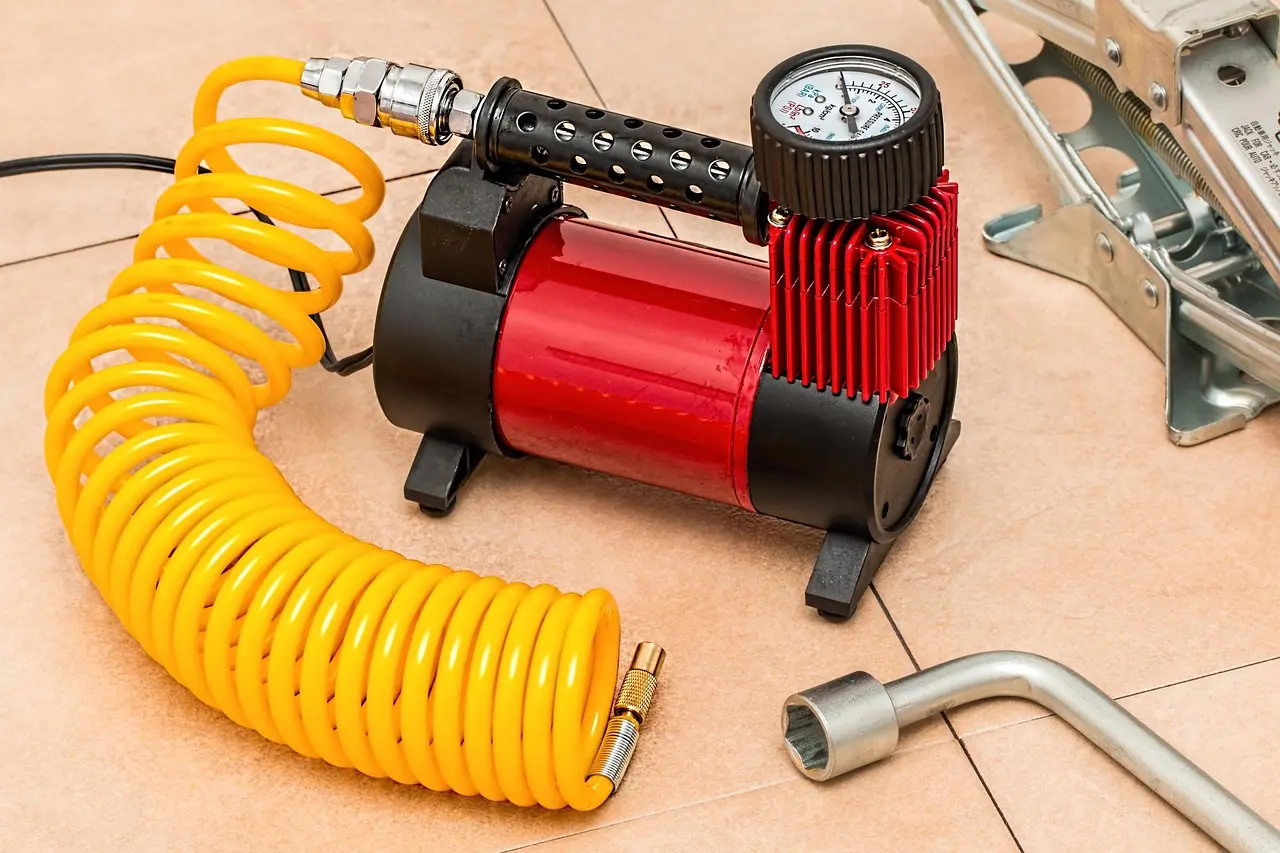
- Air compressor or inflator
- Owner’s manual or vehicle handbook
- Clean view of the driver’s door-jamb tire inflation label
What tire pressure should your car tires be?
Use the tire pressure printed on the driver’s door placard first, then confirm the same front and rear figures in the owner’s manual or handbook. Measure the tires before driving, or after the vehicle has sat long enough to cool, because that is the standard condition for an accurate reading. Front and rear pressures may differ, so do not copy one axle to the other.
PSI stands for pounds per square inch, and many placards also list bar. If your gauge uses a different unit, compare like with like, or convert before changing air. The correct answer depends on the vehicle, not a generic number.
How to find the correct PSI
- Open the driver’s door and read the door-jamb tire inflation label.
- Match the front and rear values to the vehicle handbook.
- Use dealer or service records only if the placard is missing or unreadable.
- Set the tires cold, then compare each tire to its axle’s target.
- Add or release air in about 1 PSI steps, then check again.
Say your sedan placard lists 32 PSI front and 30 PSI rear. Inflate each axle to its own number, not to one shared value. Suppose a compact car handbook lists a load-dependent range for the rear axle. Use the higher end only when the vehicle is carrying that load, not for daily solo driving.
How to find the correct PSI
The door-jamb placard is the main source for recommended front and rear tire pressure. It is vehicle-specific and usually lists PSI or bar. If the placard is hard to read, the owner’s manual is the next check, because it can show the same values and any load-dependent range.
Read the placard first
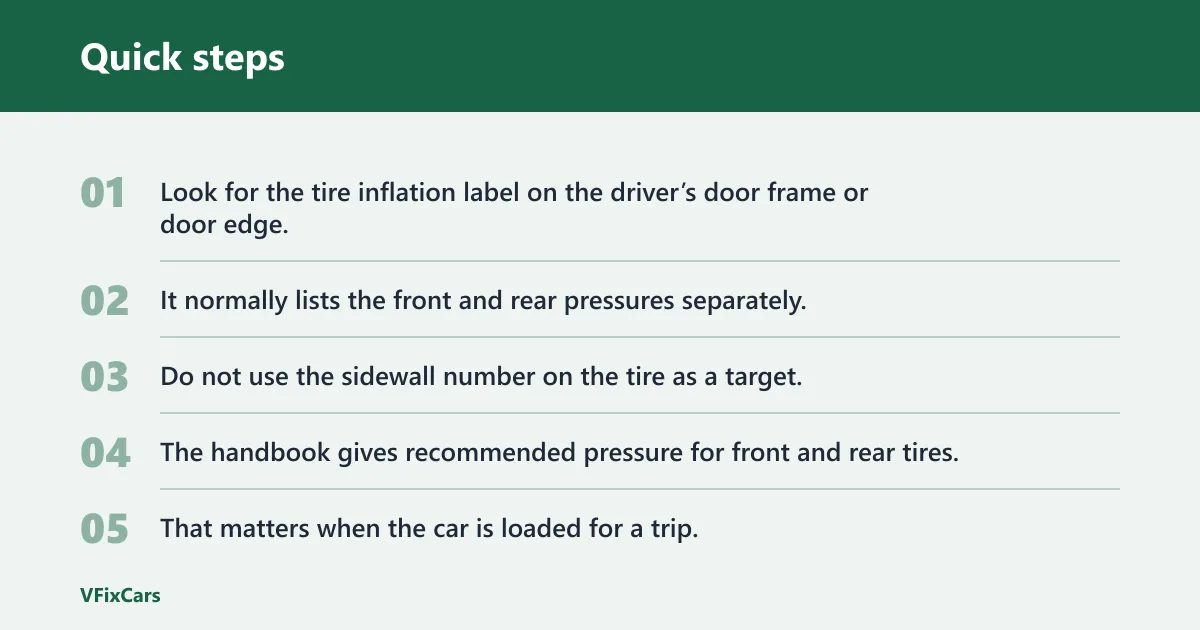
Look for the tire inflation label on the driver’s door frame or door edge, where it is commonly placed. It normally lists the front and rear pressures separately, and sometimes includes a load note. Do not use the sidewall number on the tire as a target; it is generally not the vehicle’s recommended setting.
Then check the owner’s manual
The handbook gives recommended pressure for front and rear tires, and it may explain how the range changes with passenger count or luggage. That matters when the car is loaded for a trip. Use the handbook to confirm the placard, not replace it.
Use records only as a fallback
If the placard is missing or unreadable, check dealer or service records, then ask a service department to verify the correct figures. This fallback order is better than guessing, especially on cars with different axle pressures or load-based ranges. Do not assume every model in a lineup uses the same number.
Should you check tire pressure cold or hot?
Check tire pressure when the tires are cold. That means before driving, or after the car has sat long enough to cool. Hot readings are temporary and can read higher than the setting you actually want, so they should not be treated as the final target.
If you must check hot tires, treat the result as a rough check only. Recheck cold later and set the pressure to the placard or handbook figure. Do not bleed air from a hot tire and call it done.
Tire pressure lookup and correction matrix
| Source of recommendation | Measurement condition | Unit | Action |
|---|---|---|---|
| Door placard | Cold | PSI | Compare gauge reading, add air or release air, then verify again |
| Door placard | Cold | bar | Match the listed bar value, convert only if your gauge is different, then verify again |
| Owner’s manual | Cold | PSI | Use for front and rear targets, especially if the placard is unclear, then verify again |
| Owner’s manual | Cold | bar | Use the handbook value for the axle in question, then verify again |
| Dealer or service record | Cold | PSI or bar | Use only as a fallback, then verify against a placard or handbook as soon as possible |
| Any source | Hot | PSI or bar | Do not final-set pressure from this reading; verify again when cold |
Is 49 psi too much for tires?

For many passenger cars, 49 PSI would be considered overinflated unless the placard or manual specifically calls for it. Lower it only to the vehicle’s specified range, then recheck when the tire is cold. Do not keep driving on a reading that far above the placard just because the car still feels normal.
If the placard is missing, use the manual, then dealer or service records, then a service department verification. If the handbook gives a load-dependent recommended range, use the higher end only when the car is carrying that load. A lightly loaded car should stay at the normal setting.
Red flag: very high readings
A reading like 49 PSI needs action, not delay. Release air in small steps, such as 1 PSI at a time, and recheck after each adjustment. If the tire was filled at a shop or dealership, ask for the exact target they used and compare it to the placard before leaving.
Common mistakes
One common mistake is using the same pressure for every axle. Another is setting pressure from a hot reading and stopping there. Mixed units cause trouble too: if the placard says bar and your gauge shows PSI, compare the number after conversion or use a gauge that shows both.
Tire shop nitrogen fills do not change the target pressure. Nitrogen may be in the tire, but the correct PSI still comes from the placard or handbook. TPMS warnings after a temperature drop can also happen when the pressure is now below target, so check with a gauge instead of trusting the warning alone.
How to correct pressure step by step
- Check the placard or handbook for the front and rear targets.
- Measure each tire cold with a tire pressure gauge.
- Use the air compressor to add air in 1 PSI steps.
- Release air in short bursts if the tire is above target.
- Recheck after every adjustment until each axle matches its listed value.
For example, if the front tires read 30 PSI and the placard calls for 33 PSI, add about 1 PSI to each front tire, then recheck. If the rear tires read 36 PSI and the target is 33 PSI, let out air in short bursts until the reading is about on target. Stop at the listed value, not near it.
If that didn’t work, try this next
- Compare the gauge with another gauge at the same cold tire reading.
- Check whether the gauge is showing bar instead of PSI, or the reverse.
- Look again at the placard for a load note or a different rear-axle value.
- Ask a dealer or service department to verify the recommendation from the VIN.
Frequently asked questions
What should my tire pressure be?
It should be the number on the driver’s door placard for your exact vehicle, checked cold. Use the owner’s manual to confirm front and rear values, especially if the car has a load-based range. There is no universal PSI that fits every car.
What air pressure should my car tires be?
Use the same figure you would use for tire pressure: the placard value, usually listed in PSI or bar. If your gauge shows the other unit, convert before adjusting. Set each axle to its own specified number, not to a rounded guess.
Where do I find the recommended tire pressure on my car?
Look on the driver’s door-jamb tire inflation label first. If that label is missing or unreadable, check the owner’s manual, then dealer or service records, then a service department verification. Front and rear values may be different, so read both.
How do I find the correct tire pressure for my car?
Start with the door placard, confirm in the owner’s manual, and use dealer or service records only if the placard cannot be read. Then compare your cold gauge reading in PSI or bar, and adjust each tire to the listed front or rear value.