What Type of Battery Is a Car Battery: Wet or AGM?
A car battery is either wet-cell, also called flooded lead-acid, or AGM. If the label says AGM or Absorbed Glass Mat, it is AGM, and many stop-start cars use it. Using the wrong charger or replacement can shorten battery life and may cause charging faults or leave you stranded. This guide shows how to identify your battery in 60 seconds, what the label and vent caps tell you, and what changes if it is AGM.
Flooded Lead-Aid Battery Versus AGM Design
Most cars use a flooded lead-acid battery, which people also call wet-cell or wet battery. AGM is another lead-acid design. It is common in many stop-start vehicles and in some higher-demand applications, but it is not the default battery type in every car.
Why “wet,” “wet cell,” and “flooded” usually mean the same thing
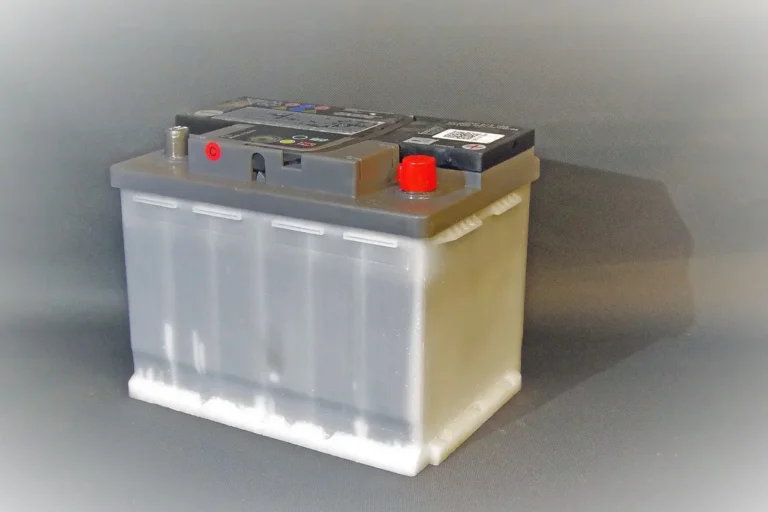
Wet batteries use liquid electrolyte and are also called flooded lead-acid batteries. On many models, the top has removable round vent caps, which are the usual visual clue for a standard battery. Those caps matter because some flooded batteries can be checked and topped up with distilled water.
Where AGM fits in the lead-acid family
AGM is commonly used to stand for Absorbent Glass Mat, though the wording may vary. It is a maintenance-free lead-acid battery that uses glass fibers or a fiberglass mat to absorb the electrolyte. AGM batteries are described as completely sealed with a flat top, and many carry the VRLA label, which means valve-regulated lead-acid.
Flooded battery vs AGM: the quick comparison
The main trade-off is simple: flooded batteries are usually cheaper and easier to identify by vent caps, while AGM batteries are sealed, often cost more, and are used in vehicles that demand more from the battery. The right choice depends on the vehicle spec, not just on price or size.
| Feature | Flooded lead-acid | AGM |
|---|---|---|
| Other names | Wet, wet cell, flooded | Absorbent Glass Mat, Absorbed Glass Mat, often VRLA |
| Electrolyte | Liquid electrolyte | Absorbed in glass fiber mat |
| Top design | Often removable round vent caps | Sealed top, no service caps |
| Maintenance | Some models need water checks | Maintenance-free |
| Typical cost | Cheaper upfront | About 1.5 to 3 times more |
| Common factory use | Many non-stop-start cars | Many stop-start cars |
Construction: liquid electrolyte and vent caps vs absorbed electrolyte and a sealed top
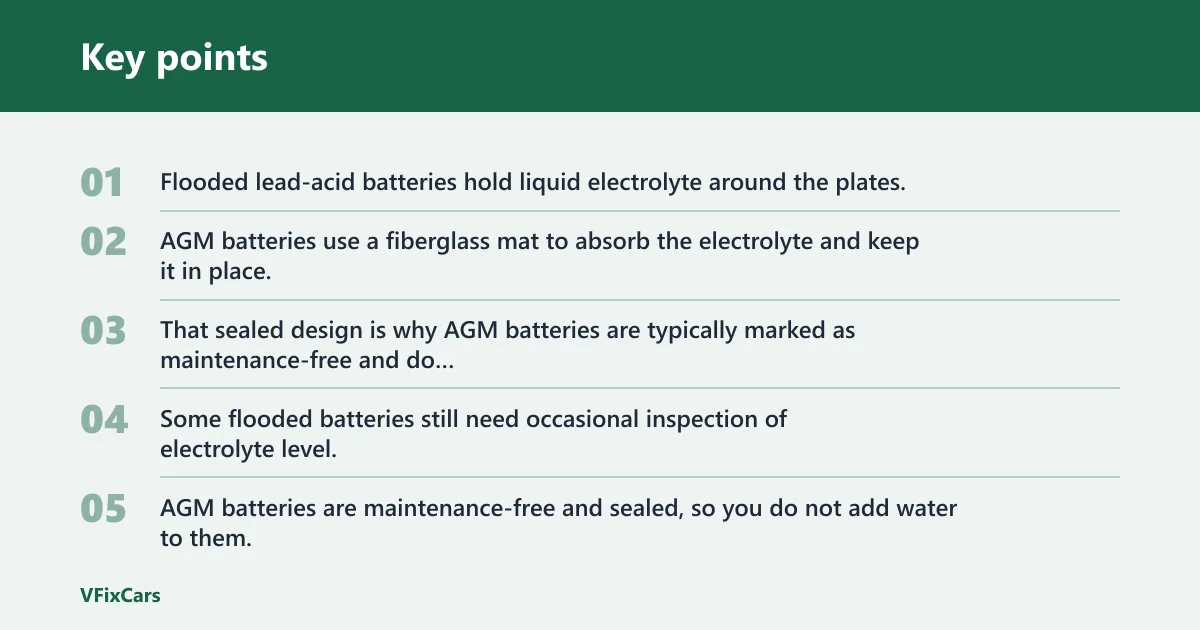
Flooded lead-acid batteries hold liquid electrolyte around the plates. AGM batteries use a fiberglass mat to absorb the electrolyte and keep it in place. That sealed design is why AGM batteries are typically marked as maintenance-free and do not use the same service caps as flooded batteries.
Service needs: checking water on some flooded batteries vs maintenance-free AGM
Some flooded batteries still need occasional inspection of electrolyte level. AGM batteries are maintenance-free and sealed, so you do not add water to them. If a battery has round vent caps on top, that strongly points to flooded construction rather than AGM.
Charging and replacement: when the chemistry choice changes the next step
The chemistry matters most when you charge or replace the battery. AGM batteries need the correct charger mode, and many vehicles with stop-start technology almost always use AGM or EFB from the factory. Replacement should usually match the factory battery type unless the vehicle maker allows a change and the charging system supports it.
How can you tell if your battery is standard or AGM?
Start with the label, then check the top of the battery, then verify the owner’s manual. If the battery says AGM, Absorbed Glass Mat, or VRLA, that is the answer. If the label is unclear, the top design and the vehicle spec usually settle it fast.
Check the label for AGM, VRLA, or sealed wording
The label may say AGM, Absorbed Glass Mat, or VRLA. Many AGM batteries also mention sealed construction or maintenance-free status. If the label clearly names AGM, do not treat it as a standard wet battery.
Look for round vent caps or a removable top on flooded batteries
The usual visual clue for a standard battery is removable round vent caps. Those caps are common on flooded batteries and not on AGM batteries. A flat, fully sealed top is a stronger sign of AGM or another sealed design.
Use the owner’s manual and stop-start system as the tie-breaker
The owner’s manual wins if the label is missing or hard to read. This matters most on stop-start vehicles, because the battery spec is vehicle-specific. If your car has stop-start and the manual calls for AGM or EFB, do not guess based on appearance alone.
Use this 60-second under-hood checklist
This quick check helps you identify the battery type without tools. Follow the yes/no path in order. If you land on a mixed answer, stop and use the owner’s manual before buying a replacement or selecting a charger mode.
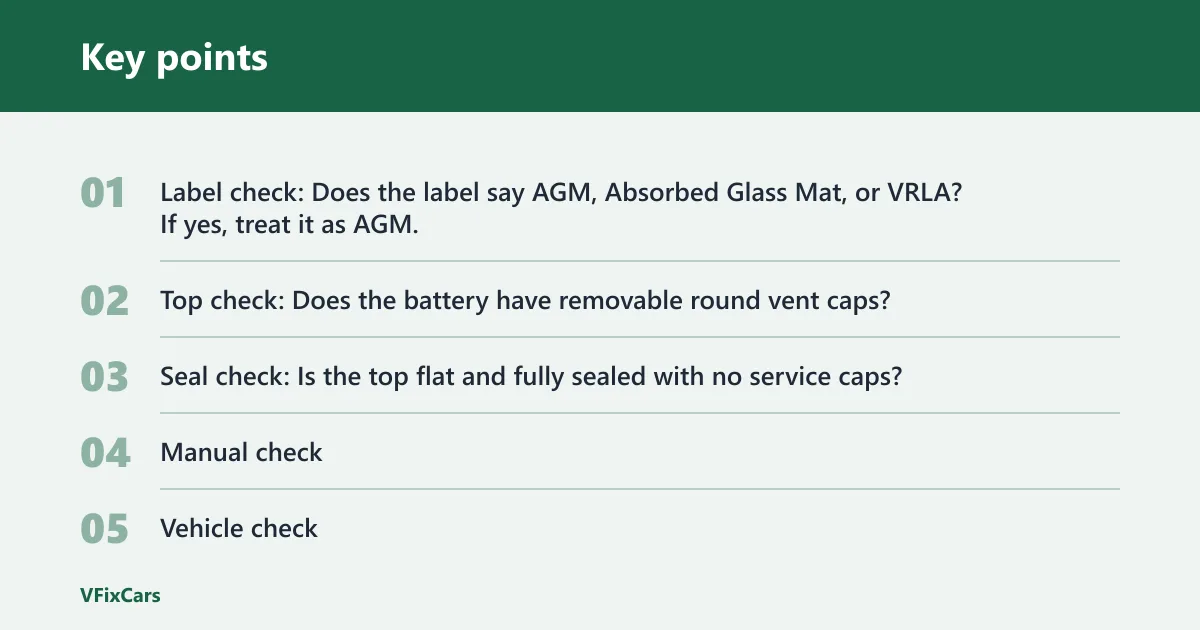
- Label check: Does the label say AGM, Absorbed Glass Mat, or VRLA? If yes, treat it as AGM.
- Top check: Does the battery have removable round vent caps? If yes, it is usually flooded lead-acid.
- Seal check: Is the top flat and fully sealed with no service caps? If yes, it is likely AGM or another sealed type.
- Manual check: Does the owner’s manual list AGM, EFB, or another specific battery type? If yes, follow that spec.
- Vehicle check: Does the car have stop-start technology? If yes, AGM or EFB is often factory-installed.
- Charger check: Does your charger have an AGM mode or automatic battery-type detection? If yes, use the correct setting before charging.
What to do after each result
If the label says AGM, buy an AGM replacement and use an AGM charger mode. If you see vent caps and a flooded design, match it with a flooded battery unless the manual says otherwise. If the label and the manual disagree, trust the manual and the vehicle specification.
Say your sedan has a battery with six round caps on top and no AGM wording on the label. That is the classic flooded layout. If the replacement box says AGM but your manual calls for a standard flooded battery, skip it unless the vehicle maker allows the change.
Suppose your hatchback has stop-start, a sealed flat-top battery, and the label reads VRLA. That points to AGM. A charger set to standard mode may still charge it, but an AGM setting is the safer choice because the charge profile should match the battery type.
Do AGM batteries need a special charger?
Yes, AGM batteries are generally best charged with a charger that has an AGM mode or automatic chemistry detection. That matters because AGM charging targets differ from flooded-battery charging, and the wrong setting can lead to poor charging or charging faults.
Why AGM mode matters on a charger
A charger with an AGM or AGM/Gel setting uses a profile meant for sealed lead-acid batteries. If the chemistry is unknown, automatic detection is useful, but only if the charger reliably identifies the battery type. When in doubt, check the battery label first.
Why equalization charging belongs with flooded batteries, not AGM
Equalization charge is a flooded-battery charging step used to balance cells under certain conditions. It does not belong on AGM unless the charger and the battery maker specifically allow it. Using that kind of charging on AGM can damage the battery or shorten its life.
What to do if the battery chemistry is unknown
If the label is missing, read the owner’s manual and inspect the battery top. If the battery is sealed and the car has stop-start, treat AGM as the likely type until the vehicle spec says otherwise. If you still cannot confirm it, use a charger with automatic detection or have the battery identified before charging.
Can you replace a standard battery with AGM?
Sometimes, but not always. An AGM swap can be acceptable if the vehicle maker allows it and the charging system can support it. In many cars, though, the safest choice is to match the factory battery type exactly, especially when stop-start technology is involved.
When an AGM swap is acceptable
An AGM replacement can work when the physical fit, terminal layout, and vehicle charging strategy all support it. The battery group size still has to match, because group size is a fitment spec, not a chemistry label. Size and terminal location matter as much as type.
When you should match the factory battery type instead
If the manual calls for a flooded battery, replacing it with AGM is not automatically better. If the manual calls for AGM or EFB, keep that specification. Stop-start systems are especially sensitive, because they depend on the battery chemistry the car was designed around.
Why battery group size and terminal layout still have to match
Group size tells you whether the battery fits the tray and whether the terminals line up. It does not tell you whether the battery is flooded, AGM, or something else. A correct chemistry with the wrong group size is still the wrong battery for the car.
What is the difference between a regular battery and an AGM battery?
A regular battery usually means a flooded lead-acid battery with liquid electrolyte and a vented top. AGM uses absorbed electrolyte in a sealed case. The practical difference is service, charging, and cost, not the job of starting the engine, which both types do.
Cost and lifespan
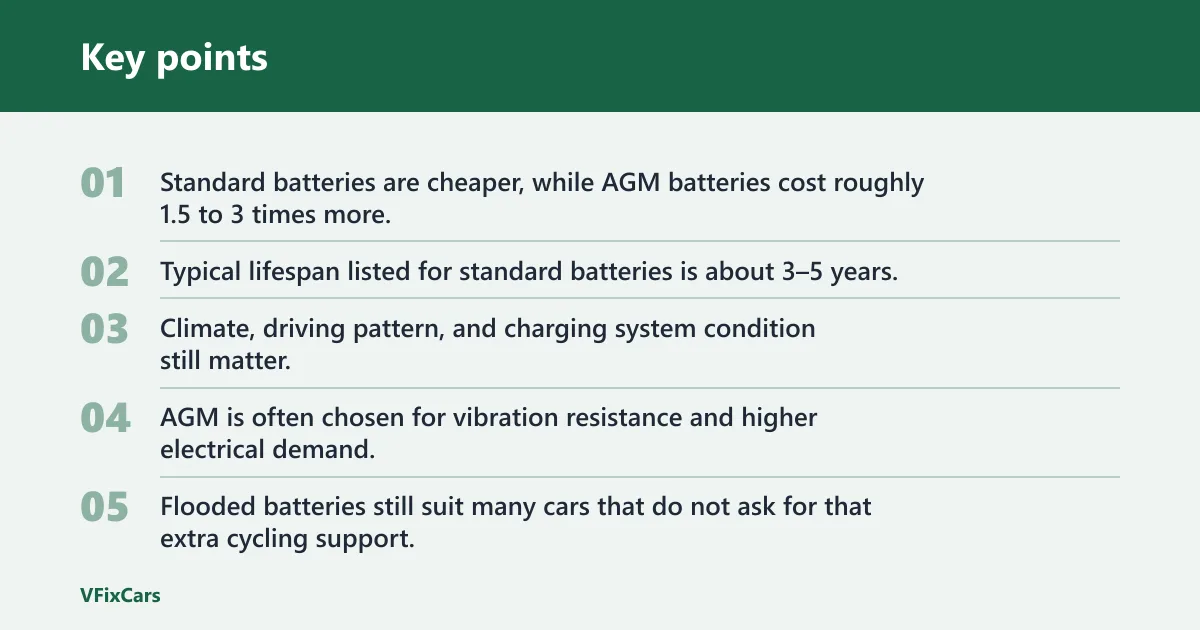
Standard batteries are cheaper, while AGM batteries cost roughly 1.5 to 3 times more. Typical lifespan listed for standard batteries is about 3–5 years, and typical lifespan listed for AGM batteries is about 4–7 years. Climate, driving pattern, and charging system condition still matter.
Performance and use case
AGM is often chosen for vibration resistance and higher electrical demand, which is why it appears so often in stop-start vehicles. Flooded batteries still suit many cars that do not ask for that extra cycling support. The right answer is the one the vehicle spec calls for.
What is the difference between a standard battery and a AGM battery?
“Standard” battery usually means flooded lead-acid. AGM is a separate sealed lead-acid design with absorbed electrolyte and a pressure-relief valve. If the manual says standard, that usually points to flooded. If it says AGM, use AGM.
Why the label matters more than the marketing
Some listings blur the terms and leave out the chemistry. That is a problem because wet, flooded, AGM, and gel are not interchangeable labels. A battery marked AGM or VRLA should not be treated like a conventional flooded battery during charging or replacement.
How a wrong choice causes trouble
A wrong charger mode can charge a battery poorly or select a profile that does not suit the chemistry. A wrong replacement can create charging faults, shorten battery life, or leave the car with a battery that does not support its electrical system. That risk is highest on stop-start cars.
What type of battery is a car battery wet gel or agm
“Wet gel” is not the same as AGM, and the wording is often a source of confusion. A wet battery is usually flooded lead-acid. AGM is a sealed lead-acid type. Gel batteries are another sealed lead-acid design, so do not mix the three terms together.
How to separate gel from AGM and flooded batteries
If the label says AGM, Absorbed Glass Mat, or VRLA, it is not a wet battery. If it has removable vent caps and liquid electrolyte, it is flooded. If the label says gel, treat it as a different sealed type and follow the charger and replacement spec for that chemistry.
What type of battery is a car battery wet or dry
For modern cars, “wet” usually means flooded lead-acid, and “dry” is not the right label for a typical starting battery. AGM is sealed, but it is still a lead-acid battery, not a dry battery in the casual sense people often mean online.
What to look for instead of the word dry
Use the actual chemistry label. Look for flooded, AGM, VRLA, or gel. If you cannot find that, check the owner’s manual. The word “dry” does not tell you enough to pick the right charger setting or replacement.
What type of battery is a agm battery
An AGM battery is a valve-regulated lead-acid battery that uses a fiberglass mat to absorb the electrolyte. It is maintenance-free, sealed, and built to reduce spillage and support higher-demand vehicle use. The label may say AGM, Absorbed Glass Mat, or VRLA.
What kind of battery is an agm battery
An AGM battery is a sealed lead-acid battery, not a flooded wet-cell battery. It uses glass fibers to hold the electrolyte in place and a pressure-relief valve to manage internal pressure. That construction changes how you charge it and how you identify it under the hood.
Frequently asked questions
How can I tell if my car battery is standard or AGM?
Check the label first. AGM, Absorbed Glass Mat, or VRLA points to AGM. Then look for removable round vent caps, which usually mean flooded standard battery. If the answer is still unclear, use the owner’s manual, especially on a stop-start vehicle.
Choose flooded lead-acid if… / choose AGM if…
Choose flooded lead-acid if the vehicle calls for a standard battery, the top has vent caps, and cost matters most. Choose AGM if the manual calls for it, the car has stop-start technology, or the charger and charging system are set up for AGM. If the label and manual disagree, follow the manual.
Choose flooded lead-acid if…
- The label says flooded, wet, or standard battery.
- The battery has removable round vent caps.
- The owner’s manual lists a standard flooded battery.
- The vehicle does not use stop-start and does not call for AGM or EFB.
Choose AGM if…
- The label says AGM, Absorbed Glass Mat, or VRLA.
- The top is sealed and there are no service caps.
- The owner’s manual specifies AGM or EFB, especially on stop-start cars.
- You need a charger with AGM mode for proper charging.
What to do if the label and the manual disagree
Trust the owner’s manual and the vehicle specification. If the battery in the car does not match the spec, assume the battery may have been changed before and verify the intended type before buying a replacement. On stop-start vehicles, that step matters even more.
Frequently asked questions
If your battery is unclear, do not guess from the price or the case shape alone. Read the label, check for vent caps, and confirm the vehicle’s battery specification. That quick routine avoids the most common mistakes: wrong charger mode, wrong chemistry, and wrong replacement.
What is the difference between a regular battery and an agm battery
A regular battery usually means flooded lead-acid with liquid electrolyte and vent caps. AGM is sealed, maintenance-free, and uses absorbed electrolyte in glass mat. The main differences are construction, charging profile, and cost. The battery still has to match the vehicle spec.
What is the difference between a standard battery and a agm battery
A standard battery usually points to flooded lead-acid. AGM is a different sealed lead-acid type with a flat top and no service caps. Standard batteries are cheaper, while AGM batteries cost more and are often used where the electrical system asks for repeated starts or higher demand.
Can I replace a standard car battery with AGM?
You can only do that if the vehicle maker allows it and the charging system supports it. Matching group size and terminal layout is still required. On cars with stop-start technology, replacing the factory battery type without checking the manual can cause charging issues.
Do AGM batteries need a special charger?
Yes. Use a charger with AGM mode or automatic detection. AGM does not need flooded-battery equalization charging, and the wrong setting can shorten battery life. If you cannot identify the chemistry, read the label and owner’s manual before charging.