
What Is the Best Tire Rotation Pattern for AWD?
For AWD, the best tire rotation pattern is usually rearward cross on non-directional, square setups; use front-to-back only for directional tires, and no rotation for staggered fitments. Use the wrong pattern and you can get uneven wear, vibration, and early tire replacement on AWD systems. This guide shows how to pick the correct pattern by tire construction first, then drivetrain, plus the service interval to follow.
Tire rotation setup and pattern guide
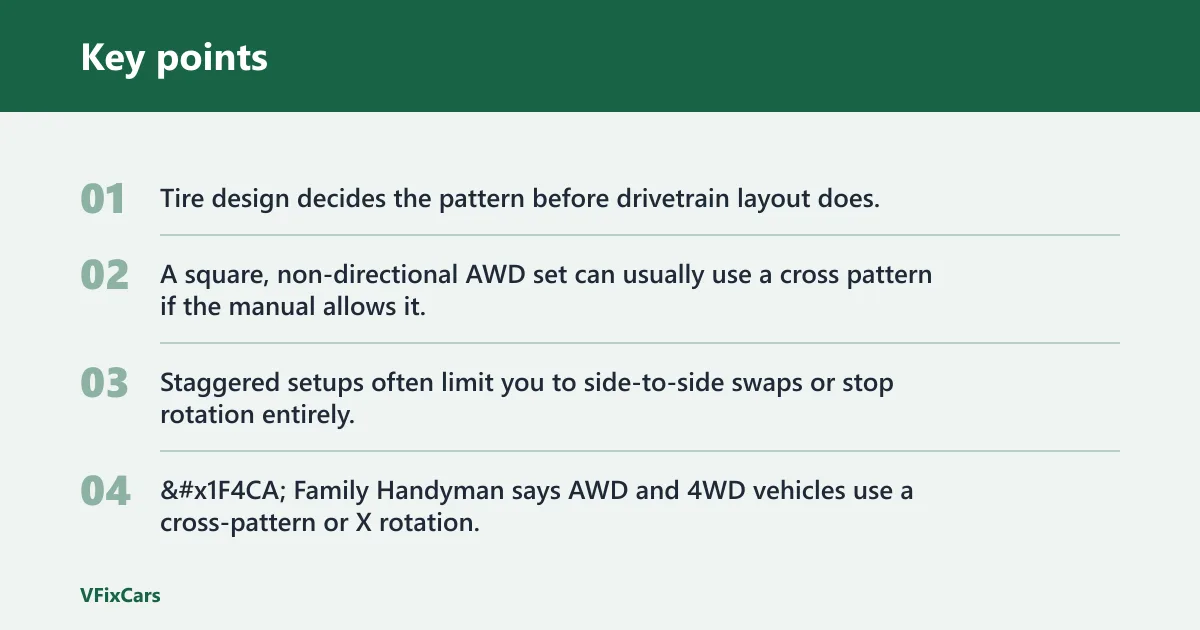
Tire design decides the pattern before drivetrain layout does. A square, non-directional AWD set can usually use a cross pattern if the manual allows it. Directional tires cannot cross sides. Staggered setups often limit you to side-to-side swaps or stop rotation entirely.
Tire rotation decision table
| Setup | Correct pattern | Crossing sides allowed? | Recommended interval | Red flags: inspect or replace instead |
|---|---|---|---|---|
| Non-directional, square setup | Rearward cross, or X-pattern if the manual calls for it | Yes, if the tire maker and owner’s manual allow it | 3,000 to 5,000 miles | Tread depth spread over 2/32 inch; vibration; pull; noise; one tire shoulder worn faster than the others |
| Directional setup | Front-to-rear only on the same side | No | 3,000 to 5,000 miles | Tread depth spread over 2/32 inch; arrow or rotation marking conflicts with a cross move; mixed wear that points to alignment or suspension trouble |
| Staggered setup | Side-to-side only if the tire maker allows it; some cannot be rotated | Usually no front-to-back movement | 3,000 to 5,000 miles if rotation is possible | Different front and rear sizes; tire maker forbids rotation; one axle wears much faster; manual states no rotation |
| Mixed-wear setup | No rotation until inspection confirms the tires are still serviceable | Depends on tire type, but rotation may be the wrong fix | Inspect now | Tread depth spread over 2/32 inch; cords visible; cupping; vibration; warning lights; inside or outside edge wear |
📊 Family Handyman says AWD and 4WD vehicles use a cross-pattern or X rotation. Source: Familyhandyman.
Which AWD pattern should you use?

The right answer depends on whether the tires are directional, non-directional, or staggered. For a non-directional, square AWD set, a rearward cross is common and an X-pattern is also used by some guides. Directional tires stay on the same side. Staggered tires may not rotate at all.
Rearward cross moves the front tires to the rear and crosses them to the opposite sides. That helps balance wear patterns on many vehicles. Family Handyman and other rotation guides also describe an X-pattern for AWD and 4WD, but that does not override the tire’s construction or the owner’s manual.
Rearward cross and X-pattern explained
Rearward cross means the front left tire moves to the rear right, and the front right moves to the rear left. The rear tires move straight forward. An X-pattern crosses both axles. Both patterns can work on non-directional square AWD fitments when the tire maker and vehicle manual allow crossing sides.
When front-to-rear only is the right call
Directional tires should stay on the same side of the vehicle and only move front to rear. The tread blocks and arrows are built to roll one way. If you cross them, you can reverse the intended direction and hurt wet-weather performance.
Suppose your AWD crossover wears 225/60R17 directional tires and the left front has more shoulder wear than the rest. The correct move is still same-side front-to-rear rotation, not a cross pattern. If the wear spread is too large, inspection comes first.
When side-to-side swaps are allowed
Staggered fitments use different front and rear sizes. That often rules out front-to-back rotation. Some staggered tires can be swapped side to side, but many cannot because of tread direction or wheel fitment limits. If the manual says no rotation, follow that instruction.
How often should you rotate AWD tires?

Most manufacturers recommend rotating AWD tires every 3,000 to 5,000 miles. Continental gives a broader general interval of 5,000 to 7,000 miles or every six months, whichever comes first, and notes that AWD should usually be serviced more often to limit drivetrain stress.
That shorter interval matters because AWD systems can be sensitive to small circumference changes. Torque-vectoring setups and winter use can justify the shorter end of the range. Aggressive driving, short trips, or lots of wet-road use can also shorten the schedule.
Six-month fallback
If you do not drive enough to hit the mileage target, use the time limit. Six months is a practical fallback when the odometer stays low. That keeps tire wear from drifting too far apart, especially on AWD vehicles that rely on similar tire circumference at all four corners.
When winter tires or aggressive use shorten the interval
Winter tires often wear faster, especially if the vehicle sees dry pavement often. Aggressive throttle use, frequent cornering, and torque-vectoring behavior can move load around more sharply than a simple part-time AWD system. In those cases, the 3,000 to 5,000 mile range is the safer target.
Why uneven tire wear matters on AWD
AWD systems prefer tires with similar rolling circumference. When one tire is smaller from wear, it turns more times over the same distance. That difference can create a mismatch the drivetrain has to absorb. Over time, that adds heat, friction, and load to the transfer case and related components.
A tread depth spread of about 2/32 inch or more is often treated as a warning sign. At that point, rotation may not fix the problem cleanly because the system has already started to compensate for different tire sizes. The vehicle may still drive, but handling balance and AWD behavior can change.
Think of the load path in plain terms: one tire turns slightly faster, the AWD system tries to keep up, the transfer case and couplings work harder, and extra heat builds. That is how a tire wear problem becomes a drivetrain stress problem.
Circumference mismatch and drivetrain stress
Uneven circumference changes how each wheel speeds up and slows down. On AWD, that can make the drivetrain work against itself instead of rolling evenly. The result is not instant failure. It is gradual wear from extra friction, extra heat, and repeated correction.
Picture an AWD wagon with one rear tire at about 4/32 and the others at about 7/32. The spread is already large enough to inspect before rotating. If the wear pattern is also cupped, the better fix may be alignment or replacement, not a routine swap.
How to properly rotate tires AWD
Start by checking the owner’s manual and tire sidewall markings. Then mark each tire’s original position before removal. That gives you a clean record of the pattern used, which matters if the vehicle later develops vibration or if a warranty claim needs proof of service.
- Confirm whether the tires are non-directional, directional, or staggered.
- Check the owner’s manual for any pattern override.
- Mark each tire position before lifting the vehicle.
- Rotate using the correct pattern for the tire type.
- Set pressures to the placard specification after installation.
- Torque the wheel fasteners to the vehicle’s listed specification.
- Record the date and mileage in your service log.
Torque specs matter. Reusing the same torque as another vehicle or guessing is a bad shortcut. After rotation, reset tire pressures and make sure the tire positions match the chosen pattern. If the vehicle uses a tire pressure monitoring system, check that it reads normally after the swap.
Conti notes that many tire warranties require documented rotation. Keep the date, mileage, and pattern used. That record is simple, but it can matter if a warranty review asks whether you followed the maintenance schedule.
What should make you skip rotation?
Skip rotation when the tires are too uneven, the setup limits movement, or the manual forbids the pattern you planned to use. A spread greater than 2/32 inch is the clearest warning. Also stop if you hear noise, feel vibration, or notice a pull that suggests a separate fault.
Do not rotate if one tire shows cupping, cords, bulges, or shoulder wear that is much worse than the others. That tire may need replacement or a suspension and alignment check first. Rotation does not repair damage that has already gone past normal wear.
Staggered fitments deserve special caution. Some allow only side-to-side movement. Others allow no rotation at all because the fronts and rears are different sizes. Manufacturer guidance overrides a generic pattern every time.
Frequently asked questions
What is the standard tire rotation pattern?
There is no single standard for every AWD vehicle. For non-directional, square AWD setups, a rearward cross or X-pattern is common when the manual allows it. Directional tires stay on the same side and move front to rear only. Staggered setups may not allow rotation.
What pattern to rotate tires?
Use the pattern that matches the tire construction first, then confirm it against the owner’s manual. Non-directional tires can often cross sides. Directional tires should not cross sides. Staggered tires may be limited to side-to-side swaps, or rotation may be impossible.
What is the best tire rotation pattern for AWD?
The best pattern depends on the tire, not just the drivetrain. Rearward cross is usually the best choice for non-directional, square AWD setups when allowed. Directional tires need same-side front-to-rear rotation. Staggered fitments may limit rotation to side-to-side only, or rule it out.
Do AWD tires need to be rotated more often than FWD tires?
Usually yes. AWD systems are more sensitive to differences in rolling circumference, so manufacturers often call for shorter intervals. Rotating more often helps reduce uneven wear, limits transfer case load, and lowers the chance that one tire drifts far enough out of range to affect handling.