Can You Mix Different Brands or Weights of Motor Oil?
Yes, mixing motor-oil brands is usually fine for a top-off if the oil matches your engine’s required API/ILSAC spec and viscosity grade; mixing different weights is only a short-term emergency fix, and a major mismatch means you should change the oil soon. Bad mixes can thin the oil, raise wear risk, and leave you guessing about protection. This guide gives a practical mix-or-no-mix rule for store runs and what to do after a mixed fill.
Emergency brand swaps are safe but shorten drain intervals

Usually, yes, when the oils share the same SAE viscosity grade and are used for an emergency top-off. If both oils are API-certified and the same SAE viscosity grade, different brands are generally compatible for an emergency top-off. The bottle brand matters less than the spec and the viscosity grade. The main caveat is oil life: different additive packages can dilute each other, so a full oil change should follow.
Why API-certified oils are built to work together
API-certified motor oil is built to work with other API oils. That applies to conventional and synthetic oils. The same viscosity grade is the key compatibility factor, not the label on the bottle.
That does not mean every blend performs exactly like the original fill. It means the oils are meant to mix without creating an immediate compatibility problem in most engines.
When brand differences matter less than viscosity and spec
If you are low on oil and the store only has a different brand in the correct grade, that is usually the smart move. A same-grade top-off is a short-term emergency fix, not a substitute for a proper service.
For modern engines, the required spec matters too. Some engines call for manufacturer-specific approvals that go beyond the basic API mark, especially in turbocharged or direct-injected applications.
What changes in additive packages still mean for oil life
Different brands can use different additive packages. Those packages include anti-wear, anti-oxidation, detergents, and corrosion inhibitors. When oils are mixed, that chemistry can be diluted, which may affect sludge control, oxidation resistance, and oil-change life.
That is why same-grade mixing is acceptable for now, but not ideal for long-term service.
Can you mix different weights of motor oil?
Mixing different weights is where risk starts to rise. SAE viscosity grade tells you how the oil flows when cold and how thick it stays at operating temperature. A small mismatch may be tolerable as a temporary fix, but a bigger mismatch can change cold-start flow, hot-film strength, and engine protection.
What 5W-30 and 10W-40 actually mean
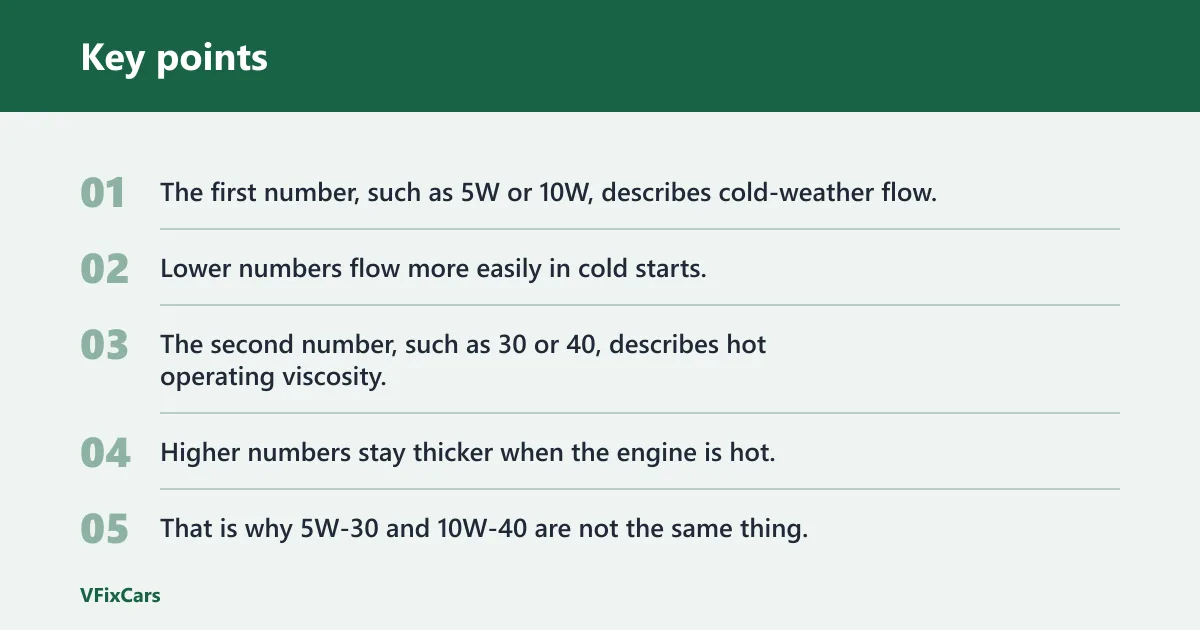
The first number, such as 5W or 10W, describes cold-weather flow. Lower numbers flow more easily in cold starts. The second number, such as 30 or 40, describes hot operating viscosity. Higher numbers stay thicker when the engine is hot.
That is why 5W-30 and 10W-40 are not the same thing. They behave differently at startup and after the engine reaches temperature.
How mixed viscosities affect cold start flow and hot protection
Different weights can change engine protection because viscosity controls how quickly oil reaches critical parts and how well it maintains a film under heat. Mixing can create unpredictable results, especially if the grades are far apart.
The sourced guide gives 5W-30 plus 10W-30 as a low-impact example, while 5W-30 plus 5W-20 creates a thinner oil at operating temperature. By contrast, 20W-50 instead of 5W-30 is often a much thicker substitute than many engines want.
When a viscosity mismatch calls for a drain-and-refill
If the mix is close to the approved grade and you are only correcting a low level, you can usually drive on it and plan a full oil change soon. If the mix is a major mismatch, or if the oil spec is unknown, the safer move is to shorten the interval immediately.
Modern engines can be less forgiving here, especially turbocharged or direct-injected engines that may need tighter viscosity control or a manufacturer approval. Turbocharged, direct-injected, and warranty-sensitive engines often rely on tighter viscosity control and, in some cases, a specific manufacturer approval.
Synthetic and conventional oil mixing
Synthetic and conventional motor oil are compatible enough to mix in an emergency. A synthetic fill can be topped off with conventional oil, and conventional oil can be topped off with synthetic oil. The blend may not perform like a full synthetic fill, so treat it as temporary and plan service afterward.
Why synthetic and conventional oils can mix short term
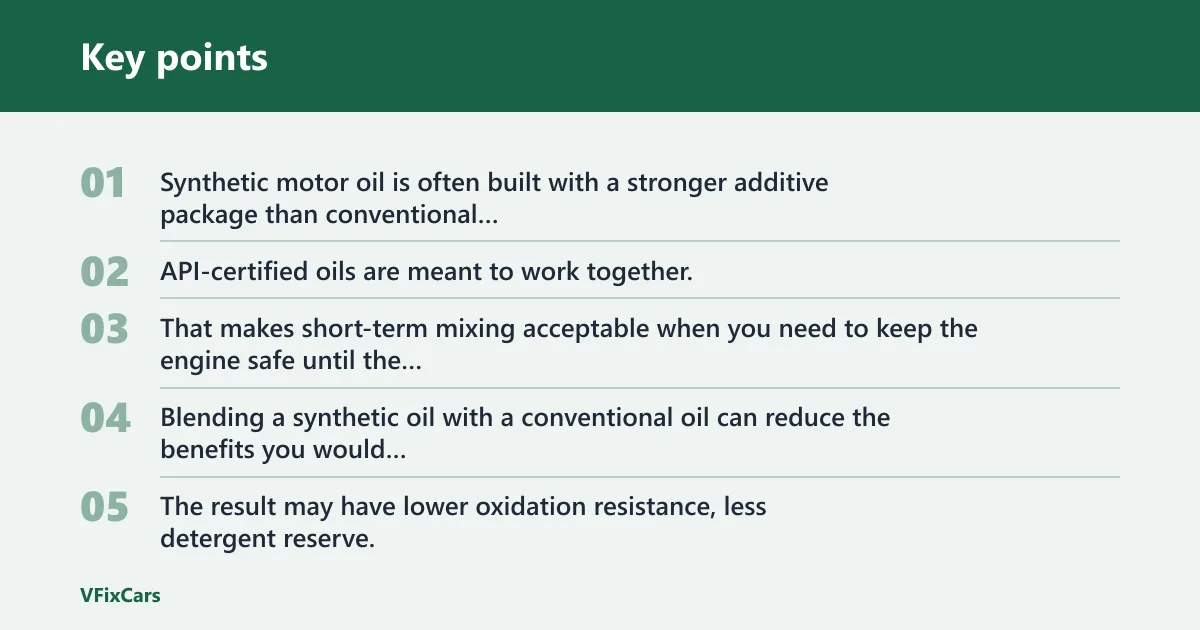
Synthetic motor oil is often built with a stronger additive package than conventional oil, but the two oils are not chemically incompatible. API-certified oils are meant to work together, and the key question is still viscosity plus spec.
That makes short-term mixing acceptable when you need to keep the engine safe until the next service.
What you lose when additive packages get blended
Blending a synthetic oil with a conventional oil can reduce the benefits you would expect from the higher-end fill. The result may have lower oxidation resistance, less detergent reserve, and less margin against sludge formation than a proper full synthetic fill.
That does not mean the engine will fail. It means the oil may not last as long or protect as well under heavy heat and load.
How to judge whether the fill is temporary or acceptable until service
If you added a small amount to bring the dipstick back to the safe range and the grade stayed close to spec, treat it as an emergency top-off. If you had to pour in a large amount, or if the replacement oil is a very different grade, schedule a change soon rather than stretching the interval.
What happens if I mix 5W-30 with 10W-40?
That mix is riskier than a same-grade top-off because the oils do not behave the same at cold start or at operating temperature. 10W-40 is thicker when hot than 5W-30, so the blend can move the oil away from the grade your engine was designed to use. It is not an automatic disaster, but it should be treated as a temporary fix.
Why adjacent grades are less risky than major mismatches
Adjacent grades are usually less concerning than a large jump in viscosity. The guide’s 5W-30 plus 10W-30 example is low impact because the hot grade stays close. By contrast, 5W-30 plus 10W-40 can be unstable, and thicker substitutes like 20W-50 are a bigger departure still.
In plain terms, a small top-off is different from pouring in a quart that changes the whole fill.
What to watch for after the top-off
Watch for louder valvetrain noise, a change in oil-pressure behavior, harder cold starts, or a rise in oil consumption. Those are the practical signs that the blend is not behaving like the original oil choice.
Suppose your sedan normally idles quietly on 5W-30, but after topping off with 10W-40 it starts sounding harsher on cold mornings. That is a reason to shorten the interval and return to the approved grade soon.
When to replace the oil sooner rather than later
If the engine is sensitive, the oil level was very low, or the mix involved a major viscosity mismatch, plan a drain-and-refill soon. The earlier you reset the fill, the less time the engine spends on a compromise blend.
Motor oil mix decision matrix
Use this as a quick decision rule. Same viscosity is usually fine for a short-term top-off. Mismatched viscosity is the real risk. If the spec is unknown or the blend is far from the approved grade, treat the fill as temporary and replace it soon.
| Scenario | Risk level | What to do now | How soon to replace oil |
|---|---|---|---|
| Same brand, same grade | Low | Top off and verify level | Normal interval unless another issue exists |
| Different brand, same grade | Low | Top off if API/spec matches | Change at the next service or sooner if the fill was large |
| Synthetic plus conventional | Low to moderate | Accept as an emergency mix only | Change soon; do not treat as a full synthetic fill |
| Adjacent grades | Moderate | Drive cautiously and confirm the manual | Shorten the interval and return to the approved grade |
| Major viscosity mismatch | High | Avoid extended driving | Drain and refill soon |
| Unknown spec | High | Use only if needed to prevent low oil | Replace as soon as practical |
When a mixed fill needs attention
A mixed fill needs attention when the viscosity no longer matches the engine’s requirement, when the oil spec is unknown, or when the engine starts acting differently after the top-off. The manual is the final authority, but the practical clues are noise, pressure changes, and consumption spikes.
Warning signs to monitor after topping off
Check for ticking, rougher cold starts, oil-pressure warnings, a new burning smell, or a faster drop on the dipstick. If the level falls again quickly, the engine may already be consuming oil or leaking, and the mixed fill is only part of the story.
Which engines need stricter caution?
Turbocharged engines, direct-injected engines, and engines that require a manufacturer-specific approval deserve the strictest match. Those designs often run hotter or depend on tighter oil control, so the wrong viscosity can matter more than it would in an older, simpler engine.
When to shorten the oil-change interval
Shorten the interval any time the fill involved a major mismatch, a large top-off, or a blend that does not clearly meet the manual’s requirement. A common rule is simple: if you had to compromise to stay on the road, reset the oil sooner.
Owner’s manual rules that override everything
The owner’s manual is the final authority for approved viscosity and any required manufacturer approvals. If the manual specifies a grade, follow that grade first. If it lists a special approval, match that too, especially on newer engines and warranty-sensitive vehicles.
Approved viscosity is the first check
Start with the manual before you buy a bottle. A same-brand oil that misses the approved grade is a worse choice than a different brand that meets the spec and the viscosity requirement.
Manufacturer-specific approvals can matter as much as grade
Some engines need more than a simple SAE label. The approval requirement can control oxidation stability, deposit handling, or compatibility with emission-system hardware. For those engines, brand is less important than meeting the listed approval.
Why warranty-sensitive engines deserve the strictest match
If the vehicle is under warranty, keep the oil as close to the manual as possible. That means the correct grade, the correct specification, and a prompt change if the fill became a compromise mixture.
Frequently asked questions
Can you mix different brands of motor oil?
Yes, if the oils are API-certified and the same SAE viscosity grade. Different brands are generally compatible for a top-off, and same-weight oils from different brands have negligible initial effects. The catch is oil life: blended additive packages can reduce the margin you would get from a full, matched fill.
Is it okay to mix synthetic and conventional oil?
Yes. Synthetic and conventional oil are compatible enough to mix in an emergency. The blend may not deliver the same performance or oil life as a full synthetic fill, so treat it as a short-term solution and plan a proper oil change afterward.
Can I top off my oil with a different brand?
Usually yes, if the replacement oil matches the required grade and spec. A different-brand top-off is acceptable as a temporary fix, especially when the level is low. Afterward, plan a complete oil change so the engine is not left on a mixed fill longer than necessary.
Will mixing oil damage my engine?
Not usually if you match the approved viscosity and API/spec requirements. Damage risk rises when the grades are far apart, the oil spec is unknown, or the engine is sensitive to oil quality. Mixing is a stopgap, not a substitute for the right oil in the right engine.