What Is a Mass Airflow Sensor and What Does It Do?
A mass airflow sensor measures incoming air so the ECU can meter fuel accurately. If it reads wrong, the engine may run rich, lean, stall, or waste fuel, and swapping the sensor alone can miss the real fault. This guide explains how the MAF affects fueling, the symptoms it causes, and the first checks that separate sensor trouble from intake leaks or other engine problems.
Quick answer
The MAF sensor sits in the intake tract and measures air entering the engine. The ECM, ECU, or PCM uses that airflow signal to decide how much fuel to add, then the O2 sensors fine-tune the mixture after combustion. That makes the MAF a key input, not the only input.
Same idea, fewer words: it tracks incoming air for the engine computer. Future Auto Repair describes it as tracking the air that flows into the engine and reporting that airflow to the engine control module. If that report is wrong, fuel delivery can drift off target fast.
A dirty or failed MAF can cause rough idle, hesitation, stalling, hard starting, poor fuel economy, and a check engine light. Delphi says contamination is a key reason these sensors fail, which is why location and condition matter before you replace anything.
Where is the mass airflow sensor located?
The MAF sensor is located between the air filter box and the throttle body. That puts it in the intake path, where all incoming air passes through before it reaches the engine. The common mounting area makes it easy to find, but also easy to contaminate if the intake tract has leaks or poor filtration.
Look near the air filter box first, then trace the duct toward the throttle body. On many vehicles, the sensor is built into the duct or installed as a separate probe in that section. The exact housing varies, but the location does not: it belongs in the airflow path before the throttle body.
That placement matters for diagnosis. If the sensor is seeing unmetered air after a cracked intake boot, the MAF can report less air than the engine actually gets. If the sensor is coated with dirt or oil film, it can report the wrong airflow even when the intake hardware is intact.
How does a mass airflow sensor work?
A MAF sensor measures the mass of air flowing into the engine and turns that into a signal for the engine computer. In a hot wire design, airflow cools a heated wire and the sensor adjusts current to keep it at a target temperature. In a vane-meter design, incoming air moves a flap or vane.
The hot wire style is commonly used on many modern vehicles. It reacts to airflow changes quickly, which helps the ECM respond to throttle changes and load. The vane-meter style is older and more mechanical, so it is worth knowing about when a repair guide or parts listing mentions a different measuring strategy.
Once the sensor creates its signal, the ECM uses it as one of the main inputs for air-fuel control. Some engine management systems use manifold pressure sensor and throttle position data instead of a MAF sensor, so not every engine relies on the same layout or strategy.
How does the ECU use MAF data?
The ECU uses MAF data to calculate fuel delivery, then adjusts that command as conditions change. It does not run on the MAF alone. O2 sensors still matter because they measure the results after combustion and let the system trim the mixture toward target.
If the MAF signal is out of range, the ECU may set a fault code. A bad reading can push the mixture rich or lean, and the computer may respond by adding or subtracting fuel until it hits its correction limits. At that point, drivability often gets worse.
Some vehicles can keep running on fallback fueling if the MAF signal fails or the sensor is unplugged. That does not mean the sensor is good. It only means the control unit has a backup strategy that lets the engine run well enough to move the car.
What a bad MAF sensor does
A faulty MAF sensor may under-report airflow or over-report it. If airflow is under-reported, the ECU may think less air entered the engine, so it may command too little fuel and cause a lean condition. Over-reporting does the opposite and can drive the mixture rich.
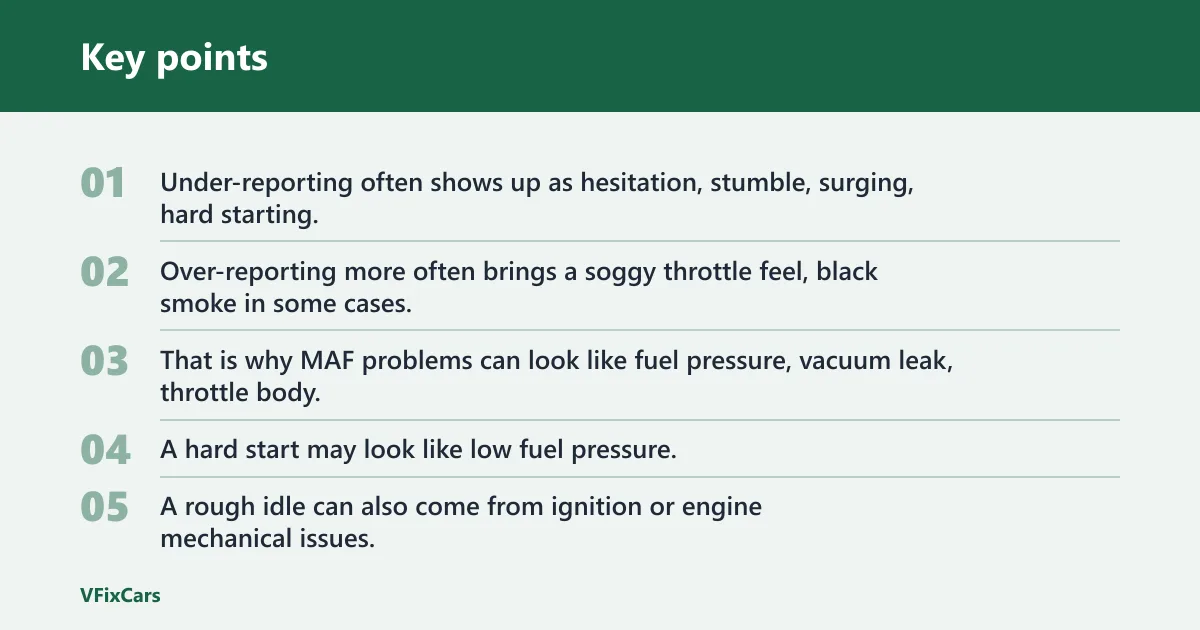
Lean and rich faults do not feel the same. Under-reporting often shows up as hesitation, stumble, surging, hard starting, or stalling on throttle tip-in. Over-reporting more often brings a soggy throttle feel, black smoke in some cases, fuel smell, rough idle, and poor fuel economy.
That is why MAF problems can look like fuel pressure, vacuum leak, throttle body, or compression trouble. A lean surge may point to a vacuum leak. A hard start may look like low fuel pressure. A rough idle can also come from ignition or engine mechanical issues.
Say your 2.0-liter four-cylinder idles smoothly in park but hesitates when you pull away from a stop. If the MAF under-reports airflow, the ECU may lean out the mixture just as load increases. The symptom looks like a fuel delivery problem, but the first clue is often the airflow signal direction.
A common mistake is to blame the mass airflow sensor for rough idle when a cracked vacuum hose is actually letting in unmetered air. Suppose a split intake hose sits after the MAF and lets in unmetered air. The scan tool may still point toward the MAF, but the real fix is the leak, not the sensor.
MAF sensor checklist
Use this checklist to separate signal direction from the next action. Start with the symptom, then decide whether the likely problem is under-reporting, over-reporting, or still unclear. That keeps you from replacing a sensor when a leak, contamination, or unrelated fault is more likely.
| Symptom | Likely airflow signal direction | Next diagnostic step |
|---|---|---|
| Hesitation on acceleration, lean codes, stumble when load increases | Under-reporting | Inspect intake leaks, then scan codes and retest |
| Rough idle with fuel smell, rich codes, poor fuel economy | Over-reporting | Clean the sensor with MAF sensor cleaner, then retest |
| Hard starting, stalls, check engine light, no clear lean or rich clue | Inconclusive | Scan codes first, then inspect intake leaks and sensor condition |
| Vehicle runs better with the MAF unplugged | Inconclusive | Test replacement after checking for leaks and contamination |
| Surging cruise, poor throttle response, no obvious intake damage | Either direction | Scan codes, clean the sensor, and compare live data if available |
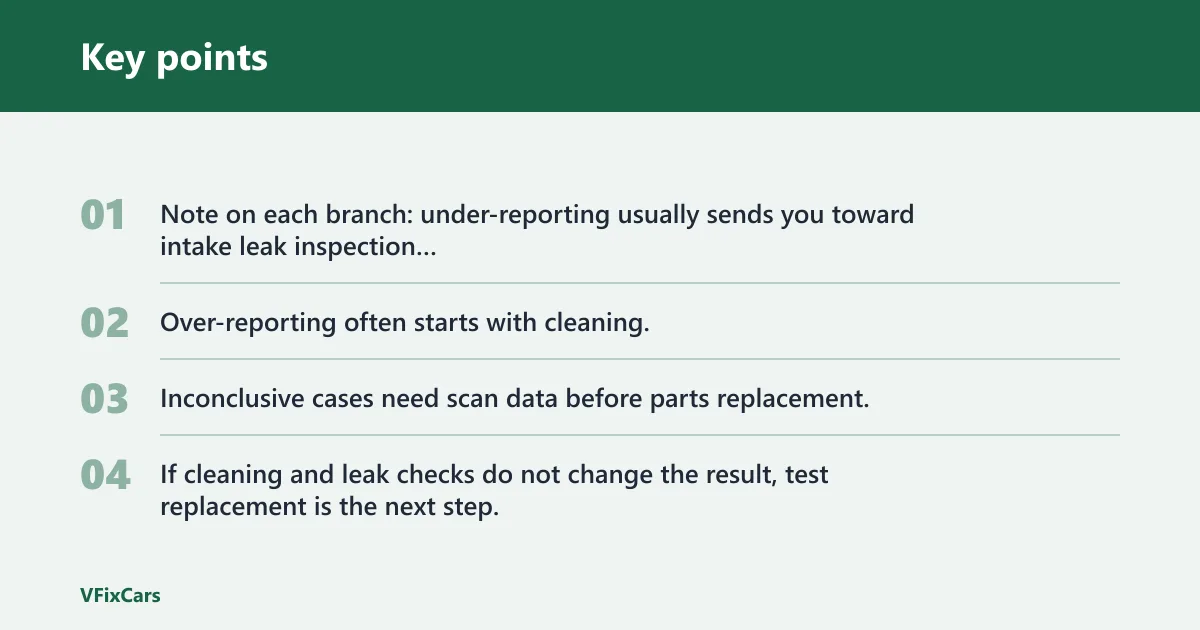
Note on each branch: under-reporting usually sends you toward intake leak inspection first. Over-reporting often starts with cleaning, because contamination can bias the signal high or low. Inconclusive cases need scan data before parts replacement. If cleaning and leak checks do not change the result, test replacement is the next step.
Can a MAF sensor be cleaned instead of replaced?
Yes, if contamination is the problem and the sensor is still electrically healthy. Use MAF sensor cleaner only, not generic parts cleaner or brake cleaner. Carbon Cleaning Europe says the sensor can be cleaned with MAF cleaner or electrical contact cleaner, but sensor-specific cleaner is the safer choice for most owners.
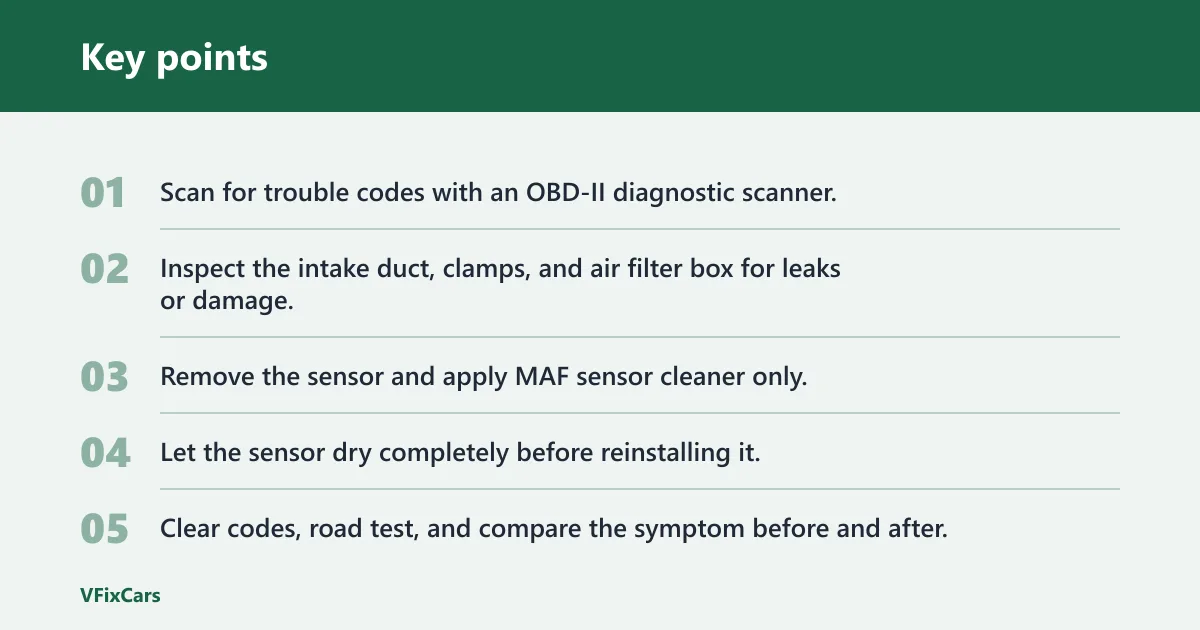
Clean the sensing element gently and let it dry fully before reinstalling. Do not touch the hot wire or probe with a cloth, brush, or finger. Delphi also notes that contamination is a key reason MAF sensors fail, which is why cleaning is worth trying before replacement.
- Scan for trouble codes with an OBD-II diagnostic scanner.
- Inspect the intake duct, clamps, and air filter box for leaks or damage.
- Remove the sensor and apply MAF sensor cleaner only.
- Let the sensor dry completely before reinstalling it.
- Clear codes, road test, and compare the symptom before and after.
- Replace the sensor if the fault returns or the data still looks wrong.
The same source says its MAF sensors are tested to meet or exceed OE requirements, built with calibrated all-new components, and available as a complete unit or as a probe-only design. That split matters for replacement cost and fitment, especially on vehicles where only the sensing element is serviceable.
Frequently asked questions
What does a mass airflow sensor do in a car?
It measures incoming air so the engine computer can calculate fuel injection. The sensor lives in the intake tract, usually between the air filter box and the throttle body. Without that input, fuel control becomes less accurate, and the vehicle may rely on fallback logic if the signal fails.
Is a MAF sensor necessary?
Many vehicles need it for normal fueling accuracy, but not every engine uses one. Some systems use manifold pressure sensor and throttle position data instead. Even on MAF-equipped cars, the engine may still run in a backup mode if the sensor fails, though drivability usually suffers.
What does a bad mass airflow sensor do?
A bad MAF can under-report or over-report airflow. Under-reporting tends to create lean hesitation, stalling, and hard starting. Over-reporting can cause rich running, poor fuel economy, rough idle, and fuel smell. It can also set a fault code when the reading falls out of range.
Why does a dirty MAF sensor cause hesitation?
Contamination changes how the sensor reads airflow, so the ECU may command the wrong amount of fuel during throttle changes. If the sensor under-reports airflow, the engine can go lean right when you ask for more power. That often feels like a flat spot or stumble on acceleration.
Can a bad MAF sensor make a car hard to start?
Yes. A faulty MAF can make starting difficult if the airflow signal is far enough off that the ECU miscalculates fueling during cranking. That can happen with contamination, an electrical fault, or intake leaks that distort the reading before the throttle body.