Check Engine Light: Meaning, Causes, What to Do
A steady check engine light usually means you can drive a short distance after a few basic checks, but a flashing light means stop driving and address a misfire risk right away. Miss that difference and a cheap gas-cap or sensor issue can grow into catalytic-converter damage, poor fuel economy, failed emissions, or a breakdown on the road. This guide sorts the light by urgency, points to the most likely fault family, and lists the low-cost checks to do before you pay for diagnosis.
The useful question is not “what part is bad?” It is “how urgent is this, what fault family matches the symptoms, and what is the cheapest sensible first test?” That method gets more from the Malfunction Indicator Lamp, the stored code, and the freeze-frame snapshot than guessing and swapping parts.
How the MIL and OBD-II diagnostics work
The check engine light is the Malfunction Indicator Lamp, or MIL, and it comes on when the engine computer detects a fault that meets its set criteria. The light is controlled by the OBD-II system, used on every modern vehicle sold since 1996, and that system stores a code that gives your first real clue.
What the MIL is actually reporting
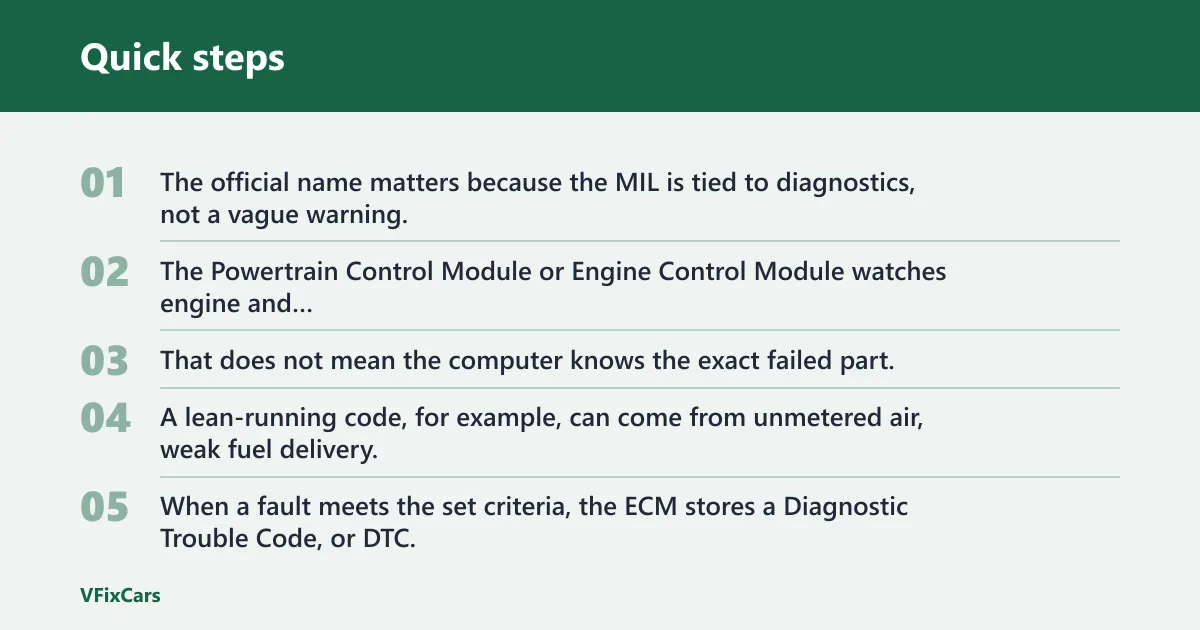
The official name matters because the MIL is tied to diagnostics, not a vague warning. The Powertrain Control Module or Engine Control Module watches engine and transmission-related systems, compares sensor and system data with expected values, and turns the light on when a fault repeats in the pattern the software is programmed to catch.
That does not mean the computer knows the exact failed part. It means the computer saw a fault pattern. A lean-running code, for example, can come from unmetered air, weak fuel delivery, bad sensor data, or an exhaust leak ahead of a sensor.
What OBD-II stores
When a fault meets the set criteria, the ECM stores a Diagnostic Trouble Code, or DTC. It may also save freeze-frame data and readiness monitor status. Those two extras matter because they show the operating conditions when the fault set and whether the self-checks have completed since power was lost or codes were cleared.
Freeze-frame commonly includes engine load, RPM, coolant temperature, and vehicle speed at the moment the code set. Readiness monitors show whether systems such as catalyst, EVAP, and oxygen-sensor tests have run again after a battery disconnect or a recent code clear.
Pending versus confirmed codes
A pending code is an early warning. The fault was seen, but not often enough yet to turn the light on every time. A confirmed code has met the criteria for storage as a stronger fault record. Both matter, especially when the car acts up only on cold start, during refueling, or at highway cruise.
Can you keep driving with the check engine light on?
Often, yes, but only if the light is steady and the car still runs normally enough to reach a safe destination. If the light is flashing, if power drops sharply, or if you also see overheating or low oil pressure warnings, driving farther can turn a manageable fault into major damage.
When a steady light is usually a short-trip warning
A steady check engine light usually means the computer has detected an active fault that still needs prompt diagnosis. If the engine idles normally, throttle response is acceptable, temperatures are normal, and there are no hard misfires, brief driving is often reasonable to get home, to a parts store for a code scan, or to a repair shop.
Do not turn “usually” into “ignore it.” A steady light can still mark a problem that hurts fuel economy, emissions, starting, or converter life if you keep driving for days or weeks.
What overrides the light itself
The MIL is only one part of the decision. Stop and shut down sooner if you also have an overheating warning, a low oil pressure warning, a heavy fuel smell, loud knocking, stalling in traffic, or obvious smoke.
Say your light is steady, but the temperature gauge climbs fast in stop-and-go traffic and the cabin heat suddenly turns cold. Treat that as a cooling-system problem first, not a routine code-scan errand.
Why is the light flashing?
A flashing check engine light means the engine computer is detecting an active misfire. That matters because unburned fuel can enter the exhaust, overheat the catalytic converter, and drive repair costs up fast. The right move is to reduce load, pull over as soon as it is safe, and decide whether the car needs a tow.
Why misfire changes the risk
Worn spark plugs, failing ignition coils, injector faults, or low compression are common reasons for a flashing MIL. The risk is not just rough running. Raw fuel in the exhaust can overheat and melt the catalytic converter, one of the more expensive emissions parts on the car.
What to do at the roadside
If the light flashes, back out of the throttle, avoid hard acceleration, and move to a safe place. If the engine shakes, stalls, smells strongly of fuel, or the flashing does not stop, shut it off and arrange a tow.
Suppose the light starts flashing as speed rises onto a freeway ramp, the engine shudders, and the car will not pull past moderate speed. That points toward an active misfire, not a small EVAP leak, so the sensible next step is stopping, not “seeing if it clears up.”
When towing is the better call
Tow the car if the light keeps flashing, the engine is running on fewer cylinders, power is sharply reduced, or the car will not idle without stumbling. A short tow bill is often cheaper than a catalytic converter plus the original misfire repair.
MIL triage table
| Light behavior | Common companion symptoms | Likely fault family | Immediate driving advice | Cheapest first test |
|---|---|---|---|---|
| Steady light, car feels normal | No power loss, no rough idle, no smell | Small EVAP leak, loose gas cap, early oxygen-sensor or MAF drift, intermittent electrical fault | Usually safe to drive briefly to a destination; scan soon | Tighten and inspect gas cap seal, then read codes and note pending or confirmed status |
| Steady light after refueling | Car drives normally; light appears within a drive cycle or two | EVAP leak or gas cap sealing problem | Drive normally for a short period after correcting the cap; no need to tow | Remove cap, inspect for cracked seal or cross-threading, reinstall until it clicks, then scan for EVAP codes |
| Steady light with rough idle or lean surge | High or unstable idle, hiss, stumble off idle | Vacuum leak, purge valve stuck open, fuel trim fault | Short trips only; same-day diagnosis is smart | Read fuel-trim related codes, inspect intake hoses and PCV lines, listen for obvious vacuum leak |
| Steady light with poor acceleration | Flat throttle response, hesitation, lower fuel economy | MAF sensor fault, oxygen-sensor fault, fuel delivery issue | Often drivable briefly, but avoid long trips until scanned | Scan for air-metering or mixture codes, check air filter housing and intake duct for leaks or loose clamps |
| Flashing light | Strong shake, misfire, fuel smell, loss of power | Ignition misfire, injector fault, compression problem | Pull over soon; tow if flashing continues or the engine runs badly | Scan for misfire codes once safely stopped; do not keep driving to “clear it out” |
| Steady light with rotten-egg smell or heat under floor | Poor power at higher load, possible rattling exhaust | Catalytic converter efficiency fault or converter damage after misfire | Limit driving; repair soon; tow if the exhaust glows, rattles badly, or power collapses | Scan for catalyst and misfire codes together; check whether a recent misfire likely caused the converter fault |
| Steady light with low-voltage behavior | Hard starting, dim lamps, odd electronic resets | Charging or battery problem affecting monitored systems | Drive only if the car starts and charging seems stable; repair quickly | Test battery and alternator output before replacing sensor parts |
| Steady light after battery disconnect or recent code clear | No symptoms, emissions test not ready | Readiness monitors incomplete rather than a new active failure | Usually safe to drive; do not assume fixed until monitors complete | Check readiness status with a scanner instead of focusing only on whether the MIL is off |
What should you do first when the light comes on?
Start with urgency, not parts. Check whether the light is steady or flashing, look for overheating or low oil pressure warnings, note how the engine is running, inspect the gas cap, and then read the stored code before clearing anything or buying parts by code name alone.
First checks in order
- Check whether the light is steady or flashing.
- Look for oil pressure or overheating warnings. If either is present, stop the engine.
- Note rough idle, shaking, power loss, fuel smell, smoke, or unusual noises.
- Inspect the gas cap for looseness, damaged seal, or cross-threading.
- Read the code with an OBD2 scanner, or use a parts store’s free basic code reading if available.
- Save the code numbers, freeze-frame details, and readiness status before clearing anything.
Why the gas cap check belongs early
A loose or leaking gas cap can turn on the light. It is one of the few common causes that is both cheap and easy to check before you move into deeper diagnosis. If the code points to an EVAP leak, a cap problem is a sensible first stop, not a guess.
What not to do first
Do not erase codes before recording them. Do not replace an oxygen sensor just because the scanner mentioned oxygen sensor data. And do not assume a parts-store scan is a full diagnosis; basic scans are useful, but they usually do not include enough live-data analysis to prove the failed part.
How do you diagnose a check engine light?
Diagnosis starts by reading the DTC and then checking freeze-frame, readiness, and symptoms together. The code is the primary clue, not a parts verdict. Useful diagnosis asks what conditions triggered the fault, whether it is pending or confirmed, and what simple mechanical checks can confirm the fault family first.
Reading codes with an OBD2 scanner
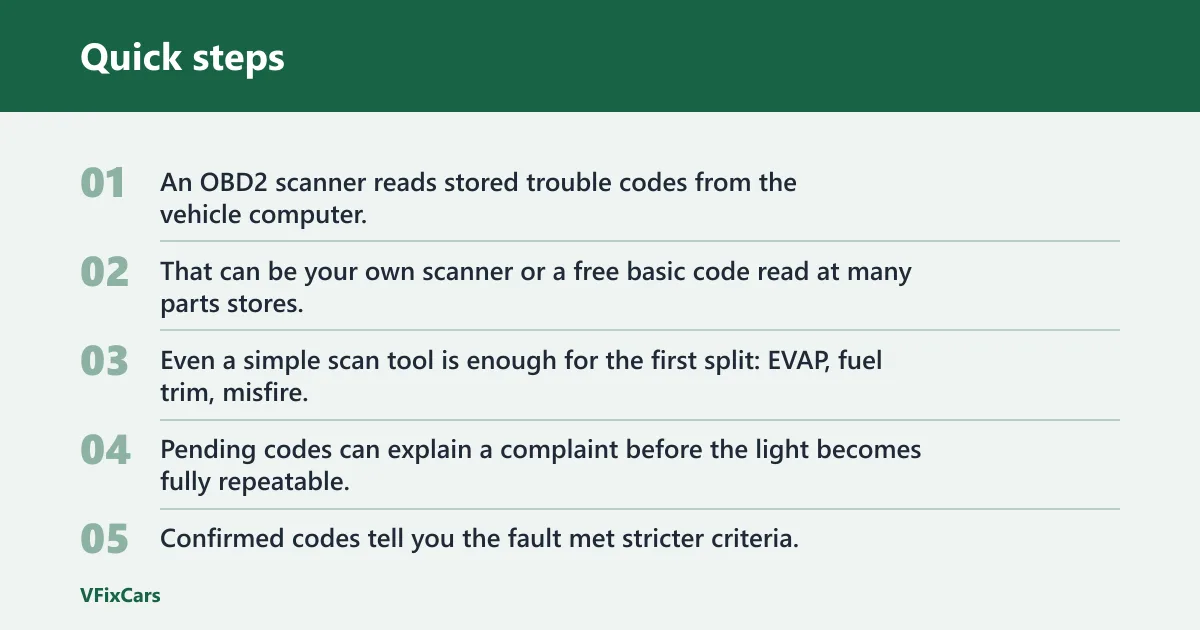
An OBD2 scanner reads stored trouble codes from the vehicle computer. That can be your own scanner or a free basic code read at many parts stores. Even a simple scan tool is enough for the first split: EVAP, fuel trim, misfire, catalyst, temperature-related, or transmission-related powertrain faults.
Using pending and confirmed codes correctly
Pending codes can explain a complaint before the light becomes fully repeatable. Confirmed codes tell you the fault met stricter criteria. If both are present, read them together. A confirmed lean code plus a pending misfire, for example, pushes diagnosis toward a vacuum leak, purge problem, or low fuel delivery rather than random ignition part replacement.
What freeze-frame adds
Freeze-frame gives context. If a lean code set at cold idle with high fuel trim, a vacuum leak becomes more likely than a weak pump that shows up under heavy load. If a misfire set at highway speed under load, coil breakdown or fuel delivery can fit better than a tiny EVAP leak that would not cause that symptom set.
Why clearing codes too early wastes time
Clearing codes removes evidence and resets readiness monitors. After a battery disconnect or a code clear, the light may stay off for a while simply because the self-tests have not run again yet. That can make a problem look fixed when the system is only waiting for enough driving conditions to retest itself.
Do you need a scanner?
No, but diagnosis is slower without one. You can still do first checks such as light behavior, gas cap inspection, battery condition, and obvious hose or intake issues. The scanner moves you from “something is wrong” to “this fault family is most likely,” which cuts wasted parts spending.
What are the most common causes of a check engine light?
The most common causes cluster into a few fault families: EVAP leaks, purge valve problems, vacuum leaks and fuel trim faults, oxygen sensor and MAF sensor issues, ignition misfires, catalytic converter efficiency faults, cooling-related temperature faults, and some battery, alternator, or transmission-related powertrain problems.
EVAP leaks, gas cap faults, and purge valve problems
EVAP faults are common because the system checks fuel vapor sealing closely. A loose gas cap can trigger the light, but so can a cracked cap seal, a leaking hose, a bad vent path, or a purge valve stuck partly open. These can set a light while the car still feels normal.
Oxygen sensor, MAF sensor, and fuel trim faults
A bad oxygen sensor is a common cause. A dirty or bad MAF sensor is another. Intake vacuum leaks also belong in this group because they upset the air-fuel calculation and push fuel trims out of range. These faults often show up as hesitation, lower fuel economy, or a steady light with mild drivability changes.
The useful split is this: EVAP leaks affect vapor containment, vacuum leaks add unmetered air, purge faults can act like either depending on when they stick, and fuel-trim codes report the result rather than the root cause.
Ignition misfires, spark plugs, coils, and injectors
Worn spark plugs, weak coils, and injector faults are common causes, and they are high on the list when the light flashes. A code naming one cylinder narrows the path, but it still does not prove whether the cause is spark, fuel, wiring, or compression.
Catalyst efficiency, thermostat, and other monitored failures
A failing catalytic converter is another common cause. Sometimes the converter is the real failure. Sometimes it is the victim of a long-running misfire or mixture problem. Thermostat or coolant temperature faults can also trigger the MIL because warm-up behavior affects emissions checks and fuel control.
Battery, alternator, and transmission-related triggers
A failing battery or alternator can trigger the light because unstable voltage disturbs sensor readings and module operation. Some vehicles also use the MIL for certain transmission and powertrain faults, so poor shifting with a check engine light should move transmission-related codes higher on the list.
Why is the light on if the car feels normal?
Yes, the light can come on with no obvious drivability problem. Small EVAP leaks, early oxygen-sensor or MAF drift, intermittent electrical faults, and some catalyst-efficiency issues may trigger the MIL before you feel a clear change from the driver’s seat. That is why “it seems fine” is not a diagnosis.
Common normal-driving scenarios
EVAP leaks are the classic example. The car may start, idle, shift, and cruise normally, yet the computer can still detect a sealing problem in the vapor system. Early sensor drift can do the same. The system sees values moving out of range before the engine becomes obviously rough.
Picture a compact SUV that runs smoothly on a school commute, then shows a steady MIL the morning after refueling. No rough idle, no noise, no smoke. That pattern fits EVAP or cap issues more than ignition misfire, so the cheapest first move is cap inspection and a code read.
Recent battery disconnects and monitor rechecks
After a battery disconnect or code clear, readiness monitors reset. That creates two common points of confusion. First, the light may stay off until the system reruns its checks. Second, an emissions test may fail because monitors are not ready even though no code has returned yet.
If a repair was just done, monitor status matters as much as the absence of a light. A car is not fully “proven fixed” until the relevant monitors run and stay satisfied.
How much can it cost to fix?
Cost depends on whether you are paying only for code reading, for a confirmed diagnosis, or for the full repair. Basic code reading can be free, while the repair itself can range from a simple cap or hose issue to major catalyst or drivability work that changes the bill dramatically.
Separate diagnosis, parts, and labor
Keep these categories separate when a shop quotes the job:
- Diagnosis: basic code reading may cost nothing at a parts store, but that is different from paid troubleshooting with live data and inspection time.
- Parts: a gas cap, hose, spark plugs, sensor, purge valve, coil, or catalytic converter all sit in very different price bands.
- Labor: access can matter as much as the part. A simple visible hose fault may be quick; intake, exhaust, or converter work can take much longer.
Realistic cost bands
Published ranges vary widely. The total can run from $0 to $2,500+, while another cites minor issues at $50-$200 and severe repairs up to $5,000. The spread is wide because the same light covers everything from a loose cap to a converter damaged by an ongoing misfire.
How to avoid paying for the wrong fix
The cheapest repair is often the confirmed repair, not the cheapest part. Reading the code, checking freeze-frame, separating steady from flashing urgency, and doing simple first checks can prevent common mistakes such as replacing sensors for a vacuum leak or blaming a converter before fixing the misfire that damaged it.
Frequently asked questions
Can a loose gas cap turn on the check engine light?
Yes. A loose or leaking gas cap can trigger the check engine light by causing an EVAP leak fault. Inspect the seal, thread it on correctly, and tighten it fully before doing anything else. Then read the code rather than assuming the cap was the only problem.
Can a check engine light come on and not affect how the car drives?
Yes. Small EVAP leaks, early oxygen-sensor or MAF issues, intermittent wiring faults, and some catalyst-efficiency codes can turn on the MIL while the car still feels normal. That does not make the fault harmless, it only means the problem has not yet become obvious from the seat.
How much can it cost to fix a check engine light issue?
The total can range from a no-cost code read or a small gas-cap fix to major repair bills for converter, drivability, or powertrain faults.
Do I need a scanner to find out why the light is on?
No, but a scanner makes the first decision much better. You can still check for flashing versus steady behavior, cap problems, overheating, low oil pressure, and obvious hose or intake faults. A scanner adds the DTC, freeze-frame, and readiness clues that make diagnosis faster and less wasteful.