What Do Fuel Injectors Do in a Car?
Fuel injectors meter fuel into the engine in timed bursts, then atomize it so the air-fuel mix can burn cleanly. If they stick, leak, or spray badly, you can get hard starts, rough running, poor fuel economy, and catalyst damage. This guide explains what injectors do, where they sit, how the ECU commands them, and how port, GDI, diesel, unit, and piezo systems differ.
What fuel injectors do
Fuel injectors are the engine’s fuel metering and spray device. They open and close on command, measure a tiny amount of fuel, and turn that fuel into a fine spray so it mixes with air before it burns. That controlled spray lets the engine make power cleanly and repeatably.
Meter fuel in precise amounts
The injector does more than send fuel into the engine. It controls fuel flow rate and injection pattern, so each cylinder gets the amount it needs for the load, speed, and temperature at that moment. Some injectors can meter less than one-thousandth of a gram of fuel.
Turn fuel into a fine spray
Fuel injectors spray fuel in atomized or mist form. That matters because small droplets mix with air more completely than a stream or drip. The injector nozzle and spray pattern affect how well the fuel atomizes, which affects combustion quality.
Open and close on ECU command
The engine control unit, or ECU, sends the electrical command that opens or closes the injector. It uses sensor data to decide injector timing and duration. In modern systems, the injector can open and close within a few milliseconds, so the engine can adjust fuel delivery many times per second.
Where do fuel injectors go in a car?
Injector location depends on the engine design. In port injection, the injector sits in the intake system and sprays fuel into the intake port. In GDI, the injector sits in the cylinder head and sprays directly into the combustion chamber, where the air-fuel mix burns to make power.
Port injection location in the intake system
On a port-injected petrol engine, the injector points at the intake port, just before the intake valve. Fuel mixes with incoming air outside the cylinder, then enters the combustion chamber as a prepared mixture. This layout is simpler and usually runs at lower pressure than GDI.
Direct injection location in the combustion chamber
With gasoline direct injection, the injector sprays straight into the combustion chamber. That is a different job from port injection. The air-fuel mixture is created inside the cylinder, so spray direction, pressure, and timing matter more because the fuel has less time to mix before ignition.
Why placement changes how fuel mixes with air
Placement changes where the mixture forms. If fuel enters the intake port, it has time to blend with air before the intake valve closes. If fuel enters the combustion chamber, the ECU must control timing and spray shape more tightly so the fuel breaks up and mixes fast enough.
How do fuel injectors work in a car?
The ECU decides when each injector opens, how long it stays open, and how many times it fires. That electrical command turns pressure into a measured spray. The nozzle shape, fuel pressure, and pulse width all affect how much fuel reaches the cylinder and how well it atomizes.
How the ECU decides injector timing
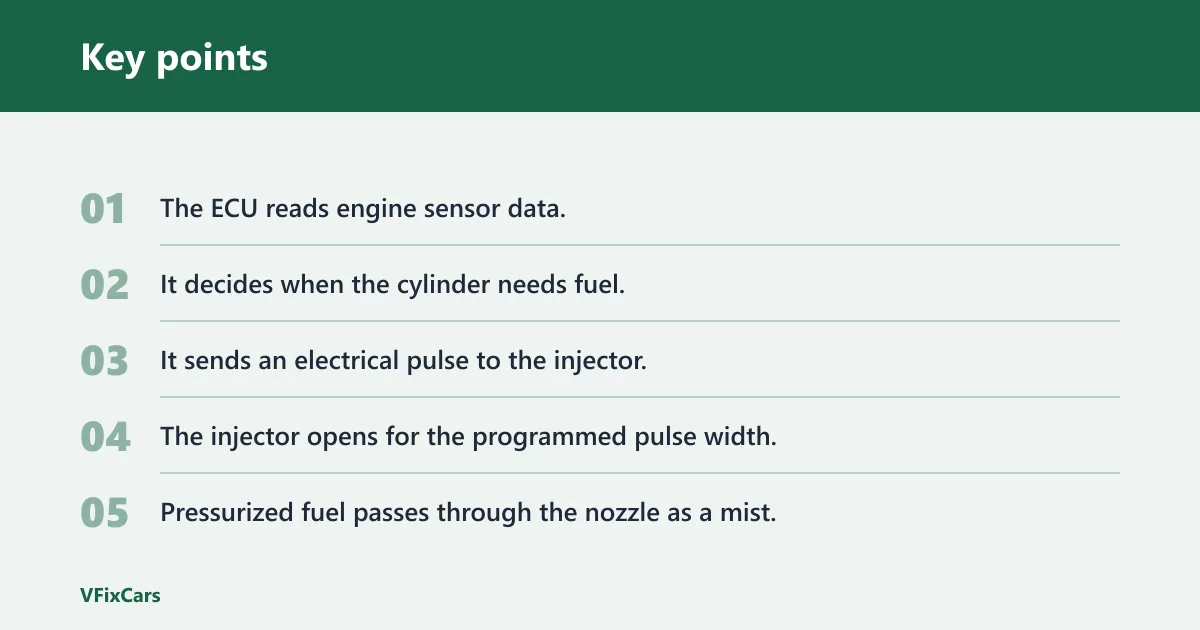
The ECU reads sensor data such as engine speed, throttle position, load, coolant temperature, and oxygen sensor feedback. It uses that information to choose injector timing and duration. Timing tells the injector when to fire. Duration, often called pulse width, tells it how long to stay open.
What pulse width means
Pulse width is the length of the electrical command sent to the injector. A longer pulse usually means more fuel, while a shorter pulse means less. The actual fuel amount still depends on pressure, nozzle design, and injector condition, so pulse width is only part of the picture.
Why pressure and nozzle shape matter
Pressure pushes fuel through the nozzle. A high-pressure pump feeds fuel to a high-pressure fuel rail in many direct-injection systems. Nozzle shape then breaks that fuel into tiny droplets. Bosch HDEV5 injectors can reach nominal system pressure up to 20 MPa, with droplet size of 15 μm SMD, which helps the spray mix more evenly with air.
- The ECU reads engine sensor data.
- It decides when the cylinder needs fuel.
- It sends an electrical pulse to the injector.
- The injector opens for the programmed pulse width.
- Pressurized fuel passes through the nozzle as a mist.
- The air-fuel mix burns and pushes the piston.
If a petrol engine idles roughly at a traffic light only when warm, that can point to an issue with the idle or fuel system. That can point to an injector that is sticking or spraying unevenly, because the problem shows up when the ECU trims fuel more tightly and the mixture needs to stay stable at low load.
What fuel injectors do by engine type
| Engine type | Injector location | Who controls it | Typical pressure range or delivery method | What the driver notices |
|---|---|---|---|---|
| Petrol port injection | Intake port, before the intake valve | ECU sends the electrical pulse | Low to moderate fuel pressure through a rail | Usually smooth running; faults can cause rough idle or hard starting |
| GDI | Combustion chamber | ECU controls timing and pulse width | High-pressure pump feeds a high-pressure fuel rail; nominal system pressure can reach 20 MPa on some injectors | Better fuel control under load; faults may cause misfire, fuel smell, or power loss |
| Conventional diesel | Combustion chamber | ECU or mechanical control, depending on system | Average nozzle opening pressures of 140 to 210 kg/cm2 | Diesel knock, smoke, rough idle, or hard starting if delivery is off |
| Unit injector | At each cylinder, as one combined unit | Engine management or cam-driven actuation | Combines pump and injector; can deliver injection pressure up to 2,200 bar | Strong spray control, but problems can show as rough running or uneven power |
| Piezo injector | Usually direct-injection diesel systems | ECU controls a very fast actuator | Can create fuel pressures up to 3,000 bar or 44,000 psi; can support up to seven injections per combustion cycle | Very fine fuel control; faults can show up as hesitation, noise, or emission problems |
What changes by injector type?
The basic job stays the same, but the hardware changes a lot. Petrol port injectors spray into the intake port. GDI injectors spray into the combustion chamber at higher pressure. Diesel systems often use different injector hardware again, because diesel fuel, ignition timing, and combustion strategy are not the same as petrol.
Petrol port injection
Port injection is commonly found in older petrol engines and in some current models. Fuel is sprayed before the intake valve, so it mixes with air in the intake path. That arrangement gives the engine more time for mixing, and the injector itself does not need the same pressure found in GDI.
GDI systems
GDI engines inject fuel directly into the combustion chamber. That is why a high-pressure pump and high-pressure fuel rail matter. Fuel has to be delivered at the right moment and in the right shape, because the mixture is formed inside the cylinder rather than in the intake port.
Diesel, unit, and piezo injectors
Conventional diesel injectors, unit injectors, and piezo injectors are built for diesel combustion and higher injection pressures. A unit injector combines the pump and injector in one unit, which is used in some diesel systems. Piezoelectric injectors respond very quickly and can support multiple injections per cycle in advanced diesel systems. (Wikipedia)
A common first-timer mistake is assuming “injector problem” means the same thing on every car. On a petrol port-injected engine, a weak injector may cause a lean misfire and fuel smell near the intake. On a diesel with piezo injectors, the same basic fault can show up as harsh idle, smoke, or a fault code tied to injection control.
What happens when injectors do not work right?
Bad injectors usually show up as drivability problems, not just a warning light. Rough idle, misfire, hard starting, fuel smell, poor economy, and power loss are all possible when injectors stick, leak, clog, or spray poorly. Those symptoms happen because the cylinder is no longer getting the right amount of fuel at the right time.
Rough idle and misfire
If one injector under-delivers or sprays badly, that cylinder may burn unevenly. The engine can shake at idle or set a misfire code. This is common when the spray pattern is distorted or the injector cannot open and close cleanly on command.
Hard starting or long cranking
Hard starting often means the engine is not getting enough fuel during cranking, or fuel pressure is bleeding off after shutdown. A leaking injector can also flood a cylinder, which makes starting difficult. In either case, the mixture is wrong before the engine even settles into idle.
Fuel smell, poor economy, and power loss
A leaking or stuck-open injector can put too much fuel into the engine, which may cause a fuel smell and worse fuel economy. A clogged injector can do the opposite and starve the engine under load, which feels like weak acceleration or hesitation. Both conditions can damage the catalyst if ignored.
Frequently asked questions
What do fuel injectors do in a car?
Fuel injectors deliver fuel in measured bursts so the engine can burn it at the right moment. They atomize the fuel into a fine spray, which helps it mix with air. The ECU controls when they open and how long they stay open.
What are fuel injectors in a car?
They are the engine parts that meter fuel into each cylinder or intake port. In petrol engines they may sit in the intake path or directly in the cylinder. In diesel systems, the hardware is built for much higher pressure and different combustion timing.
What does fuel injection do for a car?
Fuel injection gives the engine accurate fuel control. That helps starting, idle quality, throttle response, emissions control, and overall drivability. It also lets the ECU adjust fuel delivery as temperature, load, and speed change.
Do fuel injectors need programming?
Some systems may need injector coding or adaptation after replacement, especially where the ECU needs to account for injector flow differences. Many older port-injection systems do not need the same level of programming. The exact requirement depends on the engine and the service procedure.