How Often Should You Rotate Your Tires?
Rotate your tires about every 5,000 to 8,000 miles, or about every 6 months. Many front-wheel-drive cars do better near 5,000 miles, and some EVs may need checks sooner because of weight and torque. Skip rotations and you invite uneven wear, road noise, and shorter tire life. This guide explains the interval by mileage, time, drivetrain, and when EV tires need extra attention.
Tire rotation basics
Tire rotation moves each tire to a new position on the vehicle so wear stays more even. It does not fix alignment, repair damage, or correct a worn suspension part. It simply shifts the wear pattern so one corner does not take the same load every service cycle.
Driven wheels wear faster. On front-wheel-drive vehicles, the front tires steer, brake, and put power down, so they usually lose tread sooner than the rear pair. Alignment and suspension condition also affect wear, so a rotation visit should do more than move tires around.
How often should you rotate your tires?
The practical default is every 5,000 to 7,500 miles, or about every 6 months. If your oil changes happen less often than that, use the tire interval instead of waiting for the next oil service. Some manufacturers still call for 5,000 miles, and some manuals or tire makers use shorter or longer windows.
That is why the owner’s manual comes first. If it gives a manufacturer-recommended interval and a pattern, follow that guidance. If it is silent, the 5,000 to 7,500-mile rule is the safer general schedule for most passenger vehicles.
When to use the manual instead
Use the manual when it is stricter than the general rule, or when the vehicle has a tire layout that changes the pattern. Directional tires, staggered fitments, and some EVs can narrow your options. If the book says rotate at a certain mileage, use that number even if it falls outside the common range.
For cars driven only a few thousand miles per year, months matter as much as mileage. A vehicle that covers 2,000 miles in six months still ages in service, and the tread can wear unevenly from position, load, and tire pressure drift.
Rotation intervals by vehicle type
Front-wheel-drive cars usually need the closer end of the interval because the driven wheels work harder. Rear-wheel-drive vehicles often wear the rear tires differently under power, but they still need rotation. All-wheel-drive and 4WD/4X4 vehicles also need rotation, because the front and rear tires do not wear at exactly the same rate.
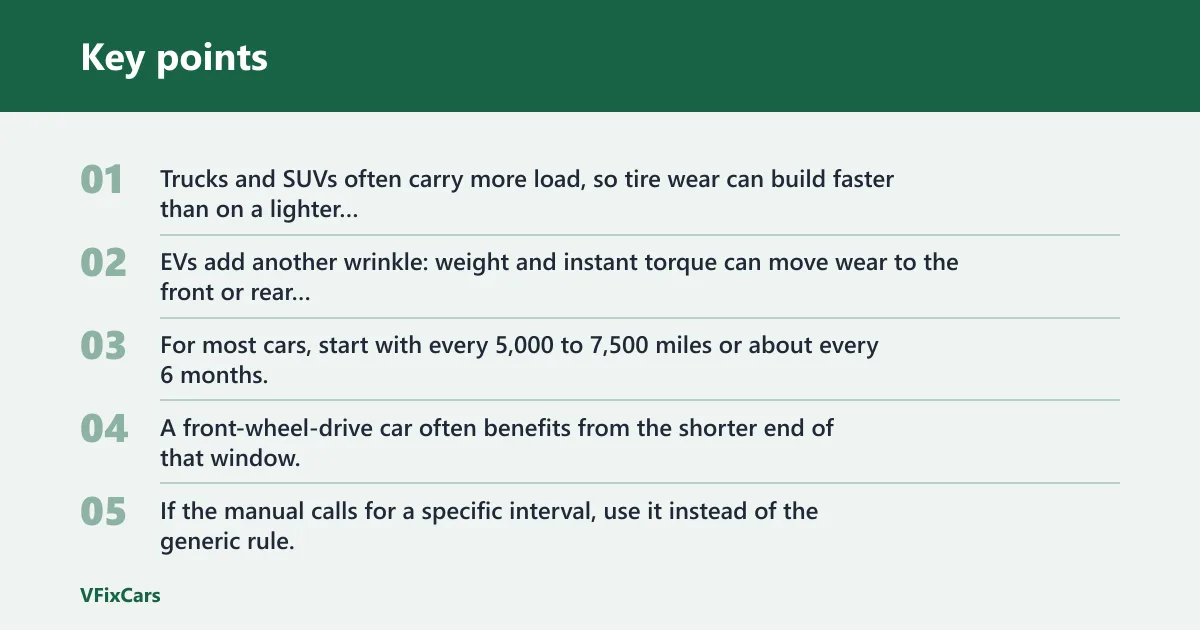
Trucks and SUVs often carry more load, so tire wear can build faster than on a lighter sedan. EVs add another wrinkle: weight and instant torque can move wear to the front or rear more quickly, depending on the drivetrain and tire setup.
How often should you rotate your tires on a car?
A front-wheel-drive car often benefits from the shorter end of that window. If the manual calls for a specific interval, use it instead of the generic rule.
How often should you rotate your tires on a front wheel drive car?
Front-wheel-drive cars usually need rotation on the shorter side of the normal range because the front tires wear faster. A good starting point is every 5,000 miles, then adjust to the owner’s manual if it gives a different schedule. Watch for front-shoulder wear and cupping.
How often should you rotate your tires on a truck?
For most trucks, every 5,000 to 7,500 miles is a reasonable interval, but heavy towing, hauling, and mixed city use can justify the shorter end. If the truck has LT tires, staggered fitment, or a manual with a stricter rule, follow that setup instead of a blanket schedule.
How often should you rotate your tires on an SUV?
Many SUVs fit the same 5,000 to 7,500-mile window, but weight and load use matter. Family hauling, roof loads, and stop-and-go driving can shorten tread life. If the SUV uses same-sized tires, the pattern choice is usually easier than on a staggered performance setup.
How often should you rotate your tires on AWD?
All-wheel-drive vehicles still need rotation, and the interval often stays close to the common 5,000 to 7,500-mile window. Use the manual for the exact pattern, because AWD can be sensitive to uneven tire diameter. Keep the tire set matched in size and tread depth as closely as possible.
How often should you rotate your tires on an electric vehicle?
For an EV, use the manual first, then treat 5,000 to 7,500 miles as the general starting point. Heavier curb weight and instant torque can push wear faster than on a similar gasoline car. Check tire pressure and tread depth at each visit, not only at rotation time.
How often should you rotate your tires on a Tesla?
Tesla owners sometimes follow a 6,250-mile interval, but the manual still wins if it says something different for your model and tire setup. Treat that figure as a practical planning point, not a universal rule. Tire type and drive layout can change the pattern.
How often should you rotate your tires in months?
About every 6 months is the clean time-based rule when mileage is low or uneven. That matches the service cadence many drivers use and keeps long-idle tires from sitting too long in one position. If you hit mileage first, rotate sooner.
How often should you rotate your tires in km?
If your manual gives a kilometre figure, use that. For infrequent driving, set a calendar reminder at the 6-month mark.
Tire rotation decision table
| Vehicle type | Tire type | Driving pattern | Recommended interval | Pattern | Do not rotate like this |
|---|---|---|---|---|---|
| FWD car | Non-directional, same-sized | City | 5,000 miles or 6 months | Forward cross | Do not keep the front tires on the front axle only. |
| FWD car | Directional | Highway | 5,000 to 7,500 miles | Front-to-back on the same side | Do not cross directional tires side to side. |
| RWD car | Non-directional | City | 5,000 to 7,500 miles | Rearward cross | Do not ignore rear wear just because the front tires steer. |
| AWD or 4WD/4X4 | Non-directional, same-sized | Mixed | 5,000 miles | Crisscross if the manual allows it | Do not mix tread depths far apart on the same vehicle. |
| Truck | Staggered or directional | Highway, towing | 5,000 miles | Front-to-back if allowed | Do not force a cross pattern on a staggered fitment. |
| SUV | Asymmetric, non-directional | Low-mileage | 6 months or 5,000 to 7,500 miles | Rearward cross or front-to-back | Do not skip rotation because the vehicle is driven only on weekends. |
| EV or Tesla | Same-sized, non-directional | City, high torque | About 6,250 miles or 6 months | Use the manual’s pattern, often front-to-back or rearward cross | Do not assume every EV uses the same pattern as a gasoline sedan. |
Which rotation pattern fits your tires?
The pattern depends on drivetrain and tire design. Forward cross and rearward cross are common for same-sized, non-directional tires. Crisscross can apply to certain setups when the manual allows it. Front-to-back and side-to-side are used when the tire design limits how each wheel can move.
Forward cross and rearward cross
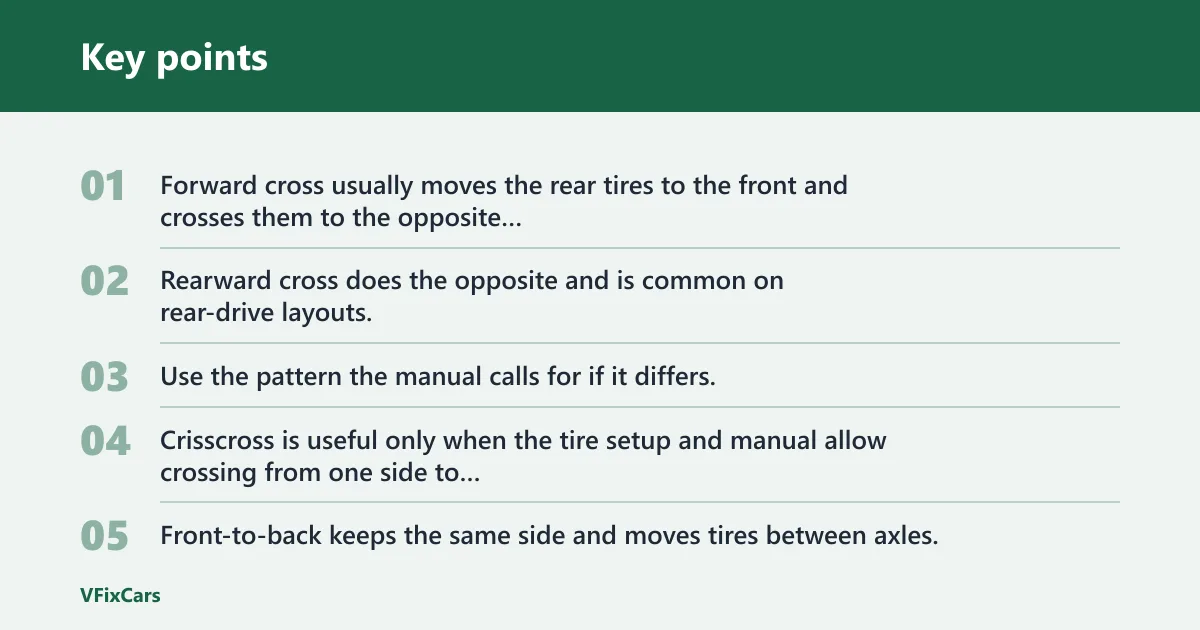
Forward cross usually moves the rear tires to the front and crosses them to the opposite sides, while the front tires go straight to the rear. Rearward cross does the opposite and is common on rear-drive layouts. Use the pattern the manual calls for if it differs.
Crisscross, front-to-back, and side-to-side
Crisscross is useful only when the tire setup and manual allow crossing from one side to the other. Front-to-back keeps the same side and moves tires between axles. Side-to-side may be used when the tires are mounted in a way that limits front-to-back movement.
Directional tires must remain on the same side of the vehicle. For those, front-to-back is the only possible rotation pattern. Asymmetric tires can often be rotated, but the mounting direction and the manual still matter.
Directional and staggered setups
Directional tires point one way, so they cannot be crossed from left to right. Staggered setups, where front and rear tires are different sizes, can limit rotation even more. In those cases, the safe answer is often a partial front-to-back swap, or no rotation at all if the manual forbids it.
Suppose your sedan uses 245/40R19 directional tires and the inside edge on the front-left shows faster wear. The fix is not a crisscross pattern. The tire still has to stay on its side, and the manual may limit you to front-to-back only.
Should you rotate during oil changes?
Rotation often lines up with oil service because the visit is already on the calendar, but the two intervals do not have to match. If oil changes are less frequent than tire rotation, do the tire service on its own. Waiting for the oil change can push rotation too far past the right mileage.
When oil service and rotation line up
If your oil service lands near the 5,000 to 7,500-mile tire window, bundle the work. That keeps maintenance simple and gives the technician a good chance to inspect the tires at the same visit. It also reduces the chance that the rotation gets postponed.
What to do when they do not
Do the rotation when the tire interval hits, even if the next oil change is months away. A service plan is only useful if it matches the car’s real schedule. Free rotation can be a good deal, but only if the shop will rotate on the proper interval and pattern for your setup.
What to inspect at rotation time
Rotation should include more than moving wheels around. Ask for tire pressure checks, tread depth checks, and a look for damage, vibration, and wheel balance issues. Bridgestone also notes that rotation is a chance to inspect those items, which makes the visit more useful than a simple tire shuffle.
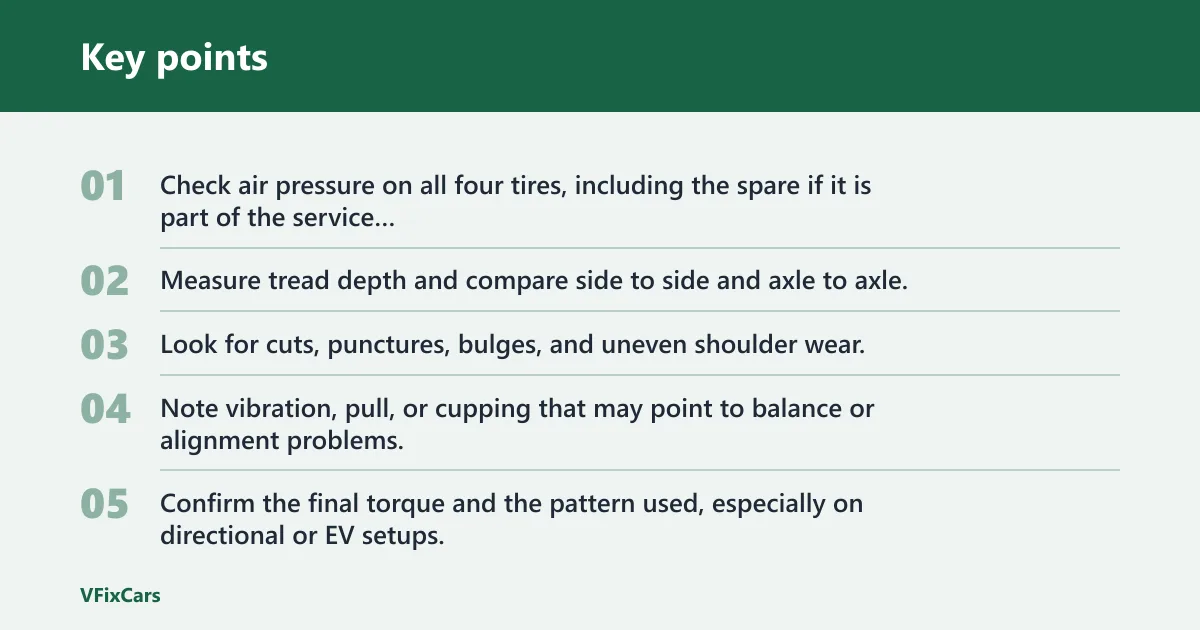
- Check air pressure on all four tires, including the spare if it is part of the service plan.
- Measure tread depth and compare side to side and axle to axle.
- Look for cuts, punctures, bulges, and uneven shoulder wear.
- Note vibration, pull, or cupping that may point to balance or alignment problems.
- Confirm the final torque and the pattern used, especially on directional or EV setups.
Say your compact crossover comes in at 6 months with one front tire 2/32 deeper wear on the outer shoulder than the rest. That is a clue to inspect alignment and suspension, not just to rotate and send it out the door. A rotation cannot correct a wheel that is pointed out of spec.
Consumer Reports notes tire rotation can cost about $60. If a shop offers a free rotation plan with tire purchase, the value depends on whether the schedule matches your car and whether the pattern fits your tire type. A cheaper plan that ignores the correct interval is not a real bargain. (Consumerreports)
Frequently asked questions
How often should you rotate your tires and get an alignment?
Rotate on the tire interval, and get an alignment when wear, pull, vibration, or steering-center issues point to a problem. You do not need an alignment at every rotation, but uneven wear during inspection is a strong reason to check it sooner rather than later.
How often should you rotate your tires on your car?
If you drive less than that in a year, use the calendar. Low mileage does not stop tire aging or position-related wear.
How often should you rotate your tires on a truck: use the same base interval?
Use the same base interval, then shorten it if the truck tows, hauls, or runs heavier-duty tires. Many trucks sit near 5,000 miles for rotation. If the fitment is staggered or directional, the pattern may be limited, so the manual matters more.