Dead battery vs drained battery: what’s really different?
A drained battery can usually be recharged and retested; a dead battery will not hold voltage or recover after charging, and a charging-system fault can look like either one. A bad diagnosis can waste money on a battery you do not need, or leave the real no-start cause untouched. This guide explains the symptom patterns, quick checks, and the recharge-retest-replace decision.
This guide is part of our Dead battery: symptoms, fixes, and next steps series.
Dead battery vs drained battery: the short answer
The difference is simple in theory and useful in practice. A drained battery is discharged from use and often comes back after charging or a jump start. A dead battery has failed inside, usually from age, damage, or a defect, and it will not hold a charge.
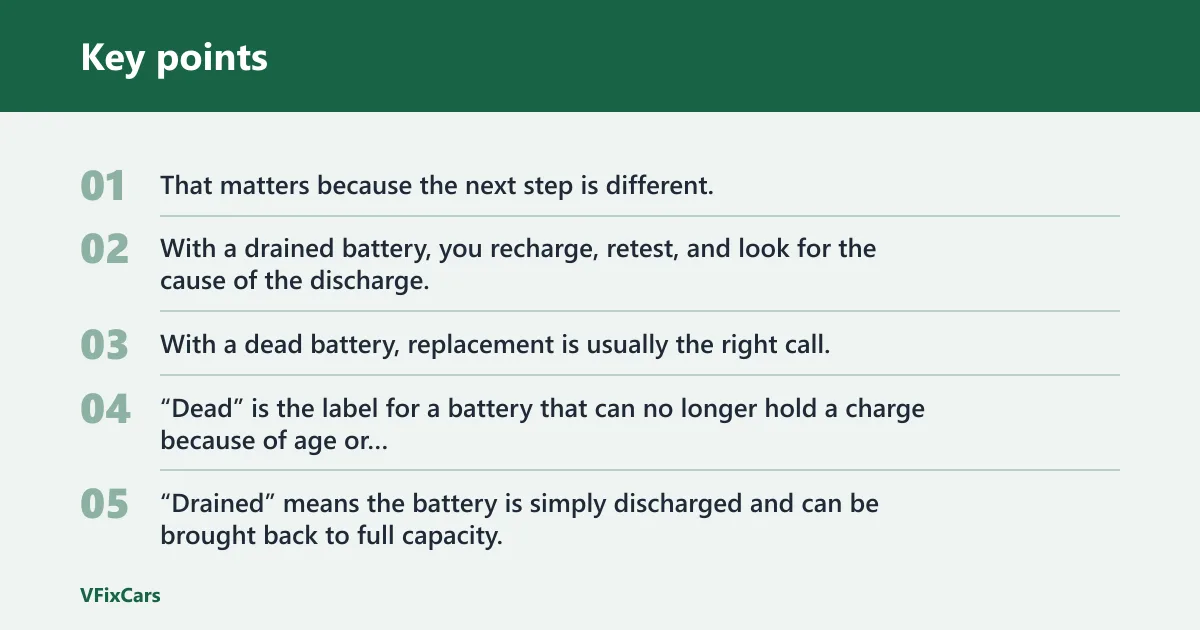
That matters because the next step is different. With a drained battery, you recharge, retest, and look for the cause of the discharge. With a dead battery, replacement is usually the right call, especially if the battery is old, cracked, leaking, or unable to hold voltage after charging.
| Decision factor | Dead battery | Drained battery | Winner |
|---|---|---|---|
| State of charge | Will not hold a charge | Discharged but rechargeable | Drained battery |
| Likely cause | Age, internal failure, physical damage | Lights, accessories, short trips, or temporary load | Tie |
| Next action | Replace after basic checks | Recharge, then retest | Drained battery |
| Jump start value | Temporary at best, not a fix | Often appropriate to restart the car | Drained battery |
| Replacement urgency | High if damaged, old, or failing to retain charge | Usually lower unless symptoms repeat | Drained battery |
What each label means in practice
“Dead” is the label for a battery that can no longer hold a charge because of age or damage. “Drained” means the battery is simply discharged and can be brought back to full capacity. The wording sounds similar, but the repair path is not the same.
A common first-timer mistake is treating every no-start as a dead battery. Leaving parking lights or the cabin lamp on can flatten a healthy battery, while an older battery can seem weak for the same reason but fail again after charging.
Why the difference matters for recharge, retest, or replace
If the battery is drained, a charger or jump start may restore enough power to start the car. If the battery is dead, repeated charging only delays the inevitable and can hide the real issue. Age, visible damage, and failure to retain a charge push the decision toward replacement.
What signs point to a drained battery?
A drained battery usually shows weak starting and weak electrical output rather than total silence. Slow cranking, dim headlights, dim dashboard lights, or a rapid clicking noise all fit a battery that has lost charge but may still be healthy enough to recover.
Slow crank and weak electrical output
A slow engine crank is one of the most common signs of a drained battery. The starter turns, but the engine feels sluggish to fire. Dim lights at the same time support the idea that the battery is undercharged rather than fully failed.
Dim lights or clicking during start-up
Dim headlights and dashboard lights point to low voltage. A rapid clicking noise can happen when the starter solenoid does not get enough current. Those signs suggest a drained battery, but they do not prove the battery is healthy enough to keep using.
Common causes: lights left on, accessories running, short-trip use
Leaving lights or electronics on, such as headlights, dome lights, a phone charger, or the infotainment system, is a common cause of battery drain. Short-trip driving can also leave the battery undercharged because the alternator may not have enough time to refill what the start used. That is why a battery can seem fine one day and flat the next.
What signs point to a dead battery?
A dead battery usually shows no charge retention, repeated failure after charging, or obvious physical damage. Age, corrosion, internal failure, cracks, leaks, or swelling all point away from a simple recharge and toward replacement.
No response or no charge retention
If the car shows little or no response, or it starts only once and goes flat again after a proper charge, the battery may be dead. says a dead battery is one that can no longer hold a charge because of age or damage. That is the key clue.
Age-related failure and internal damage
Most batteries have a lifespan of 3 to 5 years. Older batteries are more likely to fail, even if they still accept a charge for a short time. Once internal wear becomes severe, the battery may act drained today and dead tomorrow.
Physical damage: cracks, leaks, swelling, corrosion
Physical damage like cracks or leaks can render a battery unusable. Corrosion can block electrical flow and lead to battery failure. If the case is cracked, leaking, or swollen, treat the battery as an immediate replacement issue rather than a charging problem.
How can you tell which one you have?
Use the symptom pattern, not one clue. One weak start does not prove the battery is dead, and one successful jump start does not prove the battery is healthy. Age, charge retention, visible damage, and whether the car accepts a charge all matter.
Battery age: why 3 to 5 years matters
Battery age is a replacement warning sign. A battery in the 3 to 5 year range may still work, but it deserves more suspicion if the car has repeated no-start events. An older battery that cannot hold a charge after a full recharge is far more likely to be dead than merely drained.
When a jump start is appropriate and when it is only a temporary check
Jump starting uses jumper cables and another vehicle’s battery. It can restart a drained battery, but it is not the same as fixing a dead battery. If the engine starts and then dies again, or the battery will not recharge, the jump was only a temporary check.
Suppose a 4-year-old sedan sits overnight after the dome light was left on. The engine cranks slowly, the lights are dim, and a jump start gets it running. That pattern leans drained, not dead, unless the battery fails to hold charge after a proper recharge.
Diagnosis matrix: symptom pattern, likely state, next action
Use this matrix as a practical decision tree. It does not replace voltage testing, but it helps you choose between recharge, retest, and replacement. If the battery keeps dying, the alternator or another charging-system fault needs attention too.
| Symptom pattern | Likely battery state | Next action | Jump start appropriate? |
|---|---|---|---|
| No crank after lights were left on | Drained | Jump start or charge, then retest | Yes |
| Slow crank after a short drive | Drained or weak battery | Charge fully, then check for repeat failure | Yes, as a temporary restart |
| Starts with a jump, then dies again | Dead battery or charging-system fault | Test battery hold and alternator output | Only as a check |
| Battery is cracked, leaking, or older than 3 to 5 years | Likely dead | Replace immediately | No, not as a fix |
Use the matrix as a failure tree
Start with the symptom, then ask whether the battery was simply discharged or whether it failed to hold charge. If the answer changes after a full charge, the battery may be dead or the car may have an alternator or parasitic-draw problem. Repeated failure after a recharge is the strongest warning sign.
How do you charge or jump-start a drained battery?
A drained battery can usually be revived with a jump start or a charger. Jump starting is the fastest way to get moving, while a charger is the better way to restore the battery more fully. If the battery is completely dead, jump starting is not recommended as a fix.
Jump start basics and what it can do
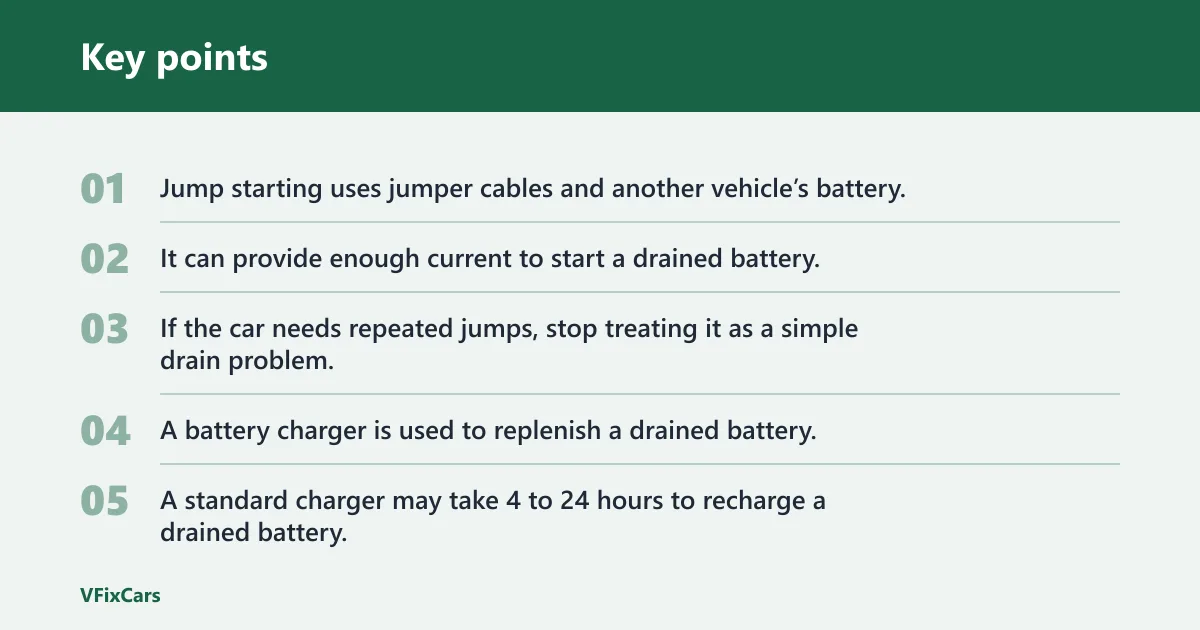
Jump starting uses jumper cables and another vehicle’s battery. It can provide enough current to start a drained battery, but it does not repair an underlying failure. If the car needs repeated jumps, stop treating it as a simple drain problem.
Battery charger use and charging-time range
A battery charger is used to replenish a drained battery. A standard charger may take 4 to 24 hours to recharge a drained battery, while a fast charger can take 1 to 3 hours. Charging time depends on charger amperage, battery size, and how much charge remains.
Why charger amperage and cold weather change recovery time
Lower amperage means a longer charge. Cold weather can slow chemical recovery and make the battery look weaker than it is, while short-trip use may leave it partly discharged even after a drive. A battery that seems “fine after a jump” may still need a full overnight charge before retesting.
Picture a hatchback used for five-minute school runs in winter. The battery starts the car after a jump, but the next morning it struggles again. That pattern points to repeated undercharging, a weak battery, or a charging-system issue, not a one-time drain.
What causes a battery to go dead instead of drained?
A battery goes dead when it can no longer hold a charge. Age, internal failure, corrosion, and physical damage are the main reasons. A drained battery is low on charge; a dead battery has lost the ability to store that charge properly.
Age and normal wear
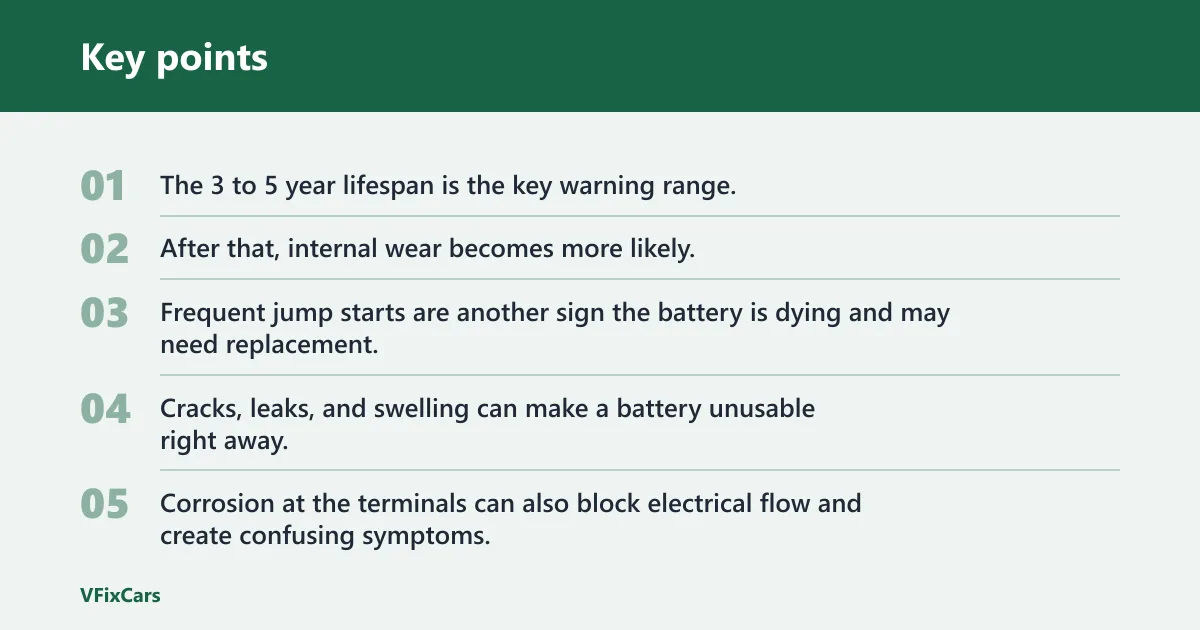
The 3 to 5 year lifespan is the key warning range. After that, internal wear becomes more likely, even if the battery still starts the car sometimes. Frequent jump starts are another sign the battery is dying and may need replacement.
Damage, corrosion, and internal failure
Cracks, leaks, and swelling can make a battery unusable right away. Corrosion at the terminals can also block electrical flow and create confusing symptoms. If cleaning the terminals does not restore normal operation, the battery itself may be failing.
Repeated battery drain from another fault
If batteries keep dying, the alternator should be checked. A faulty alternator may cause repeated battery drain, and a parasitic draw from a module or accessory can do the same. That is why repeated flat batteries call for diagnosis, not just replacement.
When should you replace a car battery instead of charging it?
Replace the battery if it will not hold a charge, shows visible damage, or keeps failing after a full charge. Age is also a strong replacement warning sign. Charging a dead battery may work briefly, but it does not solve an internal failure.
Choose dead battery if… / Choose drained battery if…
Choose dead battery if the battery will not hold a charge, is cracked or leaking, or keeps failing after a full charge. Choose drained battery if the battery was discharged by use and recovers after charging or a jump start. Check the alternator if batteries keep dying.
Vehicle-specific caution: AGM, start-stop systems, and battery management systems
Modern vehicles can change the diagnosis. AGM batteries and start-stop systems often need the correct replacement type, and some cars use a battery management system that may need a reset or registration after replacement. If the wrong battery type goes in, repeated low-voltage problems can follow.
What to do if you have a flat or dead battery
Start with safety, then sort the symptom pattern. If the battery was likely drained, a jump start or charger can get the car running again. If the battery is damaged, old, or unable to hold charge, replace it and inspect the charging system.
- Check for obvious damage such as cracks, leaks, swelling, or heavy corrosion.
- Think about the last event: lights left on, short-trip use, or a car that has sat for days.
- If the battery seems drained, try a jump start or charger.
- After charging, retest whether the battery holds voltage and restarts the car.
- If it fails again, check the alternator and look for a parasitic draw.
- Replace the battery if it is old, damaged, or cannot hold a charge.
Frequently asked questions
What’s the difference between a dead battery and a drained battery?
A drained battery is discharged and can usually be recharged. A dead battery has lost the ability to hold a charge because of age, damage, or internal failure. That difference decides whether you recharge and retest, or replace the battery outright.
How can I tell if my car battery is dead or just flat?
Look at the full pattern, not one symptom. A flat or drained battery often gives slow cranking, dim lights, or clicking and then improves after charging. A dead battery usually fails to hold charge, especially if it is old, cracked, leaking, or repeatedly dies after a full recharge.
Can a drained battery be recharged?
Yes. A drained battery is simply discharged and can be recharged to full capacity. A standard charger may take 4 to 24 hours, depending on charger amperage and how depleted the battery is. Cold weather and short-trip use can slow recovery.
Does a dead battery need replacement?
Usually, yes. A dead battery cannot hold a charge due to age or damage, so charging only provides a temporary result. If the battery is older than 3 to 5 years, or if it has cracks, leaks, or repeated failures, replacement is the sensible step.
Should I jump-start a battery that’s completely dead?
No, not as a fix. Jump starting uses jumper cables and another vehicle’s battery, and it can help a drained battery. A completely dead battery is unlikely to be restored by a jump start alone, and frequent jump starts suggest replacement is needed.
RAC Drive — What to do when calling the RAC about a flat battery
Have the key symptom ready: no crank, slow crank, clicking, or total silence. Also note whether the battery is old, recently jumped, or visibly damaged. That information helps separate a simple drain from a battery that is dead or a vehicle that has a deeper electrical fault.