How to Tell If Your Engine Air Filter Needs Replacing
Inspect the engine air filter if it’s visibly dirty, clogged with debris, wet, torn, or collapsing; a light dusting is normal, but dark buildup across most pleats means replace it. A restricted filter cuts airflow, can lower fuel economy, and can let dirt reach the engine. This guide gives a fast yes/no checklist so you can clean the airbox, monitor the filter, or replace it in under two minutes.
Engine air filter inspection checklist
Use the filter’s condition, not color alone, to decide. Surface dust is common. Thick grime, moisture, tears, flattened pleats, or debris packed between folds move the filter into replacement territory.
| Outcome | What you see | What it means | Notes to write down |
|---|---|---|---|
| Clean and reinstall | Light dusting, even discoloration, no tears, no moisture, pleats still open | Filter still has usable service life | Mileage: ____; driving: mostly highway, mixed, dusty, city |
| Monitor and recheck in 3,000 miles | Noticeable dust but no heavy blockage, no damage, airflow still looks decent in the light test | Not urgent, but it is closer to the end of service life | Mileage: ____; driving: pollen season, construction detours, gravel roads |
| Replace soon | Dark buildup across much of the media, clumps of dirt, leaves, or reduced light passing through | Airflow is likely becoming restricted | Mileage: ____; driving: dusty roads, short trips, heavy pollution |
| Replace now | Tears, collapsed pleats, wet spots, moldy or fuel-like odor, rodent nesting material, or severe clogging | Filter is no longer fit to serve the intake system | Mileage: ____; driving: storm water, flood splash, rodent signs, service overdue |
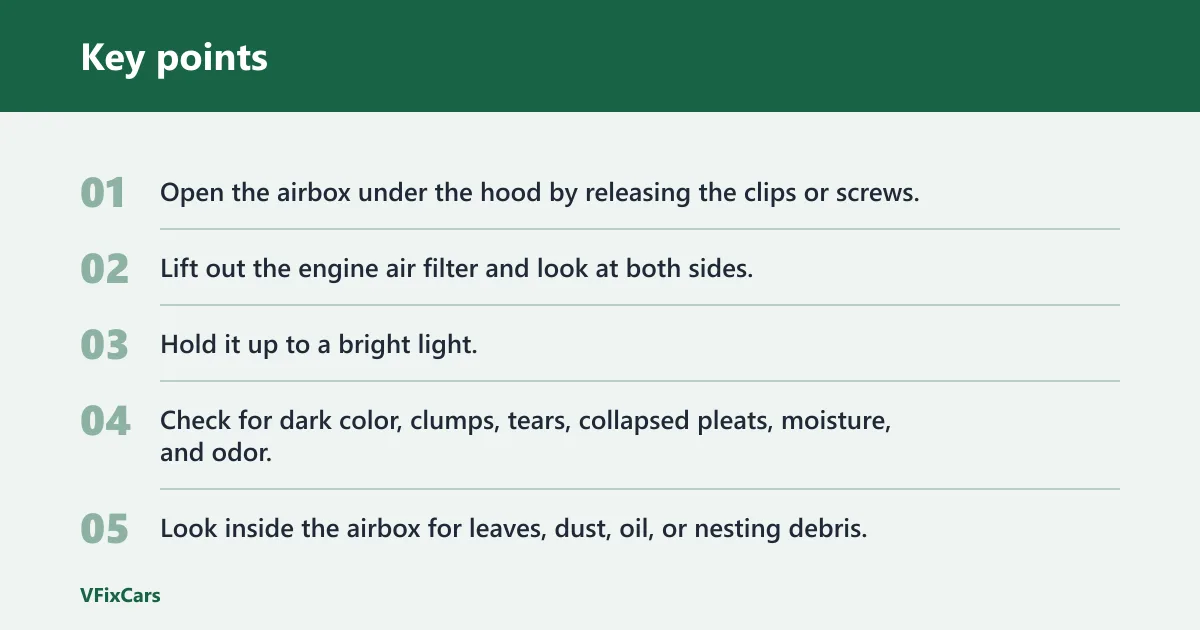
- Open the airbox under the hood by releasing the clips or screws.
- Lift out the engine air filter and look at both sides.
- Hold it up to a bright light.
- Check for dark color, clumps, tears, collapsed pleats, moisture, and odor.
- Look inside the airbox for leaves, dust, oil, or nesting debris.
- Decide on one of the four outcomes above.
A vehicle with roughly 20,000 or more miles on the original filter and pleats that look dusty but still open when held to light should be monitored and rechecked in about 3,000 miles. That points to monitor and recheck in 3,000 miles, not automatic replacement. If the same filter had a wet corner and shredded edge, it would move straight to replace now.
What an engine air filter does
The engine air filter is typically located in the airbox under the hood and filters intake air before combustion. It is usually a paper or pleated media element. Its job is simple: keep dirt out of the intake and still feed the engine enough air.
When the filter loads up with dust, airflow can drop. That can affect throttle response, fuel economy, and how smoothly the engine breathes under load. A clogged filter can also let the engine run rich because the intake side is not moving air as freely as it should.
Where the filter sits in the airbox
The airbox is the housing that holds the filter. You usually open it with clips or screws. After service, it must be sealed properly again, or unfiltered air can bypass the element.
That housing can collect leaves, dust, and sometimes rodent nesting material. If the box is dirty, clean it out before installing the new filter.
How do you know if the filter is dirty enough to replace?
Hold the filter up to light and judge how much light gets through the pleats. A little dust is normal. Dark, packed areas across most of the media, or debris sitting deep in the folds, point to replacement. Tears, collapsed pleats, moisture, and odor push it into replace-now territory.
Use the light test
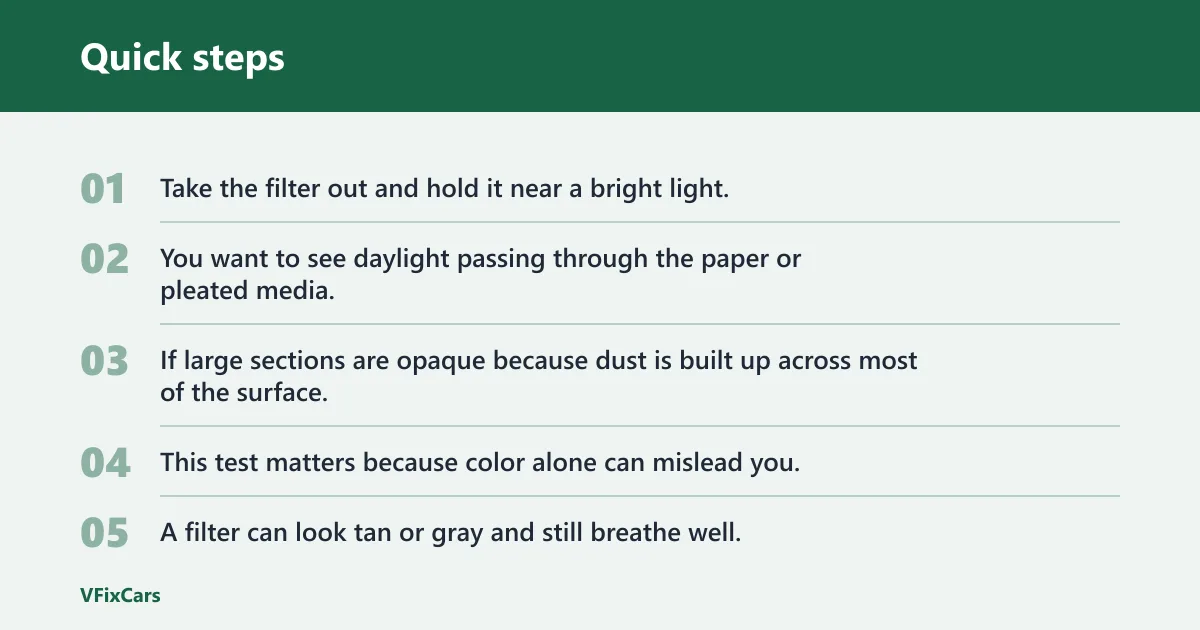
Take the filter out and hold it near a bright light. You want to see daylight passing through the paper or pleated media. If large sections are opaque because dust is built up across most of the surface, the filter is approaching restriction.
This test matters because color alone can mislead you. A filter can look tan or gray and still breathe well. The better question is whether the pleats still pass light and keep their shape.
Look for damage, debris, and moisture
Replace the filter if you see tears, holes, collapsed pleats, wet spots, or clumps of dirt that sit in the folds. Also replace it if you find leaves, insects, rodent nesting material, or signs that the filter media has been soaked.
Moisture is generally a hard stop for filter reuse. A wet filter can block airflow and may carry dirt deeper into the intake path.
Check for odor
A musty smell, fuel-like odor, or dirty intake smell is a warning sign, especially if it comes with visible debris or moisture. Odor alone is not proof of failure, but it is worth treating as a service cue rather than ignoring it.
Suppose you remove the filter from a compact car after a heavy rainstorm and find one corner damp with a leaf stuck to it. Even if the rest looks only lightly dusty, the wet area and debris are enough to replace it now.
When should the engine air filter be replaced?
A common replacement range is every 15,000 to 30,000 miles, but the interval changes with driving environment and filter condition. The best schedule is mileage plus inspection, not mileage alone. Auto Care Plus says you can check the filter visually at every oil change.
Why dusty roads and construction shorten the interval
Dust roads, construction areas, and similar conditions load the filter faster. If you spend time on gravel, unpaved shoulders, or work zones, the filter can clog well before the upper end of the 15,000 to 30,000 mile range.
Why pollen and pollution matter
Heavy pollen seasons can cake onto the media and reduce airflow. City driving with higher pollution can also shorten service life. That is why two cars with the same mileage may need different service timing.
Use this as a practical rule: if the filter sees dirty air every day, inspect it sooner. If the car lives on cleaner roads and the filter passes the light test, the original interval may still be fine.
Can a dirty air filter cause driveability symptoms?
Yes, but do not pin every rough-running complaint on the filter. A clogged filter can cause sluggish acceleration, reduced power, rough idle, occasional misfire, and whistling or sucking intake noise. Those symptoms can also come from the throttle body, MAF sensor, spark plugs, or vacuum leaks.
Fuel economy and check engine light questions
A dirty filter can hurt fuel economy, but gains after replacement are usually modest unless the old filter was truly restrictive. Modern fuel-injected engines may not show a dramatic change. A clogged filter may also trigger a check engine light, but not every dirty filter will.
That warning light should prompt inspection of the intake system, not a guess. If the filter is only dusty, the light may point elsewhere.
Here is a simple way to separate filter trouble from a false alarm: if power loss comes with visible clogging, a dirty airbox, and weak light passing through the media, the filter is a strong suspect. If the filter looks serviceable, look harder at the MAF sensor, ignition, and vacuum side.
Inspect the airbox and MAF sensor
Do not stop at the filter. Check the airbox for leaves, dirt, oil, or nesting material before reassembly. Also inspect the area around the MAF sensor for contamination. Dirt or oil on that sensor can affect drivability if it is exposed during service.
Keep the sensor area clean
Handle the filter and housing carefully so debris does not fall into the intake tract. Do not knock loose dirt toward the sensor. If the MAF housing looks dirty, clean only what the service procedure allows and keep the sensing element free of contact.
Reseal the housing correctly
Once the new or reused filter is in place, close the airbox fully and confirm the clips or screws are seated. A poor seal can let unfiltered air in and defeat the point of the filter change. That matters as much as the filter itself.
A common first-timer mistake is leaving a leaf trapped in the lower half of the airbox. The box appears closed, but the debris can hold the seal open and send dirty air past the element.
Can you clean a paper air filter instead of replacing it?
For a standard paper filter, replacement is the safer default. It is not designed to be cleaned, and compressed air can tear the media. Blowing it out may make the damage worse while leaving hidden clogging behind.
When replacement is the safer choice
If the filter is dark, heavily loaded, torn, wet, or smells bad, replace it. If it only has a light dusting and passes the light test, you can reinstall it and check again later. The goal is to use condition, not habit, to decide.
Do not try to save a paper filter by forcing air through it. If the media has already begun to clog, the filter has done its job and it is time to stop reusing it.
Frequently asked questions
How do I know when my engine air filter needs replacing?
Replace it when the filter is dark across most pleats, clogged with debris, torn, wet, collapsing, or smelly. A light dusting is normal. Hold it up to a bright light; if very little light passes through, or if you see damage or moisture, replacement is the right call.
How to tell if a car air filter needs replacing
Open the airbox, remove the filter, and inspect both sides. Look for heavy discoloration, packed dirt, leaves, tears, collapsed pleats, or wet spots. If the filter still passes light and the pleats stay open, it may only need monitoring rather than immediate replacement.
Can a dirty engine air filter cause poor gas mileage?
Yes. A dirty filter can restrict airflow and hurt fuel economy. The change is often modest on modern fuel-injected engines unless the filter is badly clogged. If mileage drops, also look for tire pressure, spark plugs, and other causes before blaming the filter alone.
Can a dirty engine air filter trigger a check engine light?
It can, but not always. A clogged filter may affect engine operation enough to set a warning light, yet many dirty filters never do. If the light comes on, inspect the intake system, including the filter, MAF sensor area, throttle body, and vacuum lines.
Can I clean my engine air filter instead of replacing it?
For a standard paper filter, no. It is not designed to be cleaned, and compressed air can tear the media. If it is dusty but still passes the light test, reinstall it and check again later. If it is dirty enough to restrict airflow, replace it.