Windshield Wipers: How to Choose the Right Blades
Choose windshield wiper blades by matching three things first: your vehicle’s connector, the exact blade length for each position, and your climate. Beam blades suit snow and highway speeds, hybrid blades fit mixed driving, and conventional blades still work well on older arms and tighter budgets. Miss any one of those, and you can get chatter, streaks, weak coverage, or a blade that simply will not lock onto the arm. This guide covers blade types, sizes, materials, rear wipers, fitment checks, and sensible price tradeoffs.
Start with fitment, not brand
Brand comes after fitment. The useful order is year, make, model, trim, front left length, front right length, rear size if fitted, then connector style. That order prevents the two buying mistakes that show up most often: the right blade style with the wrong attachment, and the right connector with the wrong length.
Use the vehicle record before the old blade
Start with the owner’s manual or a current fitment lookup that matches your exact year, make, model, and trim. That matters most on vehicles with different left and right front sizes, a rear wiper, or connector changes within the same model line.
Do not trust the blade already on the car by sight alone. A previous owner may have installed the wrong length, replaced only one side, or fitted a “universal” blade whose adapter latches but does not seat on the arm the way it should.
Confirm all wiping positions separately
Driver and passenger blades are often different lengths. wikiHow notes that left and right wiper blades may be different lengths, and that is normal on many windshields with uneven sweep areas.
Treat the front driver, front passenger, and rear as separate parts. Rear blades often use a different connector and a different length from the front pair, so leaving the rear for last leads to easy returns.
Match the connector before comparing blade styles
J-hook, side pin, top lock, and pinch tab typically do not swap automatically. J-hook is common, but it is far from universal. So-called universal adapters fit many arms, not every arm design still on the road.
Connector fit also changes how easy the job is and how often people get it wrong. wikiHow says some wipers only lift two to three inches from the windshield, which makes bulky adapters and awkward release tabs more annoying on some vehicles. (Wikihow)
📊 Firestone recommends replacing wiper blades every 6-12 months. Source: Firestonecompleteautocare.
How do you know what windshield wipers you need?
You need the exact fitment for each wiper position, the correct arm connector, and a blade design that matches climate and use. Start with the owner’s manual or a current fitment lookup for your exact vehicle, then verify driver, passenger, and rear sizes one by one before choosing conventional, beam, or hybrid blades.
The 4-step selection workflow
- Confirm year, make, model, and trim in the owner’s manual or a current fitment database.
- Write down the driver-side length and passenger-side length separately.
- Add the rear blade size and connector if the vehicle has one.
- Only then choose blade type and material based on climate, parking conditions, and driving pattern.
What to pull from the owner’s manual
The manual usually settles size and position. It can also help when the vehicle has a less common rear arm, a low-clearance hood line, or a service note about how far the wiper arm can be lifted.
If the manual and the current blade disagree, trust the documented fitment first. The part on the car may simply be wrong.
When the catalog and current blade disagree
Use the catalog as your starting point, then compare connector shape and how the blade sits on the arm. A blade can have the stated size and still be a poor match if the adapter leaves it crooked or loose.
Suppose the lookup says 26 inches on the driver side and 16 inches on the passenger side, but both old blades are 24 inches. That does not prove the catalog is wrong. More often, someone installed a same-length pair for convenience and gave up some glass coverage.
What to verify before checkout
- Front left and front right lengths are listed separately.
- Rear blade, if equipped, is listed as its own part.
- The connector shown matches the arm on the vehicle.
- The blade style suits climate and speed use.
- The return policy is clear if an adapter mismatch shows up at install time.
Matching Wiper Blade Design to Your Climate and Driving Speed
Beam blades hug curved windshields evenly and resist ice buildup, making them the practical choice for winter climates and regular highway driving. Conventional wiper blades use an external frame that costs less upfront and allows simple rubber insert swaps, but they chatter more at high speeds and trap snow.
Picking the wrong design leads to streaks, noise, or unnecessary replacement costs. A detailed breakdown of beam vs conventional blades compares both types across windshield curvature, climate, vehicle speed, adapter fitment, and lifespan so you can match the blade architecture to your actual driving conditions rather than guessing at the parts counter.
What size windshield wiper blades do you need?
You need the size specified for each position on your vehicle, not a guessed average and not whatever is currently installed. Measure driver and passenger sides separately only as a cross-check, because a blade that is too long can interfere, while one that is too short leaves part of the glass unwiped.
Why driver and passenger lengths often differ
Windshields are rarely symmetrical in the area each arm can sweep. The driver side often reaches farther, while the passenger side may need a shorter blade to avoid hitting the A-pillar trim, cowl, or the opposite blade at the center overlap.
What happens when a blade is too long
Too-long blades can hit each other, catch trim, or load the motor more than intended. The result may be chatter, poor parking at the bottom of the glass, or a blade that rides up on the windshield edge.
Say your vehicle calls for a 24-inch driver blade and an 18-inch passenger blade, but a store shelf pair offers two 24-inch blades at a discount. The passenger blade may strike the driver blade on the return sweep or clip the windshield molding.
What happens when a blade is too short
Too-short blades leave unwiped sections, usually at the upper corners or near the passenger edge. That may not look severe in dry weather, but it matters in road spray or salt mist when film builds up exactly where side traffic appears.
Rear-wiper sizing mistakes to avoid
Rear blades are often treated as interchangeable. They are not. Rear arms commonly use different connectors, and the rear glass shape can be less forgiving of an oversize blade than the front windshield.
Should you buy beam, conventional, or hybrid wiper blades?
Choose based on how the vehicle is used. Conventional blades still make sense for older arms and lower cost, beam blades suit snow, ice, heavy rain, and highway speeds, and hybrid blades sit in the middle with a more aerodynamic shape and mid-to-premium pricing. No single design is right for every vehicle.
Conventional blades: where they still make sense
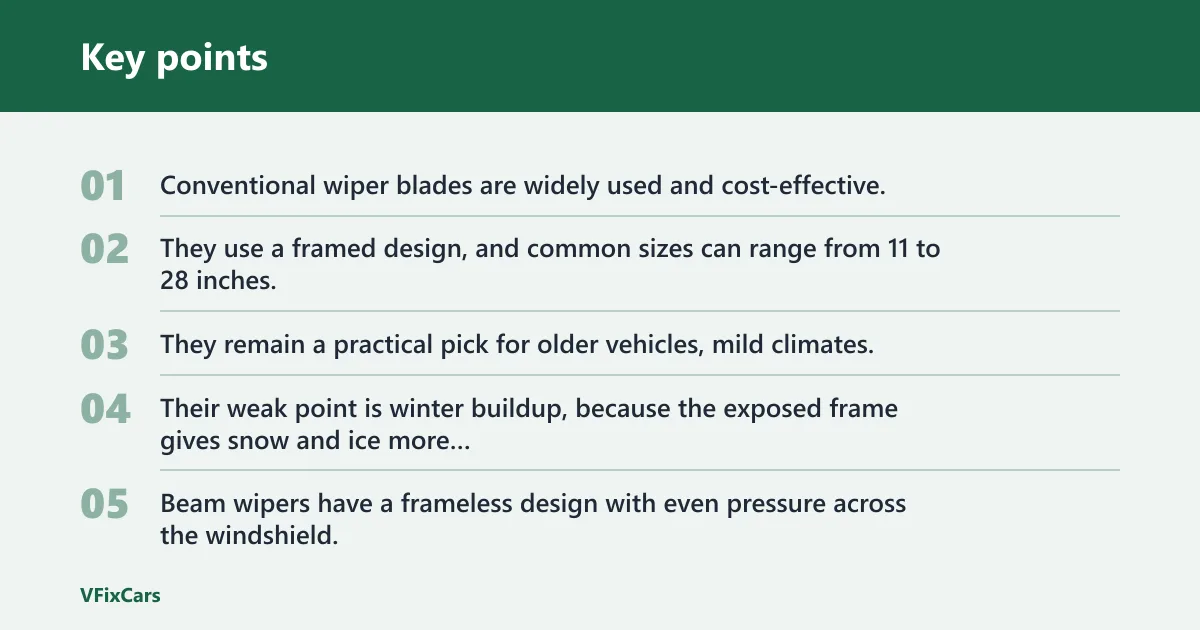
Conventional wiper blades are widely used and cost-effective. They use a framed design, and common sizes can range from 11 to 28 inches.
They remain a practical pick for older vehicles, mild climates, and buyers chasing the lowest upfront cost. Their weak point is winter buildup, because the exposed frame gives snow and ice more places to pack in, which can reduce contact pressure.
Beam blades: high-speed and harsh-weather strengths
Beam wipers have a frameless design with even pressure across the windshield. That design usually helps at highway speed, in heavy rain, and in winter conditions where exposed frame joints would otherwise ice up.
Beam blades often cost more, but that extra money buys a design advantage, not a miracle. If the length or connector is wrong, a premium beam blade will still wipe badly.
Hybrid blades: middle ground on structure and price
Hybrid blades combine features of conventional and beam blades. In practice, that usually means a framed structure with a shell that improves airflow and shields some moving parts from grime and slush.
For many daily-driven cars in mixed climates, hybrid blades are the compromise option: more weather-tolerant than a basic framed blade, usually less expensive than the priciest beam or silicone models.
Which design suits your use pattern?
If the car sits outside in snow country or covers frequent highway miles, beam blades usually make the strongest case. If the vehicle is older, lightly used, or fitted with simpler arms, conventional blades can still be the sensible buy. Hybrid fits the middle.
Archived buyer guides can miss newer connector revisions, current price bands, and updated fitment databases. Current-season fitment data often matters more than last year’s brand ranking.
Are silicone blades worth it over rubber?
Silicone can be worth the extra spend when the vehicle sits outside in heat, strong sun, or cold swings, or when replacement convenience matters more than the lowest upfront cost. Basic rubber still makes sense for garage-kept, low-mileage cars where climate stress is low and value matters most.
Rubber versus silicone in heat, UV, and cold
Basic rubber is the common baseline and usually the cheaper option. It works well enough when fitment and pressure are right, but it tends to be less tolerant of heat, UV exposure, and long outdoor parking.
Silicone blades are generally chosen for better resistance to heat, UV, and cold stiffness. That does not guarantee longer service on every car, but it does match harsh parking and climate conditions better.
Wipe quality, noise, and service-life tradeoffs
Material affects noise and glide, but it is not the only cause. Chatter can come from dirty glass, wax residue, or poor arm pressure. Smearing can come from bad washer fluid, oily film, or a torn edge.
Many sources recommend replacing wiper blades every 6-12 months, and Firestone gives the same 6-12 months guidance. Silicone may extend that window on some cars, but it should not be sold as a fixed lifespan promise.
When silicone is worth the extra spend
Picture a car parked outdoors year-round in a hot, dry climate. The blade spends more time baking in UV than wiping rain. That is where paying extra for silicone makes more sense than paying extra for a premium name alone.
When basic rubber is the better buy
If the car is garage-kept, driven lightly, and inspected monthly, a basic rubber blade can be the value choice. Spending more on silicone while replacing on a short schedule anyway may not change the ownership math much.
Wiper choice matrix
| Scenario | Best blade type | Best material | Must-check fitment details | Do not buy |
|---|---|---|---|---|
| Hot, dry climate; car parked outside | Beam or hybrid | Silicone preferred | Verify exact front lengths separately; confirm connector type; check rear blade if equipped | Basic rubber chosen only by brand name; oversized blades that hit trim at the ends of the sweep |
| Rainy city driving with frequent stop-start use | Hybrid or beam | Rubber or silicone | Confirm driver and passenger lengths; make sure the blade parks cleanly at the cowl without chatter | Longest blade that “almost fits”; cheap adapter that leaves the blade twisted on the arm |
| Snowy winter and ice exposure | Beam | Silicone preferred | Confirm winter-friendly beam fitment; verify non-hook adapters carefully; check rear blade separately on hatchbacks and SUVs | Conventional framed blade if snow packs into the frame; rear blade ignored during front-pair replacement |
| Highway-heavy commuting | Beam | Rubber or silicone | Check for even contact across the full sweep; confirm connector locks firmly with no play at speed | Low-cost framed blade that lifts or chatters at speed; wrong-length passenger blade that bumps the driver blade |
| Low-mileage, garage-kept vehicle | Conventional or hybrid | Rubber usually sufficient | Match listed sizes, not memory; inspect for age cracks even if mileage is low | Paying for premium material while skipping monthly inspection; keeping old blades because tread on the tires still looks new |
| Vehicle with rear wiper | Front: choose by climate; Rear: dedicated rear blade | Match front use; rear often fine with rubber unless climate is harsh | Rear size and connector must be checked separately; front fitment does not predict rear fitment | Front blade family assumed to fit the rear; “universal” rear blade bought without connector confirmation |
Will universal wiper blades fit your car?
Sometimes, but never assume they will. Universal blades usually mean a blade sold with multiple adapters, and adapter coverage still varies by arm design. Confirm the exact connector on the car first, because a listed “universal” blade can still fit poorly, install awkwardly, or fail to latch securely.
Common arm types and adapter limits
J-hook or hook arms are common, but side pin, top lock, and pinch tab are also common enough to matter. Even within one blade family, some part numbers fit one top-lock width but not another.
A universal adapter can add bulk at the connection point. That may matter on low-clearance arms or on vehicles where the blade parks tightly against trim.
Why connector shape affects returns and install time
The wrong connector wastes more time than the wrong brand. It can also create the false impression that the blade is defective when the real issue is simply the wrong adapter for the arm.
Consumer interest in 2026 “best overall” lists is understandable. Car and Driver listed Rain-X Latitude Water Repellency as best overall in 2026 and Aero Voyager as best value in 2026, but those rankings still come after fitment confirmation, not before it.
Fitment checks for non-hook arms
- Compare the arm end shape to the package diagrams.
- Check whether the blade needs a dedicated adapter already included.
- Confirm that the blade can articulate freely after installation.
- Do not force an adapter that almost lines up.
What failure signs actually mean
Streaking, smearing, squeaking, chattering, skipping, split rubber, lifted edges, and missed edge zones all point to a problem, but not always a worn blade. Before buying replacements, check the glass, washer fluid, and arm pressure, because contamination or a bent arm can mimic blade failure.
When the blade is the problem
Replace the blade when the rubber edge is split, hardened, curled, or lifting away from the frame. Skipping in one repeated section of the sweep, or a missed outer edge that remains after cleaning the glass, usually points back to the blade itself.
When the windshield, washer fluid, or arm is the problem
Streaking can come from road film, wax residue, sap, or oily contamination. Smearing can come from poor washer fluid or a dirty windshield. Chatter can come from frozen contact points in winter, dry glass, or an arm with weak spring pressure.
A common first-timer mistake is replacing both blades after one rainy drive with smearing, then finding the new pair smears too. If the windshield still has a film layer or the washer fluid is poor, the symptom can remain even with new blades.
A quick inspection routine before you buy replacements
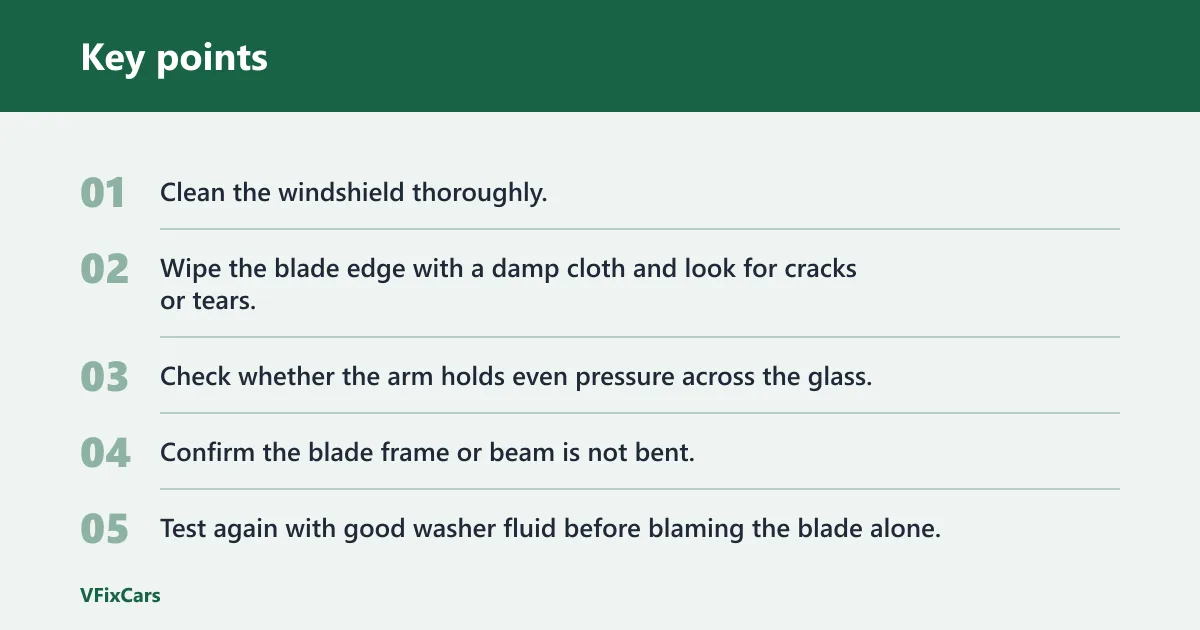
- Clean the windshield thoroughly.
- Wipe the blade edge with a damp cloth and look for cracks or tears.
- Check whether the arm holds even pressure across the glass.
- Confirm the blade frame or beam is not bent.
- Test again with good washer fluid before blaming the blade alone.
How often should you replace wiper blades, and what should they cost?

Plan on 6-12 months in normal service, inspect monthly, and replace sooner when symptoms or climate exposure justify it. Cost depends on size and type: Consumer Reports says a smaller blade can cost under $10, while larger 24- or 26-inch blades can cost $25 or more.
Replacement timing: 6 months versus 12 months
Many sources recommend replacing wiper blades every 6-12 months, and Firestone repeats that range. Six months is often cited for average use, especially when the car is parked outside and driven through seasonal swings.
Consumer Reports advises replacing blades in pairs. That makes sense because uneven wear between sides can leave one fresh blade and one weak blade fighting for the same windshield.
Monthly inspection points that matter
- Check for split or shiny rubber edges.
- Watch for missed edge zones on each side.
- Listen for chatter after the glass is clean and wet.
- Inspect the rear blade too, not only the front pair.
DIY price bands by blade type and material
At the low end, a smaller conventional blade can cost under $10. As size and design move up, larger 24- or 26-inch blades can cost $25 or more. In practice, conventional usually sits at the lower end, hybrid in the middle, and premium beam or silicone options at the higher end.
The extra spend should buy one of four things: better fitment coverage, better high-speed stability, better resistance to snow and ice packing, or better resistance to heat and UV. If it buys only a brand label, keep shopping.
Installed service versus buying blades yourself
Firestone says wiper replacement service typically ranges from $20 to $40. That can be reasonable if the vehicle uses awkward connectors, limited arm lift, or a rear blade that is easy to order wrong.
DIY usually wins on part cost, but installed service can reduce returns and connector mistakes. That matters most on non-hook arms or vehicles with tight parking positions near the hood edge.
Frequently asked questions
Do I need different wiper blades for the driver and passenger sides?
Often, yes. Many vehicles use different front blade lengths because the windshield shape and wiper sweep are not symmetrical. Check each side separately in the owner’s manual or a fitment lookup, because matching lengths from a shelf pair can reduce coverage or cause blade interference.
Can I replace just the rubber insert instead of the whole blade?
Sometimes, but only when that insert is sold for the exact blade assembly and the frame is still in good condition. Full blade replacement makes more sense when the frame is worn, the connector is loose, or the vehicle uses beam blades where insert-only options are limited.
How do I choose wipers for snow, ice, or highway driving?
Start with beam blades. Their frameless design and more even pressure make them the better default for snow, ice, heavy rain, and highway speeds. Then match the exact connector and blade length for each position, because winter performance drops fast when the blade does not fit the arm correctly.
How much should windshield wipers cost?
Consumer Reports says a smaller blade can cost under $10, while larger 24- or 26-inch blades can cost $25 or more. Installed replacement service typically ranges from $20 to $40. Price should track fitment, size, material, and blade design more than marketing claims.
Will universal wiper blades fit my car?
Maybe, but universal only means the package includes adapters for several arm types. It does not mean all cars. Confirm whether your arm uses J-hook, side pin, top lock, or pinch tab, and verify the adapter shown on the package before buying.
How often should windshield wipers be replaced?
Use 6-12 months as the normal replacement window and inspect them monthly. Replace earlier if you get streaking, smearing, skipping, squeaking, split rubber, or missed edge zones after cleaning the windshield and confirming the problem is not bad washer fluid or weak arm pressure.