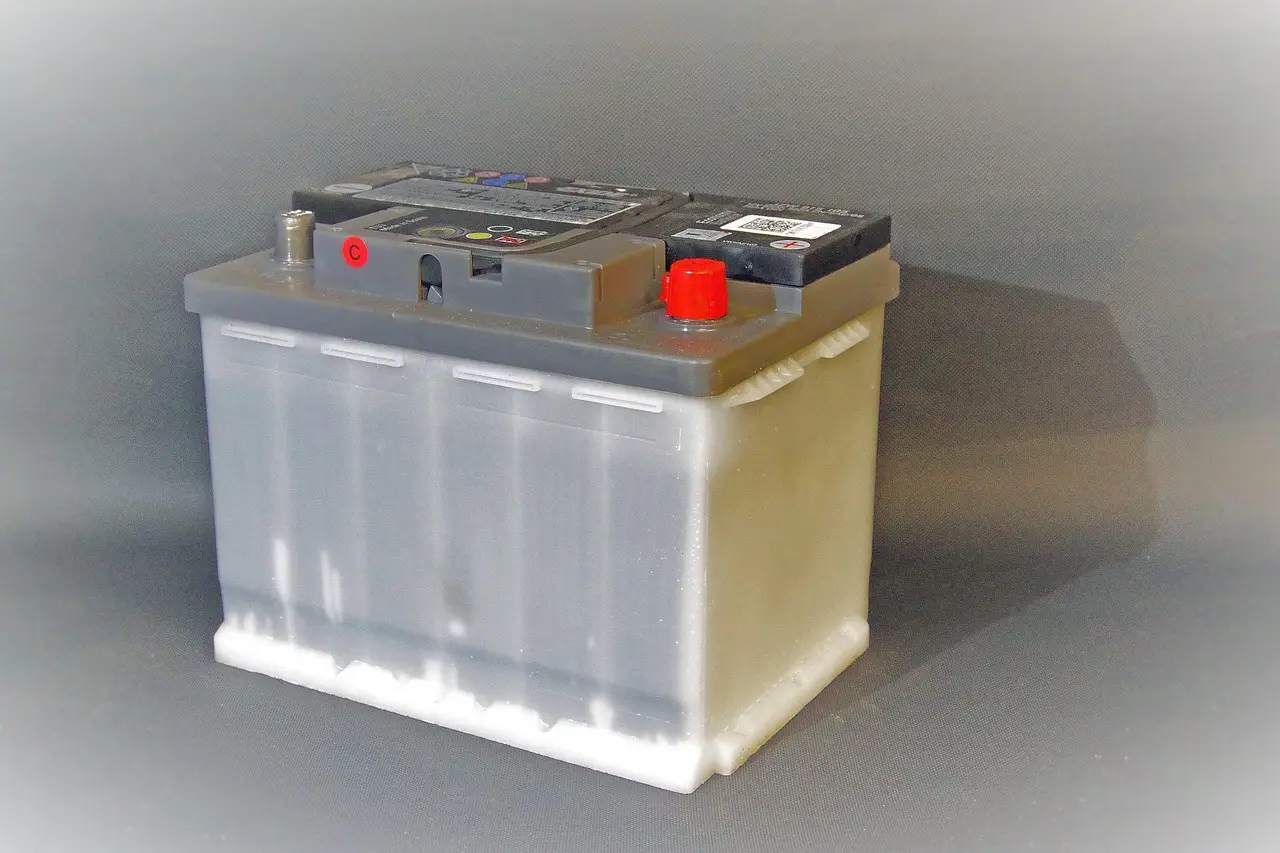
What Is a Good Car Battery Life for a Daily Driver?
A good car battery life for a daily driver is usually 3 to 5 years, but a 2-year-old battery in extreme heat or mostly short-trip use may already need testing. Ignore age and symptoms, and you risk no-starts, weak cranking, and a dead battery at the worst possible time. This guide shows how climate, driving pattern, and simple checks decide whether to keep, test, or replace it now. (Consumerreports)
Quick answer: what counts as good battery life
For most 12-volt lead-acid starter batteries, a good daily-driver life is about 3 to 5 years. That is the baseline, not a promise. If you drive in hot weather, make many short trips, or run a lot of accessories at idle, the useful life can drop to 2 to 3 years.
Daily-driver reliability matters more than the calendar alone. Most drivers expect the car to start without hesitation, so a battery that is technically “not dead” can still be too weak for dependable use. A battery that is old, slow to crank, and weak on test is due for action even if it still starts sometimes.
Hot-climate and short-trip use are the two big exceptions. Heat shortens battery life, and short trips often do not give the alternator enough time to recharge the battery after each start. That is why a battery can look fine at 24 months in one region and already be risky in another.
Why daily drivers wear batteries out faster
Daily drivers often make repeated start cycles with limited charging time. That matters because the battery loses some charge every time the engine starts, and short city trips may end before the alternator restores it fully. Over time, that shallow recharge pattern shortens service life.
Short-trip driving limits full recharge
Short-trip driving is hard on a starter battery because the engine may run only long enough to recover part of the starting draw. If your commute is a few miles, then more battery work is happening per mile than in a long highway drive. That can halve effective battery life in some use patterns.
Heat speeds internal wear
Ambient temperature matters. Heat dries out and ages internal battery parts faster, which is why hot regions often see 2 to 3 year service life instead of the longer average seen in mild weather. Cold does a different kind of damage: it does not always shorten life as fast, but it exposes weakness because starting demand rises.
Frequent accessory load adds strain at low rpm
High electrical demand at idle or low rpm also works against a battery. Heated seats, defrosters, fans, infotainment, and phone charging all pull power while the alternator is turning slowly. In stop-start and high-accessory vehicles, AGM batteries usually hold up better than standard flooded batteries.
What is a good car battery life for a daily driver?
A good car battery life for a daily driver is the point where age, climate, trip pattern, and symptoms still line up with dependable starts. Around 3 to 5 years is normal for many 12-volt lead-acid starter batteries, but a battery can be due for testing earlier if it lives in heat, takes mostly short trips, or shows weak-start symptoms.
The practical line is simple. If the battery is under 3 years old, has no symptoms, and lives in mild conditions, it is usually still normal. By 4 years, you should pay closer attention. At 5 years and beyond, a daily driver should be treated as a replace-soon item unless testing proves there is still healthy reserve.
Say your sedan is 4 years old, starts fine on cool mornings, but needs a jump after two days of sitting in summer heat. That is not “normal aging” to ignore. It is a test-now battery, because age, heat, and a sitting-loss symptom have already stacked up against reliability.
Battery types and what life to expect
Not every starter battery has the same expected life. A standard flooded lead-acid battery is the cheaper common option, but it also has the shortest lifespan among common types. AGM batteries are built for repeated charging cycles and often last longer. Lithium-ion is mostly a different conversation, because it is more relevant to EV systems than standard 12-volt starter-battery advice.
Flooded lead-acid
Flooded lead-acid batteries are common and affordable. They usually average three to five years, and hot climates can shorten that to two or three. They are more sensitive to heat than AGM batteries, so daily drivers in warm regions often see faster wear.
AGM
AGM batteries are used in start-stop and high electrical-demand vehicles. They often last slightly longer than flooded batteries, commonly 4 to 6 years, and can last up to seven years under optimal conditions. If your car has stop-start, extra electronics, or a high accessory load, AGM usually makes more sense.
Lithium-ion
Lithium-ion batteries can last 8 to 10+ years in some EV contexts, but that does not translate to ordinary 12-volt starter-battery advice. They require advanced battery management and are not the standard replacement choice for most gasoline daily drivers. Do not use EV battery expectations to judge a normal car battery.
Battery life decision table
| Battery age | What is normal | What symptoms matter | When to test | When to replace |
|---|---|---|---|---|
| 0–2 years | Starts should feel normal. Most batteries in this range are still in early life. | Repeated jump starts, clicking, or dim lights are not normal at this age. | Test if the car sits often, lives in extreme heat, or shows weak cranking. | Replace if testing shows low CCA, poor State of Health, or a charging fault. |
| 3 years | Still within the normal life range for many 12-volt lead-acid batteries. | Slow cranking, weaker headlights at idle, or a need for a jump point to aging. | Test now, especially in hot climates or if you do many short trips. | Replace if symptoms appear or the test shows reduced reserve and low SoH. |
| 4 years | Can still be serviceable, especially in mild climates or with an AGM battery. | Any hesitation at start, weak electronics after sitting, or seasonal no-starts matter now. | Test more closely before winter or before the hottest part of the year. | Replace sooner if the battery fails load test, has low SoH, or needs frequent jumps. |
| 5+ years | Past the point where a daily driver should be trusted without proof of health. | Even one symptom should be taken seriously, because failure risk rises quickly. | Test immediately if you plan to keep the car daily. | Replace now for hot-climate, cold-climate, or short-trip use unless testing is strong. |
How to tell a battery is nearing the end
Weak batteries usually show warning signs before they fail completely. Slow cranking, clicking at start, dim headlights, repeated jump starts, and electronics that act weak after sitting are all common clues. If the car feels fine one day and struggles the next, that is a warning, not a fluke.
Voltage helps, but voltage alone does not prove health. A resting reading of 12.6 to 12.8V is full resting voltage in one commonly used chart, while under 12.4V suggests trouble. Even so, a battery can show acceptable voltage and still have poor starting ability if its capacity has faded.
CCA, RC, and State of Health tell you more about remaining usefulness. Cold Cranking Amps measure starting force, and they matter most when the battery fails to crank in cold weather. Reserve Capacity shows how many minutes electronics can run if the alternator quits. State of Health is the clearest shop-level indicator; below roughly 70%, failure gets likely.
Picture a crossover that starts fine on a mild afternoon but clicks on a cold morning after sitting overnight. That pattern often points to reduced CCA rather than a dead-open battery. The battery may still read near 12 volts, yet it no longer has enough starting force for daily use.
When to test or replace before it strands you
Test at about the 3-year mark, even if the battery still starts the car. That is especially important in hot climates, after lots of short trips, or before winter. A battery that has survived 3 years in harsh use may still work, but testing is the safer decision point.
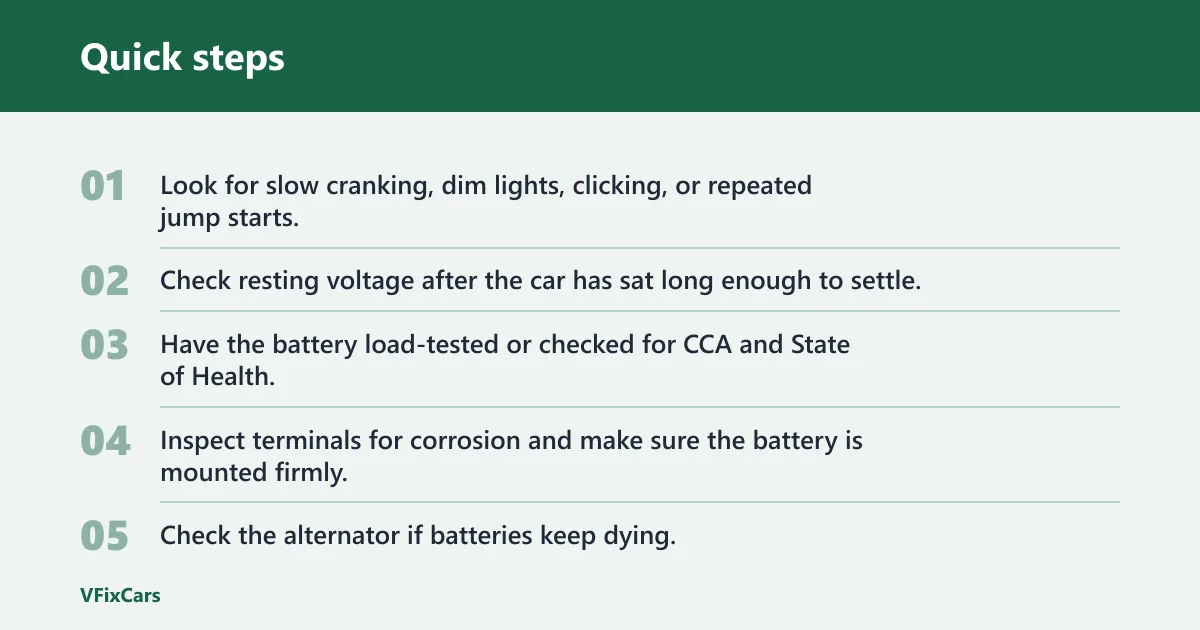
What to check first
- Look for slow cranking, dim lights, clicking, or repeated jump starts.
- Check resting voltage after the car has sat long enough to settle.
- Have the battery load-tested or checked for CCA and State of Health.
- Inspect terminals for corrosion and make sure the battery is mounted firmly.
- Check the alternator if batteries keep dying, because undercharging or overcharging can shorten battery life.
Replace sooner if symptoms appear after year 4, especially if you depend on the car every day. The cost of waiting is not only the battery itself. It can also mean towing, missed work, a jump start in bad weather, or a no-start in a parking lot when you least want it.
Keep terminal connections clean and tight. Loose mounting lets vibration work on the case and internal plates. If a battery keeps failing early, do not assume the battery alone is at fault. A parasitic drain or a charging-system fault can drain a healthy battery and make the replacement fail too soon.
Frequently asked questions
What’s the life of a car battery?
A car battery typically lasts 3 to 4 years, and many sources place the average between three and five years. Some may last up to 6 years, while others can fail in 1 to 2 years. Heat, short trips, and charging faults are the main reasons the range shifts.
How many years should a daily driver battery last?
For most daily drivers, 3 to 5 years is a good expectation for a standard 12-volt lead-acid battery. In hot climates or with frequent short trips, that can drop to 2 to 3 years. AGM batteries often last longer and are a better fit for heavier electrical use.
Is a 4-year-old car battery still good?
It can be, but it deserves close attention. A 4-year-old battery in a mild climate with strong test results may still be dependable. In hot weather, on short trips, or if it has shown slow cranking or jump-start history, it should be tested and watched closely.
Does short-trip driving kill a car battery faster?
Yes. Short-trip driving limits how long the alternator has to recharge the battery after each start. Over time, that pattern can shorten battery life and leave the battery undercharged. City driving, long idling with accessories on, and frequent restarts all add to the strain.
How does hot weather affect car battery life?
Heat shortens battery life by speeding internal wear. In hot regions, a battery that might last 3 to 5 years in mild weather may last only 2 to 3 years. Heat also makes a weak battery more likely to fail suddenly after sitting or during high electrical load.
How do I know if my car battery is near the end?
Watch for slow cranking, clicking, dim headlights, repeated jump starts, or weak electronics after the car sits. Resting voltage under 12.4V suggests trouble, but voltage alone is not enough. A load test, CCA check, or State of Health reading gives a better answer.
When should I replace a car battery before it dies?
Replace it when it is 5 years old or older and you rely on the car daily, unless testing shows it is still strong enough. Replace sooner if it shows weak-start symptoms after year 4, especially in hot weather, cold weather, or short-trip driving. Testing around year 3 is smart.
Do AGM car batteries last longer than standard ones?
Usually, yes. AGM batteries often last 4 to 6 years and can reach up to seven years under optimal conditions. They handle repeated charging cycles better than flooded batteries, which makes them a better fit for stop-start systems and higher accessory loads.