Are Floor Mats Worth It for Your Car?
Yes—floor mats are worth it if you face rain, snow, mud, sand, kids, pets, or frequent spills; for a dry commuter on a tight budget, a basic set is enough, and a good mat set usually costs far less than repairing stained carpet. Ignore them, and carpet can hold odors, stains, and wear that are harder to fix than prevent. This guide breaks down the value test by driving conditions, cleaning effort, and budget so you can decide fast.
Verdict: are floor mats worth it?
For most drivers, yes. Floor mats earn their keep when your footwell sees moisture, grit, or repeated wear often enough that cleaning time and carpet damage would cost more than the mats. If your car stays dry and clean, the return is smaller, and a basic set is usually enough.
When the purchase pays off
Floor mats take the abuse from mud, dust, and snow before it reaches the carpet. That matters most if you track in wet shoes, carry kids or pets, park outdoors, or live where winter salt and slush are part of the routine. They also help keep resale presentation cleaner by limiting visible wear and staining.
Buy better mats when the footwell is a repeat problem, not a rare one. A more expensive liner makes sense when the floor is likely to get dirty enough that you would otherwise spend more time cleaning or accept more carpet wear.
When you can skip it
If your car sees little more than dry pavement and clean shoes, a full premium set is often unnecessary. In that case, a low-cost universal mat or the factory carpet mat can be enough, especially if you already vacuum the interior often and do not care much about resale presentation.
Floor mat value matrix
This table weighs three things: protection, cleaning effort, and likely payoff. It is not a one-size-fits-all ranking. It is a fast way to see whether a cheap mat, a better universal set, or a custom-fit liner makes sense for your driving pattern.
| Scenario | Protection | Cleaning effort | Likely payoff | Verdict |
|---|---|---|---|---|
| Dry commuter | Low | Low | Low | Skip or choose budget universal |
| Rainy climate | Medium | Medium | Medium | Budget universal |
| Snowy climate | High | Medium | High | Custom-fit premium |
| Pet owner | Medium | Medium | Medium | Budget universal or custom-fit premium |
| Kid-hauler | High | High | High | Custom-fit premium |
| Lease return | High | Low | High | Custom-fit premium |
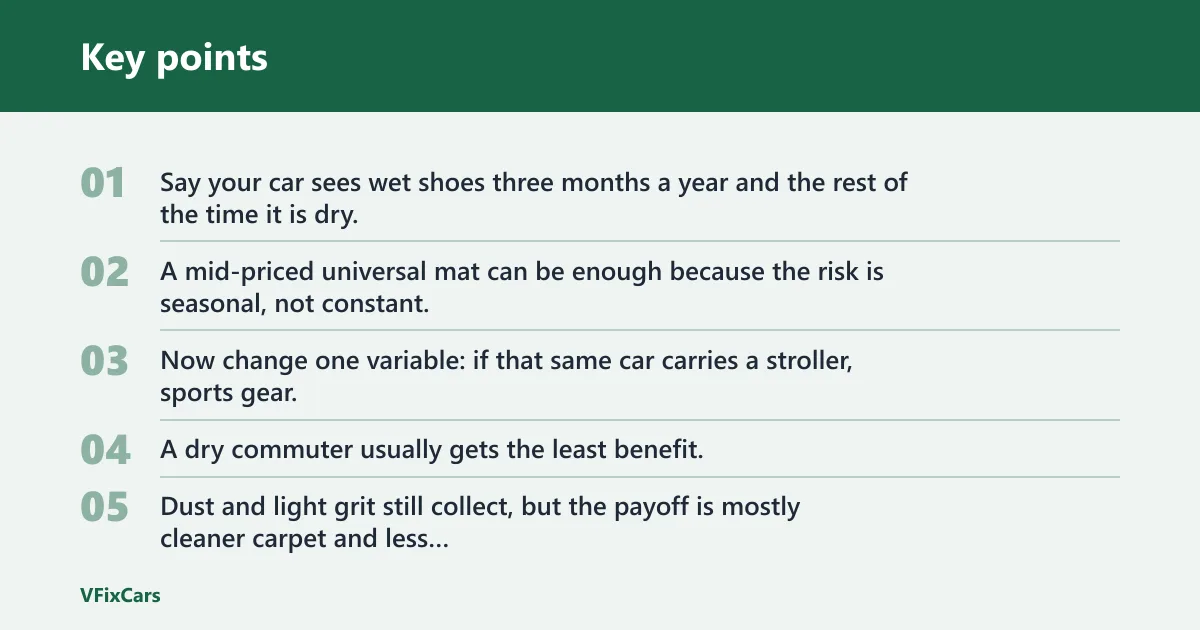
Say your car sees wet shoes three months a year and the rest of the time it is dry. A mid-priced universal mat can be enough because the risk is seasonal, not constant. Now change one variable: if that same car carries a stroller, sports gear, and snack spills every week, the case for a better liner becomes much stronger.
Dry commuter
A dry commuter usually gets the least benefit. Dust and light grit still collect, but the payoff is mostly cleaner carpet and less vacuuming. If your car is older, inexpensive, and not headed for a careful resale, a basic universal set is usually enough.
Rainy climate
Rain brings wet shoes, damp umbrellas, and more grime on the heel point. Here, floor mats start making real sense because moisture is harder on carpet than dry dust. Rubber mats are the better fit for this use case because they are waterproof, moisture-resistant, and easier to hose off or clean with soapy water.
Snowy climate
Snow is where mats move from convenience to practical defense. Meltwater, road salt, and slush can soak into carpet fast, then leave stains and odor. This is where custom-fit liners often justify their cost because they cover more of the floor pan and sidewalls than universal mats.
Pet owner
Pets add hair, dirt, and occasional spills from water bowls or muddy paws. The benefit depends on how often your pet rides along. If the trips are frequent, a liner with raised edges and good coverage saves time. If rides are rare, a cheaper mat is usually enough.
Kid-hauler
Kids are hard on interiors. Crumbs, juice, sand, and shoe scuffs all land in the same place. The hidden cost is cleaning time, because carpet mats need deeper cleaning than rubber mats. For this use case, higher-coverage custom-fit mats usually pay off faster than a cheap set.
Lease return
Lease returns make floor mats more valuable because wear, stains, and odor can become money at turn-in. A good set can help keep the footwell presentable and reduce cleanup before inspection. In this case, spending more on fit and coverage often makes more sense than saving a little up front.
Pros and cons of floor mats
Floor mats are useful because they reduce damage and make cleanup simpler. They are not magic, though. Fit problems, cheap materials, and poor coverage can cancel much of the benefit, especially if the mat bunches up, slides, or leaves the heel area exposed.
What you gain
- Less carpet wear from mud, dust, snow, and spills.
- Less vacuuming and fewer deep-clean sessions.
- Better protection against stains, odor, and salt residue.
- Cleaner interior presentation when the car stays cleaner underneath.
- More coverage with custom-fit liners than with many universal mats.
What you give up
- Up-front cost, especially for premium liners.
- Possible fit issues with universal mats.
- More cleaning time for carpet mats than for rubber mats.
- Risk of sliding or bunching if the mat lacks proper backing or shape.
- Extra bulk in some vehicles if the mat is too thick or too tall at the edges.
A common first-timer mistake is buying a cheap universal mat that looks fine on the shelf but leaves the heel wear spot exposed. Another is picking a thick mat that seems secure at first, then curls or shifts under braking because it was not shaped for that footwell.
Which mats fit your car?
Universal mats are cheaper and can often be trimmed to fit, but custom-fit floor liners are made for a specific make, model, and year. The fit gap matters because better coverage protects more carpet and lowers the chance of sliding or bunching. OEM mats sit between those two in price and fit, depending on the vehicle.
Universal mats
Universal mats are the budget choice. They usually cost less, and many can be trimmed to fit. The tradeoff is less precise coverage, which can leave edges exposed or create a fit that never feels fully settled. They make sense when the car is low-risk or the budget is tight.
Custom-fit floor liners
Custom-fit liners are the better answer when coverage matters. They are often laser-measured or vehicle-specific, and they usually cover more of the floor pan and sidewalls than universal mats. That extra shape is what helps them work better in snow, slush, pet use, and lease return situations.
OEM mats
Automakers may offer floor mats as a factory option, but third-party providers can often save money. OEM mats can be a clean choice if you want a known fit and a simple install. They are not always the best bargain, though, and they are not always the most protective option either.
Rubber or carpet mats?
Rubber mats are the stronger choice for wet shoes, mud, snow, and quick cleanup. Carpet mats look more finished and feel more plush, but they need deeper cleaning and are less ideal for heavy wet debris. If your footwell stays dry, carpet can be fine. If not, rubber is usually smarter.
Rubber mats for wet and messy use
Rubber mats are described as waterproof and more durable than carpet. They are also easier to clean because you can remove them and spray them off with soapy water. That matters when dirt is mixed with moisture, which is exactly when carpet starts becoming a maintenance problem.
Carpet mats for lighter use
Carpet mats work better when the car is mostly dry and the goal is a cleaner, more finished look. They still catch dust and light grit, but they are weaker against wet debris. Once moisture gets into the fibers, cleaning time rises quickly.
How cleaning time changes the choice
Cleaning is part of the cost. Rubber mats can be rinsed, dried, and put back in service quickly. Carpet mats often need vacuuming, scrubbing, and more drying time. Premium stitched liners sit in between on appearance, but their main advantage is coverage, not faster cleaning.
Who should buy them?
Buy mats if your driving pattern creates repeated dirt, moisture, or wear. Skip the upgrade if your footwell stays dry and your budget is better spent elsewhere. The right choice depends less on the car itself and more on how the car is used.
Low-risk drivers
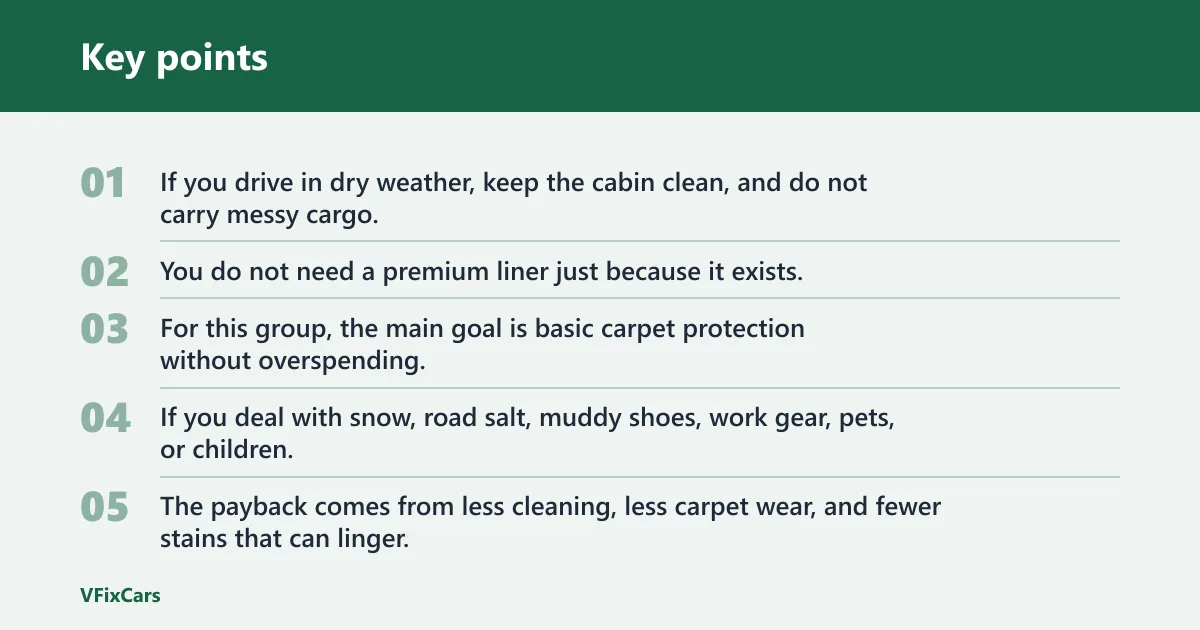
If you drive in dry weather, keep the cabin clean, and do not carry messy cargo, a budget mat is usually enough. You do not need a premium liner just because it exists. For this group, the main goal is basic carpet protection without overspending.
High-risk drivers
If you deal with snow, road salt, muddy shoes, work gear, pets, or children, better mats are worth more. The payback comes from less cleaning, less carpet wear, and fewer stains that can linger. These drivers are the best match for custom-fit floor liners with raised edges.
Lease and resale focused owners
If you care about turn-in condition or future resale, floor mats are a practical buy. They do not guarantee a higher price, but they can help keep the interior presentable and reduce visible wear. That is enough to justify them for many leased or late-model vehicles.
Suppose a three-year-old SUV is due to be returned at lease end. A liner that traps slush and sand in winter can save the floor carpet from visible scuffs. Change one variable: if the same SUV is a garage-kept weekend vehicle, that same premium set may be more than you need.
What is the best brand of car floor mats?
The best brand depends on use case, not brand name alone. WeatherTech FloorLiners are a strong premium pick for vehicle-specific fit and coverage. TuxMat suits owners who want maximum coverage. BDK All-Weather Rubber Floor Mats are a budget pick when you want basic moisture protection at a low price.
WeatherTech FloorLiners
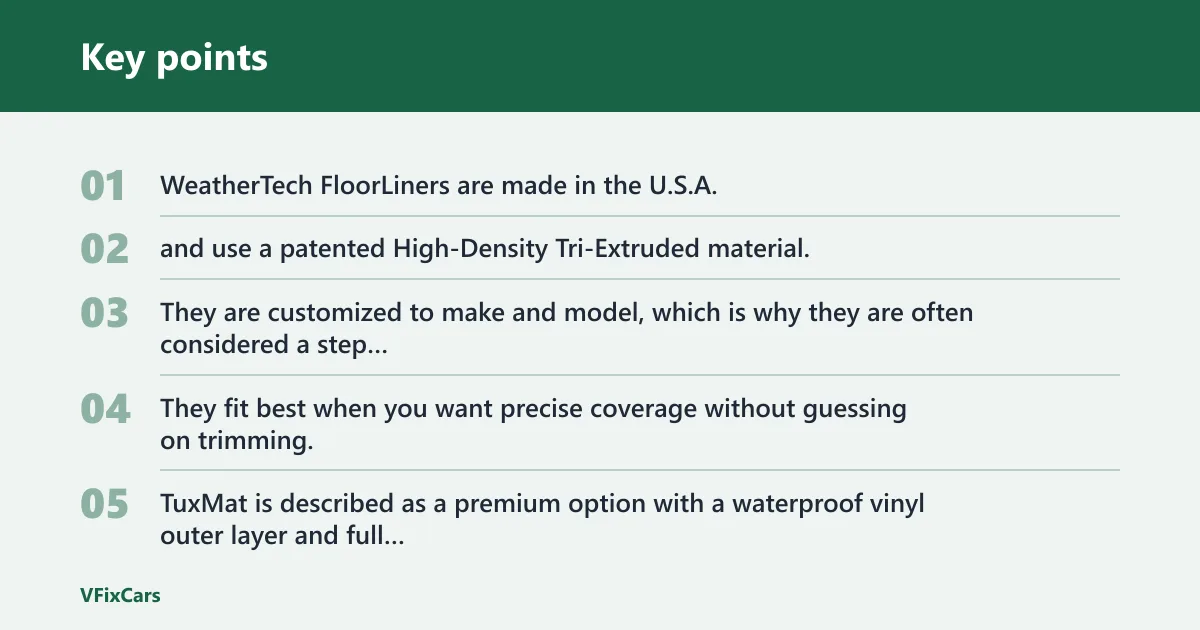
WeatherTech FloorLiners are made in the U.S.A. and use a patented High-Density Tri-Extruded material. They are customized to make and model, which is why they are often considered a step above regular floor mats. They fit best when you want precise coverage without guessing on trimming.
TuxMat
TuxMat is described as a premium option with a waterproof vinyl outer layer and full coverage, including sidewalls. In Car and Driver’s test, it provided the most comprehensive interior coverage. That makes it a strong choice for messy weather, family use, and drivers who want maximum footwell protection. (Caranddriver)
BDK all-Weather Rubber Floor mats
BDK All-Weather Rubber Floor Mats are the budget option here. Road & Track listed them at $25 in one review and described them as PVC mats designed to resist moisture and stains. They make sense when you want a low-cost answer and do not need premium fit or coverage.
Frequently asked questions
Are floor mats worth it for your car?
Yes, if your car sees rain, snow, mud, sand, kids, pets, or regular spills. In those cases, mats reduce carpet wear and cleanup time. If your driving is dry and low-risk, a basic set is usually enough and a premium upgrade may not pay back.
Are car mats worth it?
Usually, yes. They help protect the footwell carpet from dirt and moisture, and they can keep the cabin easier to maintain. The return is strongest when you drive in messy conditions or want to keep the car presentable for resale or lease return.
Which mats are best for a car?
The best mats are the ones matched to your use case. Rubber mats are better for wet and messy use. Carpet mats suit light-duty, dry interiors. Custom-fit liners are best when you want more coverage, while universal mats are fine for lower-risk drivers.
Do floor mats actually protect resale value?
They can help, but not by a fixed amount. By reducing stains, wear, and odor risk, they help keep the interior in better shape. That makes the car more presentable and can support resale value, especially if the footwell would otherwise take regular abuse.
How much better are premium mats than cheap universal mats?
Premium mats are better when fit and coverage matter. Cheap universal mats can be enough for dry, low-risk use, but they often cover less area and may shift or bunch. Premium liners cost more because they usually fit better and protect more of the floor pan.