Why Are Car Floor Mats So Expensive?
Car floor mats cost more when fit is tied to a specific vehicle, the material is thicker or finished better, coverage reaches farther, and the shape needs deeper molding or more tooling. Cheap mats can slide, curl, or leave pedals and carpet exposed, so the real cost often shows up later as early replacement or damaged flooring. This guide breaks down the four price drivers so you can judge when a higher price is worth it and when a universal set is enough.
Why car floor mats cost more than you expect
The price gap usually comes from four places: fit precision, material choice, coverage area, and manufacturing complexity. A simple universal mat can be stamped or cut for many vehicles, while a vehicle-specific set needs its own pattern, deeper contours, and often more molding around anchors, footwells, and dead pedals.
That is why a set that looks similar online can land in very different price bands. The cheapest car floor mats can start around $10, universal mats can cost around $20 or less, mid-range sets may fall around $20 to $70, and expensive floor mats may start at $70 and reach $500.
The four cost drivers
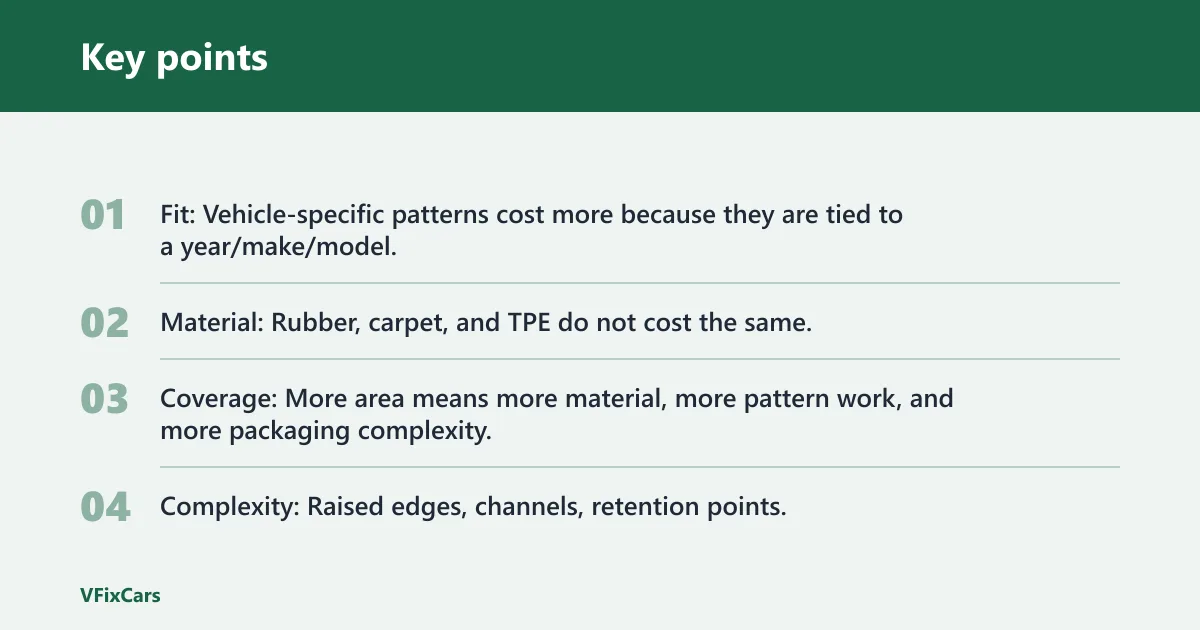
- Fit: Vehicle-specific patterns cost more because they are tied to a year/make/model, and often to front, rear, cargo, or third-row layouts.
- Material: Rubber, carpet, and TPE do not cost the same, and the same-looking set can price very differently once thickness, finish, and molding change.
- Coverage: More area means more material, more pattern work, and more packaging complexity.
- Complexity: Raised edges, channels, retention points, and left-hand/right-hand drive variations add tooling and production cost.
What the price bands usually look like
Entry-level mats often focus on basic coverage and simple fit. Midrange sets usually add better edge control, stronger attachment points, or a more exact shape. Premium mats often focus on vehicle-specific fit, deeper channels, and a cleaner look, while custom luxury sets can go much higher when the design is tied to a specific cabin layout.
Custom-fit vs. universal mats
Custom-fit mats cost more because they are made for a specific vehicle, often using year/make/model inputs and digital-fit or laser-scanned patterns. Universal mats are cheaper because one design is meant to work across many vehicles, but that broader fit often means less coverage, weaker consistency, and more trimming or adjustment.
Vehicle-specific patterns and why they cost more
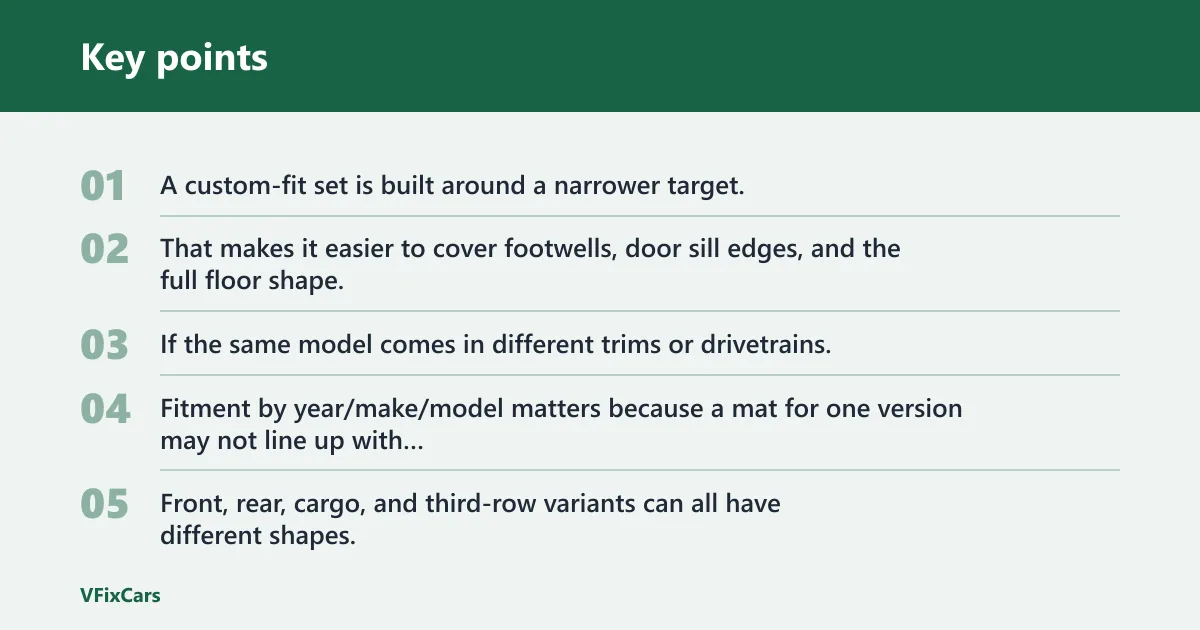
A custom-fit set is built around a narrower target. That makes it easier to cover footwells, door sill edges, and the full floor shape, but it also means the maker has to create and maintain more patterns. If the same model comes in different trims or drivetrains, the pattern library gets more complicated.
Fitment by year/make/model matters because a mat for one version may not line up with another. Front, rear, cargo, and third-row variants can all have different shapes, and compatibility limits matter when a vehicle changes floor layout across trim levels.
Trim-to-fit designs and where they save money
Trim-to-fit and one-size designs save money because they avoid vehicle-specific tooling. They are useful when you want low upfront cost, quick replacement, or a temporary solution for a work vehicle, second car, or rental-like use.
The tradeoff is fit consistency. A mat that is “close enough” can still leave exposed carpet, bunch near the pedals, or shift during use if the retention hardware is generic or absent.
Fit problems that can erase the savings
Cheap mats can save money on day one and cost more later if they curl, slide, or wear through early. The biggest failure case is a mat that interferes with accelerator, brake, or clutch travel. That is not a cosmetic issue; it is a compatibility problem.
Picture a compact sedan owner buying a universal front set for less money. The driver-side mat covers the footwell loosely, but the front edge lifts after a few weeks, and the loose corner starts creeping toward the pedals. The “cheap” set is now a safety concern and may need replacement.
Are all-weather mats worth the higher price?
All-weather mats are usually priced higher because they are built for rain, snow, mud, and spills, often with rubber or thermoplastic elastomer construction and raised edges or channels. For drivers who regularly bring water, grit, or debris into the cabin, the cleaning time saved can justify the premium.
Rubber and TPE as common all-weather materials
Rubber is common because it is easy to rinse clean and handles messy conditions well, though new-product odor can be an issue with some sets. TPE is a premium liner material used in many custom all-weather products because it can be durable and form-fitting without feeling like a basic flat mat.
That material difference is one reason price jumps even when two mats appear similar in photos. TPE sets often need more precise molding, and rubber sets may still need deeper edge shaping or more complex molds than a simple carpet mat.
Raised edges, channels, and spill control
Raised edges and channels are not decoration. They help hold slush, spilled drinks, melted snow, and dirt in the tray instead of letting it run into the carpet. That design adds material, mold depth, and more demanding quality control.
For a commuter in a dry climate, that extra structure may be wasted. For a family hauling sports gear, a dog, or wet boots, it can be worth paying for because cleanup becomes faster and the original carpet stays cleaner longer.
Cleaning effort versus long-term value
All-weather mats often cost more up front but less in cleanup time. Carpet mats look more like factory trim, but they are harder to clean when stained and can hold onto dirt once spills soak into the fibers.
Suppose a crossover sees kids, a stroller, and weekly grocery runs. A TPE liner with high edges in the front row and cargo area may cost more than carpet, but it can keep residue out of the pile and reduce the need for deep cleaning.
Carpet mats, rubber mats, and TPE liners
Carpet mats are the softer, more OEM-like option and are often cheaper than all-weather mats. Rubber mats are the plain workhorse choice for rinse-clean care. TPE liners sit near the premium tier because they combine vehicle-specific shaping with a more finished all-weather design.
Carpet mats and OEM-style appearance
Carpet mats are common as factory-style replacements and work well when appearance matters more than heavy-duty cleanup. They usually cost less because the material is simpler and the shape is less demanding than a deep-tray liner.
The drawback is stain control. Once grime, coffee, or road salt gets into carpet fibers, cleaning takes more effort than with a hose-off mat.
Rubber mats and simple rinse-clean care
Rubber mats are popular because they are practical. They are often used in all-weather sets and usually do not need special products for routine cleaning. That lower maintenance cost is part of the value, even when the purchase price is above a basic carpet set.
TPE liners and why they sit near the premium tier
TPE liners are often custom-fit and can cost more because they combine material cost with vehicle-specific pattern work. They are designed to hold shape, cover more of the floor contour, and resist messy use without looking like a plain utility tray.
That is why they often land in the premium range even before you add cargo or third-row coverage. The price reflects fit precision as much as the material itself.
Floor mat value calculator
The table below is a quick buyer tool. Use it to separate the features that deserve more money from the features that are mainly cosmetic or convenient.
| Fit type | Material | Coverage area | Vehicle specificity | Expected cleaning effort | Likely price tier |
|---|---|---|---|---|---|
| Universal | Carpet | Front only | Low | Moderate to high | Entry-level |
| Universal | Rubber | Front and rear | Low | Low | Low to midrange |
| Trim-to-fit | Rubber or PVC | Front, rear | Low to medium | Low | Midrange |
| Custom-fit | Rubber or TPE | Front, rear, cargo | High | Low | Midrange to premium |
| Custom-fit | TPE | Front, rear, third row | High | Low | Premium |
| Custom-fit | Carpet with bound edges | Front, rear, cargo, seatback | High | Moderate | Premium to luxury |
When to pay more
- Choose custom-fit when you want maximum protection and your vehicle has unusual floor contours, a third row, or cargo use.
- Pay for TPE or all-weather rubber when mud, snow, spills, pets, or kids are part of normal use.
- Pay for better retention if the mat must stay locked in place under hard braking or frequent entry and exit.
- Pay for cargo, seatback, or third-row pieces when the back of the vehicle sees regular use and cleanup matters.
When to save
Save money if the vehicle is a beater, the cabin sees light use, or the mat will be replaced often anyway. A universal set can make sense for a short-term solution, a second vehicle, or a driver who mainly wants basic dirt control and does not need exact coverage.
What makes one set $20 and another $200?
The price jump usually comes from tooling, fit development, and coverage, not from the name on the package alone. A $20 set can be a simple universal design, while a $200 set may be built around a specific vehicle, deeper molding, better anchors, and wider coverage across multiple rows.
Tooling and pattern development
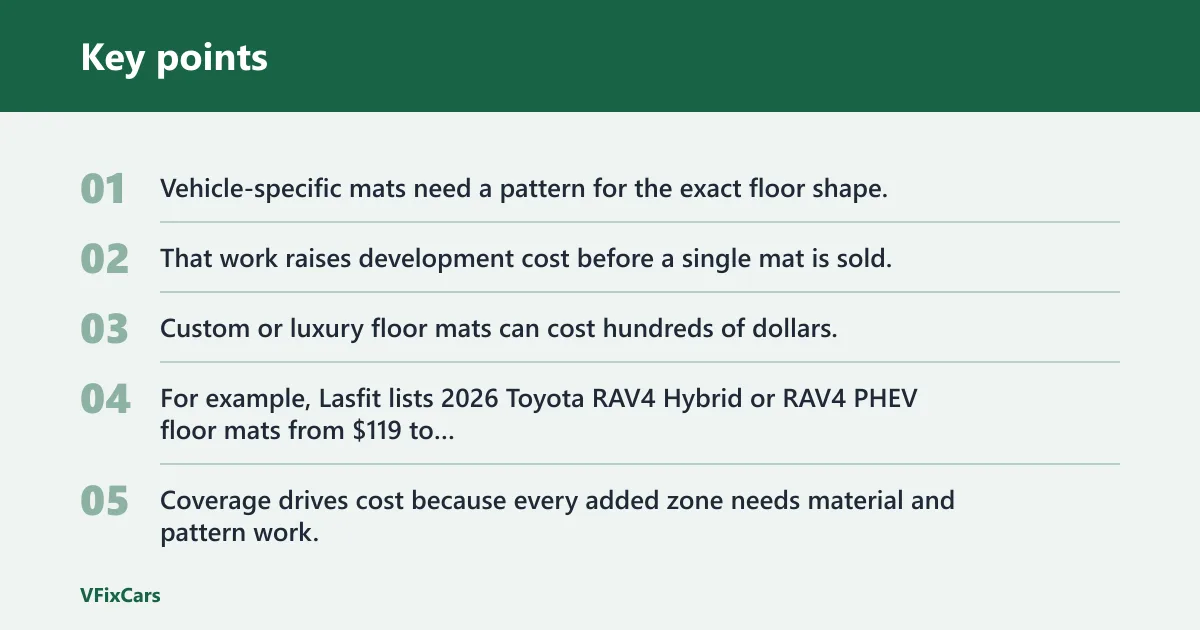
Vehicle-specific mats need a pattern for the exact floor shape, and that pattern may need revision when a model changes trim, drivetrain, or row count. That work raises development cost before a single mat is sold.
Custom or luxury floor mats can cost hundreds of dollars, and custom exact-fit sets can run much higher when the maker supports a narrow vehicle application. For example, Lasfit lists 2026 Toyota RAV4 Hybrid or RAV4 PHEV floor mats from $119 to $199, 2025-2026 Toyota 4Runner floor mats from $75 to $219, and 2024-2026 Toyota Tacoma all-weather floor mats at $139.
Coverage area: front, rear, third row, cargo, and seatback
Coverage drives cost because every added zone needs material and pattern work. A front-row set may be simpler than a package that includes additional rear, cargo, or seatback pieces.
That is why price often climbs with family vehicles, SUVs, and trucks. More pieces means more mold features, more packaging, and more chances for compatibility limits between trims.
Pedal clearance, retention clips, and other fit checks
Safety-related fit checks matter because a mat that blocks pedal travel is not usable. The driver-side piece should clear the accelerator, brake, and clutch area, and retention clips should help keep the mat from shifting while driving.
That is one hidden reason some expensive mats are worth paying for. Better fit control reduces the chance of curling edges, bunching, and movement that can create a problem later.
Left-hand and right-hand drive variations
Left-hand/right-hand drive differences add complexity because the driver footwell is mirrored. A maker that supports both layouts needs separate patterns, which raises development and inventory cost.
A common first-timer mistake is buying by vehicle name alone and skipping the exact trim or drive-side check. That can lead to a mat that almost fits, then interferes with the pedal area or leaves a gap near the seat rail.
Frequently asked questions
Why are car floor mats so expensive?
They cost more when the set is built for a specific vehicle, uses heavier or more refined material, covers more floor area, or needs deeper molding and more tooling. The price often reflects fit accuracy and added coverage, not only the raw material in the box.
How much do car floor mats cost?
Prices range widely. The cheapest car floor mats can start around $10, universal mats can cost around $20 or less, mid-range sets may fall around $20 to $70, and expensive floor mats may start at $70 and reach $500. Some custom sets can cost hundreds of dollars.
Are custom-fit floor mats worth paying more for?
They are worth it when you need maximum coverage, a cleaner fit, or protection around complex floor shapes, cargo areas, or third rows. They are less useful if the vehicle sees light use and a low-cost universal set already stays put without interfering with pedals.
What makes one floor mat set cost $20 and another cost $200?
The difference usually comes from fit precision, material, coverage, and tooling. A budget-priced set is often universal and simple. A $200 set may be custom-fit, use TPE or thicker rubber, include more rows or cargo coverage, and require more detailed pattern development.
What are the best floor mats for your car?
The best choice depends on use, not price alone. For wet, muddy, or family use, all-weather custom-fit mats usually make the most sense. For dry-weather commuting or light use, a carpet or universal set can be enough if it stays in place and clears the pedals.
Why are car mats so expensive?
Car mats get expensive when they are made for a specific vehicle, include more than the front row, or use materials and mold shapes that cost more to produce. Extra price is often tied to fit control, retention, and coverage rather than appearance by itself.