Why Do Car Seats Expire?
Car seats expire because plastic, foam, straps, labels, and replacement parts age, and many seats also reach a manufacturer-set limit, often 6 to 10 years from the build date. Using an expired, damaged, or crash-used seat can reduce protection, throw the restraint parts out of spec, and make recalls or installation guidance harder to verify. This guide shows how to find the expiration date, judge a used seat, and decide when to replace it.
What car seat expiration means
A car seat expiration date is the manufacturer’s service limit, not a guess based on how clean the seat looks. Most car seats expire 6 to 10 years after manufacture. The exact rule belongs to the seat’s manual or label, and that rule can be month/day/year or years after manufacture.
Manufacturer service life versus seat age
Two seats can be the same age and still have different service limits. One model may stop at 6 years, while another from the same brand may be allowed longer use. The printed rule matters more than assumptions, because the manufacturer decides how long that model stays within its intended service life.
Expiration is not the same as recall action
An expired seat is past its service limit. A recalled seat has a separate safety notice that may call for repair, replacement, or inspection. Check both. A seat can be current by date and still need recall action.
Why do car seats expire?
Car seats expire because the parts that protect a child do not age forever. Sun, heat, humidity, and cold can weaken car seat plastic, and wear can affect straps, buckles, foam, and labels. The shell may crack, the restraint webbing may stretch or fray, and missing markings can make it harder to verify the correct use.
Different parts fail in different ways
The shell is the main structure, so cracking, brittleness, or warped mounting points are serious. Webbing can fray or lose smooth movement through the adjuster. Buckles can stick, fail to latch cleanly, or become sluggish after years of dirt and wear. Foam and padding can break down, but the shell and straps usually matter most for safety.
Labels and manuals also age out
If the label is torn, faded, or missing, you may not be able to confirm the date of manufacture, model, or installation rule. That is a real problem, not cosmetic damage. A seat with unreadable labeling is harder to verify and may be unsafe to keep in service if the expiration date cannot be confirmed.
How to find the expiration date
Look on the seat itself first. The date of manufacture is often on the bottom, side, back, or base, and the expiration date may be printed on the shell, label, underside, or in the manual. If the seat does not list a direct expiration date, the date of manufacture is used to calculate it.
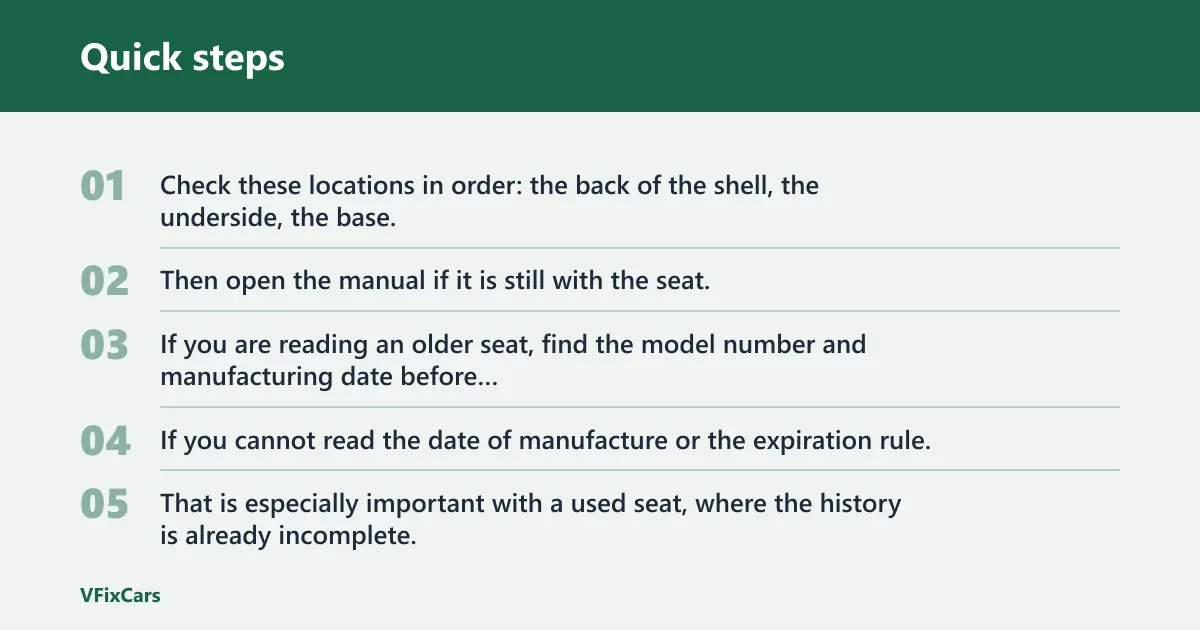
Where to look first
Check these locations in order: the back of the shell, the underside, the base, and the side label. Then open the manual if it is still with the seat. If you are reading an older seat, find the model number and manufacturing date before assuming anything about lifespan.
What if the label is missing or unreadable?
If you cannot read the date of manufacture or the expiration rule, treat the seat as difficult to verify. That is especially important with a used seat, where the history is already incomplete. Missing labels, worn stickers, or a lost manual remove the evidence you need to judge whether the seat is still usable.
Practical example
Say your booster seat is only 5 years old, but the sticker on the back has peeled off and the manual is gone. The plastic may still look fine, yet you cannot confirm the model, the expiration rule, or whether the seat is current. That is a verify-before-use problem, not a clean-looking-seat problem.
Why do car seats expire after 6 years?
Some seats use a 6-year service limit because the manufacturer sets a shorter window for that design, materials package, and testing plan. The seat may still look intact, but the rule still controls use. The manual is the final word, not a general guess about how long all seats should last.
Shorter limits are model-specific
A shorter limit does not mean every seat is unsafe at year 6. It means the maker will not support use beyond that point for that model. Seats with more frequent wear points, more exposed materials, or older design assumptions may have shorter approved service lives.
What changes over time
Sun, heat, humidity, and cold can weaken car seat plastic. Repeated tightening can also stress the belt path, buckle, and shell edges. Even if no single part breaks, age can change how the seat fits, locks, and holds a child during a crash.
Why do car seats expire after 10 years?
Some seats are approved for longer use because the manufacturer has set a 10-year limit for that model. A longer limit does not mean the seat is immune to wear. It only means the maker allows a longer service window if the seat has no crash history, no missing parts, and no damage.
Longer life still depends on condition
An 8-year-old seat that is clean and complete may still be usable if the printed rule allows it. But a 10-year limit does not override cracked plastic, frayed straps, missing inserts, or a crash history. Condition and history still matter.
When a longer date still fails the check
Suppose an all-in-one seat is 9 years old and still within its date, but one strap is twisted, the chest clip is missing, and the base has a hairline crack. The printed date does not rescue those defects. The seat should be replaced because the parts are no longer trustworthy.
Used seat safety checklist
Used and secondhand car seats are only worth considering when the full history is known and every required part is present. The seat must not be expired, must have no crash history, and must still include labels, inserts, and the correct hardware. If any of that is missing, the risk rises fast.
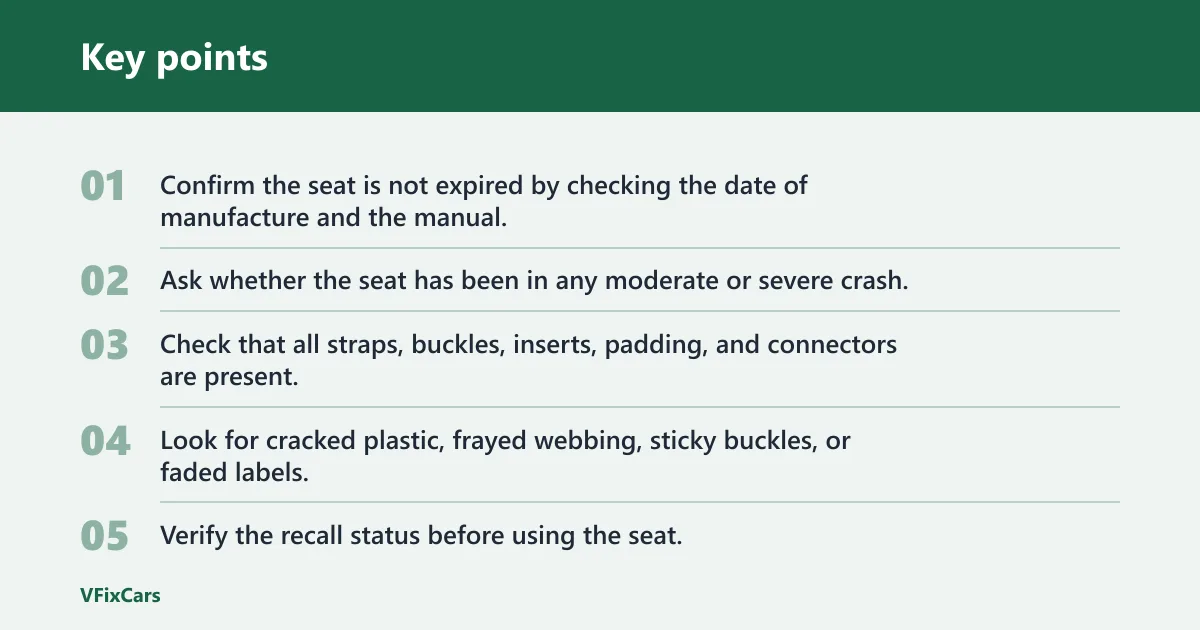
- Confirm the seat is not expired by checking the date of manufacture and the manual.
- Ask whether the seat has been in any moderate or severe crash.
- Check that all straps, buckles, inserts, padding, and connectors are present.
- Look for cracked plastic, frayed webbing, sticky buckles, or faded labels.
- Verify the recall status before using the seat.
A clean shell does not tell you whether the restraint webbing was overstressed, whether the label is missing, or whether a recall applies. The history has to be known, not guessed.
Car seat expiry table
Expired or Still Usable?
| Seat age | Visible condition | Crash history | Action |
|---|---|---|---|
| Under 6 years | Missing labels or unreadable date | Unknown | Verify first; do not use until the model and date are confirmed |
| 8 years | Pristine shell, full parts, clear labels | None known | Verify against the manual; usable only if still within the model’s limit |
| Any age | Looks clean but history is incomplete | Unknown used-seat history | Discard or replace now; unknown history is not acceptable |
| Any age | No obvious damage after a crash | Moderate or severe crash | Replace now, even if it still looks intact |
Why do car seats expire after an accident?
Car seats may need replacement after a crash because the shell, straps, or anchor points can be stressed in ways you cannot see. NHTSA says a car seat should be replaced after a moderate or severe crash. Manufacturer guidance can be stricter than general crash advice, so the seat manual still matters.
Why visible damage is not the full story
A crash can leave the outside looking normal while internal stress has already changed the way the seat performs. That is why a seat does not need a cracked shell to be unsafe after a serious impact. If the crash was moderate or severe, replacement is the safer call.
Minor crash rules can still differ
Some manufacturers give narrower rules than general guidance for small crashes. That means a “minor” crash does not automatically clear the seat. Check the manual or manufacturer guidance before putting the seat back into service.
What are car seat expiration dates for?
Expiration dates give the seat a clear stop point for service life. They help account for wear, changing rules, recalls, and testing limits. They also keep parents from relying on a seat whose parts, labels, or support status are no longer reliable enough to verify quickly.
Why the date is printed or calculated
Some seats print the expiration date directly. Others print the date of manufacture, and the manual tells you how long the seat lasts. That difference matters because a seat may use a month/day/year format or a years-after-manufacture rule, depending on the model.
Why do car seats expire but not seat belts?
They are not treated the same because they are different systems with different service rules. A car seat has plastic shells, straps, labels, and often removable bases or inserts that age as a unit. Seat belts can also need replacement after damage, wear, or certain crashes, so they are not immune to aging either.
Different parts, different replacement logic
A child seat is a child-restraint system with its own testing and manufacturer limits. A vehicle seat belt is part of the car’s restraint system and is replaced or inspected when damaged, worn, or affected by a crash. The absence of a printed expiration date on a belt does not mean it can never need replacement.
What should I do with an expired car seat?
Do not keep using an expired seat, and do not donate or sell it. Cut the straps, remove the fabric cover, mark the seat as not for use, and follow local trash or recycling rules. Because local recycling, trade-in, and take-back rules vary widely, check what is allowed in your area before choosing a disposal option.
Simple disposal steps
- Remove the child from the seat and clear out loose accessories.
- Cut the restraint straps so the seat cannot be reused.
- Remove the fabric cover and any soft inserts.
- Write “do not use” on the shell in a visible spot, as a common disposal step.
- Dispose of it through trash or a local recycling program, as allowed.
Check recall status before you decide
Before replacing or disposing of an older seat, check whether it is under recall. If you do not have the registration card, use the model number to check NHTSA or the manufacturer website. A recall may change the next step, even if the seat is not yet expired.
Do car seats expire for babies and children?
Yes. The expiration rule applies to infant, convertible, and all-in-one seats, though the exact date varies by model. Infant seats are usually used from birth to 22-35 pounds, convertible seats should stay rear-facing until they reach the seat’s rear-facing height or weight limit, and all-in-one seats can move through more than one mode.
That means the child may outgrow the seating mode before the seat expires, or the seat may expire while still physically usable. The printed service limit still applies either way. The age of the child does not extend the date on the shell or manual.
Frequently asked questions
How do I know if my car seat is expired?
Look for the date of manufacture and the expiration rule on the seat, base, or manual. If the seat uses a date-from-manufacture rule, compare that date with the service limit. If the label is missing, unreadable, or the manual is gone, verify the model before using it.