Why Is My Car Overheating While Idling?
If your car overheats while idling but cools at speed, start with the radiator fan, coolant level, thermostat, and water pump, because idle overheating usually means an airflow or coolant-flow fault, not a highway-speed fault. Ignore it and you can warp the head, blow a gasket, or strand the car. This guide shows how to separate airflow faults, coolant-flow faults, and heat-load faults so you test the right system first.
Why idle overheating happens
At idle, the engine makes heat but the car moves very little air through the radiator. That matters most in traffic, drive-thrus, and long stops, where the cooling fan must replace road speed. If the fan, radiator, thermostat, or coolant circulation is weak, the temperature rises at a stop first.
Airflow drops at stop speed
The radiator depends on air passing through its fins to reject heat. At 30 mph or higher, road airflow helps a marginal system survive. At a stop, the engine cooling fan has to pull that air through, and it should cycle on when coolant temperature rises at idle.
Heat load rises in traffic and with AC on
The AC condenser sits in front of the radiator and adds heat to the air entering the cooling stack. That extra load can push a weak system over the edge at idle, especially with the AC on in traffic. The AC is usually not the root problem; it is often the stress test.
Why the same car may cool down once moving
Once airflow increases, a partial fan problem, weak radiator, or marginal thermostat may look normal again. That is why a car can overheat in a parking spot and settle down on the road. The pattern points you toward idle-specific airflow or circulation faults, not just a general overheating complaint.
Airflow checks first
Begin with the cooling fan, because it separates airflow failure from circulation failure fast. On electric-fan setups, check the fuse, relay, motor, and fan blades. On clutch-fan setups, look for poor engagement, damaged blades, or a fan that freewheels too easily when hot.
Say your sedan only climbs past the halfway mark when the AC is on at a red light. That pattern points first to fan output or condenser heat load, not to a transmission issue or a random sensor.
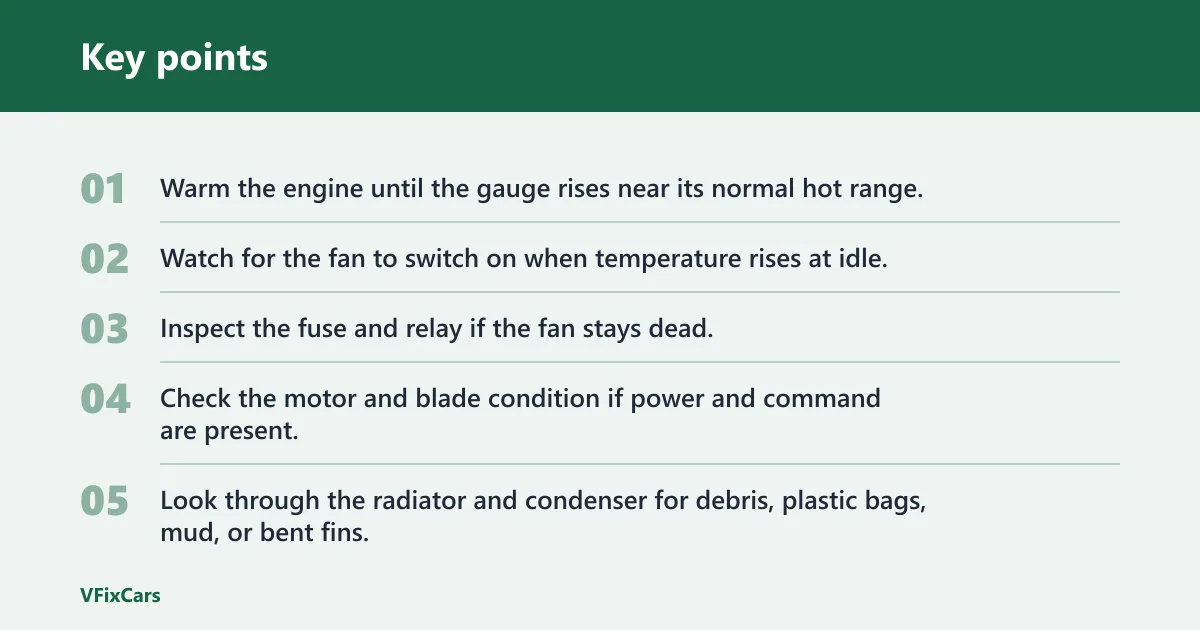
- Warm the engine until the gauge rises near its normal hot range.
- Watch for the fan to switch on when temperature rises at idle.
- Inspect the fuse and relay if the fan stays dead.
- Check the motor and blade condition if power and command are present.
- Look through the radiator and condenser for debris, plastic bags, mud, or bent fins.
A blocked radiator face can act like a clogged filter. Bent fins, leaves, and road grime cut airflow, and internal restriction from sediment limits coolant-side flow. Both problems can show up first at idle because moving air is already low.
Could low coolant be the cause?
Yes. Low coolant can expose air pockets, reduce heat transfer, and make the gauge climb at idle before it shows trouble on the highway. Check the surge tank when the engine is cold, inspect the radiator cap, and look for leaks or crusty residue before assuming a part has failed.
Check the surge tank and radiator cap safely
Use the surge tank or expansion tank as the first level check, but confirm the system is actually full according to the service procedure. Many cars also need a cold radiator check. A weak radiator cap can lower the boiling margin if the seal, spring, or pressure rating is off.
Many manufacturers list a cap pressure rating in the general range of 13 to 16 psi on common passenger cars, but the exact number should match the cap spec for that vehicle. A mismatched cap can cause boilover sooner than expected.
Look for leaks, wet hoses, and crusty residue
Wet hose ends, pink or white crust, and dried coolant near the water pump, radiator neck, hose clamps, or overflow line point to a leak path. A system that loses coolant after short drives may still look fine when cold. That makes the first clue a dropping level, not a stuck gauge.
Bleed trapped air after coolant service
Trapped air after a coolant change is commonly reported as a cause of idle-only overheating. Air pockets block circulation, can make the heater blow cold, and can cause the temperature to spike when the car sits. Bleed the system using the maker’s procedure, not a guess-and-fill method.
What low coolant does to the system
Low coolant can uncover the water pump inlet, reduce flow through the heater core, and let hot spots form in the cylinder head. That is why the same car may seem normal for a few minutes, then overheat at the next stop. The problem is often volume plus air, not just temperature.
Thermostat and water pump
A stuck-closed or slow-opening thermostat can trap heat in the engine, so the temperature may rise at idle and in traffic first. A weak water pump can also do the same by limiting circulation, especially at low engine speed. If the lower radiator hose stays cold while the engine is hot, that is a strong clue.
Thermostat symptoms that fit idle overheating
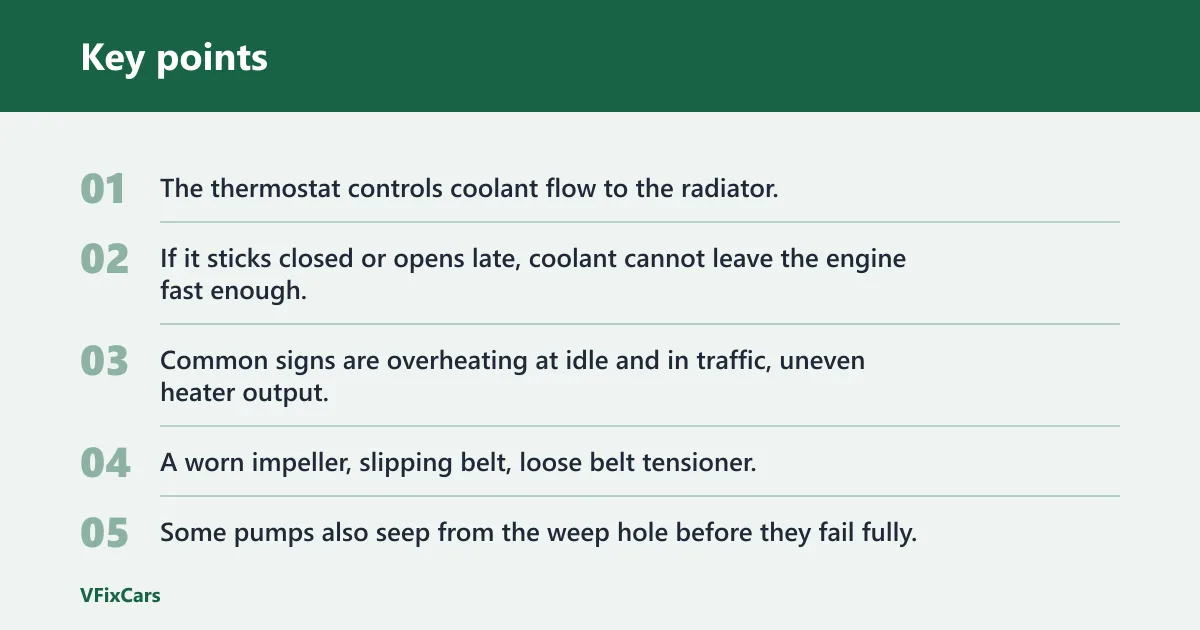
The thermostat controls coolant flow to the radiator. If it sticks closed or opens late, coolant cannot leave the engine fast enough. Common signs are overheating at idle and in traffic, uneven heater output, and a lower radiator hose that stays much cooler than the upper hose after warm-up.
Water pump problems that reduce circulation
A worn impeller, slipping belt, loose belt tensioner, or pump bearing problem can weaken flow. Some pumps also seep from the weep hole before they fail fully. Weak circulation often shows up at idle because pump output is already low at that speed.
A common first-timer mistake is replacing the thermostat because the gauge climbs, while the real fault is air trapped after a coolant service. Another is blaming the fan when the lower hose never warms, which points more toward flow loss through the thermostat or pump.
Lower radiator hose that stays cold
If the engine is hot but the lower radiator hose stays cold, coolant may not be reaching the radiator. That can mean a thermostat that is not opening, a blocked radiator, air trapped in the system, or weak pump circulation. Use that hose test with caution and compare it to scan data.
Idle overheating triage
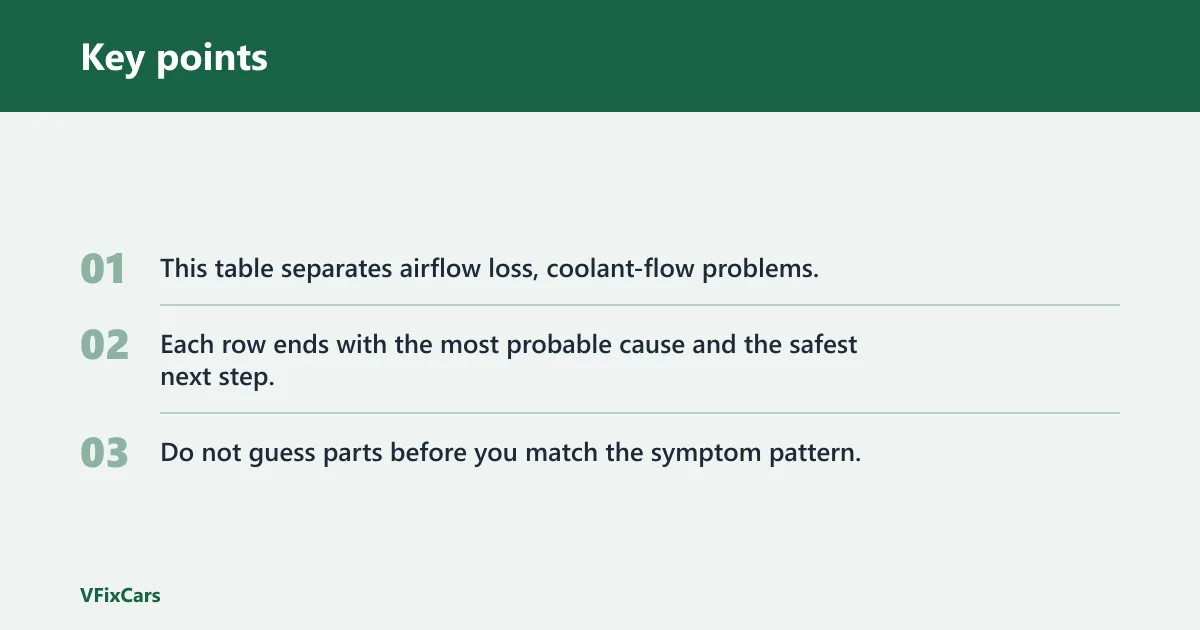
This table separates airflow loss, coolant-flow problems, and heat-load overload so you can test the right subsystem first. Each row ends with the most probable cause and the safest next step. Do not guess parts before you match the symptom pattern.
| Symptom | Likely subsystem | Quick check | Next test | Most probable cause | Safest next step |
|---|---|---|---|---|---|
| Overheats only with AC on | Airflow load | Listen for the fan and watch the gauge at idle | Check fan command and condenser debris | Marginal fan output or blocked condenser airflow | Turn off the AC and stop the engine if the gauge keeps rising |
| Fan never turns on | Fan circuit | Check fuse and relay | Test motor power and ground | Failed relay, fuse, motor, or control signal | Do not keep idling; diagnose the fan circuit before driving |
| Fan runs but temp still climbs | Radiator or coolant flow | Feel for full hose warm-up and look for blocked fins | Check thermostat and radiator restriction | Stuck thermostat or restricted radiator | Shut down and inspect circulation before adding more load |
| Heater blows cold at idle | Coolant level or air pocket | Check surge tank level when cold | Bleed the cooling system | Low coolant or trapped air | Do not drive far until coolant level and bleed status are correct |
| Coolant level drops after short drives | Leak or cap | Inspect hoses, clamps, and overflow line | Pressure test the system | External leak or weak radiator cap | Top up only as a temporary measure and repair the leak |
| Bubbles in overflow tank | Combustion gas intrusion | Watch for repeated bubbling after warm-up | Test for exhaust gases in coolant | Head gasket leak | Stop driving and get a proper diagnosis |
| Lower radiator hose stays cold | Thermostat or flow blockage | Compare upper and lower hose temperature | Check thermostat opening and radiator pass-through | Stuck thermostat or blocked radiator | Let the engine cool and inspect before restarting |
| Overheating after coolant service | Air pocket | Recheck level and bleed points | Repeat bleed with the correct procedure | Trapped air after service | Do not assume the new part is bad until air is removed |
| Overheating only in traffic | Airflow deficit | Verify fan cycling at idle | Inspect condenser and radiator face | Weak fan or airflow blockage | Pull off the road if temperature keeps rising in traffic |
| Gauge climbs fast after a long idle in park | Heat-load overload | Compare with AC off versus on | Check fan speed and radiator condition | Marginal cooling system exposed by idle heat soak | Do not keep it running while the gauge rises |
What does the heater and overflow tank tell you?
The heater and overflow tank give two useful clues. Cold cabin heat at idle points to low coolant or trapped air. Bubbles in the overflow tank after warm-up can point to combustion gas intrusion, which raises pressure and can mimic a simple overheating complaint until the failure gets worse.
Heater blows cold at idle
If the heater goes cold while the engine is hot, coolant flow through the heater core may be low. That can happen from low coolant, an air pocket, a weak pump, or a thermostat that is not opening fully. Cabin heat that returns with engine speed also points toward circulation trouble.
Bubbles in the overflow tank
Repeated bubbles after the engine is warm are not normal foaming. Repeated bubbles after the engine is warm can indicate exhaust gas entering the cooling system, which can build pressure and push coolant out. A head gasket failure can create that pattern, along with coolant loss and hard upper hoses.
Pressure buildup and possible head gasket clues
A combustion gas leak can make the cooling system act overfull, then low, then overfull again. Pressure rises too quickly, hoses feel very firm early, and coolant may be forced into the overflow tank. That pattern needs a proper pressure and gas test, not a guess.
Suppose the gauge rises in a driveway, the heater goes cold, and the overflow tank bubbles after two minutes of idle. That combination is more serious than a simple fan complaint because it points toward air intrusion or combustion gas in the cooling system.
Scan data that helps confirm the fault
OBD-II scan data can tell you whether the engine is truly hot, whether the fan is being commanded on, and whether another fault is adding heat. A live coolant temperature reading, fan command status, and misfire or lean-condition clues help separate a sensor issue from a real overheating event.
Coolant temperature reading
Compare the scan data to the dash gauge. If the scan shows a steady rise while the gauge jumps late, the cluster may be misleading. If both climb together, the overheating is real. Many systems trigger the fan based on measured coolant temperature, so that number matters.
Fan command status
If the scan tool shows fan command on but the fan does not run, the fault is likely in the relay, fuse, motor, or wiring. If the command never comes on even as temperature rises, look at the coolant temperature sensor, control logic, or the conditions that tell the module to switch the fan.
Misfire or lean-condition clues
A misfire or lean condition can add heat at idle and traffic speeds. Scan data may show fuel trims, misfire counts, or related codes that point to a problem outside the cooling system. That matters because some cars overheat only when another engine fault adds load.
Frequently asked questions
Why is my car overheating while idling but not while driving?
That pattern usually means the car loses cooling only when road airflow disappears. Start with fan operation, then check coolant level, thermostat opening, and radiator airflow. If the AC makes it worse, the condenser is probably adding heat to an already marginal system at idle.
Why is my car overheating while idling?
Idle overheating usually comes from one of three places: airflow loss, coolant-flow loss, or extra heat load. The fan may not be cycling, the thermostat may be slow, the radiator may be restricted, or low coolant may leave air pockets in the system.
Why is my engine overheating while idling?
Your engine may overheat at idle because it still makes heat, but the cooling system depends on fan flow and steady circulation to remove it. If the heater blows cold, the level may be low or air trapped. If the lower hose stays cold, flow may be blocked.
Why is my car overheating only while idling?
Overheating only while idling points away from a pure highway cooling issue and toward a weak fan, poor radiator airflow, trapped air, or a thermostat that opens too late. Traffic and parked idles are the hardest conditions because the system must do all the work without road speed.
Why is my car overheating when idle with ac on?
The AC condenser adds heat ahead of the radiator, so a weak cooling system can tip into overheating at idle when the AC runs. That does not mean the AC is the root fault. It often means the fan, radiator, or coolant flow is already marginal and the extra load exposed it.
Why does my car overheat while idling but not driving?
If it overheats while idling but not driving, the car likely depends on road airflow to stay cool. Check whether the fan comes on, whether the radiator face is blocked, and whether coolant circulation is steady. A clogged radiator or weak pump can stay hidden until the car sits still.