Will Any OBD2 Scanner Work on My Car?
An OBD2 scanner generally works only if the car is OBD2-compliant. That usually means U.S. cars from 1996 on, plus many 2001+ gasoline models or 2004/2006+ diesel models in other markets. Buy the wrong tool, and you may get no data, partial data, or miss faults entirely. This guide explains the compliance check and the scanner features that must match your car’s protocol and diagnostic depth.
This guide is part of our OBD2 scanner guide: how to choose and use one series.
Will any OBD2 scanner work on my car?
No. A scanner has to match two layers: the vehicle must support OBD2, and the scanner must support the vehicle’s communication setup and the functions you want. A basic read-only scanner can often pull Diagnostic Trouble Codes from the ECU on many compliant cars, but advanced features depend on more than the port shape.
Two compatibility layers
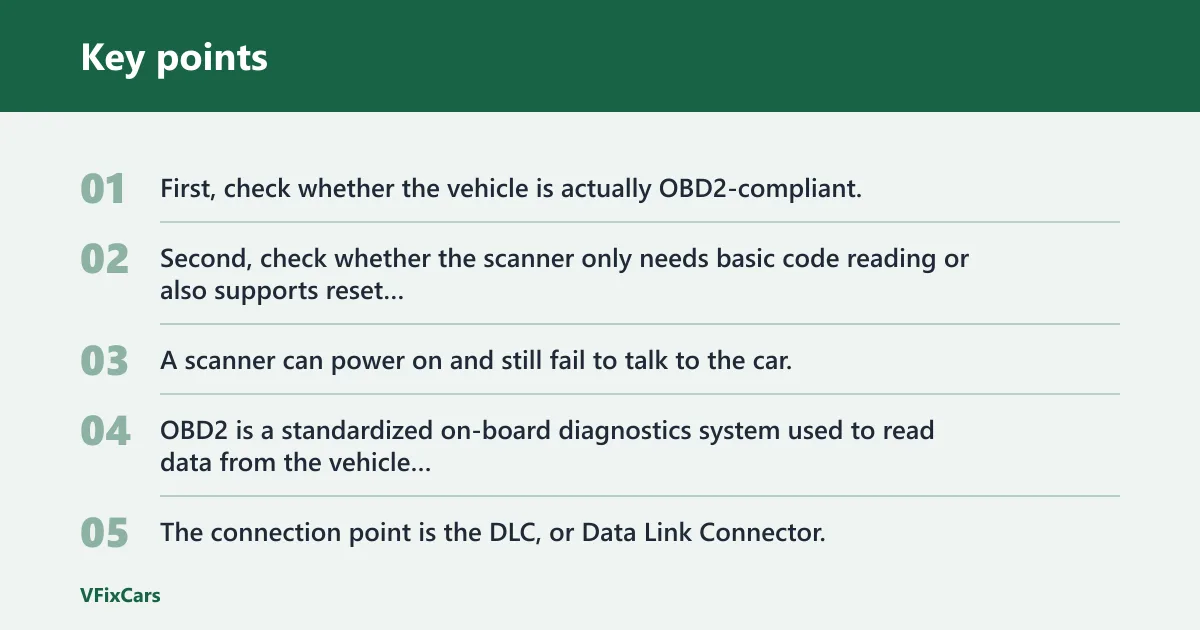
First, check whether the vehicle is actually OBD2-compliant. Second, check whether the scanner only needs basic code reading or also supports reset functions, live data, ABS, SRS, or other modules. A scanner can power on and still fail to talk to the car.
OBD2 is a standardized on-board diagnostics system used to read data from the vehicle ECU for emissions and fault reporting, and it is not brand specific. The connection point is the DLC, or Data Link Connector, which is the physical diagnostic port. If the car does not have the right port or pinout, communication can fail even if the scanner lights up.
OBD2 compatibility matrix
| Vehicle year range | Market | Fuel type | OBD2 port present | Basic code reading likely | Advanced features likely | Common failure reason |
|---|---|---|---|---|---|---|
| 1996 and newer | United States | Gasoline | Yes | Yes | Maybe, depending on scanner and module support | Missing protocol support for enhanced functions |
| 2001 and newer | Many other markets | Gasoline | Usually yes | Usually yes | Maybe | Vehicle supports emissions OBD2 only, not full-module access |
| 2004 to 2006 and newer | Many markets | Diesel | Usually yes | Usually yes | Maybe | Diesel protocol or market-specific support missing |
| Hybrid era models | Varies by market | Hybrid | Often yes | Usually yes for emissions-related data | Sometimes limited | Hybrid control modules need scanner-specific support |
| Pre-OBD2 vehicles | Any market | Gasoline or diesel | No, or nonstandard diagnostic plug | No | Rare | Vehicle is not OBD2-compliant |
| Imported edge cases | Japan, Europe, gray-market imports | Gasoline, diesel, hybrid | Maybe | Maybe | Maybe | Different protocol, pinout, or year cutoff than the buyer expects |
Basic code reading vs advanced functions
Basic scanners retrieve stored trouble codes when the check engine light is on. Some advanced scanners can clear trouble codes or reset the oil light, but that only works if the vehicle and scanner support those functions. Read-only scanners are the majority, and they cannot alter vehicle data, settings, or controls.
Say your 2008 gasoline sedan has a check engine light and a standard DLC under the dash. A read-only scanner may pull a code such as a misfire or oxygen sensor fault. A scan tool with service resets might clear the light afterward, but only after the fault is repaired.
Common failure reasons
The scanner may power on from the port and still fail to connect for a few common reasons: the vehicle is not OBD2-compliant, the protocol is unsupported, the DLC lacks power, a fuse is blown, or the ignition state is wrong for that car. Power at the screen is not proof of communication.
What year does OBD2 apply to my car?
The cutoff depends on market and fuel type, not just model year. In the United States, OBD2 generally applies to 1996 and newer cars. Elsewhere, many gasoline models are OBD2-compliant from about 2001, while many diesels tend to follow later, often around 2004 to 2006. That year alone is not enough.
Typical gasoline cutoff by market
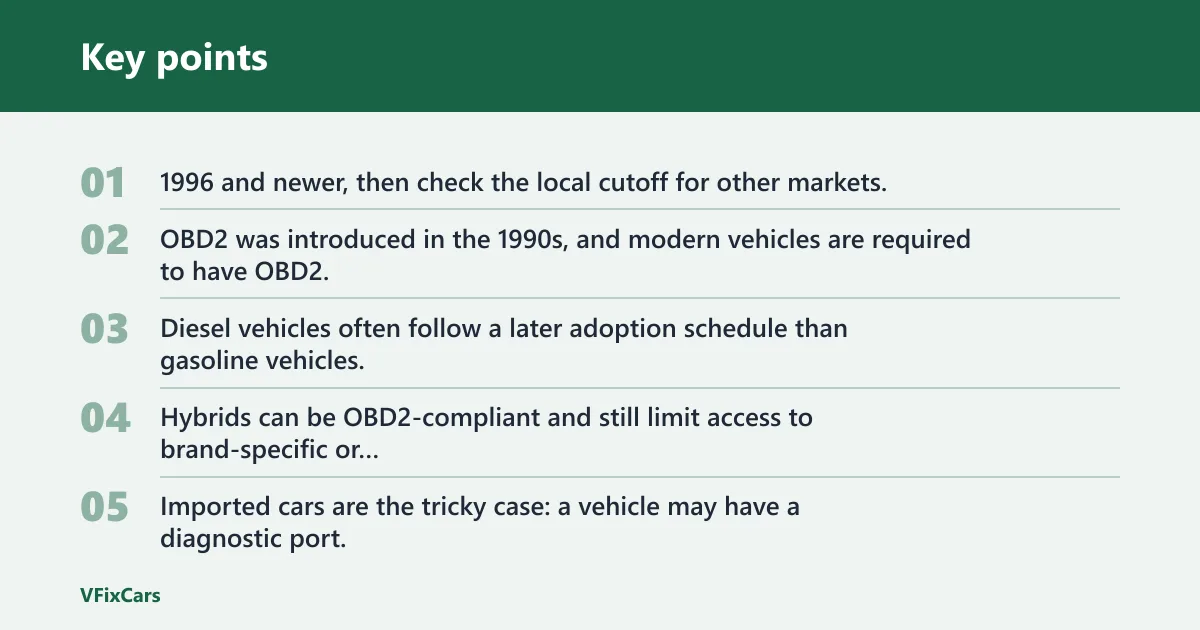
For many buyers, the simplest rule is U.S. 1996 and newer, then check the local cutoff for other markets. OBD2 was introduced in the 1990s, and modern vehicles are required to have OBD2, but older or regional models may use different systems even with a familiar-looking port.
Diesel, hybrid, and import exceptions
Diesel vehicles often follow a later adoption schedule than gasoline vehicles. Hybrids can be OBD2-compliant and still limit access to brand-specific or battery-related functions. Imported cars are the tricky case: a vehicle may have a diagnostic port, yet the pinout or protocol can differ from local scanners.
A common first-timer mistake is buying a scanner for a 2002 import because a friend’s 2002 local-market car works with it. The year matches, but the market and protocol do not. That can leave you with power at the tool and no live communication.
Why the year alone is not enough
Year helps, but it does not prove support. You still need to confirm market, fuel type, and whether the car uses standard emissions OBD2 or a more limited or manufacturer-specific setup. If the seller cannot confirm compliance, check the owner’s manual, emissions label, or the diagnostic port itself.
What your scanner can read
An OBD2 scanner reads stored trouble codes and live data from the ECU. That makes it useful for emissions faults, engine monitoring, and early diagnosis before a problem gets expensive. It does not repair the car, and it does not alter the ECU on read-only models.
ECU data and DTCs
Diagnostic Trouble Codes are stored faults that are usually checked when the check engine light is on. Retrieving them is diagnosis, not repair. The ECU stores the fault history and operating data; the scanner simply asks for that information.
Read-only scans
Most OBD2 scanners are read-only devices. They cannot alter the vehicle’s data, settings, or controls. That is why basic scanners are generally safe for the car and ECU, and why professionals and DIY owners both use them for first-pass diagnosis.
Code clearing and light resets
Some advanced scanners can clear trouble codes or reset the oil light. That is still limited by vehicle support. Clearing a code without fixing the cause usually brings the light back, and some readiness monitors may need driving cycles before the system confirms the repair.
Advanced functions that need more support
ABS, SRS, bi-directional tests, and many service resets often need a more capable scanner and a vehicle that exposes those functions through the available protocol. OBD2 scanners do not access critical control systems like airbags or ABS unless the specific scanner and vehicle support those modules.
Why won’t my OBD2 scanner connect?
A scanner can fail for reasons that have nothing to do with the tool itself. The usual causes are no power at the DLC, a bad fuse, the wrong protocol, an unsupported vehicle, or scan conditions the vehicle requires. A lit screen is not enough; the tool must actually communicate.
No power at the DLC
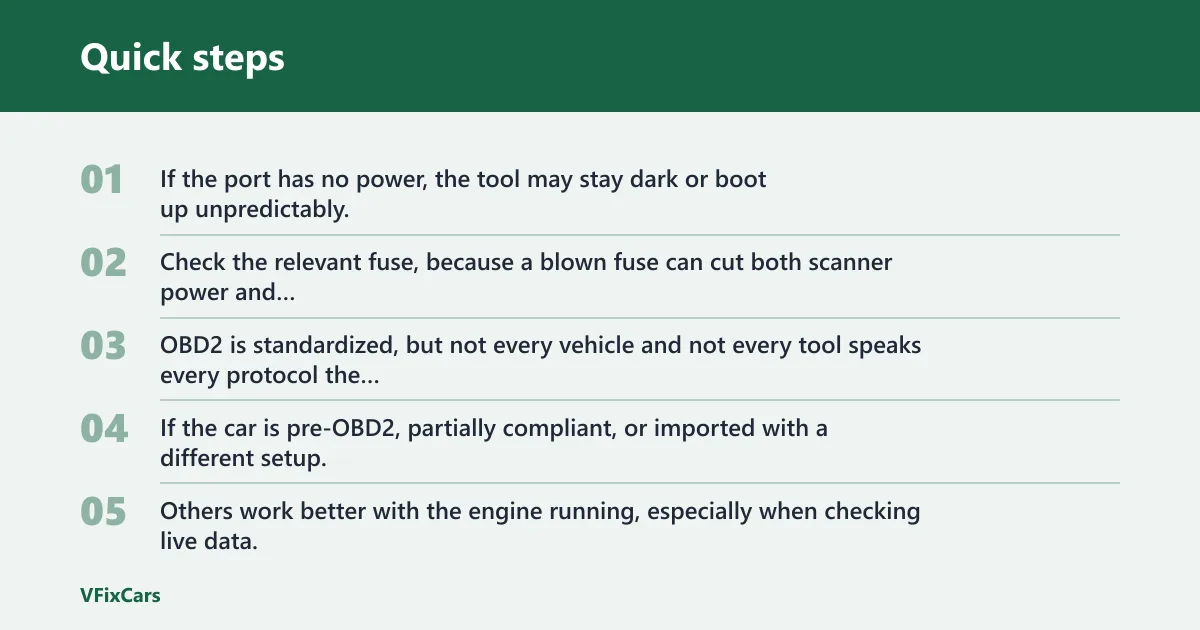
Some scanners draw power from the DLC. If the port has no power, the tool may stay dark or boot up unpredictably. Check the relevant fuse, because a blown fuse can cut both scanner power and communication on some vehicles.
Wrong protocol or unsupported vehicle
OBD2 is standardized, but not every vehicle and not every tool speaks every protocol the same way. If the car is pre-OBD2, partially compliant, or imported with a different setup, a generic scanner may never establish communication.
Ignition state and scan conditions
Some scans require key on, engine off. Others work better with the engine running, especially when checking live data. The scanner’s manual and the vehicle’s support level both matter. If the tool never links, try the correct ignition state before assuming the port is bad.
Can an OBD2 scanner damage my car or ECU?
Read-only OBD2 scanners are generally safe. They retrieve information from the ECU and do not change firmware, settings, or controls. Risk rises only when you use functions the vehicle does not support or when you clear faults without understanding what caused them.
Why read-only scanners are safe
Read-only scanners cannot alter the vehicle’s data, settings, or controls. They are built for observation, not reprogramming. That makes them suitable for quick fault checks, live data review, and emissions diagnosis without modifying the ECU.
When reset functions need caution
Clear-code and reset functions are still common, but they should be used with the right context. If a scanner can clear a light, that does not mean the fault is gone. It only removes the stored indication until the vehicle sees the problem again.
What the scanner cannot change
Generic OBD2 tools do not normally access critical control systems like airbags or ABS, and they do not rewrite ECU firmware. That boundary is part of why basic scanners are trusted by mechanics worldwide and by DIY owners who want a safe first step in diagnosis.
How to check compatibility before you buy
Use a simple yes/no/check flow before you spend money. It keeps you from buying a scanner that only half-fits the car. Start with the vehicle, then match the scanner to the functions you need.
- Check the year and market. Confirm whether the vehicle falls under the local OBD2 cutoff.
- Check the fuel type. Gasoline, diesel, and hybrid models can follow different adoption timelines.
- Check the port. Find the DLC and confirm it is the standard diagnostic connector, not a nonstandard plug.
- Check the needed functions. Decide whether you only need DTC reading or also live data, resets, ABS, or SRS.
- Check protocol support. Make sure the scanner lists support for your vehicle type and the functions you want.
Yes means a standard OBD2 reader is likely enough for basic diagnostics. No means you need a different tool. Check means the vehicle may connect for codes but still limit advanced features, so read the scanner’s supported functions before buying.
Frequently asked questions
What year does OBD2 apply to my car?: in the United States, 1996
In the United States, 1996 and newer is the key cutoff. Many other gasoline vehicles are OBD2-compliant from 2001 onward, while many diesels follow around 2004 to 2006. Market and fuel type both matter.
Will a basic code reader work if my car is older?
Only if the older car is actually OBD2-compliant. If it predates OBD2 or uses a different diagnostic standard, a basic code reader will not communicate with it. In that case, a manufacturer-specific or older protocol tool may be needed.
Do I need the car running to use an OBD2 scanner?
Not always. Many scans use key on, engine off, while live data or certain checks may work better with the engine running. The correct ignition state depends on the scanner and the vehicle, so follow the tool’s instructions.
Can an OBD2 scanner damage my car or ECU?: read-only scanners are generally safe?
Read-only scanners are generally safe because they only retrieve data from the ECU. They cannot change firmware or normal vehicle settings. Risk is low unless you use unsupported reset functions or try to apply a tool that does not fit the vehicle.