Why Do Mass Airflow Sensors Fail? Common Causes and Fixes
A mass airflow sensor usually fails because its hot wire or film is contaminated, its power or ground is weak, or the intake has an air leak that mimics failure.
Ignore the repeat fault and you can waste money on another sensor while the engine keeps running lean, rich, rough, or setting the same code.
This guide shows the common failure paths, how to separate true sensor failure from look-alikes, and what to inspect before replacing the MAF again.
How MAF Sensor Drift Triggers Drivability Issues
A mass air flow (MAF) sensor measures the mass of incoming air so the engine control unit can calculate fuel delivery. When that reading drifts, the ECU can command the wrong fuel mixture and drivability suffers. The failure is often repeatable because the root cause stays in the intake, wiring, or replacement part.
What the sensor measures and why the ECU needs it
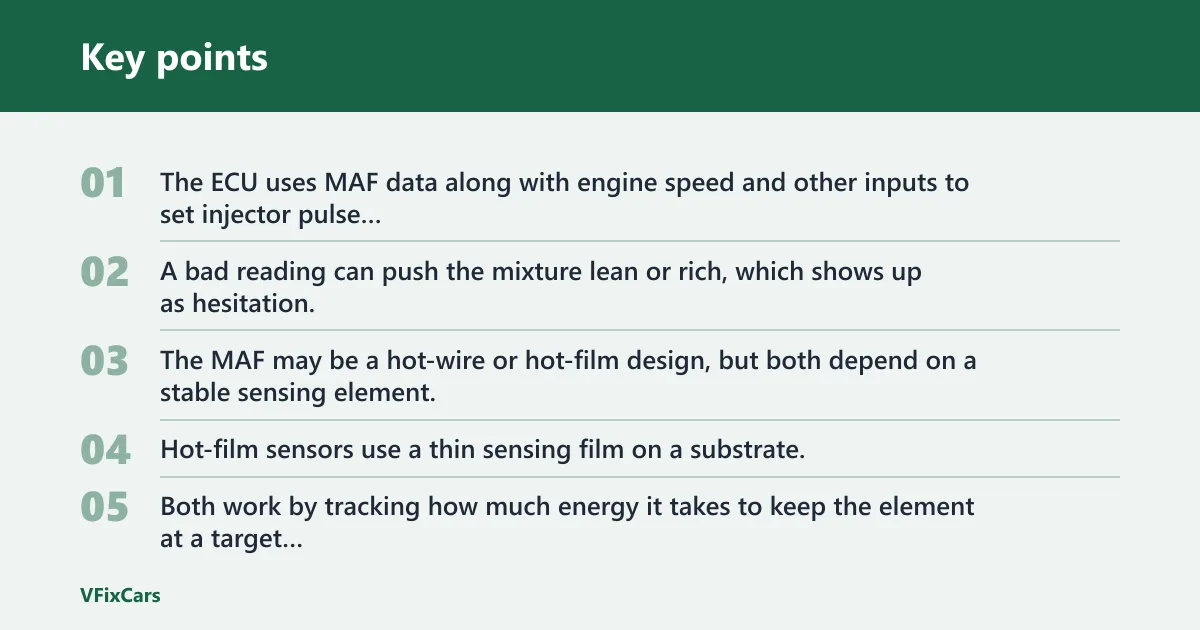
The ECU uses MAF data along with engine speed and other inputs to set injector pulse width. A bad reading can push the mixture lean or rich, which shows up as hesitation, rough idle, stalling, poor fuel economy, or a check engine light. The MAF may be a hot-wire or hot-film design, but both depend on a stable sensing element.
Hot-wire vs hot-film designs
Hot-wire sensors use a delicate heated wire. Hot-film sensors use a thin sensing film on a substrate. Both work by tracking how much energy it takes to keep the element at a target temperature. Contamination, moisture, thermal shock, or electrical overload can shift that response and make airflow look lower or higher than it really is.
How a bad reading turns into drivability problems
If the sensor under-reports air, the ECU may underfuel and the engine can stumble under load. If it over-reports, the ECU may add too much fuel and the engine can run rich, foul plugs, or idle poorly. A sensor fault is only one possible cause, so the rest of the intake and wiring still need a check.
What symptoms point to a failing MAF sensor?
Common symptoms include rough idle, hesitation, bogging, stalling, poor fuel economy, and a check engine light. Those symptoms do not prove the MAF itself is bad. Intake leaks, ignition issues, fuel delivery problems, and throttle faults can create the same complaint pattern.
Rough idle and stalling
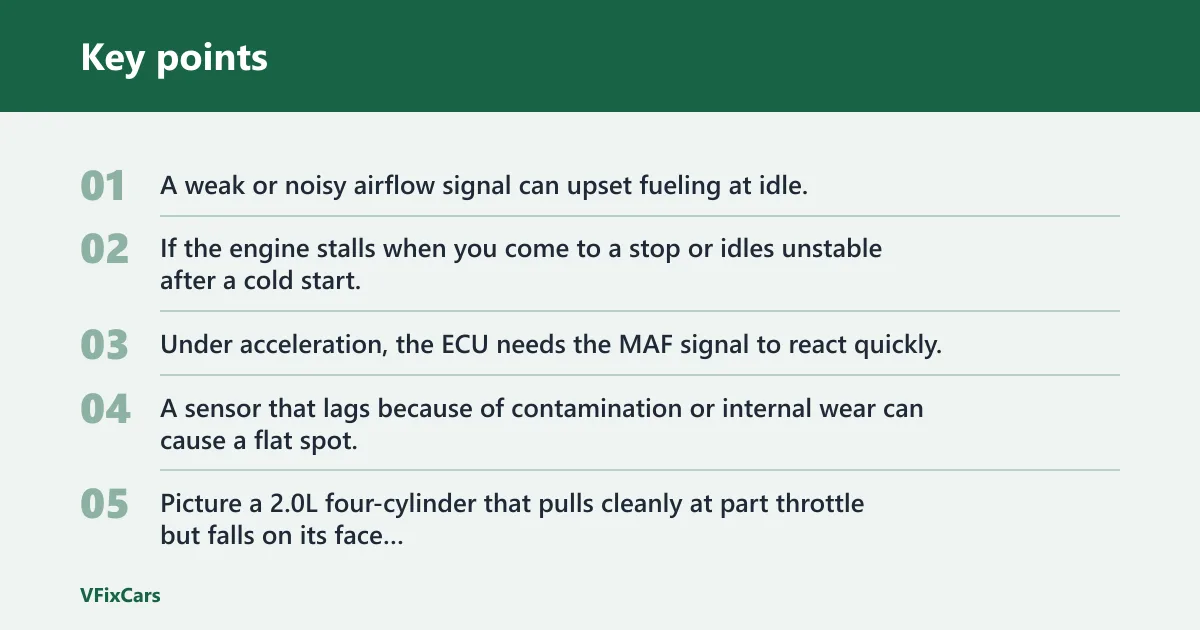
A weak or noisy airflow signal can upset fueling at idle, where airflow is low and the ECU depends on accurate data. If the engine stalls when you come to a stop or idles unstable after a cold start, check the live data and fuel trims before condemning the sensor.
Hesitation, bogging, and poor throttle response
Under acceleration, the ECU needs the MAF signal to react quickly. A sensor that lags because of contamination or internal wear can cause a flat spot, surge, or bog. Picture a 2.0L four-cylinder that pulls cleanly at part throttle but falls on its face when you floor it; that pattern can point to airflow under-reporting, but it can also come from a leak after the sensor.
Fuel trim changes and related trouble codes
Scan data helps separate MAF failure from look-alikes. Short-term fuel trim and long-term fuel trim that move strongly positive suggest the ECU is adding fuel to correct a lean condition, often from unmetered air. Common related OBD-II codes can include P0100 through P0104, but the code alone does not prove the sensor is at fault.
| Scan clue | What it can suggest | What to inspect next |
|---|---|---|
| Low MAF grams-per-second at idle | Contaminated sensor, weak signal, or intake restriction | Air filter, ducting, wiring, live data with engine warm |
| High positive fuel trims | Vacuum leak after the MAF, unmetered air | Intake boots, PCV hoses, brake booster hose |
| Intermittent code with freeze-frame at bumps or heat | Connector, loom, or ground problem | Pin fit, corrosion, voltage drop, loom strain |
| Repeat failure after recent replacement | Root cause still present or poor replacement quality | Oil contamination, air leaks, OEM fitment, calibration |
What causes a MAF sensor to fail?
Contamination is common, but it is only one cause. Dust, pollen, moisture, oil film, and residue from aftermarket oiled air filters can coat the sensing element and skew readings. Air filter and intake duct problems, PCV vapors, and engine oil blow-by can keep feeding the same contamination pattern.
Contamination from oil, dust, pollen, and moisture
A thin film on the sensing element changes how heat transfers from the hot wire or film to the passing air. That drift can happen slowly, which is why a vehicle may seem fine for weeks before fuel trims move enough to set a code. Moisture can do similar damage if water intrusion reaches the intake tract or sensor housing.
Air filter and intake duct problems
A missing or damaged air filter can let unfiltered air carry grit into the sensor. A poor filter seal, cracked duct, or loose clamp can create turbulence upstream of the MAF, and turbulent flow can make the reading unstable. Restriction before the sensor can also distort what the ECU thinks the engine is ingesting.
PCV vapors and engine oil blow-by
PCV-related vapors and blow-by can carry oil mist into the intake tract. That mist often coats the MAF after it passes through the airbox and intake duct. If the engine has chronic oil carryover, cleaning the sensor may buy time, but the contamination source still needs attention or the same failure pattern can return.
Can intake leaks make a good MAF look bad?
Yes. A vacuum leak after the MAF lets unmetered air enter the engine, which can create a lean condition and fuel trim changes that look like sensor failure. In many cases the MAF is reading correctly and the intake leak is the real fault.
Vacuum leaks after the sensor
Any leak downstream of the MAF lets air bypass the sensor, so the ECU does not count it. Common leak points include intake boots, gaskets, cracked hoses, brake booster hoses, and PCV plumbing. If a code returns after a new sensor, a downstream leak should move high on the checklist.
Why this fault is often misdiagnosed
Drivers and parts sellers often blame the MAF because the code points to airflow. That is a mistake. A lean idle with positive fuel trims and a normal MAF grams-per-second value can point away from the sensor and toward a leak. If the leak is not fixed, a replacement MAF will not solve the problem.
Example pattern
For example, an engine may set a lean code at idle or stoplights and show positive fuel trims at idle but near-normal trims at a higher rpm. That pattern fits an intake leak much better than a dead sensor, because the leak has the greatest effect when airflow is low.
How do wiring and power faults cause MAF failure?
Electrical faults can interrupt the MAF signal, corrupt its reference voltage, or weaken the ground path. Corrosion, loose pins, broken wiring, and shared-circuit faults can all create intermittent signal loss. Heat and vibration often make the failure repeat after the vehicle warms up or hits bumps.
Corrosion, loose pins, and broken wiring
The connector and harness sit in a harsh area with heat, movement, and underhood contamination. Corrosion in the terminals raises resistance. Loose pins can open the circuit under vibration. A broken conductor inside the insulation can pass a quick visual check yet fail whenever the engine torques over or the loom shifts.
Reference voltage and ground checks
Most MAF circuits depend on a clean power supply, a stable reference voltage, and a solid ground. A weak ground can mimic a bad sensor by distorting the output signal. Check for voltage drop on the ground side, not only continuity. A circuit can show continuity and still fail under load.
Intermittent loss from heat and vibration
A connector may read fine when cold but open after heat soak. A harness rubbing against a bracket can fail only on rough roads. Those patterns often produce a comeback code after repair, because the part was replaced but the wiring fault stayed in place.
Use this failure-tree checklist before you replace the sensor
Start with the symptom pattern, then follow the branch that matches the data. That keeps you from buying a sensor for a lean condition, a power fault, or a replacement-quality issue. A quick scan and a visual inspection often save a repeat repair.
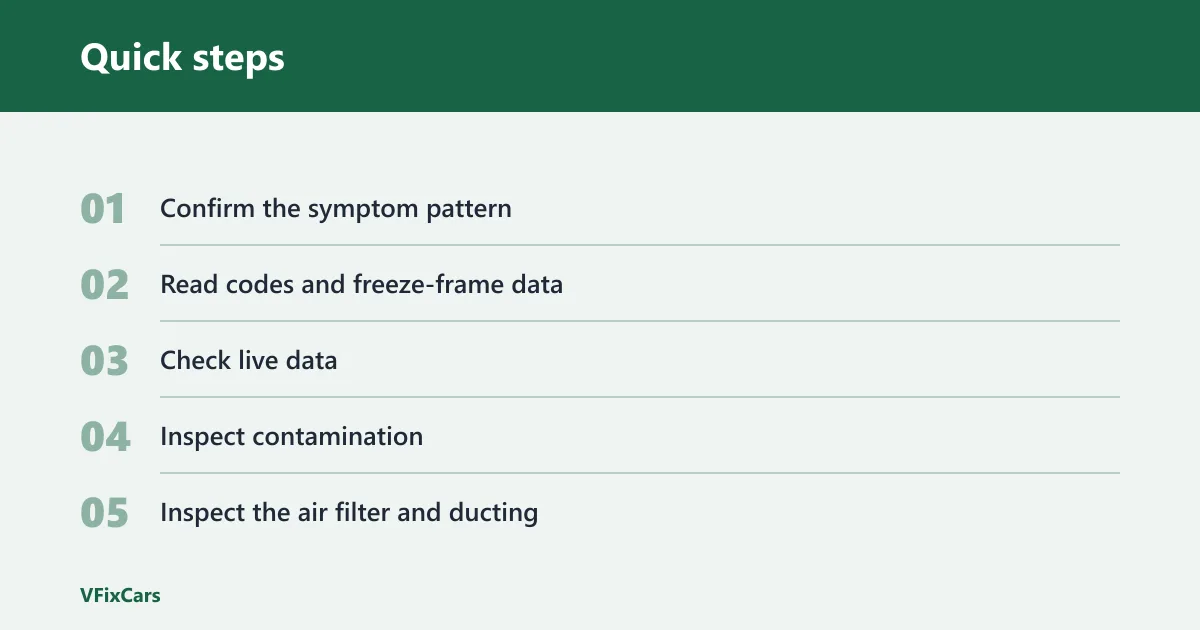
- Confirm the symptom pattern. Note idle quality, hesitation, stalling, fuel economy change, and when the fault appears.
- Read codes and freeze-frame data. Record the exact DTCs, engine speed, load, coolant temperature, and fuel trims.
- Check live data. Compare MAF grams-per-second, short-term fuel trim, and long-term fuel trim at idle and at a steady 2,500 rpm.
- Inspect contamination. Look for oil film, dust, pollen, moisture, or residue from an aftermarket oiled filter.
- Inspect the air filter and ducting. Check for missing filter media, bad seal, cracked duct, or loose clamps.
- Inspect for intake leaks. Test hoses and boots downstream of the sensor for cracks or leaks.
- Check power, ground, and connector fit. Look for corrosion, loose pins, broken wires, and voltage drop.
- Question the replacement part. Verify fitment, calibration, and whether an OEM-quality part is required for the application.
Repeat-failure checklist
- Oil mist on the sensor. Inspect the PCV system and the intake tract for blow-by carryover.
- Aftermarket oiled filter installed. Check for residue on the sensing element and inside the housing.
- New sensor fails quickly. Inspect downstream leaks and wiring before blaming the part.
- Corroded connector terminals. Repair terminal tension and corrosion, then recheck signal integrity.
- Harness rubbed or stretched. Look for strain near the airbox, engine cover, or bracket edges.
- Cheap replacement part. Compare OEM versus aftermarket fitment and signal behavior.
Cleaning versus replacement
Cleaning is reasonable when the sensor shows contamination but the element is not physically damaged and the housing and wiring test out well. Replace the sensor when the heating element is damaged, the signal stays erratic after cleaning, or the part has failed electrically. Cleaning will not fix a cracked duct, a leak, or a bad ground.
Why does my mass air flow sensor keep failing?
A MAF keeps failing when the root cause survives the repair. Repeat contamination from oil mist or an oiled filter, connector strain, harness damage, intake leaks, or a poorly matched replacement part can all make a new sensor fail again. The fix has to address the cause, not only the symptom.
Repeat contamination from filters or oil mist
If the airbox seal is poor or the engine pushes oil vapor into the intake, the replacement sensor will collect the same residue. That residue can come back quickly and alter the sensing element’s response. Inspect the filter, the housing, the PCV routing, and the ducting after the sensor, not only the sensor itself.
Connector strain and harness damage after repair
A sensor can fail soon after replacement if the connector was forced, the harness was left under tension, or a wire was nicked during service. Heat and vibration then finish the job. A careful inspection of pin fit, wire routing, and loom support helps prevent a comeback code.
Defective or poorly matched replacement parts
Not every replacement part behaves like the original. Some aftermarket MAFs have fitment or calibration issues that create a skewed signal even though the part is new. If the original fault is fixed but the new sensor still produces implausible grams-per-second data, part quality or application match should be questioned.
Do mass airflow sensors fail?
Yes. Mass airflow sensors do fail, but many faults blamed on the sensor come from contamination, wiring, leaks, or a bad replacement part. The useful question is not only whether the sensor failed, but what made the reading wrong in the first place.
How often do mass air flow sensors fail?
There is no single mileage interval that fits every vehicle. MAF life depends more on intake cleanliness, filter quality, PCV oil carryover, and connector condition than on time alone. A sensor on a clean, sealed intake may last far longer than one exposed to dust, oil mist, or repeated vibration.
Do mass air flow sensors go bad?
Yes. They can go bad from contamination, electrical faults, thermal stress, or damage to the sensing element. They can also appear bad when the real problem is a leak after the sensor or a wiring issue that interrupts the signal. That is why live data matters before replacement.
Frequently asked questions
Do mass air flow sensors fail?
Yes, but true sensor failure is only one part of the diagnosis. Many MAF codes are caused by leaks or wiring faults that produce the same symptoms. Scan data and a careful inspection help separate the sensor from the rest of the intake and electrical system.