
Why Is My Car Overheating When the AC Is On? Causes
If your car overheats only with the A/C on, the usual cause is poor cooling at idle or low speed: weak radiator airflow, a fan that slips or quits, low coolant flow, or an A/C compressor that loads the engine too hard. Ignore it and you can overheat, boil coolant, or warp parts. This guide maps the symptom pattern to the likely fault.
Why the AC can make your car run hot
The A/C adds two loads at once. It dumps heat into the condenser in front of the radiator, and it makes the engine turn the compressor. That is why a car that stays normal with the A/C off can run hot as soon as the A/C is on, especially at idle, in traffic, or with the hood full of debris.
Most cases come down to a weak cooling fan, low coolant, or a clogged condenser. At road speed, natural airflow can hide a weak fan. At idle, that same weak fan shows up fast.
Why idle and traffic expose airflow problems first
When the car moves, air is forced through the grille, condenser, and radiator. At a stop, the fan has to do that work. VehicleRuns notes that overheating mainly at idle or in stop-and-go traffic points to airflow, which is why fan faults and blocked fins rank high on the list.
What the symptom pattern tells you
The pattern matters more than the warning light alone. If the gauge climbs only at idle, think fan or condenser airflow first. If it climbs at highway speed too, look harder at coolant flow, a stuck thermostat, a blocked radiator, a weak water pump, or a head gasket fault. If the vents go hot at the same time, the coolant side deserves extra attention.
Idle only versus highway only versus all speeds
Idle-only overheating with the A/C on often means the system cannot shed heat without help from the fan. Highway overheating means air is moving but heat is still not leaving the engine, which points toward internal flow or heat transfer problems. Overheating at all speeds is a stronger clue for a larger cooling-system fault.
What hot vents, cold vents, or normal vents suggest
If the cabin vents blow hot air while the engine temperature rises, coolant circulation may be weak or the level may be low. If the vents stay cold but the engine runs hot, the A/C system may be fine while the engine side struggles with airflow or coolant flow. Normal vent temperature with a rising gauge often points away from refrigerant issues.
How fan speed and engine speed change the diagnosis
If revving the engine or driving at speed makes the temperature drop, airflow is a likely problem. If engine speed changes little and the gauge still climbs, coolant circulation or radiator capacity may be the weak point. That difference helps separate fan trouble from thermostat, radiator, or water pump faults.
Use this decision table to narrow the fault

This table maps pattern, fan behavior, vent temperature, and road speed to the most likely fault. Use it before naming the failed part. A short safe next test is included for each branch.
| Symptom pattern | Fan behavior | Vent temperature | Road speed | Most likely fault | Safe next test |
|---|---|---|---|---|---|
| Overheats at idle with A/C on, cools while moving | Fan slow, noisy, or off | Usually normal or warm | Worse at idle, better above 20–30 mph | Weak fan motor, relay, fuse, fan clutch, or blocked condenser airflow | With engine cold, switch A/C on and confirm the fan responds immediately |
| Overheats in traffic and stop-and-go only | One fan dead or both weak | May stay normal | Worse below road speed, better on open road | Dual-fan failure, fan command issue, or condenser blockage | Inspect both fans, check fuses and relays, and look through the condenser for debris |
| Overheats at highway speed too | Fan may be normal | May blow hot | Worse at all speeds | Thermostat, radiator blockage, water pump, low coolant, or head gasket | Check coolant only when fully cold, then inspect for leaks and test pressure |
| Overheats when A/C is on and vents blow hot | Fan may be weak or normal | Hot | Traffic, idle, or load makes it worse | Low coolant, weak circulation, thermostat sticking, or head gasket leak | Look for coolant loss, bubbles in the reservoir, and repeated overheating under load |
| Temperature rises fast right after A/C is switched on | Fan does not start or starts late | Usually normal at first | Idle or low speed | Fan command failure, relay, fuse, motor, or fan clutch | Verify the fan command with A/C on, then check power, ground, and relay output |
If your sedan idles in a driveway with the A/C on and the gauge starts rising after a few minutes, but it drops back down once you get moving on a city street. That pattern points first to airflow, not a bad radiator core. A dead fan or packed condenser fins would fit better than a water pump.
Is the cooling fan doing its job?
The fan is the first part to check because the A/C should command it on quickly, especially on electric-fan cars. If the fan does not respond, responds slowly, or one fan in a dual-fan setup is dead, overheating can appear only with the A/C on. On belt-driven systems, a weak fan clutch can act the same way.
Electric fan command, relay, fuse, and motor checks
With many vehicles, the PCM commands the fan when the A/C is switched on. If the fan does not start, the fault may be a fuse, relay, wiring, temperature input, or the fan motor itself. The key split is command failure versus hardware failure. If power reaches the motor and it still does not run, the motor is suspect.
Fan clutch symptoms on belt-driven systems
A fan clutch should couple more strongly as heat rises. If it freewheels too easily, the fan moves less air at idle and low speed. A clutch that is seized can add drag and noise, but a clutch that is too weak is more likely to match the “overheats only with A/C on” complaint.
What one dead fan or a weak dual-fan setup looks like
On dual-fan setups, one weak or dead fan may not cause trouble on cool days, then fail under A/C load or in traffic. One fan may run while the other stays still. That split is common enough that each fan, fuse, and relay deserves a separate check.
- Engine cold, A/C on, and hood open: confirm fan response.
- Check related fuses and relays before replacing parts.
- Listen for a motor that hums but does not spin.
- On belt-driven setups, check for a fan clutch that offers too little resistance when hot.
Could the condenser or radiator airflow be blocked?
Yes. The condenser sits in front of the radiator, so it can choke airflow before the radiator ever gets a chance to cool the engine. A clogged condenser can block 50–70% of airflow. Bent fins, plastic bags, leaves, mud, and grille blockage matter most at idle and low speed, when the fan is doing the work.
How to inspect condenser fins, grille openings, and debris
Look through the grille with the engine off and cool. Search for leaves, insect buildup, mud, and bent fins across the condenser face. If airflow seems weak on one section only, that points toward a physical blockage rather than a failing water pump or thermostat.
How radiator blockage differs from condenser blockage
A condenser blockage is usually visible at the front and often shows up as poor idle cooling with the A/C on. A radiator blockage may be external, with dirt between the condenser and radiator, or internal, with restricted coolant passages. External blockage hurts airflow. Internal blockage hurts coolant flow.
Why road speed can improve a fan-related problem
Road speed forces more air through the stack of heat exchangers. If the temperature drops once the car moves, the fan or condenser airflow is the weak point. If the temperature stays high at speed, the problem has likely moved beyond simple airflow.
Could coolant flow be the problem?
Low coolant, old coolant, or the wrong mix can reduce cooling reserve and let temperatures rise faster under A/C load. Coolant should be checked only when the engine is cold. If the level is low, a leak or weak cap is possible. If the level is correct but the engine still runs hot, think flow or pressure loss.
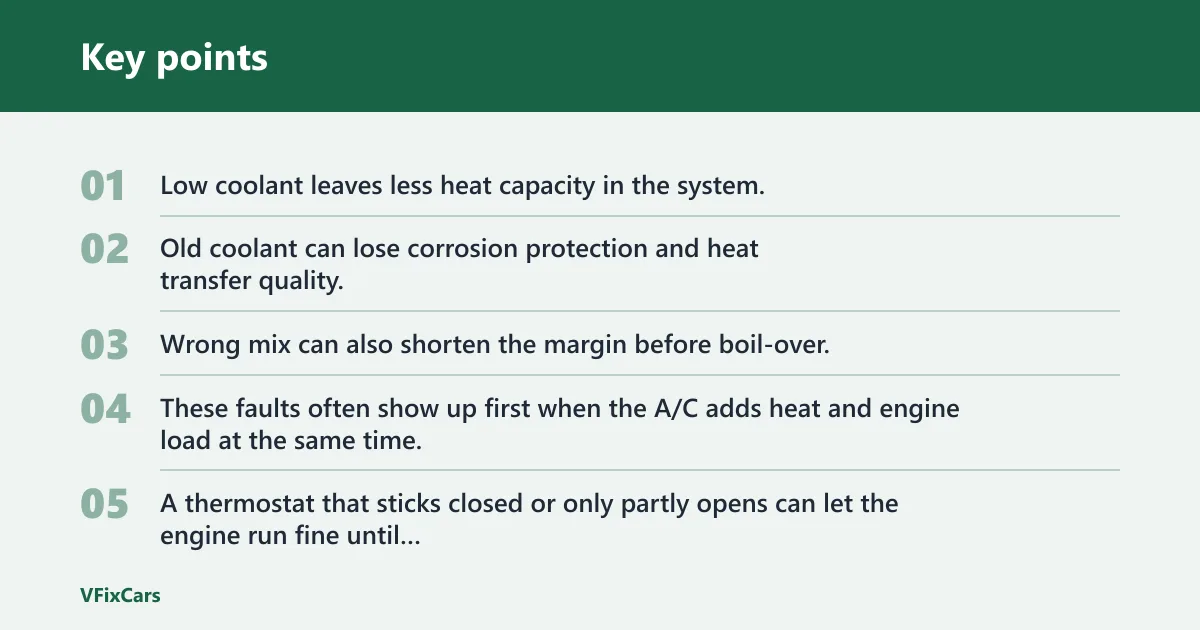
Low coolant, old coolant, and wrong mix
Low coolant leaves less heat capacity in the system. Old coolant can lose corrosion protection and heat transfer quality. Wrong mix can also shorten the margin before boil-over. These faults often show up first when the A/C adds heat and engine load at the same time.
Thermostat, water pump, and radiator cap clues
A thermostat that sticks closed or only partly opens can let the engine run fine until extra A/C load pushes it over the edge. A weak water pump can move coolant poorly and mimic a radiator problem. A radiator cap is small, but the pressure it holds is high-value diagnostically: Motor Guy cites 13–16 PSI as the cap’s pressure range, and a weak seal can drop boiling point to 212°F.
Why a pressure tester helps find slow leaks
A cooling system pressure tester is useful because it works cold and can expose weeping hoses, radiator seams, and water pump seals. It can also help separate a true low-coolant leak from a problem that only looks like one because the system cannot hold pressure.
Suppose the gauge rises in traffic, the cabin heat goes lukewarm, and you notice a faint coolant smell after parking. That combination points more toward low coolant, a weak cap, or a small leak than toward a pure fan problem. A pressure test would be the next safe branch.
Could engine load from the AC compressor be pushing it over the edge?
Yes. The compressor clutch adds engine load when it engages, and a clutch that slips or seizes can raise idle strain enough to expose a weak cooling system. This is less common than airflow faults, but it matters when the temperature rises the instant the A/C is switched on or the idle drops sharply.
How clutch slip or seizure changes idle behavior
A slipping clutch may cycle oddly, chirp, or fail to drive the compressor cleanly. A seized compressor or stiff bearing can drag the engine and lower idle speed. If the engine nearly stalls when the A/C comes on, the cooling system may be marginal and the compressor load is the trigger, not the only fault.
When compressor drag points to a wider cooling issue
Compressor drag rarely acts alone for long. If the engine only overheats because the A/C load exposes a weak fan, low coolant, or borderline radiator capacity, fixing the compressor alone will not solve the heat rise. Treat it as a load test for the rest of the system.
When overheating points to a head gasket or internal engine fault
A head gasket leak becomes more likely when overheating comes with coolant loss, bubbles in the reservoir, white exhaust smoke, sweet smell, or repeated heat spikes under load. VehicleRuns notes that a block test checks for combustion gases in coolant. A pressure test can also help confirm whether the system loses pressure too quickly.
Common warning signs that separate combustion gas intrusion from normal cooling faults
Persistent bubbles in the coolant, unexplained coolant loss, oil that looks milky, or overheating that returns soon after cooling down all raise concern. If the car overheats with the A/C on and also blows hot air, circulation loss or combustion gas intrusion becomes more likely than a simple airflow fault.
Why a block test or cooling-system pressure test matters
A block test checks for combustion gases in coolant. A pressure test checks whether the system can hold pressure without external leaks. Together, they help separate a gasket fault from a leak at a hose, radiator seam, cap, or water pump seal.
Cost-to-probability order for likely repairs
Start with the cheapest likely checks, then move to parts with higher failure probability only after the pattern points there. Repair costs from The Motor Guy run from $75 to $650 for common fixes. A cleaned condenser service example costs $75. A condenser replacement can run $450–$650. Blown head gasket repairs can reach $1,500–$3,000.
- Low-cost checks: coolant level, fuses, relays, visible debris, fan command.
- Mid-range fixes: fan motor, fan clutch, thermostat, radiator cap, cleaned condenser.
- Higher-probability mechanical repairs: fan assembly, radiator replacement, water pump.
- Highest-cost diagnosis path: head gasket testing and repair if combustion gases or repeated pressure loss are present.
why is my car overheating when the ac is on
The most common answer is less cooling margin from airflow loss, low coolant, or fan trouble. Because the A/C adds heat at the condenser and load at the compressor, a system that is already weak can tip into overheating. Start with fan action, coolant level when cold, and debris in front of the radiator.
why is my car overheating only when ac is on
Overheating only with the A/C on usually means the cooling system is close to normal, then loses its reserve under added heat and engine load. That pattern often points to fan command failure, a weak fan clutch, a blocked condenser, or low coolant. If highway driving stays normal, airflow rises to the top of the list.
why is my car running hot when the ac is on
Running hot with the A/C on means the engine can no longer reject heat fast enough for the added load. The first split is speed: idle and traffic suggest airflow trouble, while highway heat points toward thermostat, radiator, water pump, or low coolant. Hot cabin vents can be a clue that coolant flow is also weak.
why does my car overheat when the ac is on and idling
Idle-only overheating with the A/C on is the classic sign of an airflow problem. The fan has to do the work that road speed usually provides, so a weak motor, bad relay, dead fan, or fan clutch can show up fast. A clogged condenser can do the same thing.
Frequently asked questions
why is my car blowing hot air when the ac is on
Hot vent air along with rising engine temperature often points to low coolant, weak circulation, or air trapped in the system rather than a simple cabin HVAC issue. If the engine also overheats, check coolant only when fully cold, then look for leaks, thermostat problems, or signs of a head gasket fault.
why is my engine overheating when ac is on
Engine overheating with the A/C on usually means the cooling system cannot handle the extra heat load. The most common causes are a weak fan, low coolant, or a blocked condenser. If the temperature also climbs at highway speed, look harder at radiator blockage, thermostat function, water pump output, or system pressure loss.
why does my car overheat when the aircon is on
The aircon adds compressor load and rejects heat through the condenser in front of the radiator, so it stresses both engine and airflow. If the problem appears at idle or in traffic, fan and condenser checks come first. If it appears at speed too, the radiator, thermostat, or water pump deserves more attention.
why does my engine overheat when the ac is on
If the engine overheats only with the A/C on, think airflow first, then coolant flow, then added compressor load. A fan that should come on immediately but does not is a strong clue. If the vents blow hot too, low coolant, weak circulation, or a pressure problem becomes more likely.
why is my car getting hot when the ac is on
Getting hot with the A/C on means the system is fine near the edge, then tips over when the compressor and condenser add demand. Idle-only heat rise points to fan or airflow issues. Heat at all speeds points more toward thermostat, radiator, water pump, cap, or internal engine fault.