
Dead Battery: Symptoms, Fixes, and Next Steps
A battery is often the problem when the engine won’t crank and battery voltage is around 12.4 volts or lower at rest, or drops to about 9.6 volts or less while cranking; the next step depends on whether you hear silence, rapid clicks, or one heavy click. Guess wrong and you can replace the wrong part, get stranded again, or damage charging-system parts with repeated jump-start attempts. This guide maps each start symptom to the right check, fix, and decision to jump, charge, test, or replace.
What you’ll need
- Multimeter set to DC volts, 20V range
- Jumper cables or a jump pack
- Safety gloves and eye protection
- Basic hand tools for terminal clamps
- Battery terminal brush or cleaner
- Paper and pen to note readings
How do you tell if it is really a dead battery?
Start with the exact behavior at key-on or push-button start. No crank, rapid clicking, a single heavy click, slow cranking, and crank-but-no-start point to different faults. Confirm the symptom with a one-minute voltage check and stop immediately if the battery case is swollen, cracked, leaking, or gives off a rotten-egg odor.
Match the sound and motion first
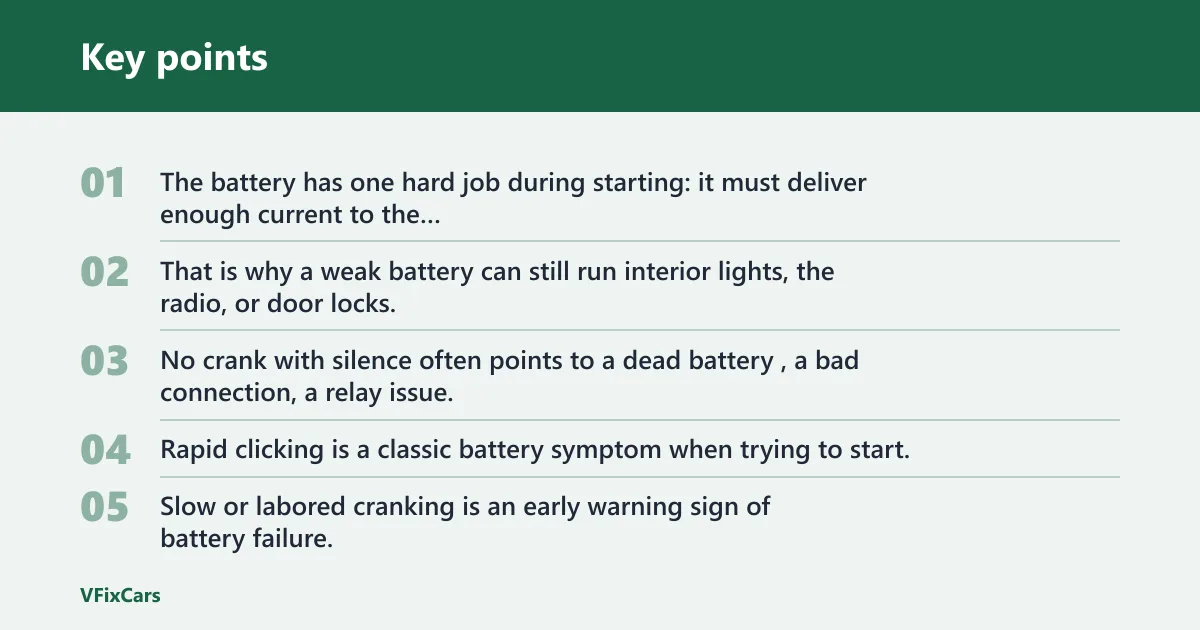
The battery has one hard job during starting: it must deliver enough current to the starter motor to turn the engine. That is why a weak battery can still run interior lights, the radio, or door locks, yet fail the moment the starter demands a heavy burst of current.
No crank with silence often points to a dead battery, a bad connection, a relay issue, or a problem with the start command itself. Rapid clicking is a classic battery symptom when trying to start. Slow or labored cranking is an early warning sign of battery failure. A single heavy click can point to the starter or relay instead of the battery alone.
Crank-but-no-start follows a different path. If the engine turns at normal speed but never fires, battery voltage is usually not the main fault. Fuel delivery, ignition spark, the immobilizer, or engine-control issues move higher on the list.
Use lights and accessories the right way
Working electronics do not clear the battery. Headlights, the dash, and infotainment draw far less current than the starter motor, which can ask for several times more in one short hit. A battery can power accessories and still fail as soon as you try to crank the engine.
That is why the next useful check is voltage, not a guess based on whether the dome light comes on.
Know when to stop DIY
Do not jump-start or charge a swollen battery, a cracked case, a leaking battery, or one with heavy corrosion damage or a strong rotten-egg smell. Those signs point to damage or gas buildup. At that point, towing and replacement or shop handling is the safer move.
Battery symptom decision table
| Symptom | Likely cause | One-minute test | Multimeter reading if relevant | Safe next step | When to stop DIY and call a shop |
|---|---|---|---|---|---|
| No crank, no click | Dead battery, loose terminal clamp, bad ground, start-circuit fault | Turn headlights on, then measure battery at rest and tug each terminal clamp by hand | Below 12.0V strongly supports a weak battery; about 12.6 volts or higher shifts suspicion to connections or control side | Clean and tighten terminals, then jump-start | If voltage is normal but the car stays silent, or a clamp or cable gets hot |
| Rapid clicking | Battery too weak to hold starter load | Measure resting voltage, then watch voltage while someone tries to crank | Below 12.4V at rest supports discharge; drop below about 9.6V while cranking points to battery weakness | Jump-start or charge, then retest | If it repeats after charging or after a short drive |
| Single heavy click | Starter motor or relay issue, sometimes high cable resistance | Check battery voltage first, then listen at the starter area for one solid click only | If resting voltage is healthy and cranking drop stays above about 9.6V, battery moves down the list | Check terminal tightness and main grounds | If there is one click with good voltage and no cranking |
| Slow cranking | Partially discharged battery, terminal resistance, internal battery weakness | Measure resting voltage and inspect for white or green corrosion | Below 12.4V means partially discharged; below 12.0V means likely too weak to start | Clean terminals, charge battery, retest cold | If slow cranking returns soon after a full charge |
| Crank but no start | Usually not the battery if cranking speed is normal | Watch whether the engine spins at normal speed and whether dash voltage stays steady | No battery number proves fuel or spark faults; a healthy cranking speed matters more here | Shift diagnosis away from battery and toward engine controls | If it cranks normally but never fires |
| Starts with a jump, then dies again soon after driving | Alternator undercharging or charging-circuit fault | With engine running, measure charging voltage at the battery posts | Charging should rise to about 13.5–14.5V; lower or unstable voltage points to charging trouble | Limit driving and test the charging system | If the battery warning light is on or running voltage stays low |
| Battery warning light while driving | Alternator, belt, wiring, or system-voltage problem | Check charging voltage with engine running and turn off extra loads | If running voltage does not rise to about 13.5–14.5V, the battery may not be getting charged | Head to a test location before shutting off if safe | If lights dim, steering assist changes, or voltage keeps falling |
| Dead after sitting overnight or for a few days | Parasitic drain, weak battery that cannot hold charge, or poor terminal contact | Charge or jump it, drive or charge fully, then let it sit and recheck resting voltage later | A battery that recovers near full charge, then falls again after sitting, may have internal weakness or be drained by the car | Plan a battery load test and drain check | If it repeatedly goes flat after parking |
Diagnose it step by step
Start with the fast checks
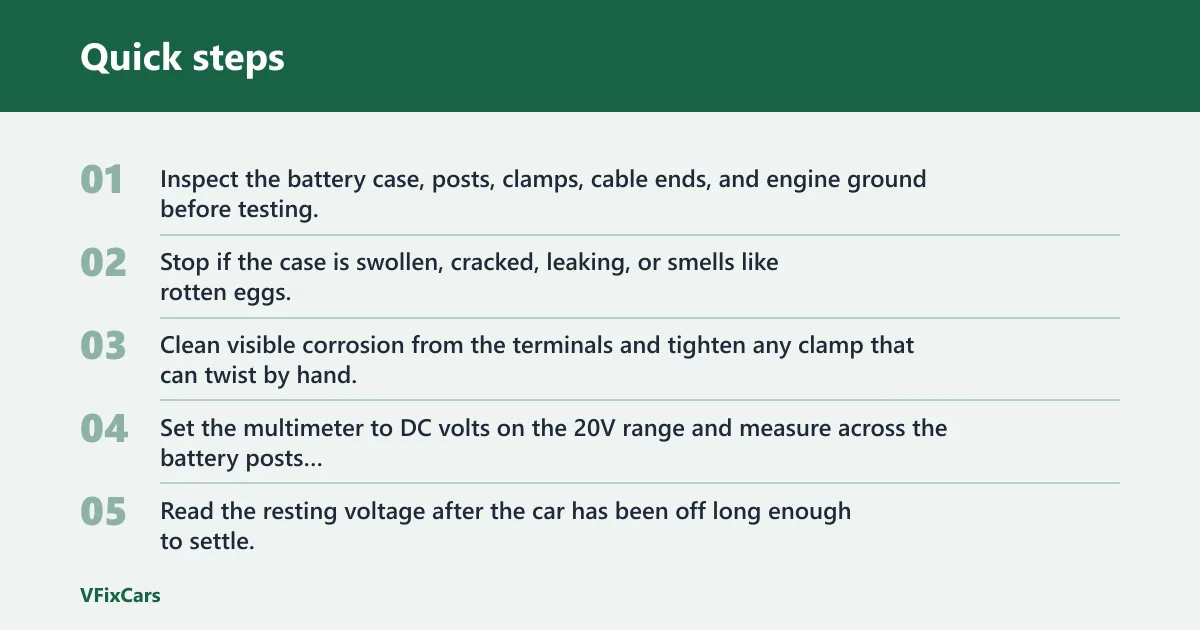
- Inspect the battery case, posts, clamps, cable ends, and engine ground before testing.
- Stop if the case is swollen, cracked, leaking, or smells like rotten eggs.
- Clean visible corrosion from the terminals and tighten any clamp that can twist by hand.
- Set the multimeter to DC volts on the 20V range and measure across the battery posts with the car off.
- Read the resting voltage after the car has been off long enough to settle, because a fresh charge or recent shutdown can skew the result.
- Treat about 12.6 volts or higher as a healthy rested battery, below 12.4V as partially discharged, and below 12.0V as likely too weak to start the car.
- Have someone try to start the car while you watch the meter if the engine will attempt to crank.
- Suspect battery weakness if the voltage drops below about 9.6V while cranking on most cars.
Try the next branch
- Jump-start the car if the battery is low but the case is physically sound.
- Connect jumper cables positive to positive first, then connect the negative lead to a clean ground metal surface on the dead car.
- Start the donor vehicle or power on the jump pack, then try the disabled car after a brief wait.
- Watch what changes: strong crank and start, stronger click only, or no change at all.
- Measure battery voltage again with the engine running if the car starts.
- Expect charging voltage to rise to about 13.5–14.5V if the alternator is doing its job.
If that didn’t work
- Recheck terminal tension at the battery posts and the main ground connection to the body or engine.
- Move suspicion to the starter or relay if the battery tests well, the connections are clean, and there is still one heavy click with no crank.
- Move suspicion to the alternator or charging wiring if the car starts with a jump but the running voltage stays low.
- Book a battery load test if the voltage numbers look borderline or the battery keeps failing after being charged.
Two quick examples
Say your midsize sedan has bright interior lights, one push of the button gives rapid clicks, and the meter shows 12.2V before cranking. That points first to a discharged battery, not proof of a bad starter. Jump it, then check whether running voltage rises into the charging range and whether it restarts after shutdown.
Suppose an SUV starts immediately with jumper cables, idles for ten minutes, then dies on the way home and the battery warning light is on. That pattern fits an alternator or charging-circuit fault much better than a battery that simply needed one charge.
Is it the battery, alternator, or starter?
The battery is the leading suspect when resting voltage is low, cranking is weak, or voltage falls hard under load. The alternator moves up when the car runs only after a jump or the battery warning light appears while driving. The starter becomes more likely with one heavy click and otherwise healthy battery readings.
Battery clues
A healthy, rested battery should read about 12.6 volts or higher. Below 12.4V means the battery is partially discharged. Below 12.0V means it is likely too weak to start the car, and a dead battery is typically below 11.8 volts.
Those numbers still do not settle everything. A battery can recover enough to show decent voltage and still fail under load. That is why repeated discharge, a poor restart after sitting, or a large cranking-voltage drop matter more than one resting reading.
Alternator clues
The alternator charges the battery while the engine runs. If the car only starts with a jump, then dies again soon after driving, the charging system may be undercharging and making the battery look guilty.
Check voltage at the battery with the engine running. It should rise to about 13.5–14.5V. If it does not rise, or it stays low with the battery warning light on, suspect the alternator, belt drive, wiring, or another charging-system fault.
Starter clues
The starter motor needs battery current, but it also has its own failure modes. One heavy click with a battery that tests well and clean, tight connections points toward the starter motor or relay. No crank with normal voltage can also come from high resistance in the main cables or grounds.
Battery first, connections second, starter third is usually the cheapest order.
When a load test settles it
A battery load test simulates starting load. It confirms internal weakness more reliably than a visual inspection or a resting-voltage reading alone. If the battery charges up, then quickly drops again or fails a load test, replacement is usually the more sensible move than more jump-starts.
Can a dead battery be charged again?
Sometimes yes. Charging is worth trying when the battery is simply discharged, the case is undamaged, and the car has no strong sign of a charging fault. Charging is a poor bet when the battery was deeply discharged repeatedly, fails a load test, or recovers voltage briefly but still cannot crank the engine.
When charging makes sense
Try charging if the battery is low after leaving lights on, after long storage, or after one known drain event. Remove corrosion first, charge it fully, and let it rest before judging the result. A number taken right off the charger can read high and still fall later.
When replacement moves up the list
Repeated deep discharge shortens battery life. If the battery keeps dropping below starting strength, needs frequent jumps, or fails to restart the car after a proper charge, replacement is usually the cleaner answer.
Picture a compact car that reads below 12.0V every few mornings even after an overnight charge, yet the charging voltage looks normal once running. That pattern points more to a battery that cannot hold charge than to an alternator fault.
Charge versus diagnose
A charger is cheaper than a battery if the battery is merely low. A shop diagnosis is cheaper than guesswork when the battery keeps going flat, because the real cause may be terminal resistance, a parasitic drain, or an alternator that never brings the battery back up.
What should you do after a jump-start?
After a successful jump, the next job is to find out whether the battery can restart the car on its own and whether the alternator is charging. Let the engine run, measure charging voltage, then shut the car off and check for a clean restart. A second failure changes the diagnosis sharply.
Do this in order
- Let the engine idle and stabilize after the jump.
- Measure voltage at the battery posts with the engine running.
- Look for a rise to about 13.5–14.5V before assuming the battery was the only problem.
- Turn the engine off after a short run and try restarting it.
- Suspect the battery first if it started with a jump, charged normally, but still will not restart soon after shutdown.
- Suspect the alternator first if it dies again while driving or the battery warning light stays on.
When the battery died after sitting
If the car starts and charges normally after a jump but goes dead after being parked, separate battery weakness from parasitic drain. A battery that will not hold a charge is one path. A battery that recharges, starts fine, then is empty after sitting points to another electrical load staying on or waking up after shutdown.
That is the point where a drain test or shop diagnosis can cost less than replacing a battery that was never the main problem.
Common mistakes
What goes wrong
Replacing the battery before checking terminal tension and grounds wastes money. Corrosion and loose clamps can block current flow so well that a good battery acts dead.
Calling every click a dead battery is another miss. Rapid clicking often fits the battery. One heavy click pushes the starter or relay higher on the list.
Reading voltage too soon after charging can also mislead. Let the battery rest before treating the number as final. Do not ignore the battery warning light once the engine is already running either, because that light often points to charging trouble, not a battery that suddenly healed itself.
How to avoid them
Test in sequence: condition, connections, resting voltage, jump response, charging voltage, then load test if the answer is still murky. That order avoids most wrong-part replacements.
Prevention
If this problem started after the car sat unused, drive or charge it fully before parking it again, and fix any parasitic drain promptly. Repeated deep discharge is hard on starting batteries.
Frequently asked questions
How do I know if my battery is dead?
Check the start behavior and confirm it with a meter. If the engine will not crank and resting voltage is below 12.4V, the battery is at least discharged. If it is below 12.0V, starting is unlikely. A battery that falls below about 9.6V while cranking is usually too weak under load.
What does a dead battery sound like?
Rapid clicking is the classic sound. Slow, dragging cranking is another strong clue. Silence can still be battery-related if the terminals are loose or badly corroded, while one heavy click with no cranking points more toward the starter motor or relay once battery voltage checks out.
How can I check if my car battery is dead?
Use a multimeter on the DC volts 20V range and measure across the battery posts with the car off. About 12.6 volts or higher is healthy at rest. Below 12.4V means discharged. Below 12.0V means likely too weak to start. Then check running voltage if the car starts.
How do I test a dead battery with a multimeter?
Set the meter to DC volts, 20V range, touch red to the positive post and black to the negative post, and read resting voltage first. Then watch the meter during cranking if possible. A big drop under load matters more than accessories working, because the starter needs far more current.
Is it the battery or the alternator?
If the car starts with a jump but dies again soon after driving, suspect the alternator or charging system. With the engine running, voltage should rise to about 13.5–14.5V. If charging looks normal but the battery keeps going flat after resting, the battery or a parasitic drain becomes more likely.
How much does it cost to replace a dead battery?
There is no single national price because cost changes with battery size, chemistry, warranty, and labor. A basic charging attempt or a store test is often cheaper than immediate replacement. A shop diagnosis can also be the least expensive move when the real fault is the alternator, starter circuit, or a drain.