Headlights vs High Beams: What’s the Difference? Explained
Headlights are the vehicle’s front lighting system. Low beams and high beams are the two modes selected with the headlight switch. Low beams are the normal setting for traffic and most night driving. High beams throw light farther ahead on dark roads, but you must dim them for other road users.
What is the difference between headlights and high beams?
| Factor | Headlights | high beams | Winner |
|---|---|---|---|
| Main job | Provides the vehicle’s front lighting system; low and high beams are the modes inside it. | Long-range mode within that system. | Headlights |
| Beam pattern | Low beams are downward and asymmetrical. | High beams are straight and symmetrical. | Headlights |
| Best traffic use | Built for oncoming and crowded roads; the default for normal night driving. | Best only when other traffic is absent. | Headlights |
| Visibility reach | About 40 meters in the comparison table; Hawkglow lists 40–100 meters. | About 100 meters in the comparison table; Hawkglow says 200–300 meters ahead in some setups. | high beams |
| Glare control | Lower glare for other drivers. | Higher glare risk. | Headlights |
| Urban and lit roads | Better match for city driving and lit roads because they let you see lane markings, pedestrians, and signs without extra glare. | Add glare without adding much useful distance. | Headlights |
| Rain, fog, and snow | Usually safer because they reduce glare and keep more of the beam below reflective haze. | Should not be used in fog, rain, or snow because the light reflects off moisture or snow and can make the scene harder to read. | Headlights |
| Dark, unlit roads | Possible, but with less reach. | Best for dark, unlit roads where other traffic is absent or far enough away that glare is not a risk. | high beams |
Headlights are the system; low and high beams are the modes
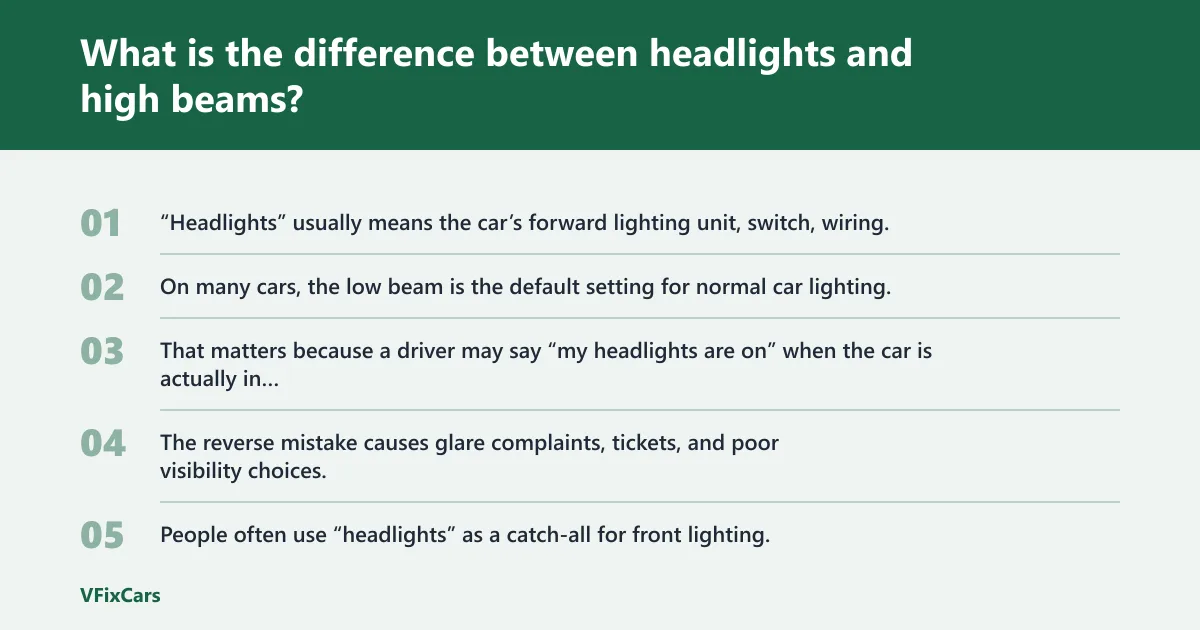
That clears up the wording confusion. “Headlights” usually means the car’s forward lighting unit, switch, wiring, and bulbs or LEDs; low beams and high beams are the settings inside it. On many cars, the low beam is the default setting for normal car lighting.
That matters because a driver may say “my headlights are on” when the car is actually in low beam mode. The reverse mistake causes glare complaints, tickets, and poor visibility choices.
Why the terms get mixed up
People often use “headlights” as a catch-all for front lighting. In practice, the beam mode matters more than the word. Low beams aim downward to light the road without blasting oncoming eyes; high beams aim farther down the lane and can spill into other drivers’ sight lines.
How do low beams and high beams differ in beam pattern and visibility?
Low beams spread light in a shorter, wider pattern with a cutoff that keeps most of the beam below other drivers’ eye level. High beams project farther and more directly, which helps you see farther ahead but raises glare risk. Low beams usually reach a moderate distance in normal use, while high beams typically reach farther on dark, open roads.
Low-beam pattern: wider, lower, less glare
Low beams are described as downward and asymmetrical. That shape puts useful light on the lane ahead, the shoulder, and the edge markings while limiting the amount sent straight into another driver’s mirrors or eyes. The tradeoff is shorter reach.
High-beam pattern: farther reach, more glare
High beams are described as straight and symmetrical. They make signs, animals, and lane continuation easier to see at distance, but that same longer throw can blind oncoming drivers or the driver you are following. Brightness alone is not the point, beam shape is what changes the result.
Why road lighting changes the choice
On a lit street, extra reach adds little because streetlights and nearby traffic already fill in the scene. On an unlit road, the long throw from high beams can reveal curves, hazards, and signs much earlier. The same beam that helps on a dark county road can be the wrong choice in city traffic.
When should you use low beams?
Use low beams for urban traffic, lit roads, rain, fog, snow, and any time you are meeting or following another vehicle. They are the default for normal night driving because they reduce glare and stay usable when there is reflected light off pavement, spray, or fog droplets. If other road users are close enough to see your lamps clearly, low beams are usually the safer pick.
Urban traffic and lit roads
City driving gives you streetlights, signals, and nearby vehicles. High beams add glare without adding much useful distance. Low beams are the better match because they let you see lane markings, pedestrians, and signs without turning your car into a moving flashbang for the lane ahead.
Rain, fog, and snow
High beams should not be used in fog, rain, or snow. The extra light reflects off suspended water droplets or falling snow and can make the scene look whiter, flatter, and harder to read. Low beams usually work better because they keep more of the beam below the reflective haze.
Following or meeting traffic
If you are behind another vehicle, dim early enough to avoid lighting up the other driver’s mirrors. If you are meeting oncoming traffic, switch down before the beams overlap. A common rule of thumb is to dim lights well before oncoming traffic, and many drivers aim for roughly a half-thousand feet as a practical target.
When should you use high beams instead of low beams?
Use high beams on dark, unlit roads where other traffic is absent or far enough away that glare is not a risk. They are best for rural roads, empty interstate stretches, and other blacked-out areas where you need more forward reach. As soon as another driver is present, you should dip back to low beams.
Unlit rural roads
Rural roads are the classic high-beam use case because signs, animals, and bends can appear late. The extra reach helps you react earlier. If a road has no shoulder lighting and no approaching traffic, high beams usually give the clearest long-view picture.
Empty highways and interstate stretches
On an empty interstate, high beams can be useful between exits or where lighting drops out completely. The switch point is simple: if no vehicle is close enough to be affected, high beams are fair to use. The moment headlights appear ahead or in the mirror, dim them.
When to dim for oncoming or leading vehicles
Dim for oncoming traffic before your beams meet theirs, not after. Dim for a vehicle you are following as soon as your lights can reach its mirrors or rear glass. That etiquette improves safety and helps you avoid creating blind spots for other drivers.
Say your lane runs through a dark two-mile county stretch with no streetlights and no cars ahead. High beams make sense there. If a pickup appears over the rise, switch down right away instead of waiting for the other driver to flash back.
Which beam should you use in rain, fog, snow, and other bad weather?
Low beams are usually the safer choice in rain, fog, snow, and spray because they reduce glare and keep reflected light under control. High beams can bounce back from moisture and make the windshield view worse. If the road surface turns into a bright white wall, you are probably using too much beam.
Why low beams are usually safer in bad weather
Low beams keep the light lower and wider, which helps you read lane lines and the road edge without flooding the air with reflection. That matters in wet weather because the pavement itself becomes a reflector. The farther beam is not the better beam when the space ahead is full of droplets.
How road surface reflection changes what you see
Wet pavement can throw light back at you and flatten contrast. In fog and snow, suspended particles scatter the beam even more. That is why the same high-beam setting that feels helpful on a dry dark road can feel worse in bad weather, even though it is brighter.
How halogen, LED, and retrofit setups change glare behavior
The beam mode does not change, but the lamp type can change how harsh it looks. Halogen, LED, and retrofit housings can differ in cutoff sharpness and stray light. A poorly aimed retrofit can glare even on low beam, while a well-designed factory LED may control the beam much better.
Why one beam may fail while the other still works
Some cars use a dual-beam bulb, where one bulb or filament helps both modes. Others use separate bulbs for low and high beams. That means one mode can fail while the other still works. If low beams are dead but highs work, or the reverse, the fault may be a specific bulb, fuse, relay, or switch circuit rather than the whole headlight assembly.
📊 Hawkglow lists common high-beam bulb types as 9005, H1, H7, and 9011. Source: High Beam vs Low Beam Headlights: What’s the Difference & Which LED….
Use this checklist to choose the right beam
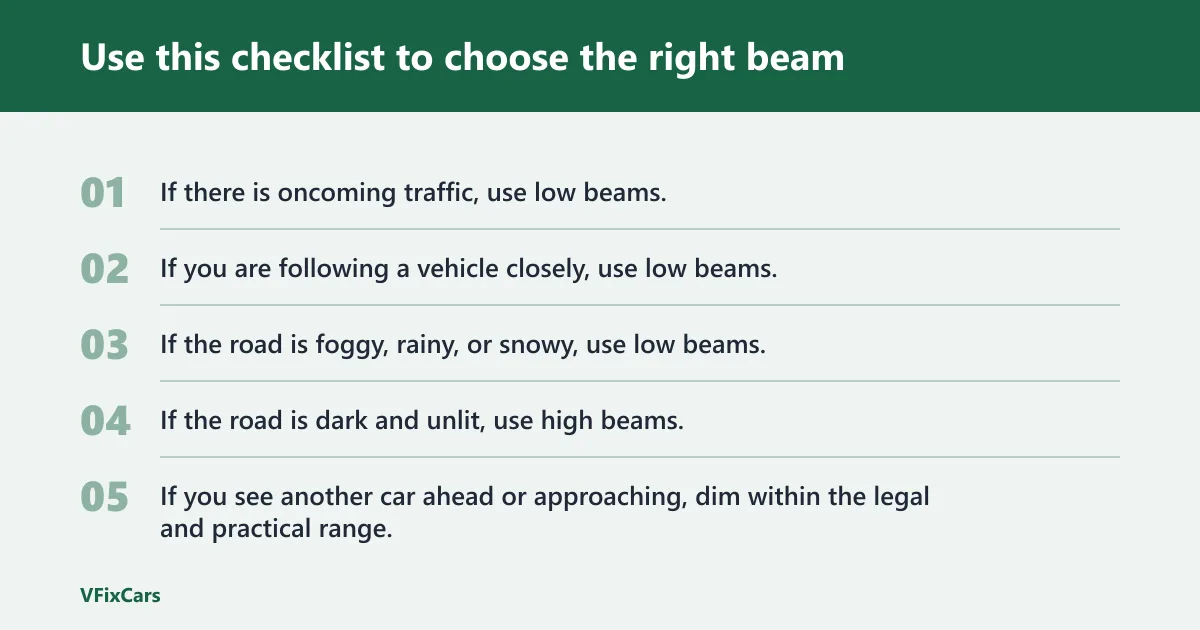
Start with traffic, then weather, then road lighting. If any other vehicle is near enough to be affected, low beams are the safer choice. If the road is dark, empty, and unlit, high beams usually help more. Your dashboard symbol should confirm which mode is active before you settle in for the drive.
- If there is oncoming traffic, use low beams.
- If you are following a vehicle closely, use low beams.
- If the road is foggy, rainy, or snowy, use low beams.
- If the road is dark and unlit, use high beams.
- If you see another car ahead or approaching, dim within the legal and practical range.
- If the beam seems to be lighting up the back of another vehicle, switch down now.
Driving condition to beam choice
| Driving situation | Use low beams | Use high beams | Winner |
|---|---|---|---|
| Urban traffic | Yes | No | Low beams |
| Rural road with no nearby traffic | Possible, but less reach | Yes | High beams |
| Oncoming traffic | Yes | No, dim first | Low beams |
| Following another vehicle | Yes | No, dim first | Low beams |
| Fog, rain, or snow | Yes | No | Low beams |
| Dark empty interstate | Possible | Yes, if no nearby traffic | High beams |
Dashboard symbols and control positions
The low-beam indicator usually appears on the dashboard as a headlamp icon with rays angled downward. The high-beam symbol is usually a blue icon with rays pointing straight out. The switch may be a stalk, a rotary knob, or an auto-light control, but the symbols tell you which mode is active.
Simple switch rules for traffic, weather, and road lighting
Use the switch the same way every time: low beams for people, weather, and glare control; high beams for darkness and distance. If you feel like you need to squint through your windshield, check whether the high-beam symbol is on when it should not be. If nobody else is around, the high-beam mode is often the better tool.
Suppose a driver is on a two-lane road at 11 p.m. and sees the blue high-beam icon still lit as a sedan approaches. That is the moment to dip. Waiting until the vehicles pass wastes distance and can blind the oncoming driver for the few seconds that matter most.
Frequently asked questions
what’s the difference between high beams and headlights
Headlights are the front lighting system, and high beams are one mode within that system. Low beams are the normal mode for most driving, while high beams send light farther down the road. The practical difference is beam pattern, glare, and when other traffic is present.
headlights vs high beams
Headlights refer to the whole setup on the front of the car, while high beams refer to the long-range setting. If someone says “headlights,” they often mean low beams in everyday speech. The safer habit is to name the mode: low beam or high beam.
can you drive with high beams on in rain or fog
No, high beams should not be used in fog, rain, or snow. The light reflects off moisture and can make it harder to see the lane, the shoulder, and distant hazards. Low beams are usually the better choice because they control glare and spread the light lower.
how do I know if my high beam is on
Look for the high-beam dashboard icon, usually a blue headlamp symbol with rays pointing straight out. Many cars place it in the instrument cluster near the speedometer. If the icon is lit and the road ahead looks strongly illuminated, the high-beam mode is active.
are headlights and low beams the same thing
No. Headlights are the lighting system, and low beams are the default mode within that system for normal night driving. People often use the terms interchangeably, but that hides the actual choice that matters: whether the car is in low beam or high beam mode.
which beam should I use on rural roads
Use high beams on rural roads when the road is dark and no other traffic is near. That extra reach helps you see farther down the lane and spot hazards sooner. Switch back to low beams quickly when an oncoming vehicle appears or you catch up to traffic ahead.
Verdict
Choose low beams for traffic, bad weather, and any road where another driver could be blinded. Choose high beams for dark, unlit roads with no nearby vehicles, especially on rural routes and empty highway stretches. The right choice is the one that gives you enough distance without creating glare for anyone else.